
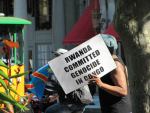
Contrary to racism that black people generally fall victims of in the Western society where it is publicly decried, a similar but nasty racism against Rwandan Hutus promoted by the regime of Paul Kagame in Kigali is world widely sponsored and celebrated. The picture of the latter is painted on the canvas of the unspeakable tragedy that the Great Lakes region experiences for more than two decades.
The lies and supporting motives of that racism are many but this note will focus on one and one only: the unspoken killings of the Rwandan Patriotic Front from October 1st 1990 to July 4th 1994. The period which followed until today has been the object of many books, reports and field researches which document the horrendous atrocities that Paul Kagame and his sponsors have committed in the entire region.
Everything happens for a reason. The ongoing covering up of the Rwandan Patriotic Front’s crimes since 1990 is motivated by the important geopolitical and economically strategic interests of US, UK, Germany, Israel, and Belgium in Central Africa. Since World War II it has been the first time that mainstream media and intellectuals of almost all boards have colluded to sustain the lies about an incredible human tragedy [8 million lives in Rwanda and DRC]. However, in the midst of half truths intended to misinform, there have been rare voices which have been raising dissent views. Unfortunately, they have been instantly qualified as revisionists of the official narrative, or even subtly eliminated or imprisoned.
At the start of the story aggressors of Rwanda on October 1st 1990 [after 1994 they became official oppressors] portray themselves as victims. As French writer Pierre Pean explains that reality, RPF had mastered the new real politics of the end of the 80s and early 90s. Its propaganda strategy was built on the power of ONGs against official governments particularly in developing countries. What they advocated for and spread around matters more than what established national institutions could claim. In the case of Rwanda, in 1992 NGOs accused the government of Habyarimana of committing genocide against Tutsis, this long before April 6th 1994. The lie stuck until today.
This wrong accusation was the result of a well orchestrated machination by RPF international lobby which, following an international report on the abuse of human rights during the Rwandan civil war of 90/94, had found the then Rwandan government guilty. Though the report came out in 1992, the reference to genocide was going to become the RPF mantra to silence everyone who would raise any accusation against the regime of Paul Kagame for its numerous crimes either in Rwanda or the Democratic Republic of Congo. Nowadays, several testimonies of RPF insiders affirm that most of atrocities were and even today continue to be committed by its infiltrated agents.
More than twenty years have passed since these initial lies which were concocted with the help of foreign actors interested in the region. More lies were invented during and well after the 1994 genocide; they are mainly aimed at eradicating Hutus politically and physically from the national scene at the extent that those among them who would survive the regime racist policies would only become citizens of second class category. The process is ongoing even more so during the 20th anniversary of 1994. And the recently produced documentary – 7 jours à Kigali, is part of it. The film joins the rally mainstream media is on for almost a quarter of a century disseminating and promoting cynical and criminal propaganda against Rwandan Hutus and other bantu populations living on coveted territories of Central African countries.
In that film, someone who experienced de visu the 90/94 tragedy unfolding could hardly believe what is projected in front of their eyes. What is striking is the role that the producers France Televisions, Ladybirds Films and visibly the Rwandan government make the two sides to the Rwandan conflict to play. On April 6th 1994 when the plane of President Juvenal Habyarimana is shot down above Kigali while approaching the airport for its landing, and the two following days, the Rwandan Patriotic Front is shown as an indecisive military force. It appears from the narrative where the Rwandan Minister of Defence James Kabarebe is the main figure that only RPF intervenes after observing almost powerlessly the massacres of the Tutsi population once the Hutu president was killed.
From the Conseil National de Development – CND building where the Rwandan parliament is located, the cameraman makes the viewer of the documentary have the impression that the Rwandan Patriotic Front was incapable of stopping the massacres which unfolded after the assassination of Habyarimana. The truth is totally something else. After 8.25 pm when the presidential plane went down, RPF started immediately systematic killings in the areas of Remera, Kicukiro and Kacyiru of Kigali. These were close to the CND building where the 600 men RPF battalion was staying. It is important to mention that its presence in the Rwandan capital had been authorised by the Arusha Agreement of August 1993.
The documentary revisits vividly announcements that the journalists of Radio Television des Milles Collines RTLM make at that time where the radio invited the population to track the enemy among them. The producer of the film does not mention anything about the thousands of RPF infiltrated cells that were spread in Kigali and across the country that Valens Kajeguhakwa and Abdul Joshua Ruzibiza talk about in their respective books – Rwanda/De la terre de paix à la terre de sang: et après? and Rwanda, l’histoire secrète. The two Tutsi writers explain extensively how the Rwandan Patriotic Front was able to cruelly and cynically massacre innocent populations Hutus and Tutsis alike in order to achieve what it did in Rwanda.

The film producers do not refer at any time to the massacres of 90/93 by the Rwandan Patriotic Front in the northern parts of the country. Civilian populations and mainly Hutus were massacred in the thousands. By the eve of the assassination of Habyarimana, in the periphery of Kigali, there are almost one million of internally displaced people who fled ethnic cleansing by RPF wherever the rebel group occupied some territory. There were massacres of Tutsis in the Bugesera region, Bagogwe people in the North West – Gisenyi, Hutu politicians – Gapyisi Emmanuel, Bucyana Martin, Felicien Gatabazi, etc. There were explosions of grenades in public places killings tens of civilians for a number of years. These atrocities are well documented and were committed by RPF. But the propagandists select tactfully what to show or not.
When one decides to tell half truths they become worst than a liar, because their intention is to cover up incriminating facts and portray their narrative as the only truth around. At least a complete lie does not lie, in the sense that it tells the whole opposite of the truth. While the Rwandan Patriotic Front is commemorating this year 20th anniversary of the 1994 genocide, the regime is apparently in a fighting mood to cement forever its narrative despite the increasing numbers of voices claiming more and more loudly a different story of what happened at that time or is still ongoing in the country. Understandably all Rwandan institutions are built on the fundamental lie that Paul Kagame stopped the genocide against Tutsis, while the truth is that he steadily prepared the genocide not only of the official victims but as well of Hutus whose ordeal when he is removed from power and racist policies he put in place eradicated.
Source: http://therisingcontinent.wordpress.com/2014/03/27



 GAHUNDE