Category Archives: International

U.S. Conventional Weapons Destruction in Africa Sets Stage for Peace and Development

us-congress-logo

Since 1993, the United States has partnered with 31 nations across the African continent to save lives and prevent injuries through conventional weapons destruction programs that safely clear landmines and unexploded ordnance in countries struggling to recover from armed conflict. The U.S. works with regional governments to dispose of excess small arms, light weapons, and munitions and secure remaining weapons stocks from potential diversion and illicit proliferation. Our $342 million investment in conventional weapons destruction across the African continent has saved lives as well as set the stage for humanitarian aid and development assistance.

Humanitarian Demining

  • U.S. support, along with support from our international partners, helped Nigeria and Burundi to declare themselves mine-free in 2011, and Uganda to declare itself landmine impact-free in 2012. With more than $53 million in U.S. aid, Mozambique, once among the world’s most landmine-affected nations, is also on track to declare itself mine-free by the end of next year. 
  • Current U.S.-funded humanitarian demining programs include projects in Angola, the Democratic Republic of the Congo (DRC), Mozambique, Senegal, Somalia, South Sudan, and Zimbabwe.

Securing Small Arms and Light Weapons

  • The U.S. Government assists African partners in securing or destroying surplus, obsolete, or poorly-secured conventional arms and ammunition, including man-portable air defense systems (MANPADS). 
  • Since 2001, the United States has funded the destruction of over 250,000 small arms and light weapons (SA/LW), and the unique marking of over 350,000 more to improve tracking and accountability in 24 African nations. 
  • The United States has invested $2.2 million to purchase weapons marking machines in support of the Regional Centre on Small Arms in the Great Lakes Region and the Horn of Africa (RECSA), a 15-nation regional initiative to address small arms proliferation. RECSA is based in Kenya and also works in Burundi, Central African Republic, the Republic of Congo, DRC, Djibouti, Eritrea, Ethiopia, Rwanda, Seychelles, Somalia, South Sudan, Sudan, Tanzania, and Uganda. RECSA has marked more than 350,000 SA/LW with this equipment, and Rwanda and Seychelles have finished marking all police equipment. 
  • In the Sahel, the United States is working closely with Niger and other regional partners to address increased security challenges from SA/LW trafficking in the aftermath of the 2011 conflict in Libya. The United States has invested almost $1 million to help Niger right-size its SA/LW and munitions stockpile and improve physical security of arms storage sites, and plans to expand training and support efforts with countries in the region. These efforts will contribute to U.S. peace and security efforts through increased national capacity to secure SA/LW and work toward reductions of weapons available for illicit trafficking.

Since 1993, the United States has invested more than $2.3 billion in aid to more than 90 countries for conventional weapons destruction. To learn more about U.S. Conventional Weapons Destruction programs, including humanitarian demining, check out the latest edition of our annual report, To Walk the Earth in Safety.

Remarks With Democratic Republic of the Congo President Joseph Kabila Before Their Meeting

Remarks

John Kerry
Secretary of State
Treaty Room
Washington, DC
August 4, 2014


SECRETARY KERRY: I don’t think we need these big, formal podiums, but let me – it’s my great pleasure to welcome President Kabila of the Democratic Republic of Congo to Washington. I’m very, very happy he’s here. He received me in May on my trip to the D.R.C. We then talked about the efforts that he is making with respect to strengthening democracy in the Democratic Republic of Congo.

And we’re very grateful to him for the efforts that he has made, the leadership that they’ve offered to help deal with the problems of the FDLR and the problems with the M23 group, which with his military effort and MONUSCO, they were able to help disarm. That process is continuing and it is a process that will help bring peace and stability ultimately to the region.

We also talked about economic development and the future. We have a lot to work on and we look forward to a good conversation today. Thank you, Mr. President, for being with us. Thank you.

PRESIDENT KABILA: Thanks a lot, Secretary of State. Of course, first of all, I am, myself, and my delegation glad and happy that we finally meet again in Washington, as I promised I would come for this particular summit. And I’m glad that on the sidelines of this particular summit that we’re going to raise, once again, the three or four issues in as far as the situation is concerned, not only in the Congo but the region.

But it’s worth noting that since we met, I believe one, two months ago, the situation has continued to evolve and move forward in the right direction, and that now the Congo is living the era of peace and that we are moving towards stability and long-term stability in all sectors – not only security but also economic development and the development of the region as a whole.

So once again, I’m glad that we’re here as per the invitation, and I hope that in our discussions we definitely are going to raise those issues and chart the way forward in our relations. Thanks a lot.

SECRETARY KERRY: Thank you, my friend. Thank you, sir.

A new book confirms strong partnership between Hima-Tutsi empire and Anglo-Saxons in Africa

Many do not understand, whichever the leading political parties in the concerned countries, the motives behind US and UK almost unconditional backing of the criminal regimes of Ugandan and Rwandan presidents, respectively Joweri Museveni and Paul Kagame. The support they receive is provided in a variety of forms: development aid, education bursaries, diplomatic facilitation, military equipment and training, etc.

In exchange of these services, Uganda and Rwanda have for mission to fight US and UK wars in Africa and defend their interests across the continent. By Museveni’s and Kagame’s soldiers becoming the ground operatives, no American or British citizens will not anymore be exposed to death fighting in Africa, since they have their African replacements.  Despite the long list of crimes committed by the two leaders in different countries and for so many years, they are and remain in the good favors of their western partners.

In a recently published book called – “La guerre mondiale africaine: la conspiration anglo-américaine pour un génocide au Rwanda. Enquête dans les archives secrètes de l’armée nationale ougandaise,” Noel Ndanyuzwe explains under a new light how since the end of the 80s and early 90s US and UK have been working with Joweri Museveni for regional domination from Egypt to Democratic Republic of Congo.

The indirect control of 11 countries of North/East, East and Central Africa has been under the radar from the indicated period and plans have been strategically worked out and being pursued. The number of victims that the pursuit of that objective of domination has costed to concerned countries amounts to more than 12 millions. This outcome made many to refer to the confrontations caused in different countries as the first African world war.

Ndanyuzwe’s book enables to assess US and UK motives and their levels of involvement. It adds as well an ideological dimension to the territorial expansion of the hima-tutsi empire by exploring its foundations. A Nilotic empire of 6 million square kilometers under anglo-saxon protectorat explains partially how Museveni and Kagame have benefited from impunity. The planned entity will have one currency, speak english, and have one army. The situation in DRC is far from being stabilized. Other countries are targeted in the region, including Tanzania.


To order the book, please go to the following link: http://www.editions-sources-du-nil.com/2014/06/vient-de-paraitre-la-guerre-mondiale-africaine-noel-ndanyuzwe.html

A section from the book: http://www.editions-sources-du-nil.com/2014/07/la-revendication-de-l-identite-juive-par-des-intellectuels-tutsis-une-supercherie-lucrative.html

Obama Condemns Hypocrisy Disguised as Reconciliation.

obam_393699617

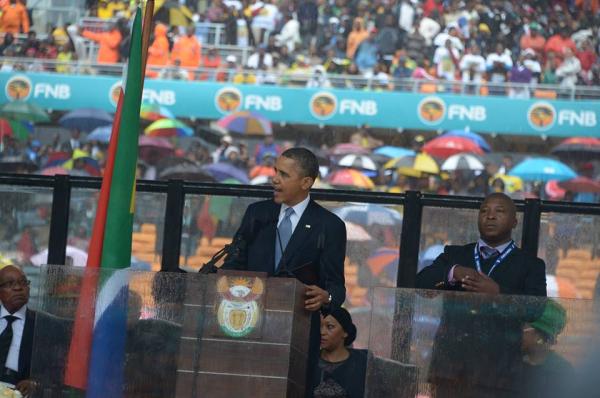
In his speech at the Nelson Mandela memorial, Obama observed that there are many leaders who claim solidarity with Madiba’s struggle for freedom, but do not tolerate dissent from their own people.

“There are too many of us who happily embrace Madiba’s legacy of racial reconciliation, but passionately resist even modest reforms that would challenge chronic poverty and growing inequality,” he added.

Obama has, however, encouraged several leaders to come out and make their voices heard no matter the resistance that is generated from the leaders in power.

“There are too many of us who stand on the sidelines, comfortable in complacency or cynicism when our voices must be heard,” he added.

Obama visits Mandela’s cell at the infamous Robben Islands

He further appreciated Mandela for his several contributions to the world at large; “Mandela taught us the power of action, but also ideas; the importance of reason and arguments; the need to study not only those you agree with, but those who you don’t. He understood that ideas cannot be contained by prison walls, or extinguished by a sniper’s bullet”.

Below is Obama’s speech on Nelson Mandela memorial:

To Graça Machel and the Mandela family; to President Zuma and members of the government; to heads of state and government, past and present; distinguished guests – it is a singular honour to be with you today, to celebrate a life unlike any other.

To the people of South Africa – people of every race and walk of life – the world thanks you for sharing Nelson Mandela with us.

His struggle was your struggle. His triumph was your triumph. Your dignity and hope found expression in his life, and your freedom, your democracy is his cherished legacy.

It is hard to eulogise any man – to capture in words not just the facts and the dates that make a life, but the essential truth of a person – their private joys and sorrows; the quiet moments and unique qualities that illuminate someone’s soul.

How much harder to do so for a giant of history, who moved a nation toward justice, and in the process moved billions around the world.

Born during World War I, far from the corridors of power, a boy raised herding cattle and tutored by elders of his Thembu tribe – Madiba would emerge as the last great liberator of the 20th century.

Like Gandhi, he would lead a resistance movement – a movement that at its start held little prospect of success.

Like King, he would give potent voice to the claims of the oppressed, and the moral necessity of racial justice. He would endure a brutal imprisonment that began in the time of Kennedy and Khrushchev, and reached the final days of the Cold War.

Emerging from prison, without force of arms, he would – like Lincoln – hold his country together when it threatened to break apart.

Like America’s founding fathers, he would erect a constitutional order to preserve freedom for future generations – a commitment to democracy and rule of law ratified not only by his election, but by his willingness to step down from power.

Given the sweep of his life, and the adoration that he so rightly earned, it is tempting then to remember Nelson Mandela as an icon, smiling and serene, detached from the tawdry affairs of lesser men.

But Madiba himself strongly resisted such a lifeless portrait.

Instead, he insisted on sharing with us his doubts and fears; his miscalculations along with his victories. “I’m not a saint,” he said, “unless you think of a saint as a sinner who keeps on trying.”

It was precisely because he could admit to imperfection – because he could be so full of good humour, even mischief, despite the heavy burdens he carried – that we loved him so.

He was not a bust made of marble; he was a man of flesh and blood – a son and husband, a father and a friend.

That is why we learned so much from him; that is why we can learn from him still. For nothing he achieved was inevitable. In the arc of his life, we see a man who earned his place in history through struggle and shrewdness; persistence and faith.

He tells us what’s possible not just in the pages of dusty history books, but in our own lives as well. Mandela showed us the power of action; of taking risks on behalf of our ideals.

Perhaps Madiba was right that he inherited, “a proud rebelliousness, a stubborn sense of fairness” from his father.

Certainly he shared with millions of black and coloured South Africans the anger born of, “a thousand slights, a thousand indignities, a thousand unremembered moments…a desire to fight the system that imprisoned my people.”

But like other early giants of the ANC – the Sisulus and Tambos – Madiba disciplined his anger; and channelled his desire to fight into organisation, and platforms, and strategies for action, so men and women could stand-up for their god-given dignity.

Moreover, he accepted the consequences of his actions, knowing that standing up to powerful interests and injustice carries a price.

“I have fought against white domination and I have fought against black domination,” he said at his 1964 trial.

“I’ve cherished the ideal of a democratic and free society in which all persons live together in harmony and with equal opportunities.

It is an ideal which I hope to live for and to achieve. But if needs be, it is an ideal for which I am prepared to die.”

Mandela taught us the power of action, but also ideas; the importance of reason and arguments; the need to study not only those you agree with, but those who you don’t.

He understood that ideas cannot be contained by prison walls, or extinguished by a sniper’s bullet. He turned his trial into an indictment of apartheid because of his eloquence and passion, but also his training as an advocate.

He used decades in prison to sharpen his arguments, but also to spread his thirst for knowledge to others in the movement.

And he learned the language and customs of his oppressor so that one day he might better convey to them how their own freedom depended upon his.

Mandela demonstrated that action and ideas are not enough; no matter how right, they must be chiselled into laws and institutions. He was practical, testing his beliefs against the hard surface of circumstance and history.

On core principles he was unyielding, which is why he could rebuff offers of conditional release, reminding the Apartheid regime that, “prisoners cannot enter into contracts.”

But as he showed in painstaking negotiations to transfer power and draft new laws, he was not afraid to compromise for the sake of a larger goal.

And because he was not only a leader of a movement, but a skilful politician, the Constitution that emerged was worthy of this multiracial democracy; true to his vision of laws that protect minority as well as majority rights, and the precious freedoms of every South African.

Finally, Mandela understood the ties that bind the human spirit.

There is a word in South Africa- Ubuntu – that describes his greatest gift: his recognition that we are all bound together in ways that can be invisible to the eye; that there is a oneness to humanity; that we achieve ourselves by sharing ourselves with others, and caring for those around us.

We can never know how much of this was innate in him, or how much of was shaped and burnished in a dark, solitary cell.

But we remember the gestures, large and small – introducing his jailors as honoured guests at his inauguration; taking the pitch in a Springbok uniform; turning his family’s heartbreak into a call to confront HIV/AIDS – that revealed the depth of his empathy and understanding.

He not only embodied Ubuntu; he taught millions to find that truth within themselves.

It took a man like Madiba to free not just the prisoner, but the jailor as well; to show that you must trust others so that they may trust you; to teach that reconciliation is not a matter of ignoring a cruel past, but a means of confronting it with inclusion, generosity and truth.

He changed laws, but also hearts. For the people of South Africa, for those he inspired around the globe – Madiba’s passing is rightly a time of mourning, and a time to celebrate his heroic life.

But I believe it should also prompt in each of us a time for self-reflection. With honesty, regardless of our station or circumstance, we must ask: how well have I applied his lessons in my own life?

It is a question I ask myself – as a man and as a President. We know that like South Africa, the United States had to overcome centuries of racial subjugation.

As was true here, it took the sacrifice of countless people – known and unknown – to see the dawn of a new day. Michelle and I are the beneficiaries of that struggle.

But in America and South Africa, and countries around the globe, we cannot allow our progress to cloud the fact that our work is not done.

The struggles that follow the victory of formal equality and universal franchise may not be as filled with drama and moral clarity as those that came before, but they are no less important.

For around the world today, we still see children suffering from hunger, and disease; run-down schools, and few prospects for the future.

Around the world today, men and women are still imprisoned for their political beliefs; and are still persecuted for what they look like, or how they worship, or who they love.

We, too, must act on behalf of justice. We, too, must act on behalf of peace.

There are too many of us who happily embrace Madiba’s legacy of racial reconciliation, but passionately resist even modest reforms that would challenge chronic poverty and growing inequality.

There are too many leaders who claim solidarity with Madiba’s struggle for freedom, but do not tolerate dissent from their own people.

And there are too many of us who stand on the sidelines, comfortable in complacency or cynicism when our voices must be heard.

The questions we face today – how to promote equality and justice; to uphold freedom and human rights; to end conflict and sectarian war – do not have easy answers.

But there were no easy answers in front of that child in Qunu. Nelson Mandela reminds us that it always seems impossible until it is done. South Africa shows us that is true.

South Africa shows us we can change. We can choose to live in a world defined not by our differences, but by our common hopes.

We can choose a world defined not by conflict, but by peace and justice and opportunity.

We will never see the likes of Nelson Mandela again. But let me say to the young people of Africa, and young people around the world – you can make his life’s work your own.Over thirty years ago, while still a student, I learned of Mandela and the struggles in this land. It stirred something in me.

It woke me up to my responsibilities – to others, and to myself – and set me on an improbable journey that finds me here today.And while I will always fall short of Madiba’s example, he makes me want to be better. He speaks to what is best inside us.

After this great liberator is laid to rest; when we have returned to our cities and villages, and rejoined our daily routines, let us search then for his strength – for his largeness of spirit – somewhere inside ourselves.

And when the night grows dark, when injustice weighs heavy on our hearts, or our best laid plans seem beyond our reach – think of Madiba, and the words that brought him comfort within the four walls of a cell: It matters not how strait the gate, How charged with punishments the scroll, I am the master of my fate: I am the captain of my soul.

What a great soul it was. We will miss him deeply. May God bless the memory of Nelson Mandela. May God bless the people of South Africa.

– See more at: http://chimpreports.com/index.php/people/14847-obama-condemns-hypocrisy-disguised-as-reconciliation.html#sthash.jk8Es7GJ.dpuf


Africa urged to shun wholesale imports of Western democracy models

By Costantine Sebastian ,The Citizen Reporter

 Dar es Salaam. Africa’s attempts to ape democracy models, mostly from the West, have been the major causes of governance pitfalls, economic failures, democratic chaos and overall growth nightmares that continue to haunt the continent, according to development strategists and activists.

They want Africans and their leaders to quickly shun the trend that has led to failed states and stuck most people in the quagmire of abject poverty. The strategists and activists warn that without changing the status quo, the future and prosperity of Africa will always remain compromised.

Speaking at the 2nd International Conference on Democratic Governance in Africa, Asia and the Middle East, held in Kigali early this week, participants called for a new internal development order. Many wondered why most African countries were still so poor, unashamed of their status as economic beggars and recipients of development aid when the continent was blessed with abundant resources.

“The time for change is now,” noted Dr John Samuel, President of the Institute for Sustainable Development and Governance in India. “Our countries should immediately adopt democratic models that suit their circumstances and address their individual needs.”

They suggested that the models that can propel the poor nations to prosperity are those which take into account the culture and historical background of the people.

The scholars, practitioners, decision makers and other development stakeholders at the three-day conference emphasized the need for home grown initiatives on problems affecting the developing world.

Under the theme, “Accountability and Youth Engagement for Sustainable Development,” they maintained that unity was a must especially among African countries if they are to have a voice on world matters.

“Direct implementation of models imposed or suggested by Western powers will never bring real change and make a significant difference in our lives,” Gabonese journalist Yves Laurent Goma told The Citizen on Sunday on the sidelines of the summit meeting held as part of Rwanda’s Commemoration of 20 Years of Liberation.

Organised by the Rwanda Governance Board (RGB), the UN and Cheyney University of the United States, the conference sought among other things to explore constraints to good governance. It also explored emerging opportunities of democratic governance and has been one of the highlights of events to mark 20 Years of Rwanda’s Liberation that climaxed on Friday.

The conference is a biannual event which was first held in Philadelphia, US in 2012.

“With 54 countries, Africa can have a voice but the problem is African countries are so easily manipulated and divided,” said Dr Jendayi Fraser, the former US under Secretary of State for Africa Affairs.

Emphasis was also put on the need for increased cooperation over competition among African countries. Dr Sumbye Kapena from the School of Business at the Copperbelt University of Zambia noted that “Africa can have one voice if we all stop competing and put our voices together.”

Some participants said African leaders too, have a hand in the continent’s woes, with a Tanzanian delegate suggesting that good leadership was most important for the future of Africa, but that this was currently wanting in many of these countries.

He described the current generation of leaders as mostly a total failure and let-down. He called on the old leaders still in power to exit the political arena and let a new breed of leaders take charge.

“Consider our case (Tanzania)…we shouldn’t be poor with all the natural resources and human capital around,” he pleaded anonymity lest his views hurt some people in high places.

“We have been mostly let down by poor leadership and bad policies…full stop. Just look at Rwanda and you will see what I mean,” he added noting that discipline and seriousness at all levels was lacking in his country.

Meanwhile, Mr Bulent Akarcali, a Turkish entrepreneur and a panellist at the conference, criticised Western donors for imposing policies on developing nations, arguing that directly copying democratic models from the West tended to disrupt governance and undermined prospects for long-term development.

“Countries in sub-Saharan Africa and Asia were targeted by Western powers because of their wealth in natural resources. All that the big powers want is to disrupt governance and get what they want, so they forced developing nations to implement systems of democracy that undermine the history and cultures of people,” Akarcali said.

“Real democracy must not be complicated and must put into context the cultural systems of countries. Europe and America are not a monopoly of democracy and they should not dictate models to Africa and Asia.”

Rwanda Management Institute Director-General Wellars Gasamagera echoed the views of Akarcali saying “there is no rule book for governance” and that every country is involved in a unique process based on its own internal challenges.

“Citizen participation is the key at all stages of democracy, yet levels of participation vary according to contexts and situations,” Gasamagera said.

Rwandan Local Government Minister James Musoni urged that all countries still on the path of development should seek home-grown initiatives in order to bring about meaningful transformation to their societies.

“It is generally accepted that ‘democratic governance’ comes as a pre-requisite to the broad socio-economic development of society. However, in order to translate a principle into tangible results, … strong political will for good, inclusive and accountable governance stemming from the very top, is key in the establishment of effective and citizen-responsive institutions,” he said.


The new wind of African independence

On July 1st, three African countries, namely Rwanda, Burundi and Somalia, gained their political independence. Anniversaries make us reflect on past events. More than half of a century since the 60s, it does not appear difficult to realize that a number of things did not work out as expected for these countries. Unfortunately the picture is almost the same across the continent. It’s a fact that the majority of African countries got their independence around that period.

What is Pan-Africanism? It has been a movement against imperialism in all its forms and for the liberation of Black Africans from the evils of Black enslavement, colonialism, and from the racism these produced.

Some years back, after analyzing the early period prior to African independence, I found that many years passed since the Manchester Conference of 1945 held by the pan African movement had some impact. It took some good years to the Nkrumah, Kenyatta and others alike who those days were prying for changes then necessary in Africa to make a breakthrough. It took particularly to Ghana twelve years. Others demanded even more time.

History books or elders don’t miss any opportunity to tell how the forefathers of African independence fought both internal and external oppressions of the masses. It was not easy at all. It was even harder to sustain whatever gain had been achieved.

The oppressors tried to hijack the outcomes of years of sacrifices. They often succeeded to regain the lost ground. They changed strategies to impose themselves and continue their exploitation. As in the previous periods, they counted on unscrupulous and selfish African leaders ready to sell out interests of their people. It took decades to the victims of yesterday to realize their mistakes.

As in old times, it was going to be around a limited number of enlightened sons and daughters of Africa that the continent’s destiny would depend on. They understood the issues involved, particularly the double speak and hypocrisy of the corrupt leaders always plotting their indefinite stay in power they had stolen from the people.

The new generation of enlightened true sons and daughters of Africa could deconstruct the plans of the internal masses’ enemy and external forces. They had learned the hard way, being themselves victims of the forces they were ready to stand against. They had role models among the forefathers. They had seen how their elders, namely Sankara, Kaddafi or Mugabe had been crashed down or weakened by the imperialist forces.

The 21st century had however brought a seemingly renewal even among the usually complacent and African elite in governments that serves the West. These were talking of Renaissance. But it was a mere caricature of what was needed to fundamentally change the oppressive and sometime tragic situation of African masses.

It was under that period that the continent experienced the most of its deadly tragedies in many parts of its regions: from Sierra Leone, Ivory Coast to Somalia passing through Rwanda, Burundi and the Democratic Republic of Congo. As a paradox, it was at the same period that the continent is portrayed as the future of humanity because of its immense resources. And the multiple wars fought on its land being seen as a necessity for the salvation of some global powers in declining influence.

2011 saw the northern African youth claiming more of its share of dignity from the corrupt elite in office. As time passed, there were again severe disappointments. They realized they had been used and betrayed. The experience added to the fact that the awakening of the necessary minority in the forefront is there. Strategizing is the key, but at the same time avoiding mistakes committed by those who came before them.

The new wind of African independence hangs on the shoulders of that enlightened minority of individuals on the continent and in the Diaspora, finding each other, developing synergies, protecting each others’ back, and coming together for action, not necessarily as one, but moving in the same direction. All these will be the ingredients of their success.

There are battles against imperialist forces that are being won in South America. It took these countries years of educating masses and organizing. They are getting there. The same way the forefathers of African independence learnt from their participation to western fronts against Hitler fascism, the new generation of aspirant African political leadership must get involved in the Latin American wars against global imperialism led by US, Canada, UK, EU and their multinationals. At the end, everything comes down to economy or war of resources. Those who can control them can impose their views onto the rest.

In the past, we were colonized and enslaved. Our stolen labour built empires in the North. Today, with every step we take for our liberation, the empires grow decadent and begin to crumble. However, our liberation is not only the emancipation of the peoples of the South. Our liberation is also for the whole of humanity. We are not fighting to dominate anyone. We are fighting to ensure that no one becomes dominated,” Evo Morales, President of Bolivia. http://climateandcapitalism.com/2014/06/20/evo-morales-liberation-whole-humanity/

Source: http://therisingcontinent.wordpress.com/2014/07/02/the-new-wind-of-african-independence/#more-5845

The US condemns Ongoing Detentions and Arrests in Rwanda

us-congress-logo

Media Note

Office of the Spokesperson
Washington, DC
June 4, 2014

The United States is deeply concerned by the arrest and disappearance of dozens of Rwandan citizens in Rwanda over the past two months. Rwandan authorities held individuals incommunicado for periods up to two months before presenting them to a court of law. We are encouraged that Rwandan authorities have recently taken steps to bring a number of these individuals before a court. Nonetheless, the United States remains concerned that additional individuals may still be held incommunicado and without due process of law. We are also concerned by credible reports that individual journalists were threatened, and that the Government of Rwanda ordered the suspension of a call-in radio program that provided citizens with a platform to discuss current events.

The United States calls upon the Government of Rwanda to account for individuals arrested over the past two months and currently in custody, and to respect the rights under Rwandan law and international human rights law of the individuals detained and arrested. We also call upon Rwanda to fully respect freedom of expression, including for members of the press so that they can investigate, report, and facilitate discussion on issues of public concern.

The United States supports all lawful efforts to identify individuals who seek to use violence against the Rwandan people and government, but stresses that, in democratic societies, individuals may not be arbitrarily arrested or detained and are entitled to due process of law to certain minimum guarantees, including to challenge the legality of their detention before a court of law and to be informed of charges and examine witnesses against them.


STAND protests speech by Rwandan president

NEW.042814.stand_bw

Around a dozen members of Stanford STAND, a human rights group, demonstrated outside a Graduate School of Business event featuring Rwandan President Paul Kagame last Friday, in an effort to prompt conversation of and raise awareness about allegedly repressive actions by Kagame’s administration.

According to Jared Naimark ‘14, the STAND students demonstrated at the event because the Stanford chapter of the national STAND organization focuses explicitly on human rights in Sudan, South Sudan, Burma, Syria and the Democratic Republic of Congo. Rwanda has repeatedly intervened in Congo in recent years.

The group also works with Friends of the Congo, an organization based in Washington, D.C. that works to raise awareness about challenges faced by people in the Congo and to support Congolese institutions.

Demonstrators emphasized, however, that their efforts were not intended to interrupt the procession of the event.

“We [were] not planning to disrupt the event in any way,” Naimark said. “We’re curious to hear what he had to say. The goal is to get information in people’s hands.”

The demonstrators handed out informational factsheets and flyers that detailed human rights violations allegedly perpetrated by the Kagame administration, as well as printed copies of an editorial article that they had published in The Daily that day, according to Melanie Langa ‘16, a member of STAND and one of the demonstrators.

“STAND was interested in changing the dialogue around this event because we felt it wasn’t representative of the whole story,” Langa said. “There are whole stories and perspectives that you can take to this event. Since he’s been president, Rwanda has made many strides and has improved and [Kagame’s] done a good job in a lot of cases and scenarios but it’s also important to recognize that his government has been destabilizing Eastern Congo and because of that we are interested in making sure that side of the story people knew about.”

Scott St. Marie MBA ‘15, one of the student coordinators of Kagame’s address, stated that he thought the STAND students’ presence at the event was beneficial.

“I’m glad that they were there to help broaden our dialogue about Kagame and Rwanda,” St. Marie said. “Rwanda has a tumultuous and complex history, and I’m glad we were able to talk about multiple perspectives.”

In fact, St. Marie later approached the students and ensured that one of the STAND representatives could engage in the audience participation portion of the event. Audience questioning, according to St. Marie, included queries about term limits and whether Kagame has plans to run for a third term.

“We passed out all the flyers we brought and people were very receptive,” Langa said. “I think it was very successful. We got people to think of other issues that we didn’t think would be addressed without some kind of push and we’re contributing to what might be missing from that conversation.”

Nitish Kulkarni contributed to this report

Secretary Kerry Travels to Addis Ababa, Kinshasa and Luanda

us-congress-logo

Press statement

Jen Psaki
Department Spokesperson
Washington, DC
April 25, 2014

Secretary of State John Kerry will visit Addis Ababa, Ethiopia, Kinshasa, Democratic Republic of the Congo, and Luanda, Angola, on April 29-May 5 to encourage democratic development, promote respect for human rights, advance peace and security, engage with civil society and young African leaders who will shape the continent’s future, and promote trade, investment and development partnerships in Africa.

The Secretary’s trip will also highlight U.S. investments in the President’s Emergency Plan for AIDS Relief (PEPFAR).

In Addis Ababa, Secretary Kerry will co-convene the Fourth Session of the U.S.-AU High-Level Dialogue and discuss a range of issues on which we partner with the African Union (AU). Secretary Kerry will meet with Prime Minister Hailemariam Desalegn and Foreign Minister Tedros Adhanom to discuss efforts to advance peace and democracy in the region, and strengthen important areas of bilateral cooperation with Ethiopia.

In Kinshasa, Secretary Kerry will meet with President Joseph Kabila and will discuss how the DRC government’s progress in neutralizing some of the dozens of dangerous armed groups that victimize the Congolese people can be consolidated and how to best advance the DRC’s democratization and long-term stability, including through a timely and transparent electoral process.

In Luanda, Secretary Kerry will commend President José Eduardo dos Santos for Angola’s leadership of the International Conference on the Great Lakes Region (ICGLR) and encourage the President’s continued personal engagement in the Great Lakes peace process. The Secretary will also discuss bilateral policy and trade issues with Foreign Minister Chikoti.

Secretary Kerry will also be accompanied by Assistant Secretary for African Affairs Linda Thomas-Greenfield, Special Envoy for the Great Lakes and the Democratic Republic of the Congo Russell Feingold, Special Envoy to Sudan and South Sudan Donald Booth, and Ambassador-at-Large for Global Women’s Issue Catherine Russell.

Angola renouvelle ses relations avec la France.

Image

Il faut aussi signaler que l’Angola est un acteur principal dans la SADC; la communauté des pays du sud de l’Afrique. admin

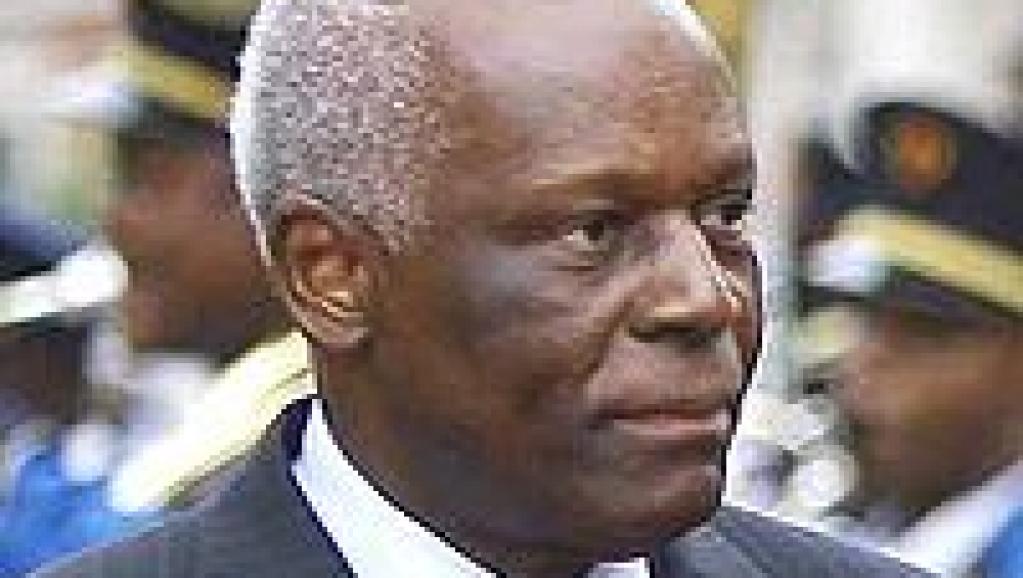
Le président angolais José Eduardo Dos Santos entame mardi 29 avril une visite officielle de deux jours en France. A midi, il aura un entretien et un déjeuner officiel à l’Elysée avec son homologue français, François Hollande. C’est la première visite en France du président Dos Santos depuis l’affaire des ventes d’armes russes à l’Angola – l’Angolagate – qui a éclaté en France à la fin de l’année 2000, avec des poursuites judiciaires contre l’homme d’affaires franco-brésilien Pierre Falcone. Une affaire qui a crispé les relations entre les deux pays.

Les relations entre les deux pays ont souvent été difficiles mais désormais, Paris souhaite « passer à une nouvelle étape ».

Il faut dire que le dernier épisode dans la querelle franco-angolaise ressemble plutôt à un pied de nez. Les autorités de Luanda ont effectivement décidé d’accorder à Pierre Falcone, sous contrôle judiciaire en France, le statut de conseiller diplomatique de leur délégation auprès de l’Unesco à Paris.

Pour Luanda, il fallait protéger Pierre Falcone qui a aidé l’Angola à acheter des armes à un moment où le pays en avait besoin pour sa survie, mais également passer un message de fermeté aux autorités françaises qui n’ont pas tenu leurs promesses dans « l’Angolagate ».

Dans cette affaire en effet, plusieurs personnalités politiques françaises, suspectées d’avoir été les bénéficiaires de commissions occultes, avaient été mises en cause et José Eduardo dos Santos s’était personnellement impliqué pour demander le retrait des plaintes. Depuis lors, le chef de l’Etat angolais boudait la France et notamment le sud où il avait l’habitude de passer ses vacances d’été.

Sur le plan économique, Luanda a également multiplié les menaces voilées concernant la poursuite du partenariat en matière de pétrole sans pour autant prendre des mesures de rétorsion contre Total, le groupe français, qui demeure dans ce secteur deuxième partenaire de l’Angola .

Lors de cette visite officielle en France, le président angolais s’entretiendra également avec le président de l’Assemblée nationale puis rencontrera des patrons de grandes entreprises françaises, des hommes d’affaires et des investisseurs représentant plusieurs secteurs d’activité.

Source: RFI