Category Archives: Africa

RWANDA-Ingabire Victoire’s case before the African Court on Human and Peoples’ Rights: Headache for the Rwandan Government

ingabire

Mrs. Ingabire Umuhoza Victoire, Chair of UDF-INKINGI opposition political party in Rwanda, detained in Kigali central prison, is to appear before The African Court on Human and Peoples’ Rights in Arusha, on March 4th, 2016. In the meantime, the government of Rwanda, which is a party to trial, is subjecting her to various forms of inhumane and degrading treatment as if to break her morale and make it hard to prepare her case properly.

Since Friday, February 5, 2016, the prison management has once again refused to allow her lawyer GATERA Gashabana to meet her in order to prepare her case.

We would like to recall that since Friday, January 29, 2016, the prison management has reduced the number of people who can visit her from 5 to one person per week. This limitation applies to her only.

On November 30th, 2015, her lawyer GATERA Gashabana, asked the President of the Kigali Bar Association to intervene and ask the Rwandan government to stop all the inhumane and degrading treatment of his client. Nothing has been done so far. In the opinion of lawyer Gatera, the molestation including the search of the lawyer and the reading of his legal notes constitute an unacceptable breach of international principles and rules protecting the legal profession.

Further to the first refusal of lawyer Gashabana’s visit, the conditions of detention of political prisoner Ms. Victoire Ingabire has deteriorated, this includes, painting black the windows of her prison cell in order to stop any natural light filtering into the cell, a vicious measure that we fear could lead to blindness.

While for medical reasons, her meal is brought in from outside the detention facility, the prison management has begun to systematically search the food brought by relatives of Mrs. Victoire Ingabire. Thus, in the process of checking the food under the pretext of looking for weapons or other prohibited items, a prison management official has systematically turns the food around in the container in a way that could make it look unpalatable to her, ostensibly to humiliate her and break her morale.

The paroxysm of the persecution is now the downright refusal of any contact between Mrs. Victoire Ingabire Umuhoza and her lawyer. The UDF- Inkingi sends an SOS message to governments, friends of the people of Rwanda and human rights organizations to:

–        Remind the inalienable and sacred right to a fair trial;

–        Remind the Government of Rwanda of its obligations regarding the treatment of prisoners;

–        Denounce human rights violations suffered by Mrs. Victoire Ingabire;

–        Remind the Rwandan government of its obligation to transport the complainant before her judges to Arusha in the best possible conditions;

–        Remind the Government of Rwanda the absolute right of Mrs. Ingabire to meet and work with her defense team on her case;

–        Support the appeal of FDU-Inkingi to the Commission of the African Union to take into account the obstacles that the Rwandan government imposes the proper judicial process.

Done in London, February 9th, 2016

Justin Bahunga

jbahunga@yahoo.co.uk

“Je pardonne … car si on ne pardonne pas, ce pays connaîtra une crise pire que ce que nous avons vécu” Simone Gbagbo

67ab1c3ea4ffa7d922bcb55da169481258b3c610

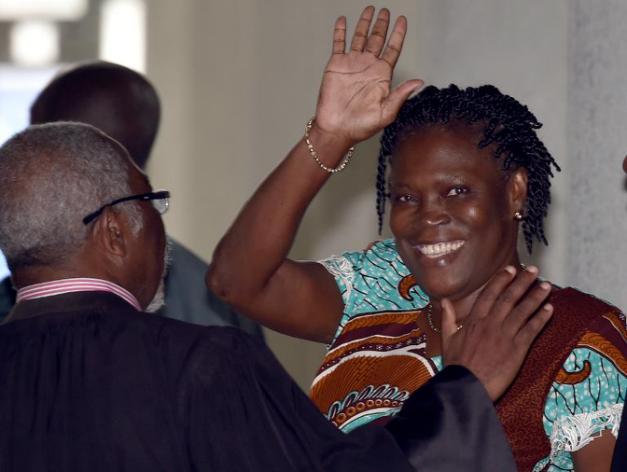
L’ex-Première dame Simone Gbagbo a été condamnée mardi matin à 20 ans de prison, une peine deux fois supérieure aux réquisitions, pour son rôle durant la crise post-électorale de 2010-2011, dont elle est désignée comme une protagoniste majeure.

La Cour “condamne à l’unanimité” Simone Gbagbo à “vingt ans” de prison pour “attentat contre l’autorité de l’Etat, participation à un mouvement insurrectionnel et trouble à l’ordre public”, a énoncé le juge Tahirou Dembelé, après plus de 9 heures de délibération du jury.

Le parquet général avait requis une peine moitié moindre, soit dix ans d’emprisonnement, contre l’ex-Première dame. Le procès en assises avait débuté fin décembre.

Surnommée “la Dame de fer” ivoirienne au temps où son mari Laurent était au pouvoir, Simone Gbagbo, vêtue d’une robe bleu clair, a accusé le coup à l’énoncé du verdict, son visage se durcissant.

Elle est “un peu affectée”, a commenté à l’AFP Me Rodrigue Dadjé, l’un de ses avocats, qui a dénoncé “une décision purement politique”. “J’ai honte pour la justice ivoirienne”, a-t-il tonné, annonçant un pourvoi en cassation.

Dans le droit ivoirien, la procédure d’appel n’existe pas pour des condamnations en assises.

Certains accusés ont entonné “l’Abidjanaise”, l’hymne ivoirien, au terme d’une journée judiciaire marathon dont le public a raté l’épilogue, exclu en fin de soirée du tribunal “pour des raisons de sécurité”, selon le procureur général.

“On a montré que l’impunité en Côte d’Ivoire ne doit plus continuer”, s’est de son côté réjoui Soungalo Coulibaly, l’un des avocats de l’Etat ivoirien, l’unique partie civile du procès.

79 personnes, dont Simone Gbagbo, étaient jugées pour leur rôle dans la crise post-électorale de 2010-2011, causée par le refus de Laurent Gbagbo de reconnaître la victoire de l’actuel chef de l’Etat Alassane Ouattara à l’élection présidentielle de novembre 2010. Les violences entre les deux camps ont fait plus de 3.000 morts en cinq mois.

L’ancienne Première dame, 65 ans, est un personnage politique très clivant en Côte d’Ivoire.

Elle a été autant respectée pour son parcours dans l’opposition que redoutée dans son rôle de “présidente” à poigne, souvent accusée d’être liée aux “escadrons de la mort” contre les partisans d’Alassane Ouattara, qu’elle a toujours honni.

– ‘Je pardonne les injures’ –

Le 23 février dernier, lors de son audience, Simone Gbagbo, tantôt souriante, ironique ou cinglante, s’était livrée à une diatribe enflammée contre le régime ivoirien actuel et contre la France, qui selon elle a soutenu l’actuel chef de l’Etat ivoirien.

Confrontée à cinq témoins, dont deux ont affirmé l’avoir vu livrer des armes à des jeunes d’Abidjan, elle avait calmement nié. “Je ne me reconnais pas dans les faits. Je ne connais pas ces personnes”.

Invitée lundi après-midi à livrer ses derniers mots à la barre, la très dévote ancienne Première dame, faisant plusieurs références à la Bible, a déclaré “pardonner” à la partie adverse ses “injures”.

“J’ai trouvé les avocats de la partie civile outranciers. J’ai subi humiliation sur humiliation durant ce procès. Mais je suis prête à pardonner. Je pardonne les injures, je pardonne les outrances. Car si on ne pardonne pas, ce pays connaîtra une crise pire que ce que nous avons vécu”, a-t-elle affirmé.

Simone Gbagbo est, tout comme son époux, accusée de “crimes contre l’humanité” par la Cour pénale internationale. Mais alors que Laurent Gbagbo comparaîtra à La Haye en juillet, Abidjan refuse son transfèrement à la CPI au motif que la justice ivoirienne est en mesure de la juger équitablement.

Le procès, présenté comme le plus important pour la Côte d’Ivoire depuis la fin de la crise, a été entaché de nombreux manquements, aucune preuve matérielle n’ayant été fournie pour confondre les accusés, dénoncent des organisations de la société civile et les sympathisants pro-Gbagbo.

Si les deux camps se sont montrés coupables d’exactions, aucun responsable pro-Ouattara n’est en outre inquiété, ce qui nourrit des accusations de “justice des vainqueurs”.

Pascal Affi N’Guessan, le patron contesté du Front populaire ivoirien (FPI), qui souhaite représenter ce parti pro-Gbagbo à l’élection présidentielle d’octobre, a été condamné à 18 mois de prison avec sursis. Cette peine est couverte par les deux ans de détention provisoire qu’il a effectués.

Abou Drahamane Sangaré, qui défie M. N’Guessan à la tête du FPI, a, lui, été condamné à 5 ans d’emprisonnement, tout comme Michel Gbagbo, le fils de l’ex-président, issu d’un premier mariage avec une Française.

Source: AFP

Belgium stands ready to contribute to a successful electoral process in the DR Congo

téléchargement        téléchargement (1)

The Deputy Prime Ministers Didier Reynders and Alexander De Croo, respectively Minister of Foreign Affairs and Minister of Development Cooperation, met with members of the government, the opposition and the civil society during their joint mission in the Democratic Republic of the Congo (DRC), from 21 to 25 February 2015, in Kinshasa and Goma (North Kivu).

Belgium closely followed the developments related to the adoption of the new election law, and welcomes the publication of the timetable for the provincial, urban, municipal and local elections in 2015 and for the parliamentary and presidential elections in 2016. The Ministers Reynders and De Croo insisted that everything should be done to ensure that the presidential and parliamentary elections in 2016 are not subject to any delay because of the provincial, urban, municipal and local elections. They reiterated that Belgium stands ready to contribute to a successful electoral process.

Didier Reynders welcomed the willingness of the DRC for a military intervention by the Armed Forces of the Democratic Republic of the Congo (FARDC) against the Democratic Forces for the Liberation of Rwanda (FDLR) in the eastern part of the country. Finding a solution for the problem of the armed groups is important, not only for the Congolese people, but also for the stability of the African Great Lakes region. In this context, Minister Reynders stressed the importance of a constructive synergy between MONUSCO, mandated by the UN Security Council, and the FARDC. Pragmatic solutions should be found to ensure the efficiency of the operations and the protection of the population.

The visit of both ministers to the DRC also underlined the continued support of Belgium for the development of the country. The objective is that everyone benefits from economic growth. The DRC is the largest beneficiary of Belgian development aid. Alexander De Croo confirmed this commitment, that favors a cooperation close to the people, particularly in the areas of education, rural development and health. In this context, Minister De Croo underlined that this partnership needs a greater involvement of the Congolese government. During the next months, Alexander De Croo wishes to develop a more integrated approach for the Belgian cooperation, where different actions are mutually reinforced and produce more results. He asked the Belgian Development Agency (BTC) as well as his administration to present proposals to develop this approach.

Didier Reynders and Alexander De Croo underlined that socio-economic development, as well as the rule of law and democracy imply respect for universally recognized human rights and fundamental freedoms. Following the events of January 2015 and the measures that have been taken, especially the freedom of the internet and the actions of the security forces were discussed with the Congolese government.

The working visit was also an opportunity to make progress on economic issues, in the aviation sector, port management and river transport. Individual consular cases were also discussed, in particular the situation of detained persons, including compatriots.

Security cooperation was discussed, with a mutual interest in preventing radicalization and violent extremism in Central and Eastern Africa.

Source:Diplomatie

Kikwete and Kagame break the ice at EAC summit

EAC_presidents

East African leaders from left; President Yoweri Museveni (Uganda), President Uhuru Kenyatta (Kenya), President Jakaya Kikwete (Tanzania), President Paul Kagame (Rwanda), President Pierre Nkurunzinza (Burundi) and Deputy President William Ruto during the 16th Summit of EAC Heads of State at KICC, in Nairobi.

Heart-warming gestures by President Jakaya Kikwete and President Paul Kagame of Rwanda injected hope of a new beginning in the strained relations between the two countries during the East African Community (EAC) Heads of State Summit here yesterday.

Midway through the summit, with President Kikwete having taken the Chair, the Rwandan leader approached the Tanzanian leader and exchanged warm gestures as the latter apparently reported that he had to rush back home.

Packed to capacity, Tsavo Hall at the Kenyatta International Conference Centre briefly went silent as the two presidents spoke in low tones before President Kagame left. President Kikwete appeared quite relieved.

A senior official of the EAC hinted this could be the first time the two leaders have been seen in a friendly mood in public for some time and affirmed that relations between the two Heads of State have always been cordial but not visibly so in public.

President Kagame told the Chair he had to leave for home, having been in Kenya for two days during which he commissioned a 140mw geothermal plant.

Relations between Tanzania and Rwanda have been strained since mid-2013 over the ex-Rwandan rebels operating in eastern DR Congo. At some point, this led to a spat between senior officials of the two EAC member countries.

Despite the leaders having regularly attended EAC Summits and other international meetings outside the bloc, there had been no public and recorded instance of such a friendly gesture.

Summit host Uhuru Kenyatta sat between the Tanzanian and Rwandan leaders at the podium as the 16th ordinary summit started before the Rwandan leader left the hall. His place was taken by his country’s EAC minister, Ms Valentine Rugwabiza.

The Tanzanian leader showered special praise on his predecessor, President Kenyatta, and the EAC secretary general, Dr Richard Sezibera, for steering the regional organisation to the current level that has seen intra-regional trade soar to $5.8billion. “Ambassador Sezibera, thank you for the trust,” he said. “Tanzania will not let down the EAC.”

He said he was impressed by Kenya and Rwanda, which were ahead of other EAC partner states in implementing outstanding decisions of strategic importance to the bloc–as shown in a recent study.

President Kikwete did not waste time after taking the Chair, about three hours behind the scheduled time, in declaring that the Summit of Heads of State, which is the supreme organ of EAC, has now devised a new way of doing things. “We (leaders) consult intensively before the plenary sessions,” he said as he pledged to secure the Community. “We come here after exhausting all the crucial matters to announce the major decisions made.”

The traditional pre-summit consultations of all the five presidents–Mr Kikwete, Mr Kagame, Mr Kenyatta, Mr Pierre Nkurunziza of Burundi and Mr Yoweri Museveni of Uganda–had to be re-rescheduled to early yesterday from Thursday evening.

President Kikwete, with the chairperson’s baton firmly in hand, steered the Summit for about three hours but was categorical that he was stepping down later this year a happier citizen of the bloc though concerned over the slow pace of integration.

“After October, I will be a prominent retired Tanzanian,” he said to applause and noted that the challenges the economic bloc have endured over time had made it much stronger.

Analysts suggested that his reference to stepping down was an indirect message to President Nkurunziza, who is reported to be seeking another five-year term as president of his violence-wracked country–which has raised tensions there.

President Kikwete, as the new EAC Summit Chairperson, alternated the podium with Dr Harrison Mwakyembe, the EAC Cooperation minister who is now the Chairperson of the EAC Council of Ministers and the EAC Secretary General Dr Sezibera.

The Tanzanian leader outlined the main challenges the EAC faces–including infrastructure deficits, non-tariff barriers and threats to peace and security in the region posed by neighbouring countries.

Source: The citizen

Tanzanian town builds for the future after Rwanda tribunal concludes

By 

Inside the ICTR
Inside the ICTR during the 2004 trail of Pauline Nyiramasuhuko (on screen), an ex-minister in Rwanda who was given a life sentence for war crimes in the 1994 genocide. Photograph: Christophe Calais/Corbis

The pioneers of the international criminal tribunal for Rwanda arrived in Arusha, Tanzania in 1996. They were destined to spend the following 18 years prosecuting those accused of responsibility in the Rwandan genocide. The lepers on the potholed avenue leading to the courthouse, who used to reach out in the hope of a gift from the rich muzungu(whites in Swahili), have vanished. And the last judges and prosecutors of the International Criminal Tribunal for Rwanda were to have left by the end of 2014.

“For the tribunal’s very first hearing they had to place buckets in the courtroom to catch the leaks during the rainy season,” a lawyer recalls. The steady drip set the cadence for proceedings as Georges Rutaganda, former leader of the Interahamwe militia, who brutally slaughtered the Tutsi with machetes, pleaded not guilty before Judge Laity Kama, of Senegal.

This was the fourth international criminal tribunal in history, after the Nuremberg trial of Nazi war crimes, its counterpart in Tokyo, then more recently the Hague tribunal for crimes committed in former Yugoslavia in the 1990s.

For many years, Arusha was just a base camp for safaris into the surrounding savannah. Its new role came by default: all other potential hosts declined the offer, so Tanzania was left to accommodate the tribunal. In the course of its stay, the court tried 71 suspects: army officers, ministers, politicians, militia, priests and purveyors of propaganda. All in all it performed its duties well, though there are some grounds for the accusation that it dispensed “victor’s justice”. It did not bring to trial any of the former Rwandan rebels, who resorted to terror tactics, too, in their drive to end the genocide.

Close to the Maasai homeland, Arusha has long attracted flocks of tourists. Some tour operators even gave them the opportunity to view the big game in the dock at the international tribunal between two safari outings. En route for Kilimanjaro, they would traipse through the public gallery in their T-shirts and sandals before transferring to the aerodrome across the road from the prison. But some 3,000 witnesses from Rwanda came here, too.

ICTR wanted poster
Inside the international criminal tribunal for Rwanda, in Arusha, Tanzania, a wanted poster with portraits of those accused of perpetrating genocide. Photograph: Christophe Calais/Corbis

Originally people in Arusha only spoke Swahili. Water was in short supply and an out-of-date copy of Le Monde, gleaned by street sellers from the daily flight from Amsterdam, would cost you $5. On return flights, the cargo was generally a consignment of roses. But the aircraft did not only carry flowers. Jean Kambanda, who led the government formed a few hours after President Juvénal Habyarimana’s plane was shot down in 1994 (the occasion for the start of the killing in Rwanda), was flown back to The Hague and imprisoned alongside alleged Yugoslav war criminals, after pleading guilty in 1998. There this austere former banker was taught to play poker by Mladen Naletilić, a militia leader from Mostar, Bosnia.

Today Arusha has daily flights and 4G connections. In less than 20 years the city has been transformed. In the bar of the New Safari Hotel, Akayesu, as he is known, orders a Kilimanjaro, the local beer. The estate agent owes his nickname to Jean-Paul Akayesu, the first person ever to be convicted on charges of genocide. When the violence first started in Rwanda, in 1994, this local council leader tried to stop the slaughter, but finally gave in and joined the killers. He was sentenced to life imprisonment. What is currently troubling the estate agent is the likely drop in house prices when the court finally closes. In contrast Modest Akida, a local barrister, is delighted. “We went to the same shops, rented the same houses and all the prices soared. So it’s really very good news that they’re leaving at last,” he says. According to a 2004 survey, ICTR staff injected more than $2.5m a month into the local economy. The court employed some 200 Tanzanian nationals.

According to Kosic, a UN guard who came here from former Yugoslavia, the town is “a black hole, halfway between Cape Town and Cairo”. He thinks Arusha owes its prosperity to the court, “but now it has grown up and can stand on its own two feet”. The ICTR attracted investors and theEast African Community established its headquarters in a brand-new building next door to the court. Now the African Court on Human and People’s Rights has moved in and peace talks have been held here. Arusha is beginning to see itself as Africa’s Geneva.

In Kijenge neighbourhood, Alfred Lotuno, an elderly Maasai, voices his concerns. “Tanzania has acted like a saint in Africa. We have tried to help Congo, Rwanda, Burundi, Sudan, Darfur and Somalia,” he says. “Tanzania has become the policeman of Africa and everyone says: ‘Tanzania, Tanzania!’ But now we have al-Shabaab in Arusha and bombs are going off. So I’m not so sure.”

In recent months the town has suffered several attacks allegedly perpetrated by the Somali Islamists, though some say it has more to do with local politics.

This article appeared in the Guardian Weekly, which incorporates material from Le Monde

EALA MEMBERS ELECT HON CHRIS OPOKA- OKUMU TO PRESIDE OVER MOTION FOR REMOVAL OF SPEAKER

ealanbid5a

…Rt. Hon Zziwa suspended until investigations into proceedings for her removal are dispensed with

East African Legislative Assembly, Nairobi, November 26, 2014: The Assembly has this afternoon moved to elect Hon Chris Opoka-Okumu to preside over the Motion for removal of Speaker. With it, the Motion for the removal of the Speaker from office, which was cut short on April 1, 2014, has been resuscitated and referred to the Legal Rules and Privileges Committee for investigations in accordance with Rule 9 (4) of the Rules of Procedure. The Committee was given 21 days within which to finalise the investigations and to report back to the House.

The Assembly further resolved to suspend/bar Rt. Hon Margaret Nantongo Zziwa from exercising the functions of Office of the Speaker pending the finalization of the investigations into the Motion for her removal. The Motion was moved by Hon Abdullah Mwinyi.

On 4th June this year, Rt. Hon Margaret Nantongo Zziwa ruled on the Motion for her removal to have fallen short of the requirements of signatures of atleast four elected Members from each Partner State and thus collapsed. This followed the withdrawal of signatures of three Members from the United Republic of Tanzania.

Rt. Hon Zziwa pegged her ruling on Rule 82(2) of Rules of Procedure that grants the Speaker of the Assembly, the final powers on the interpretation and the application of the same. However, prior to that, the Counsel to the Community, Hon Wilbert Kaahwa had maintained that the Motion was “alive”.

The Motion, initially introduced in the Assembly by Hon Peter Mathuki in Arusha during the Fifth Meeting of the Second Session of the 3rd Assembly was cut-short when it was adjourned on April 1, 2014 sine die following two applications made at the East African Court of Justice (EACJ) halting the debate.

The Motion among other things accuses Rt. Hon Zziwa of abuse of office and disrespect to Members.

Pursuant to the provisions of Article 53 (3) of the EAC Treaty and Rule 9 of the Assembly’s Rules of Procedure, Members may with a two-thirds majority pass a Resolution to remove the Speaker from office.

Source: http://www.eala.org/media-centre/press-releases/731-eala-members-elect-hon-chris-opoka-okumu-to-preside-over-motion-for-removal-of-speaker.html

People Power in Burkina Faso Has Shaken up Africa’s Autocrats

The people of Burkina Faso, in October 2014, achieved the unthinkable. They literally drove an autocrat out of Burkina Faso. Sub-Saharan Africa is, of course, home to more than half a dozen autocratic rulers that have held the reigns of state power between 20-40 years. Cameroon’s 81-year-old Paul Biya is one year short of 40 years of being at the helm initially as prime minister and as president.

Teodoro Obiang Nguema Mbasogo, who is 72 years old, has ruled Equatorial Guinea for 35 years. Jose Eduardo dos Santos who has run Angola for 35 is 72 as well. The 90-year old Robert Mugabe has led Zimbabwe first as prime minister and president for 34 years. At 71, Yoweri Kaguta Museveni of Uganda has been in power for 28 years. The 70-year old Omar al-Bashir has ruled Sudan for 25 years. Initially ruling as vice president through a figurehead and then president, the 57-year old Paul Kagame has been at the helm in Rwanda for 20 years.

Blaise Compaore was a member of this club of African dictators, having ruled Burkina Faso for no less than 27 years. And he was about to to extend his rule through a constitutional amendment when more than a million Burkinabé poured on the streets and said “enough is enough.” The collapse of the regime has resulted in a one-year transitional phase at the end of which there will be presidential and national elections.

The spectacular ouster of Compaoré by “people power” raises a key question: will it inspire similar uprising against Africa’s dictatorships?

There are hopeful signs in that direction. Even before the uprising in Burkina Faso, hundreds of people in Benin in September, 2014, had poured onto the streets to give solidarity to the “Red Wednesday movement” whose slogan is ”Don’t touch my constitution.” The incumbent head of state, Thomas Yayi, has in the past hinted on the need of removing term limits to enable him to stay in power. Barely two weeks after the disintegration of the Compaoré regime, thousands of Togolese demonstrated for several days demanding reforms of electoral laws that have entrenched a father-son dictatorship that has run by the country for more than 50 years. The current ruler, Faure Gnassingbe, took power in 2005 following the death of his father, Gnassingbe Eyadema, who had ruled Togo for 38 years.

For millions of Africans, most of whom have lived under one ruler all their lives, developments in Burkina Faso have breathed a new life and hope into nascent democratic movement across Sub-Saharan Africa. The Burkina Faso’s people power is bound to affect every other Sub-Saharan country in some way — small or large, direct or indirect, proving that Africa is not preordained to remain under dictatorship forever.

Source: Huffingtonpost

Policy Choices for a Connected World

usdos-logo-seal

Catherine A. Novelli
Under Secretary for Economic Growth, Energy, and the Environment 

University of Pretoria

Pretoria, South Africa

November 13, 2014

Good afternoon.  I am delighted to be here to speak at this distinguished university and to visit your beautiful country.  Thank you so much for inviting me.  South Africa is the last stop on an Africa trip that included Tanzania and Kenya.  Along the way, I’ve seen incredible energy and dynamism.

I’d like to speak today about a new economic reality and the policy choices we all face.  These choices are in front of every government, business, university, and individual as they determine their economic future.  The reality is, the world is more connected than ever before, with goods, services, information, people, and financial resources crossing borders at an unprecedented rate.

Before this speech and after it – perhaps during it – you will be looking at mobile devices, tapping into the internet, engaging in social media, and conducting business and commercial transactions on line. The object in your hand, perhaps a smart phone, is the result of a manufacturing process that started with innovation and design at various locations around the world, manufacturing at a host of other sites, and distribution and marketing from even different corners of the globe.

That’s the reality of today’s world, whether you are in South Africa, Kenya and Tanzania – as I was in recent days – or Washington, DC, or London or Tokyo.  Global supply chains have come to define the way we do business in today’s economy.

The Connected World

McKinsey Global Institute recently wrote that cross-border flows of goods and services totaled $26 trillion in 2012.  This represents 36 percent of global gross domestic product, more than 50 percent larger than 20 years ago.  About half of those flows are knowledge-intensive, compared to labor-intensive, and the proportion is growing. Intermediate goods – ones that are incorporated into a finished product—have become an ever-increasing proportion of trade.   These goods in turn are fueling exports from the countries that have imported them.  Over a quarter of the total value of global exports is made up of intermediate imports, and this share has nearly doubled since 1970. These statistics bring to light the changing nature of business.  Older models of single-country, soup-to-nuts manufacturing arrangements are giving way to globally integrated supply chains.  Innovation and design come from a worldwide network of research and development.  Raw materials and components flow from site to site, supported by worldwide procurement systems, logistic hubs and warehousing.  Marketing and financial services may be at other locales. Consumers are targeted for sales around the globe.

How Countries Can Take Advantage of Value Chains

So what are the implications for countries, companies and citizens of a world where global value chains are increasingly dominating trade?  What policies should countries follow to benefit the most from value chains? I would suggest that countries need to focus on five policy areas as they enable their citizens to fully reap the benefits of today’s connected world.

First, open markets facilitated by fast customs procedures, international product standards and modern infrastructure is critical. Supply chain production is more complex than traditional export systems, with more import and export transactions for each unit of value added.  This means that as goods and services move across multiple borders on their way to the final market, even small barriers can add up and affect the competitiveness of a product.

In the connected world, policies that may have offered protection to domestic firms in an earlier era, like import substitution, local content requirements, or data localization obligations, now make them less attractive as supply chain partners.  An OECD study of local content requirements, found that local content requirements not only made countries less innovative, these requirements actually harmed the domestic market by raising prices for the public for products of lesser quality.

Because of just-in time production, concentrating on bread and butter trade facilitation issues like customs procedures, transportation and modern infrastructure is all the more important.  Since products need to be sold in many markets, adhering to international standards is essential for their international viability.

Second, countries need to adopt legal and regulatory processes for doing business that are transparent, predictable, streamlined and include input from all stakeholders. The ability for investors to enforce contracts, and high standards for labor and environmental protections along with an intolerance for corruption are all key considerations for businesses in deciding where to locate or source.

I have heard some voices suggest that these “doing business” issues don’t matter, and that companies merely want to find the lowest labor costs.  But in my experience, that’s not true.  The ability to do business transparently matters a great deal to the bottom line.  Morever, branded companies value their brand image, and don’t want to risk harming it due to scandals over labor or environmental conditions. Nor do they want to be in the position of being labor and environment regulators.  Besides the moral issues surrounding poor labor and environmental enforcement, the need to constantly oversee these practices among suppliers when countries are not policing them themselves adds a great deal of cost.

Fostering Global Collaboration Through the Internet

Third, an open Internet, access to broadband, and free flows of data are essential to competitiveness. As I mentioned earlier, global supply chains are dynamic and highly collaborative, with teams of suppliers and purchasers from various stages of the value chain working together across borders to solve design, manufacturing, and marketing problems.   This really is the essence of today’s connected world. This cannot occur without internet.

The best way to unleash the creativity and ingenuity of your people, your companies, and your universities is to let them connect with others to develop new ideas and start new businesses.

There is an inaccurate perception that the Internet mostly benefits industrialized countries.  The truth is that the Internet’s economic benefits are increasingly shifting to the developing world.  The Internet economy is growing at 15 to 25 percent per year in developing countries, double the rate in the developed world.  In Turkey, for example, smaller businesses that use the web have experienced revenue growth 22 percent higher than those that do not.  Here in South Africa, Ronnie Apteker founded the first Internet service provider and enabled countless new technology businesses.  I am looking forward to meeting some of those new entrepreneurs tomorrow.

A recent report by the American think tank, the Brookings Institution, showed how the internet and cross-border data flows are providing opportunities for small and medium-sized enterprises. The report notes that SMEs on eBay are almost as likely to export as large businesses and, in fact, over 80 percent of SMEs export to five or more countries.

Fourth, strong intellectual property protection allows countries to be part of a higher-value global supply chain. At a recent conference in Washington, General Electric noted that it maintains research and development centers in Shanghai, Bangalore, Munich, Rio de Janeiro and New York.  Many other international firms have similar R&D footprints.  This geographic diversity allows for an R&D operation that, given time zones, literally never stops.  Companies look at many factors when considering where to locate their R&D centers, including the level of education, vocational training, and scientific collaboration.  But the level of intellectual property protection is also critical.

Closely related to this is a fifth policy— an open market for services. We often think of trade as the physical movement of goods from place to place.  But in today’s global economy, knowledge-intensive trade and investment, particularly in the services sector, plays an increasingly central role.

Economists from the Organization for Economic Cooperation and Development have found that services now constitute 50% of the manufacturing process.  Insurance, accounting and other financial services, and creative and design services, are all integral parts of supply chains.  But in many countries, markets for these services are closed, or heavily regulated.   If the goal is to maximize participation in global value chains, closed market policies like these no longer make sense.

Regional Trade Liberalization

The policies I have set forth are important, but not sufficient to be globally competitive.  In addition to being islands of good practices, countries need to join together to create regions where those good practices are integrated.

Last August, I chaired a roundtable on global supply chains at the U.S-Africa Leaders Summit in Washington.  We invited corporate representatives as well as trade, investment, and economic ministers from African countries.

One of the most interesting themes was the need to create regional markets in Africa. Companies were clear that the markets in many individual countries in Africa are too small to support operations just for that market. That does not mean that there are no opportunities for smaller countries to benefit from the global supply chain.  In fact, recent research indicates that, on average, regional trade agreements increase member countries’ trade about 86 percent within 15 years.

The European Union is perhaps the largest, best known and most successful example or regional integration.  There is also the North American Free Trade Agreement, which just celebrated its 20th anniversary.  With Asia, we are now negotiating a Trans-Pacific Partnership, and with Europe we have launched talks on a Transatlantic Trade and Investment Partnership.

Arrangements such as these, which lower barriers to trade and investment, deliver a big boost to commerce in member countries. These arrangements also offer ready-made hubs for setting up a global supply chain.  Countries who haven’t established some type of true regional integration will find it harder to compete for the investment that a global supply chain brings.

In Africa, regional organizations like the Economic Community of West African States, the East African Community, and the Southern African Customs Union are working to create regional integration and address barriers so that countries can achieve economies of scale and maximize their comparative advantages.  Nelson Mandela recognized the importance of looking at regional integration when he  conceived of Development Corridors along cross-border  transportation routes.

Africa and Supply Chains

Here in South Africa, I had a wonderful illustration of the connected world yesterday at the Ford factory in Silverton.  It is an American investment, creating jobs in South Africa.  Inputs, like raw materials and components, arrive from various locations around the world.  Local workers assemble those components and the factory exports to other African countries and to European markets.

The United States recognizes Africa as a dynamic continent where economies are growing and innovation is taking root.  Many African countries are reaping the benefits of economic reforms, better governance and social investments.  We would like to be a part of this positive change and contribute to Africa taking its place in the global supply chain, so that the people of Africa can reap the benefits of global growth.

The United States is supporting Africa’s growth through the African Growth and Opportunity Act (AGOA), the Trade Africa Initiative, and similar efforts.  The Millennium Challenge Corporation, for example, has issued grants of almost $10 billion to support projects in sectors like transportation, education, and property rights and land policy.  Through President Obama’s Power Africa initiative, a number of U.S. agencies are making available $7 billion in financial assistance to double access to power in six sub-Saharan African countries.

Some continue to argue that African nations need “protectionism” to compete.  I disagree.  Africans are strong, resilient, and ingenious, and I have seen in my meetings with entrepreneurs, businesses, and students people who can go toe-to-toe with the most competitive companies in the world.  We need to go forward together towards openness, high standards, and opportunity for all of our citizens.

Thank you very much.

Source: US Department of State

Burkina : comment les chefs d’État africains voient la chute de Compaoré

 Goodluck Jonathan (à g.), Macky Sall et Isaac Zida (centre), le 5 novembre à Ouagadougou.

Goodluck Jonathan (à g.), Macky Sall et Isaac Zida (centre), le 5 novembre à Ouagadougou. © Issouf Sanogo/AFP

D’Alassane Ouattara à Boni Yayi, en passant par Ibrahim Boubacar Keïta, Faure Gnassingbé ou Alpha Condé… Tous n’ont pas le même avis sur le départ de Compaoré.

De tous les chefs d’État africains, le plus affecté par la chute de Blaise Compaoré est certainement l’Ivoirien Alassane Ouattara. Entre les deux hommes, la relation était stratégique. De bonne source, le jour de sa chute, le 31 octobre, Blaise a téléphoné à son ami ivoirien pour lui demander asile et recevoir protection dans sa fuite. Aussitôt, Alassane Ouattara a appelé François Hollande afin que la France prête hélicoptère et avion au fugitif.

Après son arrivée à Yamoussoukro, le Burkinabè a reçu deux fois la visite du président ivoirien, les 1er et 4 novembre. Autre ami très marqué par l’événement, Guillaume Soro, le président de l’Assemblée nationale ivoirienne. Le Front populaire ivoirien (FPI) de Laurent Gbagbo, lui, dénonce “l’exil doré” accordé par la Côte d’Ivoire.

>> Lire aussi : qui pourrait bien prendre la tête de la transition ?

Qui se désole de la chute de Blaise ?

En Afrique centrale, tous les chefs d’État, ou presque. En Afrique de l’Ouest en revanche, très peu de monde. À l’exception d’Alassane Ouattara, bien sûr, et de son homologue togolais, Faure Gnassingbé, qui doit redouter une propagation de l’onde de choc jusqu’à Lomé. “Blaise avait la particularité d’être accessible à tout le monde, confie avec un brin de nostalgie le ministre d’un État d’Afrique de l’Ouest. Quand j’étais dans l’opposition, il me recevait souvent à sa table. Mais ce n’était pas seulement pour mes beaux yeux. Selon lui, tout opposant pouvait faire naître la subversion chez l’un de ses partenaires et l’affaiblir. Le Burkina était riche de ses voisins.”

C’est sans doute au Mali que l’événement est le mieux accueilli. Le Rassemblement pour le Mali (RPM), du président Ibrahim Boubacar Keïta (IBK), “apprécie le geste héroïque du peuple burkinabè […] contre une dictature de plus de vingt-sept ans”. Commentaire d’un proche d’IBK : “Nous ne pardonnons pas à Blaise d’avoir accordé le gîte et le couvert à tous les chefs rebelles du Nord-Mali. Son départ va faciliter les négociations d’Alger.”

> > Lire aussi:

Au Niger, même son de cloche. Sur la BBC en langue haoussa, Mohamed Bazoum, le ministre des Affaires étrangères, a lâché : “Ce qui s’est passé doit servir de leçon aux chefs d’État qui veulent se maintenir trop longtemps au pouvoir.” Mahamadou Issoufou se frotte les mains à l’idée que son opposant Hama Amadou ne puisse plus se réfugier au Burkina Faso.

En Mauritanie, l’Union pour la République (UPR, au pouvoir) félicite les Burkinabè “pour la réalisation du triomphe des peuples africains contre la tyrannie”. Mohamed Ould Abdelaziz se réjouit quant à lui de voir son opposant Limam Chafi, proche conseiller de Compaoré, errer désormais entre Abidjan et Rabat.

> > Lire aussi: Pour Mohamed Ould Abdelaziz, “la solution de la crise viendra des Burkinabè”

Pas de réaction officielle en Guinée, car Alpha Condé était à la fois très proche de Blaise et très inquiet devant son obstination à rester au pouvoir. “Cela va très mal se passer”, prédisait-il ces dernières semaines.

Pas de commentaire non plus au Bénin. Mais subitement, Boni Yayi retrouve des mots simples pour dire qu’il n’essaiera pas de briguer un troisième mandat en 2016. “Je ne toucherai pas à ma Constitution. Je le jure”, a-t-il déclaré le 3 novembre sur France 24. “L’an dernier, à chaque fois qu’il le disait aussi clairement, il recevait un coup de fil menaçant de Ouagadougou, explique l’un de ses proches. Aujourd’hui, Blaise ne peut plus lui pourrir la vie.”

Lire l’article sur Jeuneafrique.com : Burkina Faso | Burkina : comment les chefs d’État africains voient la chute de Compaoré | Jeuneafrique.com – le premier site d’information et d’actualité sur l’Afrique
Follow us: @jeune_afrique on Twitter | jeuneafrique1 on Facebook

Support for Civil Society’s Charter for Transitional Government in Burkina Faso

usdos-logo-seal

Press Statement

Jen Psaki
Department Spokesperson
Washington, DC
November 10, 2014

The United States welcomes the November 9 announcement of a Charter for Transitional Government in Burkina Faso developed by political parties, civil society, and religious and traditional leaders. We urge continued progress in the discussions between these groups and the military so that this crisis may come to a quick end and the process of rebuilding Burkina Faso’s democracy may begin.

We also underscore the urgency of Burkina Faso returning to constitutional rule. Now that civil society, political parties, and the Constitutional Court are fully engaged in elaborating the mechanics of the country’s transition, we urge the men and women of Burkina Faso’s armed forces to return to their primary mission — safeguarding the territorial integrity of Burkina Faso and the security of its citizens.

At the same time, we firmly hope that the central mission of the transitional government will be to ensure effective preparation for national elections in November 2015.

Source:US Dept of State