Category Archives: economic

The Evidence Mounts: Poverty, Inflation and Rwanda

By Sam Desiere

In a recent blogpost an anonymous researcher on roape.net showed that poverty in Rwanda has increased from 2011 to 2014 by 5 percentage points. This contradicts the official poverty statistics and narrative, which claim that poverty decreased by 5.8 percentage points, namely from 44.9% in 2011 to 39.1% in 2014 (NISR, 2015). Importantly, the author published the Stata-files used to analyse the data of the EICV 3 and EICV 4 household surveys, enabling other researchers to verify his claims.

Recently, I also calculated trends in poverty using the same datasets. Although I used a slightly different (and, arguably, less sophisticated) methodology, the results confirm that poverty did not decrease. In addition, I show that the poverty trends are very sensitive to the inflation rate used. With an inflation of 16.7% (as reported by the National Institute of Statistics of Rwanda, NISR), poverty indeed decreased by at least 5 percentage points. With an inflation rate of 30% – which is in my view more in line with the ‘real’ inflation rate – my estimates show that poverty increased by 1.2 percentage points.

The fact that two researchers arrive – independently from each other – at the same conclusion, strengthens my belief that the EICV surveys show that poverty in Rwanda has increased. This has important implications for the current debate about (rural) policies in Rwanda, but I leave a discussion of these implications to researchers and policy makers more familiar with the reality on the ground and focus in this blogpost on the technical aspects of estimating poverty trends.

In this this post, I briefly describe my methodology and key findings and discuss (food) price inflation, which turns out to be a critical parameter. The Stata do-files required to replicate my findings can be found here.

Methodology

Rwanda’s poverty estimates are based on the Integrated Household Living Conditions Survey (EICV by their French acronym), which are conducted every three years. I used data from EICV 3, conducted in 2010/11 and EICV 4, conducted in 2013/14, which are made publicly available by the NISR. More specifically, I used the modules on food consumption purchased on the market and food consumption from own production. In both waves, the questionnaire of both modules is nearly identical. Food consumption is reported for more than 100 food items.

Unlike the anonymous researcher, I did not use the modules on non-food expenditure. I did so for two reasons. First, the NISR reports that most households spend over 60% of their budget on food. Hence, food expenditure is a good proxy of poverty. Second, non-food expenditure would require some additional data cleaning, which requires additional assumptions. Hence, I simply calculated food expenditure in both waves.

The meta-data of EICV 4 (available on NISR’s website) clearly stipulates that each sampled household in Kigali was visited 11 times over a period of 33 days. The modules on food consumption were administered during every visit. Rural households were visited 8 times over a period of 16 days. The meta-data of EICV 3, however, does not provide information on the number of times a household was visited. I simply assumed that the same methodology, for both rural and urban households, was followed in wave 3 as in wave 4. If this assumption is wrong – something I could not check – the results presented below will be erroneous.

In both waves, households reported how much they had spent on food purchased on the market by food item since the previous visit of the enumerator. I simply added up expenditure on all food items. Households also reported how much they had consumed from own production. Converting the consumption from own production in monetary values was more challenging. Households typically reported consumption from own production in kg. Some households also reported in the same module how much they would have paid on the market for this food item. I used this information to calculate the median, national price for each food item and used this price to convert consumption from own production in its monetary value. Since relatively few households reported prices, I did not attempt to calculate region specific prices nor did I correct for price seasonality. On this point my methodology differs from the anonymous researcher, who calculated a Laspeyres price index to account for spatial and temporal price variation.

To verify my assumptions, I checked whether my estimates of food expenditure are correlated with the household poverty status as reported by the NISR and included as a separate variable in the datasets. In both waves, food expenditure was lower for households classified by the NISR as extremely poor compared to household classified as poor, and the expenditure of this group was in turn lower than the expenditure of non-poor households. These results, available upon request, confirm that my assumptions are at least partially similar to the assumptions of the NISR.

Food expenditure can only be compared between the waves if the food inflation rate between 2010/11 and 2013/14 is known. I used two different inflation rates. First, I used an inflation rate of 16.7%, which is reported by the NISR (NISR, 2016, p. 43). Second, I estimated inflation based on food prices reported by the respondents, which I also used to convert food consumption from own production in monetary values. Inflation is then defined as a weighted average of the price increase of nine important crops. I used the same weights as those used by NISR to construct the 2013/14 adjusted food poverty line (NISR, 2015, table B4, p. 38). These estimates of inflation will be discussed in greater detail below.

Since I did not calculate total expenditure, but only food expenditure, I could not use the poverty lines proposed by the NISR. I therefore followed the ‘inverse’ methodology. First, I assumed that the NISR correctly estimated poverty in 2010/11 (44.9%) and used this information to determine the food expenditure threshold in 2010/11 prices that corresponds with this poverty rate. Second, I deflated food expenditure in 2013/14 using two different inflation rates, namely 16.7% and 30%. The first inflation rate corresponds with the inflation rate used by the NISR and thus allows me to replicate the findings of the NISR. The second inflation rate corresponds with my own estimate of inflation using the price data from EICV 3 and EICV 4. Third, I used the food expenditure threshold as an alternative to a poverty line to estimate the poverty rate in 2013/14. This approach is valid because I am not interested in ‘absolute’ poverty figures, but only in poverty trends.

In all analyses, I used the population weights to make the results nationally representative.

Results

Poverty trends

Using the EICV 3 and EICV 4 datasets, I calculated food expenditure per adult equivalent, respectively in 2010/11 prices and 2013/2014 prices. In order to estimate poverty trends, food expenditure in 2013/14 has to be deflated to express it 2010/11 prices. Poverty trends are very sensitive to the inflation rate used to deflate food expenditure. Results are presented for two inflation rates: (1) an inflation rate of 16.7% as reported by NISR and (2) an inflation rate of 30%, which is at the lower end of my inflation estimates based on ESOKO price data or EICV price data (see below for a discussion of inflation).

Figure 1 shows cumulative frequency distributions of food expenditure for these two situations, while table 1 summarizes poverty trends

With an inflation rate of 16.7% (left panel, figure 1), real food expenditure per adult equivalent increased for all households from 2010/11 to 2013/14 and, as a result, poverty decreased. Assuming a poverty rate of 44.9% in 2010/11 (which corresponds to a food poverty line of 100,232 RWF per adult equivalent), poverty decreased by 7.9 percentage points. This poverty reduction is even more pronounced than reported by official statistics, which states than poverty decreased by 5.8 percentage points.

With an inflation rate of 30% (right panel, figure 1), food expenditure does no longer increase between 2011 and 2014 for all households. Again assuming that poverty is 44.9% in 2010/11, poverty even increased by 1.2 percentage points.

Figure 1: Cumulative distribution of food expenditure per adult equivalent for EICV 3 and EICV 4 for an inflation rate of 16.7% and 30%

Table 1: Poverty trends in function of the inflation rate

  Inflation: 16.7% Inflation: 30%
Poor HH EICV 3 (official statistics) 44.9% 44.9%
Poor HH EICV 4 (own estimates) 37.4% 46.1%
Trends in poverty (percentage points) -7.5 +1.2

In sum, the poverty trends are very sensitive to the inflation rate. With an inflation of 16.7% from 2011-2014, poverty decreased by at least 5 percentage points, which is in line with the official reports. With an inflation rate of 30%, poverty does not decrease. The question thus boils down to an accurate estimation of the inflation rate between 2011 and 2014.

Inflation rate

The EICV survey is not an ideal dataset to estimate inflation, because it does not contain much information on food prices. As explained earlier, some households report prices for those food items consumed from own production. This does not only mean that the number of observations is relatively limited, but also that households report prices of those items they did not buy on the market. I nevertheless used this information to calculate mean and median average prices by food item. I calculated national averages without taking into account price seasonality or regional price differences. In order to estimate ‘average’ inflation, a weighted average is taken over nine crops. The weights are proportional to the weights used for the construction of the 2013/14 adjusted food poverty line (NISR, 2015, table B4, p. 38). These nine crops account for 86% of the total calorific intake of the food basket. Two crops dominate this index: cassava (fermented) (weight: 38%) and dry beans (weight: 25%).

Figure 2 shows the increase in mean and median prices between 2010/11 and 2013/14 for nine crops, while the horizontal lines indicate the weighted average. The increase in median prices ranges from 10% for sorghum to 50% for cassava (both flour and roots). Median and mean inflation are 33% and 42%, respectively. This corresponds to an annual inflation of 9.5% and 12.5%, respectively.

Figure 2: Price increase for nine crops from 2010/11 to 3013/14 (mean and median prices)


These inflation estimates are substantially higher than the ones reported by NISR, which states that food prices increased by 16.7% between Jan 2011 and Jan 2014 (NISR, 2016, p. 43). Moreover, the estimates based on the EICV surveys are remarkably similar to the estimates based on detailed ESOKO price data, where I estimated inflation at 30.5% over the 2011-2014 period (details not reported here).

In sum, I believe that the ‘real’ food inflation rate is substantially higher than the one used by NISR to estimate poverty trends. This probably explains why I find that poverty increased, while the NISR reported that poverty decreased. These findings raise concerns, not only for Rwanda’s (rural) policies, but also for international donors that have presented Rwanda as a model for development because of the supposedly strong poverty reductions.

Sam Desiere is currently a senior researcher at HIVA, the research institute for work and society of the University of Leuven, Belgium. In 2015 he obtained a PhD in agricultural economics from Ghent University, Belgium, which focused on data quality of household surveys in developing countries.

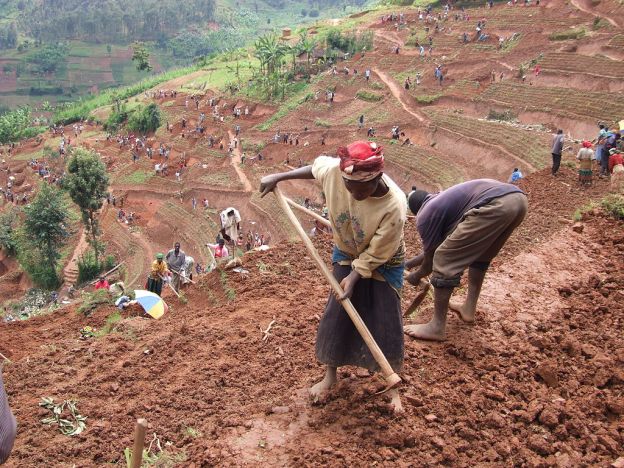
Featured Photograph: As part of the DFID funded Vision 2020 Umurenge Programme (VUP), Rwanda’s flagship Social Protection Programme, women and men in northern Rwanda work on a public works site in 2012, building terraces to prevent soil erosion

Source: A Review of African Political Economy (ROAPE)

Rwandan Poverty Statistics: Exposing the ‘Donor Darling’

In his book entitled Poor Numbers, Morten Jerven cautioned against taking African development statics at face value, given the high political and financial stakes attached to these numbers, as well as the lack of institutional mechanisms to prevent political interference in many countries. Few countries illustrate his case more starkly than Rwanda. As An Ansoms et al pointed out in an article in the print issue of ROAPE earlier this year, ‘Statistics versus livelihoods: questioning Rwanda’s pathway out of poverty, the Rwandan government has used its record on poverty reduction and economic growth to legitimize its authoritarian rule and to deflect criticism of its human rights record, just as the previous regime had done up until 1990. Furthermore, Rwanda’s spectacular recovery after the genocide has made it somewhat of a “donor darling”, and has enabled the government to attract significant foreign resources in the form of aid from donors desperate to claim a share in this African success story.

Yet, questions have been mounting in recent years about the reality and sustainability of the “Rwandan miracle”, given the heavy-handed nature of the state-led agricultural transformation project (Dawson et al. 2016), and the government’s propensity for debt-financed investments in unproductive prestige projects, such as the Kigali Convention Centre. These questions came to a head in September 2015, when the National Institute of Statistics of Rwanda (NISR) published a poverty profile (NISR, 2015) based on the most recent household budget survey (EICV4 by its French acronym). The report claimed that the proportion of Rwandans living below the poverty line had fallen from 45% in 2010 to 39% in 2014, after a string of similarly successful decreases in the previous surveys. Two months later, Filip Reyntjens published a critique, claiming that the “decrease” in poverty had been artificially engineered by NISR by changing the type of poverty line used, from an “average” consumption basket based on actual consumption patterns of poor Rwandan households, to a “minimum” or “optimal” consumption basket, containing mostly highly caloric and inexpensive food types.

The change is not in itself problematic, as the choice of a poverty line is always, to some extent, arbitrary and there are many different acceptable ways to define a poverty line. The normative minimum consumption basket adopted by NISR is one such way. However, to make trend comparisons, all experts agree that it is crucial to use consistent methodologies, assumptions and definitions across time. Reyntjens claimed that had they done that, they would have found the proportion of people living below the minimum poverty line to have increased by 6 percentage points between 2010 and 2014. Unfortunately, Reyntjens never published the syntax files he used to compute his estimate. Neither did NISR accept to publish its own syntax files. Without this key piece of evidence, the debate has never been closed from a technical point of view, as it is impossible to show convincingly whether poverty has actually increased or decreased in Rwanda between 2010 and 2014.

We hope to contribute to settling this issue by publishing open, transparent and verifiable syntax files built using a publicly available dataset, which can be downloaded from NISR’s own microdata catalogue on its website (the two syntax files can be opened with .txt notepad or STATA software here). There are many ways to compute these things and there are innumerable adjustments and assumptions that must be made to arrive at an aggregate number. Consequently, it is difficult to replicate exactly the official estimates without access to the original syntax files. However, we hope that by submitting these to public scrutiny, such differences can be ironed out in an open and transparent manner, and any mistakes can be corrected to arrive at an estimate that all parties can accept. In constructing these estimates, our main priority has been to ensure consistency between the two surveys. We therefore try to use exactly the same code and assumptions in both years wherever possible. Below, we provide an overview of the key parameters and assumptions that entered the construction of these indices. Since there are several different poverty lines that have been generated by now, we decided to compute trends for all of them, namely:

  • Average consumption basket: representing the minimum amount required to consume 2,500 kcal per day (adjusted for age and gender), using prevailing culinary habits of poor Rwandan households in 2001. This was the official poverty line used in 2001, 2005, 2010.
  • Updated average basket: representing the minimum amount required to consume 2,500 kcal per day (adjusted for age and gender), using prevailing culinary habits of poor Rwandan households in 2014. This was the new poverty line computed by NISR in 2014, which should have been used in EICV4, but was never used because it was deemed too high.
  • Minimum consumption basket: representing the minimum amount required to consume 2,500 kcal per day (adjusted for age and gender), using optimal (i.e. cheap and highly caloric) food types. This was the official poverty line used in 2014 (EICV4).
  • Reyntjen’s poverty line: Reyntjens argued that since the minimum consumption basket was 19% lower than the updated average basket, trend comparisons with 2010 should have been made using a poverty line that was 19% lower than the one used in 2010.[1] For this poverty line, we did not construct a food basket, but simply calculated 81% of the figure from the total poverty line computed from the average consumption basket.


In all consumption baskets, the quantities and caloric values are kept constant across surveys. Prices for each item are given as the national median price across regions and across months, as reported in the auto-consumption module of the EICV survey (see table 3 below). Consumption aggregates have been adjusted for spatial and temporal price differences using a Laspeyres index (see table 2 below). The Laspeyres index was chosen because it yielded estimates that were closest to official poverty estimates in EICV3 for the average basket. The choice of price index does not affect the conclusions of this blogpost.

The results are reported in table 1 below. All poverty lines yield similar trends when used consistently over time, indicating that poverty increased between 5% and 7% points between 2010 and 2014. All changes are statistically significant at the 5% level.

It should be noted that our results differ from those obtained by simply updating the poverty line for inflation using CPI data, as was done by NISR in their 2016 trend report (NISR, 2016). In principle, if the data are of good quality and sufficiently disaggregated, both methods should be equivalent and should not yield significantly different results. This therefore raises questions about the quality / reliability of official CPI data, and/or the quality of price data collected by the EICV. In either case, this would undermine our ability to correctly estimate poverty levels in Rwanda. The discrepancies found here should invite us to more closely scrutinize official statistics coming out of the Rwandan statistical office. GDP growth figures appear to be incompatible with the findings of the EICV survey, given than agriculture still accounts for about one third of GDP and two thirds of the labour force.

Tables

Table 1: Summary of poverty lines and poverty rates

Average basket Updated basket Minimum basket Reyntjen’s poverty line
2010 2014 2010 2014 2010 2014 2010 2014
Share of non-food[2](% of total cons.) 31 34.8
Total caloric intake (kcal/ adult/ day) 1346 1215 1212
Total food cost per pers./year (Rwf) 96,797 121,795 98,069 125,504 77,559 101,116
Non-food component (Rwf/ pers/year) 43,489 54,720 52,344 66,987 41,397 53,899
Total poverty line (Rwf/ pers/ year) 140,286 176,515 150,413 192,491 118,956 155,015 113,632 142,977
Poverty rate (% of pop< tot. pov. Line) 45.2 50.2 49.2 55.8 35.2 42.2 32.5 37.1
Change in poverty rate +5* +6.6* +7* +4.6*
*Change is statistically significant at 5% level


Table 2: Laspeyres price index by quarter and province (computed from price data in auto-consumption file)

2010 Kigali City Southern Western Northern Eastern
First quarter 1.47 0.98 0.89 0.98 1.14
Second quarter 1.31 0.98 0.92 0.96 1.05
Third quarter 1.38 0.98 0.92 0.98 1.13
Fourth quarter 1.31 0.98 0.92 1.00 1.14
2014 Kigali City Southern Western Northern Eastern
First quarter 1.22 0.93 1.01 0.96 1.09
Second quarter 1.20 0.95 0.96 0.91 1.08
Third quarter 1.27 0.98 1.06 1.05 1.04
Fourth quarter 1.14 0.92 1.07 0.99 1.02


Table 3: Food baskets used to compute poverty lines

PRODUCE NAME KCAL/ 100G PRICE[3] QUANTITY CONSUMED (KG/ ADULT EQUIVALENT PER DAY)
AVERAGE BASKET UPDATED BASKET MINIMUM BASKET
both years 2010 2014 both years both years both years
Sweet potato 92 80 100 0.4033 0.3114 0.0915
Irish Potato 67 120 150 0.1763 0.1257 0.0242
Banana – cooking (Inyamunyo) 75 120 150 0.0573 0.0783 0.0227
Dry beans 341 300 400 0.1130 0.0758 0.0758
Cassava (root) 109 100 150 0.0410 0.0694 0.0694
Cassava (flour) 338 200 300 0.0134 0.0391 0.0063
Sorghum juice(Ubushera) 173 150 180 0.0000 0.0000 0.0000
Tomato 17 200 200 0.0106 0.0146 0.0146
Corn (flour) 363 300 350 0.0100 0.0184 0.0012
Cabbages 19 100 100 0.0207 0.0172 0.0172
Local Banana beer 48 300 300 0.0096 0.0000 0.0000
Avocado 119 90 100 0.0036 0.0143 0.0494
Amarante (small leafed green) 22 100 150 0.0124 0.0150 0.0150
Local sorghum beer(ikigage) 173 150 180 0.0150 0.0000 0.0000
Cassava (fermented) 362 150 200 0.0056 0.0113 0.1097
Dry maize (grain) 356 180 240 0.0103 0.0138 0.0225
Eggplant 21 150 200 0.0070 0.0082 0.0082
Cassava leaves 53 150 200 0.0068 0.0093 0.0093
Local rice 280 500 600 0.0027 0.0092 0.0035
Tarot/amateke 86 100 150 0.0098 0.0189 0.0476
Maize (fresh) 36 100 150 0.0065 0.0000 0.0000
Fresh milk 61 150 200 0.0010 0.0062 0.0062
Fresh bean 53 200 250 0.0002 0.0000 0.0000
Banana fruit (Imineke) 60 150 200 0.0038 0.0056 0.0028
Sorghum (flour) 343 300 350 0.0031 0.0051 0.0075
Onion 24 250 325 0.0017 0.0024 0.0024
Curdled Milk 75 200 200 0.0007 0.0053 0.0053
Local banana juice 48 200 200 0.0000 0.0035 0.0020
Groundnut flour 387 900 1000 0.0004 0.0000 0.0000
Sorghum 343 250 250 0.0253 0.0028 0.0143
Amarante (large leafed green) 22 100 170 0.0039 0.0028 0.0028
Pumpkin 19 100 100 0.0068 0.0058 0.0058
Pineapple 26 100 125 0.0002 0.0013 0.0013
Carrot 38 200 250 0.0003 0.0011 0.0011
Papayas 26 100 150 0.0006 0.0014 0.0014
Mangos 45 100 125 0.0000 0.0022 0.0074
Beef meat 150 1400 1400 0.0006 0.0016 0.0000
Green pea (fresh) 37 400 500 0.0006 0.0000 0.0000
Fish (fresh / frozen) 49 1000 1020 0.0005 0.0000 0.0000
Eggs 139 70 240 0.0007 0.0009 0.0009
Guava 17 70 100 0.0002 0.0000 0.0000
Soya (dry) 335 300 400 0.0000 0.0004 0.0004
Yams/Ibikoro 109 130 160 0.0000 0.0104 0.0104
Pepper 17 250 300 0.0002 0.0000 0.0000
Plums 24 425 600 0.0001 0.0000 0.0000
Pork meat 220 1150 1400 0.0000 0.0003 0.0000
Wheat (flour) 364 350 450 0.0001 0.0000 0.0000
Goat meat 164 1500 1800 0.0002 0.0000 0.0000
Orange (local) 34 200 200 0.0000 0.0002 0.0002
String bean 32 200 200 0.0068 0.0000 0.0000
Soya (fresh) 405 200 250 0.0023 0.0000 0.0000
Green pea (dry) 339 500 700 0.0010 0.0000 0.0000
Ground nuts (peanuts) 567 800 1000 0.0009 0.0001 0.0001
Fish (dry / smoked) 199 500 500 0.0000 0.0127 0.0127
Other Meats 126 550 800 0.0000 0.0000 0.0005
Bread 261 239 303 0.0011 0.0000 0.0000
Imported rice 363 460 583 0.0014 0.0000 0.0000
Palm oil 884 668 846 0.0036 0.0000 0.0000
Sugar (local) 380 500 634 0.0027 0.0000 0.0000

The authors of this article have asked for anonymity.  

Featured Photograph: Parc National des Volcans, Rwanda. August 4, 2005

References

Reyntjens, F. 2015. “Lies, Damned Lies and Statistics: Poverty Reduction Rwandan-style and How the Aid Community Loves It.” Blog of 3 November 2015 posted on http://www.africanarguments.org.

NISR. 2015. Rwanda Poverty Profile Report 2013/2014: Results of Integrated Household Living Conditions Survey. Kigali: NISR.

An Ansoms, Esther Marijnen, Giuseppe Cioffo, and Jude Murison, “Statistics versus livelihoods: questioning Rwanda’s pathway out of poverty”, Review Of African Political EconomyVol. 44 , Iss. 151, 2017.

National Institute of Statistics of Rwanda (NISR), Poverty Trend Analysis Report, June 2016.

Jerven, Morten. Poor numbers: how we are misled by African development statistics and what to do about it. Cornell University Press, 2013.

Dawson, Neil, Adrian Martin, and Thomas Sikor. ‘Green revolution in sub-saharan Africa: Implications of imposed innovation for the wellbeing of rural smallholders.’ World Development 78 (2016): 204-218.

Notes

[1] Note that Reyntjens argument is not strictly speaking correct, since it would still require us to compare two different consumption baskets. To be methodologically sound, the 19% reduction would thus need to be applied to the same basket in both years, as we are doing here.

[2] In the average consumption basket, the non-food component is computed based on the average food share for households in the 7th decile in 2001. In the updated and minimum baskets, the non-food components are computed based on the average food share for households in the 5th decile in 2014.

[3] National median price of product as reported in the auto-consumption module.

Source: A Review of African Political Economy (ROAPE)

Revealed: Despot Rwanda dictator labelled a ‘visionary’ by Tony Blair falsifies poverty numbers to get more foreign aid and ‘even sent hitmen to Britain to take out rivals’


Priti Patel

Duped: The Department for International Development, overseen by Priti Patel, issued a report boasting of ‘investing’ £64 million aid this year in Rwanda.

president-paul-kagame-7

  • Paul Kagame is the President of Rwanda and commanded a rebel force before
  • Britain is the second biggest bilateral donor to Rwanda, giving £64 million a year
  • The Mail on Sunday found that the regime twists records, lying about poverty 
  • Human Rights activist Rene Mugenzi was warned by police that a hit squad from Rwanda had come to the UK to kill him

Emmanuel Gasakure could have enjoyed a comfortable life as a cardiologist in France. But when his native Rwanda was ripped apart by genocide in 1994, he returned to the country.

He helped revive the health service as the nation recovered from terrible trauma and served as President Paul Kagame’s adviser and personal physician for 14 years.

But Gasakure grew disturbed by dark forces wrecking his lifetime’s work. So he confronted the country’s health minister, a friend of Kagame’s wife, over missing funds, stray medical supplies and a mismanaged human resources project. Days later, this patriotic physician was arrested, tortured and then shot dead – by a police officer, reportedly in self-defence, inside a Kigali police station. One more dissident wiped out by a despotic regime. ‘He was executed because he was denouncing corruption in the health sector,’ said a friend. ‘Kagame is a killer.’

Few would now dispute this claim, given Kagame’s lethal interventions in neighbouring nations and the constant stream of critics who have died or disappeared after falling out with his regime.

His foes are not even safe abroad: one was strangled in South Africa, others have been eliminated in East Africa, while British and US authorities have issued warnings over Rwandan death squads.

Yet this bloodstained dictator at the helm of a ruthless one-party state is hailed a hero by Western leaders lavishing torrents of foreign aid on his tiny nation as he prepares for his latest electoral coronation next month.

Tony Blair says Kagame is a ‘visionary’. Bill Clinton called him one of the ‘greatest leaders of our time’. David Cameron proclaimed Rwanda ‘a success story’ that offers ‘a role model for development’.

The United Nations tells other African nations to ‘emulate’ Rwanda. The billionaire philanthropist Bill Gates works with him, the Davos elite fall at his feet and leading universities provide prestigious platforms for him to speak.

Britain is among the biggest cheerleaders, handing over huge sums from taxpayers and ushering Rwanda into the Commonwealth eight years ago.

Rwanda is the ultimate ‘donor darling’, where the barbarity of its vicious regime is brushed aside in a desperate search for an aid success story. And Britain backed the regime even after Kagame overturned the constitution to retain power for another 17 years.

Now, The Mail on Sunday can reveal devastating evidence that Rwanda may have distorted data, exaggerated claims of rapid development and lied about levels of poverty in its bid to shore up its credentials for foreign aid.

Our investigation reveals:

  1. Deaths of mothers and infants have been deliberately ‘unlogged’ to boost mortality statistics, exaggerating health improvements;
  2. Britain boasts its aid helped fund near-universal use of mosquito bed nets, yet corruption and mismanagement by health officials led to a massive malaria outbreak;
  3. Experts allege statistics on poverty are being manipulated to show improvements when it is actually growing worse, not better;
  4. A British firm has withdrawn from helping analyse a key national study used to measure poverty, reportedly due to concerns over data manipulation;
  5. Multilateral partners have confronted Rwanda after discovering its health data is ‘not credible’;
  6. World Bank sources say a famine caused by drought and failed agricultural policies is being covered up by the state;
  7. Dissidents claim Western donors are being duped. ‘Britain ignores reality and chooses to play an openly propagandistic role for the regime,’ said David Himbara, a former Kagame aide.

Some of the most shocking evidence uncovered by this newspaper comes from senior regime insiders who have fled the country. One said he saw the president personally beat a colleague with sticks for buying curtains from a store not owned by the ruling party, which has vast assets and is controlled by Kagame. The victim remains behind bars nine years later.

The MoS investigation was aided by a whistleblowing senior official at a global multilateral agency. ‘I feel like an accomplice to murder,’ said the source.

‘I thought I was working with God but it turned out I was working with the Devil. This kind of regime is pure evil.’

President Kagame sells himself as saviour of Rwanda after ousting Hutu militia accused of slaughtering about 800,000 mainly Tutsi citizens in the genocide, then salvaging a shattered nation. He skilfully exploited Western guilt over the genocide, despite sparking war in the Democratic Republic of Congo that led to possibly five million deaths. His forces carried out terrible atrocities, even on refugees, women and children.

He was due to stand down this year. But Kagame held a referendum to overturn limits on how long he could serve, claiming to be reacting to public opinion and winning almost all the votes. He could now stay in power until 2034.

His last election in 2010 was a sham, with rivals jailed and newspapers closed using state bodies backed by British aid.

One opponent was beheaded – yet Tony Blair, who has borrowed Kagame’s private jet, sent the dictator effusive congratulations. In May this year, an activist called Diane Rwigara declared she would stand against Kagame, bravely arguing ‘people are tired, people are angry’. Her industrialist father died two years ago in a car crash the family fear was a politically-linked murder. Two days later, nude photographs of the 35-year-old were leaked to a newspaper and circulated on social media. Then the electoral commission rejected her bid.

‘Since the ruling Rwandan Patriotic Front took power 23 years ago, Rwandans have faced huge – and often deadly – obstacles to participating in public life and voicing criticism of government policy,’ said Amnesty International regional director Muthoni Wanyeki.

The roll call of dead critics includes an opposition figure who was ordered to meet his village security official in May. A few days later his family were called to collect his corpse from a hospital.

Human Rights Watch also revealed why visitors admire capital Kigali’s neat streets: the police execute petty criminals while ‘undesirables’ such as hawkers and the homeless are held in camps. The group says there is official strategy to spread fear. Yet on Thursday, the Department for International Development, overseen by Priti Patel, issued a report boasting of ‘investing’ £64 million aid this year in Rwanda to ‘build effective government institutions’ and support ‘development of an open and inclusive society’.

It praised Kagame’s ‘strong record of using aid effectively to… produce impressive results’ and insisted his regime ‘plays a progressive role on the world stage’.

Britain is the second biggest bilateral donor to Rwanda. The nation of nearly 12 million people receives the highest levels of aid support per capita in its region – about twice as much per head as Burundi, Kenya or Uganda.

Kagame and his fans love to reel off figures highlighting how he has transformed his country in areas such as healthcare, with life expectancy soaring and sharp falls in child and maternal mortality. But according to former insiders such as Himbara, who served as Kagame’s principal private secretary and then his head of policy and strategy, ‘statistical manipulation is so widespread that hardly anyone knows what the reality is’.

Another well-placed source explained how Rwanda twists child mortality figures. ‘If a researcher goes to a household and finds a child has died, they just go to the next one. This is easy in such a tightly controlled society since no one can complain.’

Vincent DeGennaro, an American doctor, spent 18 months working in Rwanda with a charity and saw how neonatal and maternal deaths went unrecorded. ‘When I first got there, I bought into the narrative,’ he said. But he soon realised there was deliberate miscollection of data.

‘I was seeing babies dying in a hospital that did not get recorded and mothers in health centres whose deaths were not recorded. That was enough to show they were lying.’

Himbara claims Rwanda has only 684 doctors and 99 pharmacists, far lower than both official figures and rates per capita across Africa.

Britain boasts of aiding Rwanda’s health sector and funding distribution of bed nets. But a malaria epidemic with two million cases exposed corruption and purchase of shoddy nets, leading to the dismissal of the health minister and charging of officials.

‘This is proof that whatever statistics they provided were fake,’ said a senior World Bank official. ‘It is impossible to have this size of malaria outbreak if 95 per cent of the population are sleeping under proper bed nets as claimed.

‘Then they covered this up by blaming climate change but there was no other epidemic then in neighbouring countries. We are sure the statistics are false.’

This newspaper understands World Health Organisation officials have also disputed Rwandan statistics. ‘They challenged the data because it was not credible,’ said a source. Filip Reyntjens, a renowned Belgian expert on Rwanda, also raised questions over abuse of statistics. He argued the regime deliberated engineered a decline in poverty figures by changing goods used in a household budget survey.

Oxford Policy Management, a British firm of consultants, withdrew from helping analyse the study reportedly due to ‘a disagreement’ over data manipulation.

Reyntjens said results would otherwise have revealed a significant rise in the proportion of people living below the minimum poverty line between 2010 and 2014.

‘It is surprising the international aid community does not seem to be bothered by major flaws in the evidence on Rwanda’s achievements in two major pet areas of donors: poverty and inequality,’ he wrote on the African Arguments website.

‘This makes clear again that donors and recipients need each other. Donors need success stories, recipients need money and neither wants to rock the boat.’

Reyntjens told me he fears the repression is building dangerous resentments. ‘My concern is Rwanda will explode again.’

His claims were endorsed last month in the Review of African Political Economy.

The fact that two researchers arrive – independently from each other – at the same conclusion, strengthens my belief that… poverty in Rwanda has increased,’ wrote economist Sam Desiere.

There have also been reports of severe hunger in parts of the country, partly blamed on centralised agricultural policies promoting crops such as coffee, tea and flowers to sell abroad. ‘It is a typical famine of a totalitarian state,’ said the World Bank source.

‘They try to hide it but the situation is very serious.’

The author Anjan Sundaram spent almost five years in Rwanda on a journalism training project funded by British and European aid. In Bad News, his devastating exposé of dictatorship, he quotes a diplomat ‘proud’ to be giving money to Kagame.

Yet Sundaram told me donors should have no doubt their cash fuels repression and diminishes hopes of democracy. ‘Rwandans benefit from aid on condition that they do not criticise the Rwandan government,’ he said. ‘Critics are routinely denied benefits of aid-financed healthcare.

‘Worse, they often find themselves imprisoned, tortured, forced to flee the country or dead. Aid money strengthens the government’s repressive machinery.’

Kagame has officials with his Tutsi-dominated party monitoring every household and every village. This can be a force for good – seen with the elimination of plastic bags – but also creates a climate of compliant fear.

The president is thought to control $500 million of assets in Rwanda, from property to milk processing, through Crystal Ventures, the ruling party’s company. Confidants of Kagame were named in the Panama Papers leak of secretive offshore holdings.

Dissidents are dismayed by Western support for a savage and duplicitous regime. ‘Britain knows exactly what is going on,’ said Robert Higiro, a former army major who was asked to kill two of the president’s most hated enemies – one of whom was later murdered. ‘I have friends at DFID. They know the truth.’

Rene Mugenzi, a father of three and human rights activist, was warned six years ago by Scotland Yard that a Kigali hit squad had been sent after him.

‘British support to Rwanda is sustaining an oppressive government, totally contrary to development and aid principles,’ he said. ‘I am a British taxpayer but my government is funding a totalitarian regime that wants my assassination.’

DFID insists that Rwanda uses aid effectively and says it is funding work in the country to improve collection of statistics and reduce poverty. It argues that Britain’s ability to effect change is boosted by engagement.

‘All UK financial support in Rwanda is earmarked for specific programmes only, such as education,’ said a spokesman.

‘In all its dealing with the government of Rwanda, the British Government holds them to account on governance, human rights and development issues.’

Source: Mail Online