Category Archives: Politics

Obama Condemns Hypocrisy Disguised as Reconciliation.

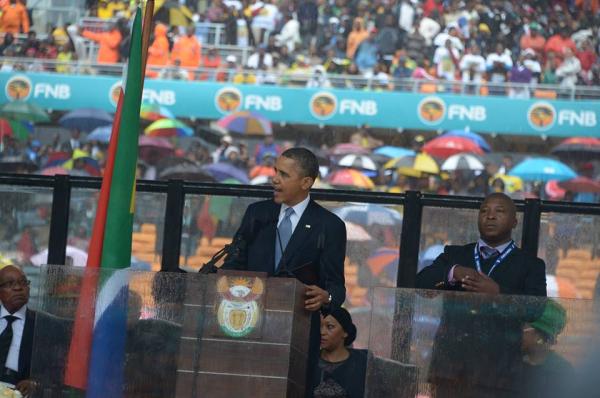
obam_393699617

In his speech at the Nelson Mandela memorial, Obama observed that there are many leaders who claim solidarity with Madiba’s struggle for freedom, but do not tolerate dissent from their own people.

“There are too many of us who happily embrace Madiba’s legacy of racial reconciliation, but passionately resist even modest reforms that would challenge chronic poverty and growing inequality,” he added.

Obama has, however, encouraged several leaders to come out and make their voices heard no matter the resistance that is generated from the leaders in power.

“There are too many of us who stand on the sidelines, comfortable in complacency or cynicism when our voices must be heard,” he added.

Obama visits Mandela’s cell at the infamous Robben Islands

He further appreciated Mandela for his several contributions to the world at large; “Mandela taught us the power of action, but also ideas; the importance of reason and arguments; the need to study not only those you agree with, but those who you don’t. He understood that ideas cannot be contained by prison walls, or extinguished by a sniper’s bullet”.

Below is Obama’s speech on Nelson Mandela memorial:

To Graça Machel and the Mandela family; to President Zuma and members of the government; to heads of state and government, past and present; distinguished guests – it is a singular honour to be with you today, to celebrate a life unlike any other.

To the people of South Africa – people of every race and walk of life – the world thanks you for sharing Nelson Mandela with us.

His struggle was your struggle. His triumph was your triumph. Your dignity and hope found expression in his life, and your freedom, your democracy is his cherished legacy.

It is hard to eulogise any man – to capture in words not just the facts and the dates that make a life, but the essential truth of a person – their private joys and sorrows; the quiet moments and unique qualities that illuminate someone’s soul.

How much harder to do so for a giant of history, who moved a nation toward justice, and in the process moved billions around the world.

Born during World War I, far from the corridors of power, a boy raised herding cattle and tutored by elders of his Thembu tribe – Madiba would emerge as the last great liberator of the 20th century.

Like Gandhi, he would lead a resistance movement – a movement that at its start held little prospect of success.

Like King, he would give potent voice to the claims of the oppressed, and the moral necessity of racial justice. He would endure a brutal imprisonment that began in the time of Kennedy and Khrushchev, and reached the final days of the Cold War.

Emerging from prison, without force of arms, he would – like Lincoln – hold his country together when it threatened to break apart.

Like America’s founding fathers, he would erect a constitutional order to preserve freedom for future generations – a commitment to democracy and rule of law ratified not only by his election, but by his willingness to step down from power.

Given the sweep of his life, and the adoration that he so rightly earned, it is tempting then to remember Nelson Mandela as an icon, smiling and serene, detached from the tawdry affairs of lesser men.

But Madiba himself strongly resisted such a lifeless portrait.

Instead, he insisted on sharing with us his doubts and fears; his miscalculations along with his victories. “I’m not a saint,” he said, “unless you think of a saint as a sinner who keeps on trying.”

It was precisely because he could admit to imperfection – because he could be so full of good humour, even mischief, despite the heavy burdens he carried – that we loved him so.

He was not a bust made of marble; he was a man of flesh and blood – a son and husband, a father and a friend.

That is why we learned so much from him; that is why we can learn from him still. For nothing he achieved was inevitable. In the arc of his life, we see a man who earned his place in history through struggle and shrewdness; persistence and faith.

He tells us what’s possible not just in the pages of dusty history books, but in our own lives as well. Mandela showed us the power of action; of taking risks on behalf of our ideals.

Perhaps Madiba was right that he inherited, “a proud rebelliousness, a stubborn sense of fairness” from his father.

Certainly he shared with millions of black and coloured South Africans the anger born of, “a thousand slights, a thousand indignities, a thousand unremembered moments…a desire to fight the system that imprisoned my people.”

But like other early giants of the ANC – the Sisulus and Tambos – Madiba disciplined his anger; and channelled his desire to fight into organisation, and platforms, and strategies for action, so men and women could stand-up for their god-given dignity.

Moreover, he accepted the consequences of his actions, knowing that standing up to powerful interests and injustice carries a price.

“I have fought against white domination and I have fought against black domination,” he said at his 1964 trial.

“I’ve cherished the ideal of a democratic and free society in which all persons live together in harmony and with equal opportunities.

It is an ideal which I hope to live for and to achieve. But if needs be, it is an ideal for which I am prepared to die.”

Mandela taught us the power of action, but also ideas; the importance of reason and arguments; the need to study not only those you agree with, but those who you don’t.

He understood that ideas cannot be contained by prison walls, or extinguished by a sniper’s bullet. He turned his trial into an indictment of apartheid because of his eloquence and passion, but also his training as an advocate.

He used decades in prison to sharpen his arguments, but also to spread his thirst for knowledge to others in the movement.

And he learned the language and customs of his oppressor so that one day he might better convey to them how their own freedom depended upon his.

Mandela demonstrated that action and ideas are not enough; no matter how right, they must be chiselled into laws and institutions. He was practical, testing his beliefs against the hard surface of circumstance and history.

On core principles he was unyielding, which is why he could rebuff offers of conditional release, reminding the Apartheid regime that, “prisoners cannot enter into contracts.”

But as he showed in painstaking negotiations to transfer power and draft new laws, he was not afraid to compromise for the sake of a larger goal.

And because he was not only a leader of a movement, but a skilful politician, the Constitution that emerged was worthy of this multiracial democracy; true to his vision of laws that protect minority as well as majority rights, and the precious freedoms of every South African.

Finally, Mandela understood the ties that bind the human spirit.

There is a word in South Africa- Ubuntu – that describes his greatest gift: his recognition that we are all bound together in ways that can be invisible to the eye; that there is a oneness to humanity; that we achieve ourselves by sharing ourselves with others, and caring for those around us.

We can never know how much of this was innate in him, or how much of was shaped and burnished in a dark, solitary cell.

But we remember the gestures, large and small – introducing his jailors as honoured guests at his inauguration; taking the pitch in a Springbok uniform; turning his family’s heartbreak into a call to confront HIV/AIDS – that revealed the depth of his empathy and understanding.

He not only embodied Ubuntu; he taught millions to find that truth within themselves.

It took a man like Madiba to free not just the prisoner, but the jailor as well; to show that you must trust others so that they may trust you; to teach that reconciliation is not a matter of ignoring a cruel past, but a means of confronting it with inclusion, generosity and truth.

He changed laws, but also hearts. For the people of South Africa, for those he inspired around the globe – Madiba’s passing is rightly a time of mourning, and a time to celebrate his heroic life.

But I believe it should also prompt in each of us a time for self-reflection. With honesty, regardless of our station or circumstance, we must ask: how well have I applied his lessons in my own life?

It is a question I ask myself – as a man and as a President. We know that like South Africa, the United States had to overcome centuries of racial subjugation.

As was true here, it took the sacrifice of countless people – known and unknown – to see the dawn of a new day. Michelle and I are the beneficiaries of that struggle.

But in America and South Africa, and countries around the globe, we cannot allow our progress to cloud the fact that our work is not done.

The struggles that follow the victory of formal equality and universal franchise may not be as filled with drama and moral clarity as those that came before, but they are no less important.

For around the world today, we still see children suffering from hunger, and disease; run-down schools, and few prospects for the future.

Around the world today, men and women are still imprisoned for their political beliefs; and are still persecuted for what they look like, or how they worship, or who they love.

We, too, must act on behalf of justice. We, too, must act on behalf of peace.

There are too many of us who happily embrace Madiba’s legacy of racial reconciliation, but passionately resist even modest reforms that would challenge chronic poverty and growing inequality.

There are too many leaders who claim solidarity with Madiba’s struggle for freedom, but do not tolerate dissent from their own people.

And there are too many of us who stand on the sidelines, comfortable in complacency or cynicism when our voices must be heard.

The questions we face today – how to promote equality and justice; to uphold freedom and human rights; to end conflict and sectarian war – do not have easy answers.

But there were no easy answers in front of that child in Qunu. Nelson Mandela reminds us that it always seems impossible until it is done. South Africa shows us that is true.

South Africa shows us we can change. We can choose to live in a world defined not by our differences, but by our common hopes.

We can choose a world defined not by conflict, but by peace and justice and opportunity.

We will never see the likes of Nelson Mandela again. But let me say to the young people of Africa, and young people around the world – you can make his life’s work your own.Over thirty years ago, while still a student, I learned of Mandela and the struggles in this land. It stirred something in me.

It woke me up to my responsibilities – to others, and to myself – and set me on an improbable journey that finds me here today.And while I will always fall short of Madiba’s example, he makes me want to be better. He speaks to what is best inside us.

After this great liberator is laid to rest; when we have returned to our cities and villages, and rejoined our daily routines, let us search then for his strength – for his largeness of spirit – somewhere inside ourselves.

And when the night grows dark, when injustice weighs heavy on our hearts, or our best laid plans seem beyond our reach – think of Madiba, and the words that brought him comfort within the four walls of a cell: It matters not how strait the gate, How charged with punishments the scroll, I am the master of my fate: I am the captain of my soul.

What a great soul it was. We will miss him deeply. May God bless the memory of Nelson Mandela. May God bless the people of South Africa.

– See more at: http://chimpreports.com/index.php/people/14847-obama-condemns-hypocrisy-disguised-as-reconciliation.html#sthash.jk8Es7GJ.dpuf
Urupfu rwa Habyarimana: Aho bukera imizinga iravamo imyibano

indege1-300x176

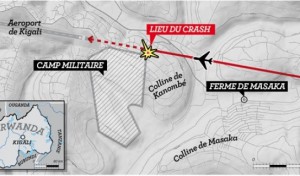
Nk’uko tubikesha ibinyamakuru bitandukanye, ngo iperereza ku mpamvu n’uwagize uruhare mu ihanurwa ry’indege yari itwaye aba perezida babiri b’abahutu ari bo Habyarimana Yuvenali w’u Rwanda na Ntaryamira Cyprien ryaba rigeze ku musozo. Iri perereza ryavuzweho amagambo menshi ndetse ubutegetsi bwa Kigali bunashinjwa mu guhanura iyo ndege  bwo bwakoresheje itangazamakuru mu gukwirakwiza inkuru ko indege yari itwaye abo bayobozi bombi hamwe n’abari babaherekeje yarashwe n’igisasu cyaturutse mu kigo cya gisirikare cya Kanombe. Ababikurikiranira hafi ntibigeze barangazwa n’izo nkuru, kuko kuba FPR iregwa muri urwo rubanza byumvikana ko ibyo itangaza bitakwizerwa.

Ku rundi ruhande ho Abanyarwanda muri rusange bahejejwe mu gihirahiro imyaka ikaba ibaye 20 batazi uko byagenze. Baba Abahutu bageretswe ho kwiyicira Generali Habyarimana ngo kugira ngo babone uko bica Abatutsi( bivuga ko Habyarimana ari we wababuzaga kwica), ari n’Abatutsi biciwe ababo bivuye ku ndege yahanuwe bakaba bakeneye kumenya uwatumye bahekurwa, habaye guceceka no gutegereza icyo iri perereza rizageraho.

Iri perereza ryafashe indi ntera mu gihe Nicolas Sarkozy yari Perezida w’Ubufaransa akaba yaranashatse ko u Rwanda rwegerana n’u Bufaransa mu rwego rwo kwiyunga. Ku bwa Sarkozy Madame Habyarimana yateshejwe umutwe cyane. Cyakora aho Sarkozy aviriye ku mwanya w’umukuru w’igihugu Abafaransa bamutereye icyizere kubera ibintu bibiri by’ingenzi yakoze akiri ku ntebe. Icya mbere ni uko Sarkozy yahanganye n’igisirikare cy’u Bufaransa akananirwa kubeshyuza ibikorwa bya Leta ya FPR yavugaga ko operation Turquoise yakoze ibyaha byibasiye inyoko muntu. Abasirikare bakomeye baramurakariye cyane ku buryo byamuviriyemo kudatorwa manda ya kabiri. Icya kabiri, Sarkozy mu gihe yakoraga campaign yakoze amanyanga akoresha amafaranga yahawe na Perezida Kadhaffi wa Libya, ndetse akabeshya umukecuru w’umuherwe witwa  Liliane Henriette Bettencourt na we akamuha amafranga yo kwiyamamaza. Ikibazo cy’uyu mukecuru cyaje kubyutsa byinshi bitari bizwi.

Uyu munsi rero ngo iperereza ryaba rigeze ku musozo ariko ababuranira Kigali bo baravuga ko ngo abo baburanira ari abere bityo ngo bakaba bagiye gutanga ikirego kuko babeshyewe.

Reka twibutse ko ikibazo cy’iyi ndege n’ubwo kitigeze gihabwa agaciro ariko gifite icyo gisobanuye ku mahano yagwiriye u Rwanda. Nta kuntu byakwemezwa ko indege yahanuwe ariyo mbarutso yateye genocide ugahana abakoze genocide nyamara ukirengagiza uwatumye itangira.

Fiat Justitia ruat caelum ( nihabeho ubutabera ijuru nirishaka rigwe).

Reka tubitegerezanye ubwitonzi, uko byagenda kose ikinyoma kiza muri ascenseur kikahagera vuba nyamara ukuri ko kuza na escaliers ariko kukahagera kukiri ukuri.


Abacamanza b’abafaransa barangije amaperereza ku ihanurwa ry’indege ya Perezida Habyalimana

Thousands of Kenyans gather for rally, day after attacks

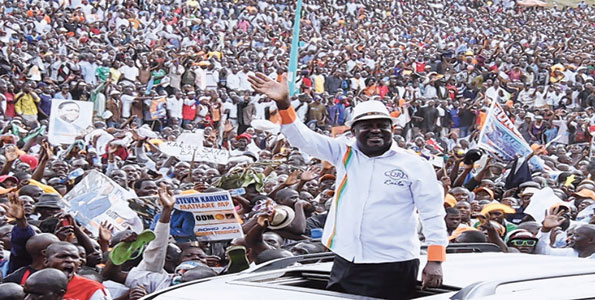
Odinga

Thousands of Kenyans rallied yesterday for an anti-government demonstration in the capital’s central park amid heavy police presence, with political and ethnic tensions high following weekend attacks in which over 21 were killed. PHOTO | NMG 

Nairobi, Monday. Thousands of Kenyans rallied today for an anti-government demonstration in the capital’s central park amid heavy police presence, with political and ethnic tensions high following weekend attacks in which over 21 were killed.

Opposition leader and former prime minister Raila Odinga has organised the rally to address what he says are major government failures, including worsening crime and insecurity, rising living costs, impunity, corruption and allegations of ethnic favouritism in government appointments.

Police were searching and screening supporters as they entered Nairobi’s Uhuru park, or “Freedom” in Swahili, an AFP reporter said.

The rally, the culmination of a series of countrywide demonstrations, is held on the July 7 anniversary of protests for multi-party democracy in the 1990s, a date heavy with symbolism and known commonly as “Saba-Saba” , or “Seven-Seven” in Swahili.

Police say they have deployed 15,000 officers to ensure the rally passes off peacefully, with the country already on high alert fearing attacks by Somalia’s Al-Qaeda-linked Al-Shabaab gunmen, who have vowed revenge for Kenya’s military presence in Somalia.

The Al-Shabaab claimed twin attacks in Kenya’s coastal region on Saturday night in which at least 21 were killed, the latest in a series of killings, although police blamed the Mombasa Republican Council (MRC), a group that campaigns for independence of the coastal region.

The Al-Shabaab also claimed responsibility for attacks last month at Mpeketoni. Survivors reported how gunmen speaking Somali and carrying Al-Shabaab flags killed non-Muslims.

Kenyan President Uhuru Kenyatta, however, denied that the Al-Shabaab were involved and instead blamed “local political networks” and criminal gangs, saying victims had been singled out because of their ethnicity. (AFP)

Source: http://www.thecitizen.co.tz/News/Thousands-of-Kenyans-gather-for-rally–day-after-attacks/-/1840340/2376062/-/u8v8c0z/-/index.html

“Iby’umugabo witwa Evode Uwizeyimana byanteye kwibaza byinshi” Jeanne Mukamurenzi

292048_2117624013238_7450344_n me-evode-uwizeyimana-arasaba-imbabazi-abababajwe-n-ibyo-yavugiraga-kuri-bbc_530a475b52543


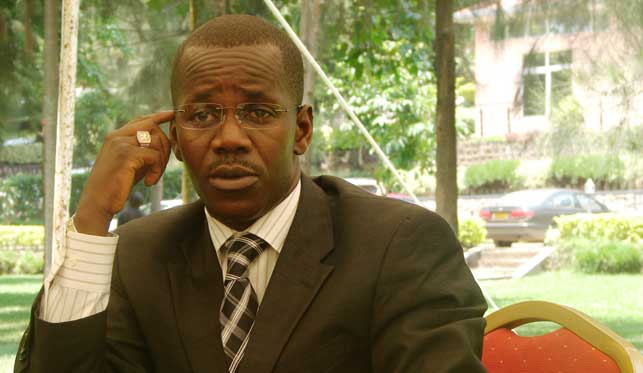
Mlle Jeanne Mukamurenzi (ifoto ibanza) na Me Evode Uwizeyimana (ifoto ikurikiraho).

FPR yakoze amahano menshi, irica,irasahura irafunga, ihindagura amateka yu Rwanda reka si nakubwira.Ifata umunsi w’ubwigenge iwugira zero,iwuhindura umunsi wo kwita ingagi amazina. Yafashe abantu iboza mu mutwe irabunyuguza reka sinakubwira, abiyitaga ko baminuje, yarabafashe ibamesa mu bwonko irangije ikoresha icyo bita (bleaching chemicals) mu cyongeleza.iyi bleaching chemicals ituma imyenda ihindura ibara.Dore ni ibi FPR isigaye ikoresha mu koza ubwonko bwa barya biyita abanyabwenge. Kera baravugaga ngo umugabo ahindukira mu buriri ariko ntahindukira mu magambo. Kuri FPR, si ko biri, abiyemeje gukorera FPR, nta n’umwe ugihindukira mu buriri,ahubwo babaye ba kabuhariwe mu guhindukira mu magambo kugira ngo bakunde baramuke.Imana izandinde umugabo uzanananirwa kwihindukiza mu buriri ahubwo akihindukiza mu magambo.

Gusa Imana tugira ni uko mwene abo bagabo ari bake cyane, bivuga ko chance z’uko nzagwa ku mugabo nk’uwo ari nkeya cyaneeeee. Iby’umugabo witwa Evode Uwizeyimana,byanteye kwibaza byinshi. Ariko rero ntabwo natangazwa n’ibya FPR birasanzwe. Gusa,umuntu asubije amaso inyuma akareba amagambo iriya njajwa y’umuhutu yirirwaga avugira kuri BBC, atuka leta ya FPR ko ari agatsiko k’amabandi n’ibindi byinshi ntakwirirwa ndondora hano,agahindukira akaba umuvugizi w’iyo leta y’amabandi kandi agakoresha BBC yabivugiragaho, niko se badi,iyo leta yaba yarahindutse?

Ariko ibigoryi biragiwra koko, Evode rwose reka kwiha urw’amenyo,nawe ubwawe ibyo urimo ntabwo ubizi gusa you are too excited for nothing. Urajya ku ma radio reka sinakubwira ,ugafata opposition ukayigira zero,abakurungurutse ubugoryi bwawe bakaguha amashyi nawe aho wicaye reka sinakubwira ugashyekerwa!! Cisha make wangu, bucya bwitwa ejo. Ayo mashuri wize abandi batize ni ayahe? ukagera n’aho uvuga ngo aba avocats b’aho bize amashuri ya saa munani??? Wa mugabo we wacishije make ukareka kwirata no kwiyemera! Yewe, aho ndakugarukiye ariko.Yes, aba avocats bari aho mu Rwanda bize aya saa munani,bakabaye batarayize, nta buryo leta yari kwemera guhamagara umuntu w’injajwa nkawe wirirwaga utuka iyo leta ku ma Radio mpuzamahanga, iyo leta watukaga ikarenga ikaguhamagara ngo uyibere umuvugizi mu mategeko! aAho nemeranyijwe nawe Evode, wakoze kubahindura zero, nzi neza ko nabo baguhaye ako kazi ejo uzaba wabahinduye ibishwi bifite mu mutwe harimo Mayonaise,iyo umaze kuba excited rwose uvuga n’akari i Murori ntuhisha uvuga uvuye inyuma. Nari ngiye kukwita Umutaripfana, ariko ntabwo ubikwiye kuko mu bwonko bwawe hara curamye ejo utazavangira abataripfana orginal. Ndabona urimo wihuta cyane,ese uwo muvuduko urikugendaraho niwo bagutegetse kugenderaho? kuri bwangize byinshi? Donc, aho wagombaga kugendera muri 20, uri kuhagendera muri 90!!!??.urakora accident, sigaho.

Wihinduye urw’amenyo, nawe ubwawe ibintu urimo uvuga ntubizi. Gusa ujye ucisha make,don,t be too excited,there is nothing to be excited about, ejo uzaba wabaye ikigarasha kibi cyane, simbikwifurije ariko ni yo nzira. Ingero ni nyinshi nta mwanya wanjye nakwirirwa nta nzitanga, posterity will judge you,and it will judge you hashly. Ubutaha nibongera kugutuma kuvugira kuri BBC, ngusabye kutazongera gushinyagurira iriya Ntwari, Madame,Victoire Ingabire Umuhoza, kuvuga ngo amashyaka yanga kwandikwa n iuko aba atujuje ibisabwa harimo n’abayoboke, urashaka kuvuga ko Victoire yahagurutse akava mu Buholandi ibyo byangombwa byose yasabagwaga bituzuye? Nta soni ugira, ejo bundi wakoresheje press conference,uragenda utuka amashyaka ya opposotion uyihanagurizaho, nta n’umwe wagusubije, kuba bataragusubije si uko ibyo wavuze bitababaje cyangwa ngo bagire uburenganzira bwo kugusubiza,bagufashe nk’umusazi bahitamo kukwihorera, ariko ndabona washyekewe cyane aho ujya gushinyagurira uwo mubyeyi wafunzwe n’iyo leta iyobowe n’agatsiko k’amabandi nawe urimo ukorera,birababaje cyane. Sigaho.

Wavuze ko waje kuvugurura amategeko ngo ataboneye muzayatera umugeri, nuko nuko di. Ndagira ngo nkwibutse ko mandat y’ako gatsiko k’amabandi kayoboye u Rwanda izarangira muri 2017,ni yo manda ya ko ya nyuma nk’uko itegeko nshinga ribyemeza. Ejo utazaba excited ugatera umugeri  ibyo itegeko nshinga rivuga kuri iyo manda, dore ko iyo migeri yawe imeze nabi! Mu byo ugomba gutera imigeri, nyamuneka witonde aho ntukahakoze umugeri. 2017 MANDA YA NYUMA Y’AGATSIKO K’AMABANDI KAYOBOYE URWANDA IZABA IRANGIYE! Evode, mbikwandiye mu nyuguti nkuru kugira ngo ejo utazabyibagirwa ugatera umugeri itegeko nshinga ribyemeza, dore ko buriya ari na cyo wahamagariwe kuko ubanza muri abo bose bize aya saa munani nta n’umwe washobora gutera umugeri itegeko nshinga, ayiga Mana! 2017 izasiga byinshi bisobanutse!

Evode rero nakubwira iki, kaza imigeri wowe wize aya mugitondo, wiga ayo abandi baraho mu gihugu batigeze biga, ariko wabantukiye rwose, babwire di,n iuko batumva. Ni uko ye!!, ujye ubabwira rwose.
Very sad to see people like Evode being turned into a usefu idiot,very sad indeed! Ariko ngo uwigize agatebo ayora ivu!!

Umutaripfana
Jeanne Mukamurenzi

Africa urged to shun wholesale imports of Western democracy models

By Costantine Sebastian ,The Citizen Reporter

 Dar es Salaam. Africa’s attempts to ape democracy models, mostly from the West, have been the major causes of governance pitfalls, economic failures, democratic chaos and overall growth nightmares that continue to haunt the continent, according to development strategists and activists.

They want Africans and their leaders to quickly shun the trend that has led to failed states and stuck most people in the quagmire of abject poverty. The strategists and activists warn that without changing the status quo, the future and prosperity of Africa will always remain compromised.

Speaking at the 2nd International Conference on Democratic Governance in Africa, Asia and the Middle East, held in Kigali early this week, participants called for a new internal development order. Many wondered why most African countries were still so poor, unashamed of their status as economic beggars and recipients of development aid when the continent was blessed with abundant resources.

“The time for change is now,” noted Dr John Samuel, President of the Institute for Sustainable Development and Governance in India. “Our countries should immediately adopt democratic models that suit their circumstances and address their individual needs.”

They suggested that the models that can propel the poor nations to prosperity are those which take into account the culture and historical background of the people.

The scholars, practitioners, decision makers and other development stakeholders at the three-day conference emphasized the need for home grown initiatives on problems affecting the developing world.

Under the theme, “Accountability and Youth Engagement for Sustainable Development,” they maintained that unity was a must especially among African countries if they are to have a voice on world matters.

“Direct implementation of models imposed or suggested by Western powers will never bring real change and make a significant difference in our lives,” Gabonese journalist Yves Laurent Goma told The Citizen on Sunday on the sidelines of the summit meeting held as part of Rwanda’s Commemoration of 20 Years of Liberation.

Organised by the Rwanda Governance Board (RGB), the UN and Cheyney University of the United States, the conference sought among other things to explore constraints to good governance. It also explored emerging opportunities of democratic governance and has been one of the highlights of events to mark 20 Years of Rwanda’s Liberation that climaxed on Friday.

The conference is a biannual event which was first held in Philadelphia, US in 2012.

“With 54 countries, Africa can have a voice but the problem is African countries are so easily manipulated and divided,” said Dr Jendayi Fraser, the former US under Secretary of State for Africa Affairs.

Emphasis was also put on the need for increased cooperation over competition among African countries. Dr Sumbye Kapena from the School of Business at the Copperbelt University of Zambia noted that “Africa can have one voice if we all stop competing and put our voices together.”

Some participants said African leaders too, have a hand in the continent’s woes, with a Tanzanian delegate suggesting that good leadership was most important for the future of Africa, but that this was currently wanting in many of these countries.

He described the current generation of leaders as mostly a total failure and let-down. He called on the old leaders still in power to exit the political arena and let a new breed of leaders take charge.

“Consider our case (Tanzania)…we shouldn’t be poor with all the natural resources and human capital around,” he pleaded anonymity lest his views hurt some people in high places.

“We have been mostly let down by poor leadership and bad policies…full stop. Just look at Rwanda and you will see what I mean,” he added noting that discipline and seriousness at all levels was lacking in his country.

Meanwhile, Mr Bulent Akarcali, a Turkish entrepreneur and a panellist at the conference, criticised Western donors for imposing policies on developing nations, arguing that directly copying democratic models from the West tended to disrupt governance and undermined prospects for long-term development.

“Countries in sub-Saharan Africa and Asia were targeted by Western powers because of their wealth in natural resources. All that the big powers want is to disrupt governance and get what they want, so they forced developing nations to implement systems of democracy that undermine the history and cultures of people,” Akarcali said.

“Real democracy must not be complicated and must put into context the cultural systems of countries. Europe and America are not a monopoly of democracy and they should not dictate models to Africa and Asia.”

Rwanda Management Institute Director-General Wellars Gasamagera echoed the views of Akarcali saying “there is no rule book for governance” and that every country is involved in a unique process based on its own internal challenges.

“Citizen participation is the key at all stages of democracy, yet levels of participation vary according to contexts and situations,” Gasamagera said.

Rwandan Local Government Minister James Musoni urged that all countries still on the path of development should seek home-grown initiatives in order to bring about meaningful transformation to their societies.

“It is generally accepted that ‘democratic governance’ comes as a pre-requisite to the broad socio-economic development of society. However, in order to translate a principle into tangible results, … strong political will for good, inclusive and accountable governance stemming from the very top, is key in the establishment of effective and citizen-responsive institutions,” he said.


Manzi Jean Baptiste abona icyo résolution ya ONU yita “génocide au Rwanda”, gitandukanye na “génocide” uko abanyamategeko bayisobanura mu mategeko mpuzamahanga

Mwirirwe, mwaramutse.

Nakurikiye ibiganiro bimwe na bimwe byerekeye inyito génocide ku byabaye mu Rwanda, n’urukiko rwa Arusha.
Ibyo uyu Pr Ch. Kambanda avuga hari icyo adasobanura neza.
Résolution ya ONU: S/RES/955 (1994) – 08 novembre 1994 – RÉSOLUTION 955 (1994) ariyo ishyiraho TPIR (Arusha), itanga ibisobanuro bihagije kuri iki kibazo cy’inyito Génocide mu Rwanda.

Muri les points “considérant”, résolution ivuga actes de génocide. Plus loin muri statut ya TPIR, résolution yerekana ibyo résolution yita génocide (art 2, al.1) itandukanya na actes de génocide (art 2, al. 3). Ubyitegereje neza usanga izo nyito Génocide na actes de génocide” bitagaruka kuri le caractère planifié du génocide ou des actes de génocides. Ni ukuvuga ngo, icyo résolution ya ONU yita génocide au Rwanda, gitandukanye na génocide uko abanyamategeko bayisobanura mu mategeko mpuzamahanga.

“Au niveau national, un Etat peut décider de juger d’un génocide au regard de son droit propre. Mais c’est aussi la compétence de tribunaux supra-étatiques, qui, en prenant le génocide comme chef d’inculpation, entérinent de facto sa reconnaissance“.

Aha ni ukuvuga ko u Rwanda “régime FPR”, ariyo yasabye ko ibyabaye i Rwanda byitwa génocide isaba ONU gushyiraho urukiko. Ibyo biri muri préambule ya résolution: « Décide par la présente résolution, comme suite à la demande qu’il a reçue du Gouvernement rwandais (S/1994/1115), de créer un tribunal international chargé uniquement de juger les personnes présumées responsables d’actes de génocide ou d’autres violations graves du droit international humanitaire commis sur le territoire du Rwanda et les citoyens rwandais présumés responsables de tels actes ou violations commis sur le territoire d’États voisins (…)»

Noneho rero ibyo Pr Karoli Kambanda adasobanura neza ni icyo kintu cy’uko ari abategetsi b’u Rwanda, ari ONU, babihaye inyito génocide. Biba bibaye reconnaissance de fait de ce génocide sans donner la possibilité au tribunal de qualifier ces actes.

En fait le procureur charge et ne demande pas à prouver. Ni ukuvuga rero ko iyo tribunal TPIR yashyizweho non pas pour examiner niba génocide yarabayeho et juger les responsables. Ahubwo le tribunal est justifié par la reconnaissance de fait du génocide avec une définition propre. kubishyira en doute byari ukuba ari “scier la branche sur laquelle tu es assis”. Ari byo certains avocats camerounais guidés par l’appât du gain et non pas du droit, batsindagira ko examiner le caractère planifié nta kamaro.

Débat ni aho yagombye gusobanura, no kwerekana ko “umwana yapfuye mu iterura”.
Aliko nk’uko benshi babivuze, ikibazo si aho kiri. Kuko la volonté politique yari ifite indi ntera n’ibyo igamije avec la complicité y’abari bafite inyungu muri ibyo byose. Ni ukuvuga ngo rero le débat sur ce thème, yagombye no guha uruhare runini icyo kintu cyo kugaruka ku nyito génocide, impamvu byagenze gutyo.

Ingero ni nyinshi:
I La Haye, izo préalables zo gushaka kubanza gukora définition “qualifier, les crimes commis dans l’ex-Yougoslavie” zabayeho. Kuki mu Rwanda bitabaye ?
None se niba abategetsi b’u Rwanda aribo basabye ishyirwaho ry’urukiko, bakaruha inyito y’ibyo izaburanisha, murumva ikibazo atari aho kiri ?
Pr Kambanda rero n’abandi bakora ibiganiro mpaka, bagombye kugaruka kuri iki kintu cy’uko inyito yatanzwe atariyo. Ni ukuvuga ngo urebye génocide yerekeye abayahudi (les juifs), habaye définition ya génocide ari naho tribunal de Nuremberg yakoze definition ya génocide au sens de ces crimes. . iyo nyito niyo yashyizwe mur mategeko mpuzamahanga.
Mu Rwanda rero, ntago iyo nyito ari yo bafashe. ONU n’u Rwanda bakoze indi nyito nshya, surtout itandukanye na génocide au sens de la shoah. Ni aho rero abenshi batavuga rumwe, kuko “le caractère planification”, qui implique kwerekana abakoze planification, les exécutants etc.. bayikuyemo bazi neza ibyo bakora.
Nyabuna mwongere musome résolution, murasanga ikibazo cyo kwibaza no kuganiraho ahubwo ni ukumenya impamvu définition ya génocide muri Rwanda itandukanye n’inyito mpuzamahanga isanzwe. Igisubizo cyo kiragaragara, ni intention ya FPR n’abo bari batafanije icyo gihe. Ni ukuvuga rero ko “la reconnaissance de fait du génocide au Rwanda”, bakanayiha une definition propre, ibintu byari bifite icyo bigamije. Kandi ibigaragara ni uko imanza za Arusha, igihe les avocats bagarutse kuri iki kibazo, aucun prévenu, je dis bien aucun n’a été reconnu coupable du chef d’accusation de planification du génocide au Rwanda. Kandi nibyo ni uko ntabyabaye. Akaba ari yo mpamvu abanyamategeko mpuzamahanga basanga ibyabaye mu Rwanda atari génocide kuko habuzemo élément fondamental, «le caractère fondamental; planification en vue d’exterminer un groupe”. Or, nongere mbigarukeho, muri résolution ya TPIR, art 2, al 2. iravuga ngo “Le génocide s’entend de l’un quelconque des actes ci-après, commis dans l’intention de détruire, en tout ou en partie, un groupe national, ethnique, racial ou religieux, comme tel”. Aha murabona neza ko, bashyira accent kuri intention de détruire. Ni ukuvuga ngo bahunga la planification.
Abatutsi barisha génocide ni ibi basubiramo. Ni ukuvuga ngo abo bavuga ko abahutu bishe abatutsi avec l’intention de les exterminer. Niyo definition bagenderaho kandi les idéologues bari inyuma y’iyi résolution barabizi.

Ngaho abazi amategeko munyereke aho wahera uhakana génocide au Rwanda, je dis bien dans l’esprit de cette résolution, et non pas selon la définition qui relève du droit international public.

Ntabwo rero ma contribution ari uguhakana cg kwemera génocide ku byabaye mu Rwanda, ni ugutanga umuganda mu buryo bwo gusobanura un aspect ntumvise mu biganiro mpaka byabaye kuri iyi radio. Ubwo nzakomeza gukurikira numve ibyo biganiro.
Mukomere kandi mukomeze kugira ibiganiro byiza.

Manzi JB.


General Nyamvumba avuga rumwe na opposition y’u Rwanda

arton53423-08000


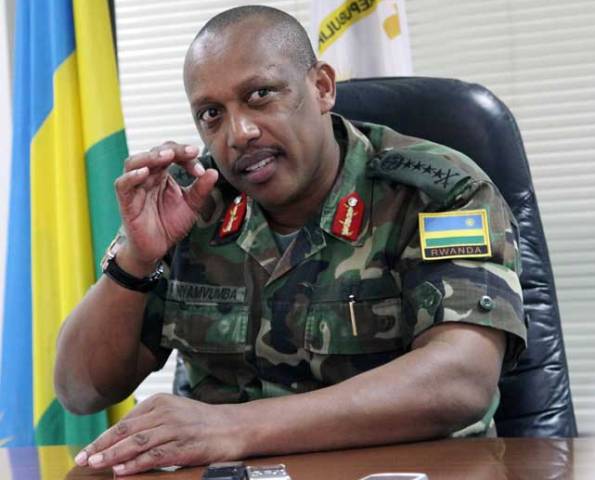
Gen Patrick Nyamvumba

Mu kiganiro umugaba w’ingabo z’u Rwanda General Patrick Nyamvumba yagiranye n’ikinyamakuru igihe.com (http://www.igihe.com/interviews/ )  yagaragaje ko avuga rumwe na opposition y’u Rwanda. Bimwe mu byo opposition isaba FPR gukosora cyangwa ikava mu nzira abandi bakabikora, harimo kubaka igihugu buri wese yibonamo. Mu gihe abenshi mu bavugizi b’agatsiko bakunze kuvuga ko nta kibazo gihari, general Nyamvumba we yagize ati: “ ugiye kubireba phase [igihe] y’intambara yararangiye ariko hasigaye kugira u Rwanda rw’Abanyarwanda, abantu bose bibonamo.” Nyamvumba rwose na we azi ko u Rwanda rwamunzwe n’ivangura kugeza havangurwa abapfuye, ivangura mu mfungwa n’imfubyi, n’ibindi bituma hatabaho igihugu Abanyarwanda bose bibonamo. Ikimenyetso gifatika kigaragara mu ngabo Nyamvumba abereye umugaba aho usanga abayobozi bose ari abo mu bwoko bw’abatutsi.

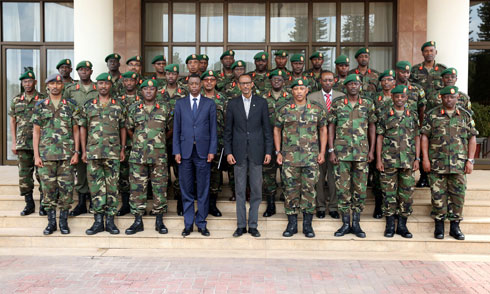
kagame-na-RDF-3-2

Kuva ku bayobozi b’ama brigades kugera ku ma sections, haba ministre n’aba chefs ba za directions za Etat Major bose ni Abatutsi. Ni byo koko Abanyarwanda bose ntibibona muri izi ngabo.

Avuga ku kibazo kijyana n’umutekano , Nyamvumba aragira ati “nkanjye ushinzwe ingabo nakwibanda ku kibazo cy’umutekano kuko ariwo musingi, tukareba ko igihugu n’abagituye bafite umutekano dufatanyije n’izindi nzego z’umutekano n’abasivili, sinavuga ko twabigezeho,…”

N’ubwo FPR ihora ihinduranya imvugo hari ikindi kimwe idashobora kubeshya ngo cyemerwe: kumva ko byose yabigeraho iheza abandi banyarwanda bashaka gutanga umusanzu wabo banyujije mu mashyaka ya politiki. Ntibizashoboka ahubwo Kagame ashatse yakwibuka wa mugani ugira uti “uwo uzaheka ntumwisha urume” maze hakabaho ibiganiro bizatuma twubaka igihugu twese twibonamo.

Ubwanditsi


The new wind of African independence

On July 1st, three African countries, namely Rwanda, Burundi and Somalia, gained their political independence. Anniversaries make us reflect on past events. More than half of a century since the 60s, it does not appear difficult to realize that a number of things did not work out as expected for these countries. Unfortunately the picture is almost the same across the continent. It’s a fact that the majority of African countries got their independence around that period.

What is Pan-Africanism? It has been a movement against imperialism in all its forms and for the liberation of Black Africans from the evils of Black enslavement, colonialism, and from the racism these produced.

Some years back, after analyzing the early period prior to African independence, I found that many years passed since the Manchester Conference of 1945 held by the pan African movement had some impact. It took some good years to the Nkrumah, Kenyatta and others alike who those days were prying for changes then necessary in Africa to make a breakthrough. It took particularly to Ghana twelve years. Others demanded even more time.

History books or elders don’t miss any opportunity to tell how the forefathers of African independence fought both internal and external oppressions of the masses. It was not easy at all. It was even harder to sustain whatever gain had been achieved.

The oppressors tried to hijack the outcomes of years of sacrifices. They often succeeded to regain the lost ground. They changed strategies to impose themselves and continue their exploitation. As in the previous periods, they counted on unscrupulous and selfish African leaders ready to sell out interests of their people. It took decades to the victims of yesterday to realize their mistakes.

As in old times, it was going to be around a limited number of enlightened sons and daughters of Africa that the continent’s destiny would depend on. They understood the issues involved, particularly the double speak and hypocrisy of the corrupt leaders always plotting their indefinite stay in power they had stolen from the people.

The new generation of enlightened true sons and daughters of Africa could deconstruct the plans of the internal masses’ enemy and external forces. They had learned the hard way, being themselves victims of the forces they were ready to stand against. They had role models among the forefathers. They had seen how their elders, namely Sankara, Kaddafi or Mugabe had been crashed down or weakened by the imperialist forces.

The 21st century had however brought a seemingly renewal even among the usually complacent and African elite in governments that serves the West. These were talking of Renaissance. But it was a mere caricature of what was needed to fundamentally change the oppressive and sometime tragic situation of African masses.

It was under that period that the continent experienced the most of its deadly tragedies in many parts of its regions: from Sierra Leone, Ivory Coast to Somalia passing through Rwanda, Burundi and the Democratic Republic of Congo. As a paradox, it was at the same period that the continent is portrayed as the future of humanity because of its immense resources. And the multiple wars fought on its land being seen as a necessity for the salvation of some global powers in declining influence.

2011 saw the northern African youth claiming more of its share of dignity from the corrupt elite in office. As time passed, there were again severe disappointments. They realized they had been used and betrayed. The experience added to the fact that the awakening of the necessary minority in the forefront is there. Strategizing is the key, but at the same time avoiding mistakes committed by those who came before them.

The new wind of African independence hangs on the shoulders of that enlightened minority of individuals on the continent and in the Diaspora, finding each other, developing synergies, protecting each others’ back, and coming together for action, not necessarily as one, but moving in the same direction. All these will be the ingredients of their success.

There are battles against imperialist forces that are being won in South America. It took these countries years of educating masses and organizing. They are getting there. The same way the forefathers of African independence learnt from their participation to western fronts against Hitler fascism, the new generation of aspirant African political leadership must get involved in the Latin American wars against global imperialism led by US, Canada, UK, EU and their multinationals. At the end, everything comes down to economy or war of resources. Those who can control them can impose their views onto the rest.

In the past, we were colonized and enslaved. Our stolen labour built empires in the North. Today, with every step we take for our liberation, the empires grow decadent and begin to crumble. However, our liberation is not only the emancipation of the peoples of the South. Our liberation is also for the whole of humanity. We are not fighting to dominate anyone. We are fighting to ensure that no one becomes dominated,” Evo Morales, President of Bolivia. http://climateandcapitalism.com/2014/06/20/evo-morales-liberation-whole-humanity/

Source: http://therisingcontinent.wordpress.com/2014/07/02/the-new-wind-of-african-independence/#more-5845