Category Archives: Human rights

La violence n’est jamais une réponse – Caritas internationalis sur la crise au Moyen-Orient

ci

De l’Irak à la Syrie et à la Bande de Gaza : la solution des conflits doit passer par le « dialogue », ou quoi qu’il en soit par « une autre voie » par rapport à « une violence supplémentaire ». C’est ce qu’a dit le cardinal archevêque de Tegucigalpa, Óscar Andrés Rodríguez Maradiaga, président de Caritas Internationalis, en ouvrant hier, lundi 15, à Rome, la rencontre de haut niveau dédiée à la crise au Moyen-Orient avec les présidents et les directeurs de la Caritas des pays impliqués et leurs partenaires internationaux.

Dans la conscience « d’être face à la plus grande crise que le monde affronte depuis la Seconde Guerre mondiale », le cardinal a invité tous les gouvernements « à la cessation totale des envois d’armes dans les pays du Moyen-Orient », en réaffirmant que « la paix ne peut pas être imposée de l’extérieur, mais doit naître de l’intérieur » sur la base de la « justice sociale entre les personnes ».

La situation dramatique de la population est au centre des travaux, qui se concluent mercredi 17, avec l’objectif, comme l’a expliqué Michel Roy, secrétaire général de Caritas Internationalis, de «réfléchir ensemble sur quelle peut être la meilleure réponse, dans les prochains mois et années, à la tragédie qui frappe le Moyen-Orient, et sur comment on peut collaborer avec d’autres organisations de l’Eglise catholique ou en dehors d’elle pour promouvoir la paix et la stabilité dans la région ».

Actuellement, a rappelé le cardinal, « à chaque minute, quatre enfants syriens sont forcés d’abandonner leurs maisons. Les extrémistes en Irak et dans l’ouest de la Syrie sont en train d’étendre le nettoyage ethnique et religieux à une vaste zone sous leur contrôle. A Gaza, un demi-million d’enfants ne peuvent pas retourner à l’école parce que leurs classes ont été détruites. A Mossoul en Irak, la lettre N qui signifie Nazaréen, a été peinte sur les portes des maisons pour identifier les chrétiens puis les passer à tabac ou les tuer ». Environ 1,3 million d’Irakiens ont dû abandonner leurs maisons, les opérateurs de la Caritas eux-mêmes ont dû fuir. Et depuis le début de la crise en Syrie, plus de 13 millions de Syriens sont dans des conditions désespérées et 3 millions se sont réfugiés hors du pays, en Jordanie, au Liban, en Turquie.

Source: http://www.news.va/fr/news/la-violence-nest-jamais-une-reponse-caritas-intern

Coup d’Etat 1973 : Abishyize hamwe ntakibananira. “Nta ngoma yarusha ubugome iya Kagame na FPR ye”

Par:Jean de Dieu Musemakweli

imiramboNta ngoma yarusha ubugome n’urugomo iya FPR na Kagame .

UMWANZURO

Ingoma ya Habyarimana (1973-1994) yatangiye imena amaraso y’abanyapolitiki bari baradukijije ingoma ya cyami na gihake. Bikwiye kugawa n’abashyira mu gaciro bose. Ingoma ya Habyarimana kandi yarangirije mu mivu y’amaraso menshi kurushaho. Kuvuga ko ingoma ya Habyarimana yarangirije mu mivu y’amaraso bisobanura ko ingoma ya Kagame (1994-?) yatangiriye muri iyo mivu y’amaraso nyine. Kuva mu w’1994 kugeza ubu, ayo maraso akomeje kumeneka. Ibimenyetso 2 bya nyuma biherutse kubyerekana ku mugaragaro (publiquement) kandi ku buryo budasubirwaho ni uko ngo “abantu ibihumbi 40 bakoraga imirimo nsimburagifungo baburiwe irengero”. Ikindi kimenyetso ni imirambo 40 abantu babonye ireremba mu kiyaga cya Rweru.

Iyo ingoma igiyeho imena amaraso, igumaho imena andi, ikazavaho nanone mu mivu y’andi menshi kurushaho. Twakora iki, Banyarwanda, Banyarwandakazi ngo dukumire ayo mahano, kugirango ingoma ya Kagame na FPR IVEHO itagombye kwisasira izindi nzirakarengane zitagira ingano?

Kuba abatsikamiwe n’ingoma ya Kagame na FPR bakomoka mu turere no mu moko anyuranye bisa n’aho ari kimwe mu bibabuza gushyira ingufu zabo hamwe ngo bayikize. Nyamara ni nacyo cyakagombye kubatera imbaraga !

Muri uru ruhererekane rw’inyandiko twise “Abishyize hamwe ntakibananira” twibanze ku iyicwa rubozo ry’abategetsi bo kuri repubulika ya mbere (1962-1971). Nabyo bikwiye kuvugwa, ni ukuri kw’amateka yacu mabi.  Bikwiye kwaturwa bikavugwa bityo abakora icyunamo bakagikora mu mutuzo, abibuka ababo bakabikora ntawe ubannyega. Ni uburenganzira bwabo. Twese twiboneye ukuntu iryo yicwa rubozo ryajyanye na Coup d’Etat yo mu 1973 ryabyaye ikintu kimeze nk’inzigo gituma Abahutu bo mu majyepfo y’u Rwanda (Abanyanduga) n’abo mu majyaruguru (Abakiga) bakomeje kurebana ay’ingwe. N’iyo batari gusubiranamo ku mugaragaro, nta cyo bakora ngo bahuze ingufu zabo birwaneho, bagamije kwikiza ingoma y’Inkotanyi ibarembeje. Nibakomeza guheranwa n’inzigo ishingiye ku byabaye mu 1973, ntibagerageze kubirenga, ngo bagire ikindi kizima bubaka, Kagame azabamarira ku icumu urusorongo nk’ubushwiriri.

Kora ndebe iruta vuga numve”.

Abayobozi b’amashyaka n’abafasha babo (les cadres) baramutse batanze urugero rwiza, abayoboke b’ayo mashyaka, ndetse n’abandi Banyarwanda benshi bakurikiza urwo rugero. Kugirango abayobozi b’amashyaka n’abafasha babo babashe kurenga iyo nzitizi, bagomba kwiyibutsa no kwicengezamo ihame rigira riti “Icyaha ni gatozi”. Niba umuntu Kanaka yarishe, ntabwo ari umwana, umwuzukuru, umuturanyi we cyangwa ukomoka muri ako karere wese wabikoze. Abakomoka ku bishe no ku biciwe, abakomoka mu turere tunyuranye kabone n’ubwo twaba dufite ibyo dupfa, bashobora kuba intwari, bagakorana. None se muri politiki kwigomwa (sacrifice) si ikintu ngombwa ? Ntibyoroshye, ariko birashoboka. Ubishoboye aba yerekanye ko yashobora n’ibindi bikomeye kurushaho agamije ineza y’u Rwanda rwamubyaye. Uwo muntu n’abandi bamugirira icyizere.

Abishyize hamwe ntakibananira”.

Kimwe mu biranga umuyeshuri w’umuswa ni uko atamenya no gukopera. Naho uw’umuhanga aba azi n’aho yajya gukopera bibaye ngombwa. Dufate urugero rw’igihugu cy’igihangange cyitwa ko cyakataje no muri demokarasi ari cyo Leta zunze ubumwe z’Amerika. Kirimo amashyaka manini ya politiki 2 gusa : Abademokarate (démocrates) n’Abarepubulike (républicains). Ariko burya buri shyaka riba ririmo ibice nibura 3 : Abatavangiye (démocrates de gauche et républicains de droite -Tea Party-), abo hagati (centre) n’aboroshya bashobora no kugendera ku cyiza babonye mu ishyaka rihanganye n’iryabo. Buri gice kiba gifite leta cyiganjemo. Kugirango ishyaka ritsinde muri rusange (niveau fédéral), biba ngombwa ko buri gice cyigarurira amajwi y’aho cyiganje. Icyo gihe rero, mu kugabana imyanya, mu kugena politiki izagenderwaho mu ngamba izo ari zo zose, umukandida watsinze yita kuri ayo mashyaka agize impuzamashyaka (démocrates ou républicains) yatsinze.

Abanyapolotiki  bacu rero n’abafasha babo (cadres des partis) nibakoreshe ubwenge, ubushishozi, gushyira mu gaciro n’izindi mpano bafite, bakurikize urwo rugero cyangwa urundi bazi kandi babonye rwiza. Kwigomwa ukifatanya n’abandi bituma ugira icyo ukiza, naho kudafatanya bibyara guhomba byose. Hagize ishyaka rimwe rukumbi riba “nyamwigendaho nk’ubugi bw’intorezo” rikagira ingufu zihagije (uretse ko bikomeye, bikaba ndetse bitanashoboka) zo gukiza u Rwanda ingoma ya FPR, naryo ryagwa mu gishuko ryo gukoresha igitugu kugirango rirambe ku ngoma. Ubwo rero u Rwanda rwaba ari “ntaho ruvuye, ntaho rugiye”.

Ubutaha tuzabagezaho urundi ruhererekane rw’inyandiko zerekana IBYIZA byinshi Repubulika ya mbere n’iya kabiri zagejeje kuri rubanda. Ibyo byiza nibyo Kagame na FPR ye bahora bashaka gusibanganya kugira ngo berekane ko Repubulika zombi nta kindi zakoze uretse gutegura no gushyira mu bikorwa jenoside. Sibyo.

Icyakora, mu ngoma zabayeho  mu Rwanda kugeza ubu, iya Kagame na FPR ni yo mbi kuzirusha zose ; kandi birakomeye, uwashaka yavuga ko bitanashoboka, kugirango hazabeho indi iyirusha ububi, ububisha, urugomo n’ubugome. Abayirwanya nibishyire hamwe, maze barebe ngo barayibirindura mu kanya ko guhumbya ijisho.


Jean de Dieu Musemakweli

i Kigali


African States: Reject Immunity for Leaders

By Human Right Watch

141 Groups in 40 Countries Speak Out

Kenneth Roth, Director of Human Rights Watch

“The immunity provision is a regrettable departure from the AU’s Constitutive Act, which rejects impunity under article 4. Immunity takes away the prospect that victims can access justice at the African court when leaders commit atrocities. African states should take a clear stand opposing this immunity.”
George Kegoro, executive director of the International Commission of Jurists-Kenya
(Johannesburg) – African countries should reject immunity for sitting leaders for grave crimes before the African Court for Justice and Human Rights, 141 organizations said today in a declaration in advance of an African Union meeting in Nairobi. The organizations include both African groups and international groups and have a presence in 40 African countries.

The African Union (AU) Office of the Legal Counsel is convening a meeting in Nairobi on August 25 and 26, 2014, with government officials of AU member countries in East Africa to promote ratification of AU treaties. Discussions, which will take place at the Hilton Hotel , are expected to include a newly adopted protocol to extend the African Court’s jurisdiction to trials of genocide, war crimes, and crimes against humanity, while providing immunity for sitting leaders and other senior officials. The protocol to expand the authority of the African Court was adopted at the 23rd African Union summit, in Malabo in June.

“The immunity provision is a regrettable departure from the AU’s Constitutive Act, which rejects impunity under article 4,” said George Kegoro, executive director of the International Commission of Jurists-Kenya. “Immunity takes away the prospect that victims can access justice at the African court when leaders commit atrocities. African states should take a clear stand opposing this immunity.”

The adopted Protocol on Amendments to the Protocol on the Statute of the African Court of Justice and Human Rights is the first legal instrument to extend a regional court’s authority to criminal jurisdiction over genocide, war crimes, and crimes against humanity. The protocol also covers 11 additional crimes and notably provides for an independent defense office.

But Article 46A bis of the amendments provides immunity for sitting leaders, stating: “No charges shall be commenced or continued…against any serving African Union Head of State or Government, or anybody acting or entitled to act in such capacity, or other senior state officials based on their functions, during their tenure of office.”

The statutes of international and hybrid international-national war crimes tribunals reject exemptions on the basis of official capacity. Other international conventions, including the Convention against Torture, the Convention on the Prevention and Punishment of the Crime of Genocide, and the Geneva Conventions of 1949, recognize the crucial importance of accountability for serious crimes.

“Granting immunity to sitting officials is retrogressive, and risks giving leaders license to commit crimes,” and Timothy Mtambo executive director at Malawi’s Centre for Human Rights and Rehabilitation. “Immunity also risks encouraging those accused of the crimes to cling to their positions to avoid facing the law.”

Some African countries like Benin, Burkina Faso, Democratic Republic of Congo, Kenya, and South Africa rule out immunity for sitting officials for serious crimes under their national laws, the groups said.

This text of the group declaration was drafted by Malawi’s Center for Human Rights and Rehabilitation, with input from several African organizations and international organizations with a presence in Africa.

“Instead of retreating from important achievements to limit impunity, advance the rule of law, and promote respect for human rights, African governments should remain steadfast in supporting justice for victims of the worst crimes by rejecting immunity before the African Court,” said Angela Mudukuti, international criminal justice project lawyer at the Southern Africa Litigation Centre.

Why Ferguson is the Congo ?

 By BK Kumbi

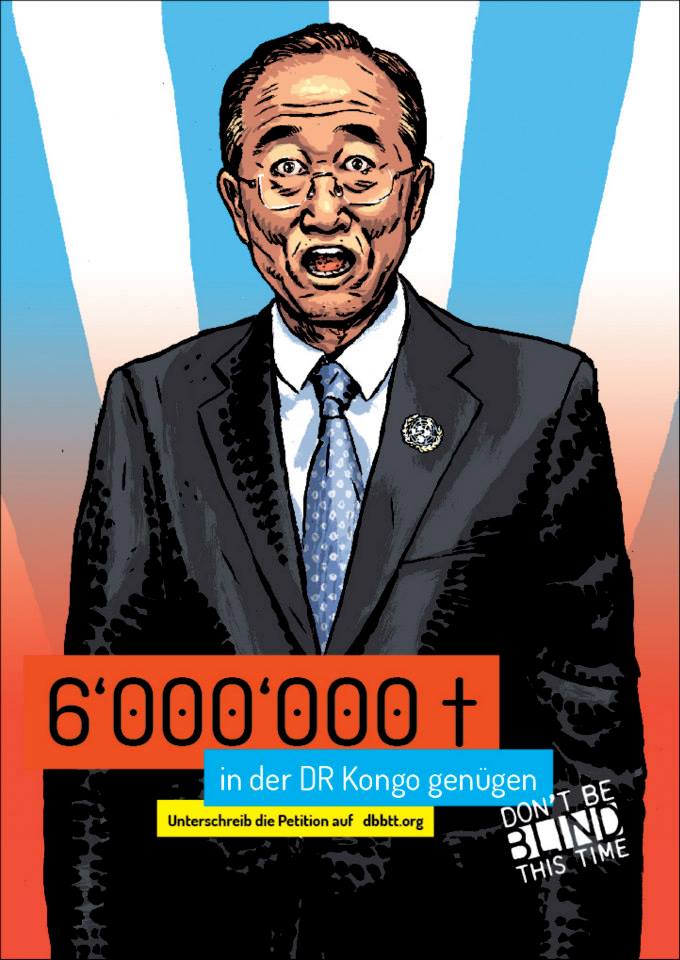
Picture of Ba Ki-Moon, UN Secretary General, by Don't Be Blind This Time

The author of the article that follows starts from an assumption that we all know Ferguson. If I hadn’t been reading recent news feeds on that nth US police brutality case against black people in America I wouldn’t know. I omitted deliberately putting the date when that happened, because it happens every day. Now you know. But where is the link between Ferguson and Congo?

In March 1978 US President Jimmy Carter commissioned a report – NSCM/46 – put together by the National Security Council Interdepartmental Group for Africa. Zbignew Brezinski as National Security Advisor had been tasked with reviewing what was happening in Black Africa from the point of view of possible impacts on the black movement in US. The exercise had to consider:

  1. Long-term tendencies of social and political developments and the degree to which they were consistent with or contradicted US interests
  2. Proposals for durable contacts between radical African leaders and leftists leaders of the US black community
  3. Appropriate steps to be taken inside and outside the country in order to inhibit any pressure by radical African leaders and organizations on the US black community for the latter to exert influence on the policy of the Administration towards Africa

When the report was submitted in the same year it included among other findings these ones:

  1. The mineral resources of the area [Black Africa] continue to be of great value for the normal functioning of industry in the United States and allied countries
  2. If the idea of economic assistance to black Americans shared by some African regimes could be realized by their placing orders in the United States mainly with companies owned by blacks, they could gain a limited influence on the US black community

The recommendations from the report privileged the sanctified principle of divide and rule in order to weaken any emergence of a strong black opposition to dominant policies serving inside and outside US national interests.

  1. Special clandestine operations should be launched by the CIA to generate mistrust and hostility in American and world opinion against joint activity of the two forces [Black America and Black Africa], and to cause division among Black African radical national groups and their leaders
  2. To preserve the present [we were then in 1978 but looking at it today 36 years later the situation has not much changed] climate which inhibits the emergence from within the Black leadership of a person capable of exerting national [or global] appeal.
  3. To support actions designed to sharpen social stratification in the Black community which would lead to the widening and perpetuation of the gap between successful educated Blacks and the poor, giving rise to growing antagonism between different black groups and a weakening of the movement as a whole.

BK Kumbi, Congolese activist, historian and founding member ofDon’t Be Blind This Time, decrypts what such measures and probably many others similar taken over the years by US authorities and allies have had as consequences to black American community and black Africa. She starts her analysis with the intentionally engineered and differing perceptions of the other between the two groups. She moves on the inadequacies that such differences create and the behavior of the white in a well wheeled tragedy where all black as a race becomes a consistent victim. She finds the ultimate exit from the situation to be within the victim itself, or its own humanity.

As Africans our eyes are often turned towards America because for some of us there is the illusion that attracts but for others the eye focuses on how the black man is staged in the American reality. For many black Americans, as for the majority of Americans, Africa is a land of savages and this idea has a particular resonance among the Afro-American population because it shows how they were taught to hate themselves through the figure of a so to say original man, the one that is stored in the sub-humanity. However, when we look at things more closely, one has to ask if there is a real difference of treatment for us all? Imperialist policies affecting African populations are the same as those applied to the black population in the United States precisely because the principle states that the black body shall be exploited alive or dead, it must generate profit. I come from a country, the Democratic Republic of the Congo, where more than 6 million people were murdered and where the killings continue so that the world benefits from the wealth of this country, namely from the coltan, a mineral that is used to make cell phones, but also to manufacture weapons which kill other blacks thousands miles away of my land.

This tragedy is absent from the majority of the American channels or if it is presented, it is to say that there are blacks who kill blacks. There are no questions raised as per the people or the countries who arms those blacks and for what purpose? The corporate media rather prefers to broadcast on the visits of the gang leaders of our region that the United States has hired to do the job and fuel the black on black theory at an international level. What is striking here is how the story is structured or the fact that there is no narrative at all about this issue, just silence. What I want to point out here specifically is the question of how our bodies became objects of spectacles. If there is generally silence that surrounds the Congolese tragedy, there is nevertheless one aspect of this conflict that is portrayed more than the others. The issue of rape used as a weapon of war is the beloved subject of a certain American ”intelligentsia” and it has helped forward the image of some American ‘celebrities’.

The mutilated bodies of Congolese women have become an image that is made pornographic and that it is diffused freely under the idea of a feminist fight and the narrative of this tragedy is assumed by white feminists who actually fight for their own rights in a capitalist environment. This is not done to help the Congolese women and it is also done to spread the idea that this is a femicide and not a genocide. The story of Congolese women is a way to raise funds for these organizations, to write and produce documentaries that will also generate money and, -and this is perhaps the most important, it’s a way to reaffirm the idea that the black man is a savage, a predator whose violence is atavistic, mad and he is therefore the sole instrument of the eradication of his own black being. Is not also the narrative that is served to explain to the Afro- Americans that they are the very instruments of their own annihilation and their own poverty? Is that not what is said when the corporate media uses false images to say that Brown had stolen into a store and that was the reason of his death?

We all need to have our eyes open about the way we are treated and portrayed, and I say we because the image that is conveyed of the African man in Africa necessarily affects the way the Afro-American man is perceived. For those who are looking at us, as if we were in a cage like Lumumba said, there is no difference between a black African or an African-American. We are the ones making this difference because we think that for the white man there are good blacks and there are bad blacks. We don’t look at us through our own eyes but through the eyes of another person who has defined us as not human. When Lewis said that Ferguson is not the Congo, he shows how he is very much inhabited by this idea, he shows that for him there are good and bad Negros. When one really reflects on what is happening in Ferguson, one sees precisely that Ferguson is the Congo. The lesson of this tragedy is how we all rebuild our own histories, how we teach our children to see their lives and the lives of those who look like them as valuable, how we teach them that they are human beings and that they are part of this world even though some want to deny them this right.

Source: http://therisingcontinent.wordpress.com/2014/08/22/why-ferguson-is-the-congo

245,000 est le nombre connu des réfugiés vivant sur le sol congolais


media                                 Un camp de réfugiés près de Goma, dans l’est de la RDC, en 2012.REUTERS/James Akena
 

Pour la première fois, les réfugiés rwandais ont été identifiés et enregistrés. Le Haut commissariat des Nations unies pour les réfugiés estimait jusqu’à présent que le nombre de réfugiés rwandais dans le monde était de 100 000 personnes. Mais ils sont déjà presque 245 000, rien qu’au Congo, à s’être présentés pour se faire enregistrer. C’est le chiffre auquel est parvenu la Commission nationale congolaise des réfugiés qui, avec le soutien du HCR, a réalisé ce recensement.

Sans surprise, c’est dans le Nord-Kivu que se trouvent la plupart de ces réfugiés. Ils sont environ 199 000 dans cette province, et 42 000 au Sud-Kivu. Mais on en retrouve aussi dans le Katanga, au Kasai oriental, dans le Maniema, en Equateur et encore dans une moindre mesure à Kinshasa. Héritage de l’histoire puisque c’est en plein génocide de 1994 que ces populations ont traversé la frontière devant l’avancée des troupes du FPR aujourd’hui au pouvoir au Rwanda. Puis après l’incursion de l’armée rwandaise au Congo, elles ont fui vers l’intérieur du pays.

Beaucoup n’ont jamais connu le Rwanda

Pour avoir plus de détails sur cette étude et notamment la répartition par sexe, âge, il faudra encore attendre la fin de la compilation des résultats, explique la Commission nationale congolaise des réfugiés. Pour l’instant, une certitude : beaucoup, parmi ces populations, sont des jeunes qui n’ont jamais connu le Rwanda.

Un sentiment demeure au sein de cette communauté : les deux tiers de ces 245 000 personnes disent ne pas souhaiter retourner dans leur pays. Une proportion qui pourrait évoluer, explique la Commission nationale des réfugiés, à l’issue d’une campagne de sensibilisation au retour dans lequel sera impliqué le gouvernement rwandais. Kigali ayant demandé depuis longtemps la clause de cessation du statut de réfugiés pour tous les Rwandais vivant à l’extérieur du pays. Depuis 2001, le HCR dit pour sa part avoir rapatrié environ 135 000 Rwandais vivant au Congo.

Ce recensement intervient alors que la pression internationale augmente pour obtenir le désarmement des FDLR, les rebelles hutus rwandais, dont certains leaders sont accusés par Kigali d’avoir participé au génocide de 1994. Les FDLR se présentent comme les protecteurs de ces populations rwandaises réfugiées et estiment que sans ouverture de l’espace politique au Rwanda, elles ne pourront pas rentrer dans de bonnes conditions.

Jointe par RFI, Berthe Zinga, coordinatrice de la Commission nationale pour les réfugiés (CNR) explique l’importance de ce recensement pour ces réfugiés rwandais.

Il était important que l’on fasse cet enregistrement et eux attendaient aussi d’être enregistrés et surtout d’exprimer leurs choix concernant, soit le rapatriement volontaire soit demeurer en RDC.
 

Obama Condemns Hypocrisy Disguised as Reconciliation.

obam_393699617

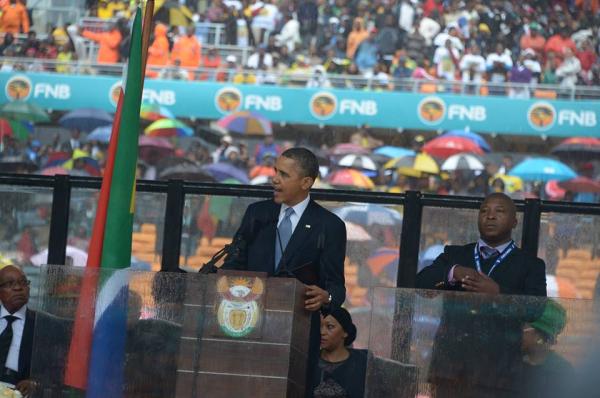
In his speech at the Nelson Mandela memorial, Obama observed that there are many leaders who claim solidarity with Madiba’s struggle for freedom, but do not tolerate dissent from their own people.

“There are too many of us who happily embrace Madiba’s legacy of racial reconciliation, but passionately resist even modest reforms that would challenge chronic poverty and growing inequality,” he added.

Obama has, however, encouraged several leaders to come out and make their voices heard no matter the resistance that is generated from the leaders in power.

“There are too many of us who stand on the sidelines, comfortable in complacency or cynicism when our voices must be heard,” he added.

Obama visits Mandela’s cell at the infamous Robben Islands

He further appreciated Mandela for his several contributions to the world at large; “Mandela taught us the power of action, but also ideas; the importance of reason and arguments; the need to study not only those you agree with, but those who you don’t. He understood that ideas cannot be contained by prison walls, or extinguished by a sniper’s bullet”.

Below is Obama’s speech on Nelson Mandela memorial:

To Graça Machel and the Mandela family; to President Zuma and members of the government; to heads of state and government, past and present; distinguished guests – it is a singular honour to be with you today, to celebrate a life unlike any other.

To the people of South Africa – people of every race and walk of life – the world thanks you for sharing Nelson Mandela with us.

His struggle was your struggle. His triumph was your triumph. Your dignity and hope found expression in his life, and your freedom, your democracy is his cherished legacy.

It is hard to eulogise any man – to capture in words not just the facts and the dates that make a life, but the essential truth of a person – their private joys and sorrows; the quiet moments and unique qualities that illuminate someone’s soul.

How much harder to do so for a giant of history, who moved a nation toward justice, and in the process moved billions around the world.

Born during World War I, far from the corridors of power, a boy raised herding cattle and tutored by elders of his Thembu tribe – Madiba would emerge as the last great liberator of the 20th century.

Like Gandhi, he would lead a resistance movement – a movement that at its start held little prospect of success.

Like King, he would give potent voice to the claims of the oppressed, and the moral necessity of racial justice. He would endure a brutal imprisonment that began in the time of Kennedy and Khrushchev, and reached the final days of the Cold War.

Emerging from prison, without force of arms, he would – like Lincoln – hold his country together when it threatened to break apart.

Like America’s founding fathers, he would erect a constitutional order to preserve freedom for future generations – a commitment to democracy and rule of law ratified not only by his election, but by his willingness to step down from power.

Given the sweep of his life, and the adoration that he so rightly earned, it is tempting then to remember Nelson Mandela as an icon, smiling and serene, detached from the tawdry affairs of lesser men.

But Madiba himself strongly resisted such a lifeless portrait.

Instead, he insisted on sharing with us his doubts and fears; his miscalculations along with his victories. “I’m not a saint,” he said, “unless you think of a saint as a sinner who keeps on trying.”

It was precisely because he could admit to imperfection – because he could be so full of good humour, even mischief, despite the heavy burdens he carried – that we loved him so.

He was not a bust made of marble; he was a man of flesh and blood – a son and husband, a father and a friend.

That is why we learned so much from him; that is why we can learn from him still. For nothing he achieved was inevitable. In the arc of his life, we see a man who earned his place in history through struggle and shrewdness; persistence and faith.

He tells us what’s possible not just in the pages of dusty history books, but in our own lives as well. Mandela showed us the power of action; of taking risks on behalf of our ideals.

Perhaps Madiba was right that he inherited, “a proud rebelliousness, a stubborn sense of fairness” from his father.

Certainly he shared with millions of black and coloured South Africans the anger born of, “a thousand slights, a thousand indignities, a thousand unremembered moments…a desire to fight the system that imprisoned my people.”

But like other early giants of the ANC – the Sisulus and Tambos – Madiba disciplined his anger; and channelled his desire to fight into organisation, and platforms, and strategies for action, so men and women could stand-up for their god-given dignity.

Moreover, he accepted the consequences of his actions, knowing that standing up to powerful interests and injustice carries a price.

“I have fought against white domination and I have fought against black domination,” he said at his 1964 trial.

“I’ve cherished the ideal of a democratic and free society in which all persons live together in harmony and with equal opportunities.

It is an ideal which I hope to live for and to achieve. But if needs be, it is an ideal for which I am prepared to die.”

Mandela taught us the power of action, but also ideas; the importance of reason and arguments; the need to study not only those you agree with, but those who you don’t.

He understood that ideas cannot be contained by prison walls, or extinguished by a sniper’s bullet. He turned his trial into an indictment of apartheid because of his eloquence and passion, but also his training as an advocate.

He used decades in prison to sharpen his arguments, but also to spread his thirst for knowledge to others in the movement.

And he learned the language and customs of his oppressor so that one day he might better convey to them how their own freedom depended upon his.

Mandela demonstrated that action and ideas are not enough; no matter how right, they must be chiselled into laws and institutions. He was practical, testing his beliefs against the hard surface of circumstance and history.

On core principles he was unyielding, which is why he could rebuff offers of conditional release, reminding the Apartheid regime that, “prisoners cannot enter into contracts.”

But as he showed in painstaking negotiations to transfer power and draft new laws, he was not afraid to compromise for the sake of a larger goal.

And because he was not only a leader of a movement, but a skilful politician, the Constitution that emerged was worthy of this multiracial democracy; true to his vision of laws that protect minority as well as majority rights, and the precious freedoms of every South African.

Finally, Mandela understood the ties that bind the human spirit.

There is a word in South Africa- Ubuntu – that describes his greatest gift: his recognition that we are all bound together in ways that can be invisible to the eye; that there is a oneness to humanity; that we achieve ourselves by sharing ourselves with others, and caring for those around us.

We can never know how much of this was innate in him, or how much of was shaped and burnished in a dark, solitary cell.

But we remember the gestures, large and small – introducing his jailors as honoured guests at his inauguration; taking the pitch in a Springbok uniform; turning his family’s heartbreak into a call to confront HIV/AIDS – that revealed the depth of his empathy and understanding.

He not only embodied Ubuntu; he taught millions to find that truth within themselves.

It took a man like Madiba to free not just the prisoner, but the jailor as well; to show that you must trust others so that they may trust you; to teach that reconciliation is not a matter of ignoring a cruel past, but a means of confronting it with inclusion, generosity and truth.

He changed laws, but also hearts. For the people of South Africa, for those he inspired around the globe – Madiba’s passing is rightly a time of mourning, and a time to celebrate his heroic life.

But I believe it should also prompt in each of us a time for self-reflection. With honesty, regardless of our station or circumstance, we must ask: how well have I applied his lessons in my own life?

It is a question I ask myself – as a man and as a President. We know that like South Africa, the United States had to overcome centuries of racial subjugation.

As was true here, it took the sacrifice of countless people – known and unknown – to see the dawn of a new day. Michelle and I are the beneficiaries of that struggle.

But in America and South Africa, and countries around the globe, we cannot allow our progress to cloud the fact that our work is not done.

The struggles that follow the victory of formal equality and universal franchise may not be as filled with drama and moral clarity as those that came before, but they are no less important.

For around the world today, we still see children suffering from hunger, and disease; run-down schools, and few prospects for the future.

Around the world today, men and women are still imprisoned for their political beliefs; and are still persecuted for what they look like, or how they worship, or who they love.

We, too, must act on behalf of justice. We, too, must act on behalf of peace.

There are too many of us who happily embrace Madiba’s legacy of racial reconciliation, but passionately resist even modest reforms that would challenge chronic poverty and growing inequality.

There are too many leaders who claim solidarity with Madiba’s struggle for freedom, but do not tolerate dissent from their own people.

And there are too many of us who stand on the sidelines, comfortable in complacency or cynicism when our voices must be heard.

The questions we face today – how to promote equality and justice; to uphold freedom and human rights; to end conflict and sectarian war – do not have easy answers.

But there were no easy answers in front of that child in Qunu. Nelson Mandela reminds us that it always seems impossible until it is done. South Africa shows us that is true.

South Africa shows us we can change. We can choose to live in a world defined not by our differences, but by our common hopes.

We can choose a world defined not by conflict, but by peace and justice and opportunity.

We will never see the likes of Nelson Mandela again. But let me say to the young people of Africa, and young people around the world – you can make his life’s work your own.Over thirty years ago, while still a student, I learned of Mandela and the struggles in this land. It stirred something in me.

It woke me up to my responsibilities – to others, and to myself – and set me on an improbable journey that finds me here today.And while I will always fall short of Madiba’s example, he makes me want to be better. He speaks to what is best inside us.

After this great liberator is laid to rest; when we have returned to our cities and villages, and rejoined our daily routines, let us search then for his strength – for his largeness of spirit – somewhere inside ourselves.

And when the night grows dark, when injustice weighs heavy on our hearts, or our best laid plans seem beyond our reach – think of Madiba, and the words that brought him comfort within the four walls of a cell: It matters not how strait the gate, How charged with punishments the scroll, I am the master of my fate: I am the captain of my soul.

What a great soul it was. We will miss him deeply. May God bless the memory of Nelson Mandela. May God bless the people of South Africa.

– See more at: http://chimpreports.com/index.php/people/14847-obama-condemns-hypocrisy-disguised-as-reconciliation.html#sthash.jk8Es7GJ.dpuf

Rwanda: Spate of Enforced Disappearances

2014AFR_Rwanda_Composite

Top row, from left to right: Anne-Marie Murekatete (Disappeared on March 18, 2014); Elie Semajeri (Disappeared on April 16, 2014); Shamusi Umubyeyi (Disappeared on April 16, 2014) Middle row, from left to right: Hassani Bizimana (Disappeared on April 16, 2014); Jean-Bosco Bizimungu (Disappeared on April 16, 2014) Bottom row, from left to right: Alphonse Butsitsi (Disappeared on April 22, 2014); Virginie Uwamahoro (Disappeared on April 23, 2014); Selemane Harerimana (Disappeared on April 30, 2014).

(Nairobi) – An increasing number of people have been forcibly disappeared or have been reported missing inRwanda since March 2014. Many of the cases occurred in Rubavu district, in Western Province.

In some cases, the whereabouts of the people involved are still unknown several weeks later. Human Rights Watch has received information that some of the people who were forcibly disappeared were detained by Rwanda Defence Force (RDF) soldiers and believes they may be in military custody.

“Enforced disappearances are a heinous crime, not least because of the anguish and suffering they cause to family and friends,” said Daniel Bekele, Africa director at Human Rights Watch. “Rwandan police and judicial authorities have strict and absolute obligations to thoroughly investigate any case of enforced disappearance.”

If the people who have been forcibly disappeared have been arrested, the authorities should immediately acknowledge their detention, reveal their whereabouts, and allow them access to their families and to a lawyer, Human Rights Watch said. The authorities should either release those being held or inform them of the charges against them and bring them before a court.

Human Rights Watch collected detailed accounts of 14 people who have been forcibly disappeared or who have been reported missing in Rubavu since March and has received credible accounts of several more cases in Rubavu and Musanze districts, as well as in the capital, Kigali. In at least eight of the Rubavu cases, there were indications of involvement of state agents in the disappearances. Several witnesses said they saw the executive secretary of Gisenyi sector, Honoré Mugisha, taking part in arrests of people who were forcibly disappeared.

Rwandan officials told Human Rights Watch that they were investigating the cases, but have not provided any information on the progress or results of their investigations.

The families of many of those who have been forcibly disappeared or gone missing have written to local and national authorities, asking that their loved ones’ location be made public so that they can visit them. One received a response from the office of the mayor of Rubavu, acknowledging receipt of the letter and saying they were looking into the case. The other family members who spoke to Human Rights Watch have not received any response. One woman said she had searched for her husband in vain and was giving up hope. “I have no idea where he is, I really don’t,” she told Human Rights Watch. “He is gone without a trace.”

Information gathered by Human Rights Watch indicates that some of the people who have been forcibly disappeared may have been detained on suspicion of being members of, or working with, the Democratic Forces for the Liberation of Rwanda (Forces démocratiques pour la libération du Rwanda,FDLR). The predominantly Rwandan armed opposition group, based in eastern Democratic Republic of Congo, consists in part of people who participated in the 1994 genocide in Rwanda. Several of those who have been forcibly disappeared used to visit relatives or conduct business in Congo, and these movements appear to have attracted the suspicion of Rwandan authorities.

Rubavu’s proximity to the Congolese town of Goma, just across the border, means that many Rwandans frequently cross the border for commercial activities. Others have relatives living in Congo.

Since 2010, Human Rights Watch has documented a number of cases of people accused of being FDLR members or collaborators, or charged with state security offenses, and who were detained incommunicado by the military and forced to confess to crimes, or implicate others, sometimes under torture. When they were eventually brought to trial, some of the defendants told the judges that their confessions had been extracted under torture. However, in many cases, the judges disregarded their claims and proceeded to convict them in the absence of any other evidence.

In view of the sensitivity of being associated with people suspected of links with the FDLR, the Rwandan government and police should ensure that relatives of the disappeared are not threatened or harmed for inquiring about their cases, Human Rights Watch said.

Civilians should not be detained in military custody, and all victims of enforced disappearances have a right to a remedy, Human Rights Watch said.

An enforced disappearance occurs when someone is deprived of their liberty by agents of the state or those acting with its acquiescence, followed by a refusal to acknowledge the deprivation of liberty or by concealment of the fate or whereabouts of the disappeared person.

“We are concerned that some of the people who have disappeared could face a similar fate to those accused of FDLR involvement or state security offenses in the past,” Bekele said. “The Rwandan authorities should make every effort to locate these people.”

For details about the circumstances of the disappearances, recommendations, and a summary of some of the cases Human Rights Watch investigated, please see below.

Involvement of Military and Local Government Officials
Several witnesses told Human Rights Watch that they saw a local government official and RDF soldiers detaining some of those who have disappeared.

On April 16, two village chiefs, Elie Semajeri and Shamusi Umubyeyi, and a traditional doctor, Jean-Bosco Bizimungu, were detained in the Kabuga, Majengo, and Ihuriro neighborhoods of Gisenyi sector. Local residents said that soldiers, together with the executive secretary of Gisenyi sector, Honoré Mugisha, detained these people near their homes. Witnesses also cited Mugisha in connection with other disappearances.

Mugisha told Human Rights Watch on May 8 that he had heard rumors of these accusations against him but said he did not understand them. He maintained that on April 16, he was in Ruhengeri, a town more than an hour away, visiting his sick mother, and said he did not learn that the two village chiefs had disappeared until April 18.

Yet six witnesses separately confirmed to Human Rights Watch that Mugisha was personally involved in the detentions on April 16. Witnesses told Human Rights Watch that when local residents questioned the detention of Umubyeyi, Mugisha said he took responsibility for it and said: “We are going to ask her some questions and then we will release her.” Similarly, Mugisha told a person close to Semajeri: “He has questions to answer and then we will release him.”

The Rwandan Penal Code prohibits kidnapping and unlawful detention and specifies that it is an offense for public servants to be involved in acts violating individual liberty. Failure by public servants who are aware of an illegal deprivation of an individual’s liberty to assist or to seek assistance from a competent authority to end it also constitutes an offense.

The Rwandan Penal Code states that any civil servant who puts or retains a person in detention without a legal order shall be liable to a term of imprisonment equivalent to the term incurred by the illegally detained person. An act of enforced disappearance is not yet defined as a crime under national law, although the Penal Code recognizes enforced disappearances as one of the acts that can constitute a crime against humanity.

Official Response
Human Rights Watch met with the District Police Commander of Rubavu District, Karangwa Murenge, on May 8. Murenge agreed that the number of reported cases of missing people had increased. He told Human Rights Watch: “I have seen the letters that have been dropped off here in which people say that they have loved ones missing. We are doing investigations. Just until now we can’t say how this is happening. We are trying to figure out what is going on.”

He disputed a list of 14 names presented by Human Rights Watch saying, “I really don’t think this can be right. This is too many people.” He said: “We are next to the DRC [Democratic Republic of Congo]. Some people can leave for the DRC for days or weeks or even months and not tell others.”

“If a soldier arrests a civilian, then he [the civilian] should immediately be sent to me,” he said. “The military can never arrest a civilian.”

On May 9, local and provincial officials held a public meeting at the football stadium in Gisenyi sector. Before this meeting, a rumor was circulating that the people who had been subject to enforced disappearance or were missing would be presented to the crowd.

This did not happen, but officials, including the governor of Western Province and the mayor of Rubavu, urged the population to reinforce local security efforts. A senior military official, Major General Mubarak Muganga, reportedly told the crowd that the RDF was detaining people who would later be presented to the public. He said these people had been detained because they collaborated with the FDLR and had confessed to this voluntarily.

Human Rights Watch raised cases of the disappeared and missing people with Brigadier General Joseph Nzabamwita, the spokesman for the RDF, on May 13. Responding to concerns that RDF soldiers may have been involved in unlawful detention, Nzabamwita said, “The RDF does not engage in such.” He questioned the relevance of Major General Muganga’s statement that the RDF was detaining people to reports of people subject to enforced disappearance.

Human Rights Watch also raised these cases with Justice Minister Johnston Busingye in an email on May 12. On May 13 Human Rights Watch met with Busingye, who said he would look into them.

The Law on Disappearances and Recommendations
The absolute prohibition on enforced disappearances is part of customary international law and is included as a crime in the Statute of the International Criminal Court (ICC). Multiple human rights instruments also address enforced disappearances. Rwanda has yet to ratify the International Convention for the Protection of All Persons from Enforced Disappearance.

Although a discrete crime in and of itself, the act of enforced disappearance has also long been recognized as simultaneously violating multiple human rights protections, including the prohibition of torture and freedom from arbitrary arrest and detention. An enforced disappearance is also a “continuing crime:” it continues to take place so long as the disappeared person remains missing, and information about his or her fate or whereabouts has not been provided.

An enforced disappearance has multiple victims. Those close to a disappeared person suffer anguish from not knowing the fate of the disappeared person, which amounts to inhuman and degrading treatment. They may also be further treated in an inhuman and degrading manner by authorities who fail to investigate or provide information on the whereabouts and fate of the disappeared person. These aspects make disappearances a particularly pernicious form of violation, and highlight the seriousness with which the authorities should take their obligations to prevent and remedy the crime.

The Rwandan government should ensure that:

–          All authorities who have received inquiries from families of people who have disappeared or are missing reply promptly, providing all known information on the whereabouts and fate of these people and on steps being taken to acquire such information if not readily available;

–          District and national authorities investigate all reported cases of enforced disappearances;

–          All those forcibly disappeared are immediately released or brought before a judge and any further custody is conducted in strict compliance with Rwandan and international law. Such custody should only be possible on the basis that the individual has been charged with a criminal offense, for which they will be promptly given a fair trial, with guarantees for absolute respect for their due process rights;

–          No information collected during the time the person was disappeared or that may have been acquired through torture or any other prohibited ill-treatment is allowed to be used as evidence in criminal proceedings, other than against those who engaged in any torture, ill-treatment or the act of enforced disappearance; and

–          All those involved in the acts of enforced disappearance are investigated and prosecuted under Rwandan law.

Selection of cases of disappearances in Rubavu district March to May 2014

Anne-Marie Murekatete – Disappeared on March 18, 2014

Anne-Marie Murekatete, 27, is an intern at the health clinic in Gatyazo, in Nyamyumba sector. She studied nursing in Congo. On March 18, she was taken by men in a vehicle just outside the clinic where she worked.

A witness told Human Rights Watch:

It was between 8:30 and 9 a.m. [and she was] dressed in her work clothes. She got a call from a girl she had studied with in Congo. I could hear the conversation. The caller said that Anne-Marie had to go outside. There was a vehicle parked there [and] two people were on the road. The men were in civilian clothes. The vehicle was a white pickup truck with tinted windows … As she was walking toward the truck, she was talking on the phone … One of the men said to her, ‘Is it you [the caller] is looking for? She is in the vehicle, you can find her there.’ As she got near the vehicle, the two men pushed her inside. They were walking behind her as she walked toward it and forced her inside. Then they sped off.

On April 14, a relative of Murekatete wrote letters to local government officials explaining what had happened and asking for help in finding her.

A relative inquired about her case in April at a regular district security meeting at which a member of the RDF addressed the local population. The RDF official responded: “If it is the enemy who took her, we will look for her. If she is with us, it is because there are things we need to ask her. We need to ask her questions and then we will release her.”

Although the men described as detaining Murekatete were dressed as civilians, the white vehicle into which she was forced matches the description of other vehicles allegedly used by government forces and civilians to detain other disappeared people.

Elie Semajeri – Disappeared on April 16, 2014
Elie Semajeri, 50, is the village chief of the Majengo neighborhood in Gisenyi sector. On April 16 uniformed armed soldiers arrived at his home around 11:30 p.m., accompanied by men in civilian clothes. They told one of his children, “Go tell [Semajeri] we need him now.”

An individual close to Semajeri who was near his home told Human Rights Watch:

Elie thought it had something to do with the neighborhood, so he got up and put on a jacket … [Another person] went outside and saw the soldiers walking Elie out of the compound. She then saw him try to resist and they [the soldiers] pushed him. She yelled, ‘[Semajeri] is being arrested!’ [Others] ran outside and threw stones at neighbors’ houses to tell everyone what was happening and to tell people to come outside…

I saw Honoré, the executive secretary, with the soldiers. The soldiers had their guns out and were pointing them up and down the street. Elie was being put into a vehicle and he yelled, ‘Look! They are arresting me! They are taking me and I will die!’ He was also crying. He yelled, ‘All the neighbors must see this!’ At this moment, they forced him into a vehicle. It was a white pickup truck.

Another witness told Human Rights Watch:

It was around 11 p.m. in the evening … I was in bed and all of a sudden, I heard a child crying, ‘Get up! They are taking [him]!’ I got up and opened the door. I saw soldiers… and men in civilian clothes. As I went outside, I saw Elie being taken by three men in civilian clothes. They told him to sit down and a soldier guarded him. There were many soldiers around. We all started to cry, ‘No! You can’t take him at night! He should stay here.’ There were many people around. Elie was yelling, ‘No! Don’t arrest me! … Leave me alone, I don’t want to go!’ We started to resist and the soldiers started to threaten us … A soldier pushed me to the ground. The soldiers scared the people back and they took Elie away in a white vehicle.

An individual close to Semajeri phoned Mugisha, the executive secretary of Gisenyi sector, who said, “He [Semajeri] has questions to answer and then we will release him.”

The next day, a relative of Semajeri went to Gisenyi police station to look for him. The police told her he was not there, and advised her that if he had been arrested by the military, she should check at the military camp.

On May 2 Semajeri’s relatives dropped letters at local government offices explaining how he was arrested by soldiers in the presence of Mugisha. They have not received a response.

Shamusi Umubyeyi – Disappeared on April 16, 2014
Shamusi Umubyeyi, approximately 45, is the village chief of the Ihuriro neighborhood in Gisenyi sector. On April 16, when soldiers arrived near Semajeri’s home (see above), one of Semajeri’s relatives ran to Umubyeyi’s home to inform her. As Umubyeyi was leaving, soldiers, accompanied by Mugisha, arrested her. Umubyeyi was last seen at a parking lot near the football stadium, where Mugisha and the soldiers had escorted her.

A local resident told Human Rights Watch:

We heard all the cries and we got up and went to look outside. People were running around yelling, ‘Come! Come! [Elie Semajeri] is being arrested!’ Shamusi got up in her night clothes and left her house. Near my house she stopped to talk to some local demobilized soldiers … At this moment the vehicle that took Elie came back. It was a white pickup truck. The executive secretary got out and approached me and asked where Shamusi was. His name is Honoré Mugisha.

He called Shamusi’s phone and I heard him say, ‘Come back, we need to see you.’ She came [and] they greeted each other. Honoré said to her, ‘You too. We are looking for you. If your conscience is clean, then come and explain yourself.’ Shamusi said, ‘I have no problems. I am here to see what has happened. I see you are a leader, so I will come.’ Honoré was with three men in civilian clothes … and three soldiers who were armed. [As she was walked off, some people asked] Honoré, ‘Who is arresting our neighbor?’ He said, ‘I am responsible. Go back to bed.’

Another local resident told Human Rights Watch, “When the military was taking Shamusi away, the population was crying out. Honoré got out of his truck and said to the population, ‘No, stay calm, we are going to ask her some questions and then we will release her.’”

On April 25 relatives of Umubyeyi dropped off letters at local government offices explaining how she was arrested and requesting help in finding her. They have not received a response. When a person close to Umubyeyi inquired about her at the Division III military headquarters in Gisenyi, commonly known as “CEPGL,” a military official told him, “If you continue to insist on following this case, you too could become a victim.”

Hassani Bizimana – Disappeared on April 16, 2014
On April 16, a soldier arrested Hassani Bizimana, 44, in the Ubutabazi neighborhood in Gisenyi sector, as he was closing his shop. A witness told Human Rights Watch:

It was around 6 p.m. and he was closing the shop. All of a sudden, a soldier was there … I turned around and I saw Bizimana … He said, ‘This soldier is saying they are going to take me somewhere.’ He yelled, ‘People! Look, the military are taking me somewhere! If you can’t find me, know that it was them who took me!’ I approached the soldier and tried to see his name, but the tag on his uniform had been removed. People started to approach, so the soldier said to Hassani, ‘Ok, let’s go.’ Someone yelled, ‘What has he done?’ The soldier said, ‘The people in charge of intelligence told me to take him.’

Another witness confirmed this, telling Human Rights Watch that he saw a soldier with a gun walking away with Bizimana and heard Bizimana shout out that he was being arrested.

An individual close to Bizimana went to the police station the same night to look for him, but the police told him that those arrested by the military were taken to a military base commonly known as the “gendarmerie,” near the border with Congo.

The next morning he went to the “gendarmerie.” Soldiers there asked him, “Who said he was arrested by the military? Is everyone in a uniform a soldier?”

On May 2 a relative of Bizimana dropped off letters to local government and police offices reporting Bizimana’s detention by a soldier and requesting that his location be revealed. There has been no response.

Jean-Bosco Bizimungu – Disappeared on April 16, 2014
Jean-Bosco Bizimungu, 51, is a traditional doctor who lives in the Kabuga neighborhood in Gisenyi sector. He often visited Congo as he had family there. Witnesses said that the executive secretary of the sector, accompanied by soldiers, detained him on April 16. One of them told Human Rights Watch:

It was around 1:30 a.m. when the executive secretary accompanied by the military went to his house. The executive secretary is named Honoré Mugisha. They knocked on the door and yelled, ‘Get up and open this door!’ Bizimungu opened the door and they said, ‘We have a man with a sick stomach. We want you to care for him.’ Bizimungu asked, ‘Where is he?’ They said, ‘You must come’ and they wanted to take him. Bizimungu said, ‘I am not leaving my house. Bring him here.’ Then the soldiers entered by force and they took him … There were six soldiers in uniform. They walked Bizimungu to the stadium where they had vehicles waiting.

Other witnesses also told Human Rights Watch they saw soldiers walking Bizimungu to the stadium.

The next morning a relative of Bizimungu’s went to the village chief to explain what had happened. The chief said, “You were not the only one with this problem last night. You should go look at the police.” The relative was not able to find Bizimungu at the police station.

Alphonse Butsitsi – Disappeared on April 22, 2014
Alphonse Butsitsi, 78, is well known locally, due to his age and outgoing personality. He lives in the Majengo neighborhood in Gisenyi sector. He was detained in town on April 22.

A witness told Human Rights Watch:

I was walking home with other people. A vehicle with Congo plates, a white pickup truck with tinted windows, passed me and parked in front of the Baptist church. Some men got out onto the road. There were three men in civilian clothes and one in a soldier’s uniform. The soldier was not armed. Butsitsi was on his bike. One of them called him. He went to them and they told him to get into the car. He agreed and they put the bike in the back of the truck.

The vehicle then sped off. Butsitsi has not been seen since.

The day he disappeared, Butsitsi’s relatives checked the local police cells but he was not there. On April 23 and 25, his relatives dropped letters at local government offices explaining how Butsitsi was detained and requesting assistance in finding him. They later received a letter from the office of the mayor of Rubavu, acknowledging receipt of their letter and saying they were looking into the case.

Individuals close to Butsitsi also inquired about him at the Division III military headquarters. They were not able to make direct inquiries to officers, but soldiers at the base asked them, “Does [Butsitsi] go to the DRC often?”

Virginie Uwamahoro – Disappeared on April 23, 2014
Virginie Uwamahoro, 38, is the director of a primary school in Gisenyi sector. She studied in Goma (eastern Congo), completing her degree in 2013.

On April 23 Uwamahoro was returning from a meeting in Kigali. Before arriving in Gisenyi, she called an individual close to her and said that Mugisha was looking for her, so she had to see him first. She never returned home.

An individual close to Uwamahoro asked Mugisha where she was. He said: “I asked [Mugisha] ‘Where is she and how can I see her?’ He said, ‘No, stay calm.’ But I insisted. I wanted to know where she was and he said, ‘I can’t tell you because if I reveal secrets, I risk consequences.’ He did tell me, though, that she had been arrested at the bus station in Gisenyi.” The person inquired at the police but the police simply told him to wait.

On April 25, April 29, and May 2, a relative of Uwamahoro wrote letters explaining to local officials that she was missing and asking them to reveal her location. There has been no response.

Selemane Harerimana – Disappeared on April 30, 2014
Selemane Harerimana, 38, works as a mason in Rubavu district and in the town of Goma, eastern Congo. He lives in the Amahoro neighborhood in Gisenyi sector.

On April 30 Harerimana left his home in the morning as usual. Later that morning he called a friend and told him he was being detained. He said he was going to be taken to the “gendarmerie” in the vehicle of the executive secretary. His friend went directly to the “gendarmerie” to look for him. He told Human Rights Watch:

They would not let me in, but I saw the vehicle of the executive secretary there. I stayed outside and watched as Selemane was put into a white pickup truck … I followed the truck to “CEPGL” but I could not get in. After seeing the truck go into “CEPGL”, I decided to ask the people there. [They said] ‘He was in the DRC a lot, so we arrested him to see what he does and to see if he collaborates with the FDLR.’

Source: http://www.hrw.org/

The US condemns Ongoing Detentions and Arrests in Rwanda

us-congress-logo

Media Note

Office of the Spokesperson
Washington, DC
June 4, 2014

The United States is deeply concerned by the arrest and disappearance of dozens of Rwandan citizens in Rwanda over the past two months. Rwandan authorities held individuals incommunicado for periods up to two months before presenting them to a court of law. We are encouraged that Rwandan authorities have recently taken steps to bring a number of these individuals before a court. Nonetheless, the United States remains concerned that additional individuals may still be held incommunicado and without due process of law. We are also concerned by credible reports that individual journalists were threatened, and that the Government of Rwanda ordered the suspension of a call-in radio program that provided citizens with a platform to discuss current events.

The United States calls upon the Government of Rwanda to account for individuals arrested over the past two months and currently in custody, and to respect the rights under Rwandan law and international human rights law of the individuals detained and arrested. We also call upon Rwanda to fully respect freedom of expression, including for members of the press so that they can investigate, report, and facilitate discussion on issues of public concern.

The United States supports all lawful efforts to identify individuals who seek to use violence against the Rwandan people and government, but stresses that, in democratic societies, individuals may not be arbitrarily arrested or detained and are entitled to due process of law to certain minimum guarantees, including to challenge the legality of their detention before a court of law and to be informed of charges and examine witnesses against them.


Rwanda’s Untold Story Documentary

Twenty years on from the Rwandan genocide, This World reveals evidence that challenges the accepted story of one of the most horrifying events of the late 20th century. The current president of Rwanda, Paul Kagame, has long been portrayed as the man who brought an end to the killing and rescued his country from oblivion. Now there are increasing questions about the role of Kagame’s Rwandan Patriotic Front forces in the dark days of 1994 and in the 20 years since.

The film investigates evidence of Kagame’s role in the shooting down of the presidential plane that sparked the killings in 1994 and questions his claims to have ended the genocide. It also examines claims of war crimes committed by Kagame’s forces and their allies in the wars in the Democratic Republic of Congo and allegations of human rights abuses in today’s Rwanda.

Continue reading