“Turamutse tugaragaje imitungo yacu ntitwakira Abanyarwanda…” Abayobozi bakuru mu mwiherero!

Image

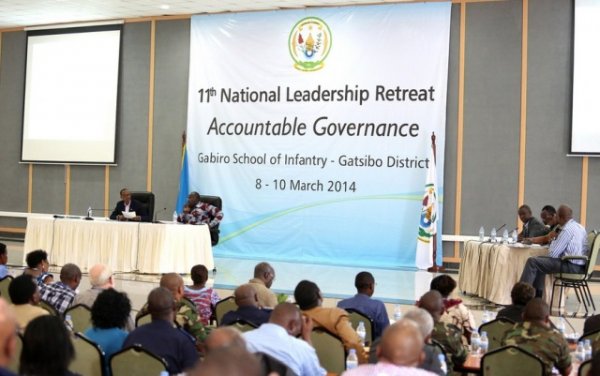
Mu mwiherero w’abayobozi bakuru b’igihugu wabaye kuva kuwa 8  kugeza kuwa 10 Werurwe 2014, hagaragaye ibyo dukunze kwandika no kuvuga bijyanye n’imikorere mibi iterwa ahanini rimwe na rimwe n’ubushobozi bukeya, ikimenyane n’icyenewabo, kutiyumvamo icyizere kubera kugira ubwoba bigatuma umuntu adafata ibyemezo bikwiye, gutinyana kw’abari munzego zikorana bugufi, n’ibindi. Bimwe muri ibi bibazo ngo nibyo bituma ubukungu bw’igihugu butazazamuka uko byari biteganyijwe.

N’ubwo bwose imyanzuro yafashwe iterekana uburyo izashyirwa mu bikorwa umwanzuro wa nyuma urasekeje cyane. Uwo mwanzuro wavugaga ku kibazo gikunze kugarukwaho cy’uko abayobozi bakuru bigwizaho imitungo. Hifujwe kenshi ko iyo mitungo yashyirwa ahagaragara kugira ngo rubanda ibashe gukurikirana abiba ibyabo. Nyamara bitewe n’uko bishobora gutuma Abanyarwanda bahagurukana agatsiko bakagahambiriza bidatinze, abari mu mwiherero basanze ngo byaba byiza baterekanye imitungo yabo. Twongeye gukora ubushakashatsi maze tureba imitungo Perezida Paul Kagame amaze kwigwizaho dusanga koko ishyizwe ahagaragara bitaba byiza! Dore imwe muri iyo mitungo:

  1. Afite amazu 2 n’isambu imwe irimo inzu muri USA
  2. Afite inzu 2 mu Bwongereza
  3. Afite inzu 1 mu Budage
  4. Afite imiturirwa 3 muri Eritereya
  5. Afite i hoteli n’indi nzu imwe muri Ethiopia
  6. Afite Hoteli muri Kenya
  7. Afite Hoteli mu Bugereki
  8. Afite amazu 2 n’umurima muri Afurika y’epfo
  9. Afite inzu ibikwamo ibintu i Dubai
  10. Afite inzu icururizwamo i Shangai mu Bushinwa
  11. Afite i hoteli mu kirwa cya Mauritius (Maurice)
  12. Afite imigabane muri sosie=yeti y’ubwikorezi mu Bwongereza
  13. Afite companyi icuruza amabuye y’agaciro afatanyije n’umuhinde mu Buhindi akahagira na Hoteli ndetse n’inzu muri icyo gihugu.
  14. Afte inzu ibikwamo ibintu mu Buyapani
  15. N’ibindi byinshi

Abayobozi ngo ntibashaka kwerekana imitungo yabo…ni mu gihe. Ariko rero amaherezo ntibizoroha.

Imyanzuro yose yafatiwe muri uwo mwiherero : Tubikesha  http://igihe.com/amakuru/u-rwanda/article/inzego-za-leta-y-u-rwanda-zigiye

1. Gushyira mu bikorwa impanuro zose zikubiye mu ijambo rya Nyakubahwa Perezida wa Repubulika.

2. Gushyiraho politike n’amategeko yo kubaka amazu aciriritse (low cost housing) no gushyiraho uburyo bunoze bwo kubaka amazu aciriritse kandi akabonekera ku gihe cyateganyijwe.

3. Kongerera ubushobozi Ikigo cy’Igihugu Gishinzwe Imiturire mu Rwanda kugira ngo kibashe gushyira mu bikorwa inshingano zacyo.

4. Kunoza imitegurire y’amasezerano Leta igirana na ba rwiyemezamirimo mu rwego rwo kunoza ishyirwa mu bikorwa ryayo.

5. Gusesengura ibibazo byagaragaye mu ishyirwa mu bikorwa ry’imishinga itandukanye (Kivuwatt, Inka zitanga umukamo utubutse n’iyindi) hagafatwa ingamba zo kubikosora kugira ngo imishinga yadindiye irangire vuba ; ababigizemo uruhare bagakurikiranwa.

6. Gufata ingamba zo kubonera, mu gihe cya vuba, uruganda rwa Gishoma Peat to Power nyiramugengeri ihagije.

7. Kurangiza, mu gihe cya vuba, inyubako z’ibitaro bya Bushenge.

8. Kunoza no gukurikirana ishyirwa mu bikorwa ry’amabwiriza ajyanye n’imitangire y’amasoko ya Leta akajya ahabwa koko ababifitiye ubushobozi.

9. Gushyiraho uburyo bunoze bwo gushishikariza abahinzi n’aborozi kongera umusaruro w’ibiva mu buhinzi n’ubworozi hakurikijwe uruhare ubuhinzi n’ubworozi bigomba kugira mu bukungu bw’Igihugu.

10. Inzego zose zirasabwa gushyira imbaraga mu kubahiriza ihame ry’uburinganire mu itegurwa ry’ingengo y’imari.

11. Kwihutisha ivugururwa ry’ibyiciro by’ubudehe.

12. Gushyiraho uburyo bunoze abayobozi bifashisha mu gusobanurira abaturage gahunda za Leta.

13. Kunoza imikorere y’inzego z’Abunzi n’Inteko z’abaturage kugira ngo zirusheho kuzuzanya mu gukemura ibibazo by’abaturage no kubaka ubushobozi bwabo mu kwikemurira ibibazo hagamijwe kugabanya ibibazo bijyanwa mu nkiko.

14. Urwego rw’Igihugu rw’Imiyoborere rurasabwa kumenyekanisha ibyavuye mu bushakashatsi bwerekana uko abaturage babona ibibakorerwa haba mu Gihugu no hanze kandi aho bishoboka rukajya rukorana n’imiryango mpuzamahanga muri ubwo bushakashatsi.

15. Gukosora imikorere mibi yagaragajwe mu mwiherero, imishinga yadindiye yose ikaba yarangiye ku bufatanye bw’inzego zibishinzwe

16. Kunoza igenamigambi n’imikoranire y’inzego zitandukanye hagamijwe kugera ku ntego Igihugu kiyemeje.

17. Kunoza imitegurire y’imihigo igashingira ku mpinduka nziza (outcome based) y’imibereho y’abaturage aho gushingira ku bikorwa

18. Gukaza ingamba zo kurwanya ruswa, mu nzego za Leta n’iz’abikorera, ku bantu batanga cyangwa bakira ruswa, yaba ntoya cyangwa nini, hifashishijwe uburyo budasanzwe (sophisticated).

19. Kurangiza ibibazo by’ingurane ku butaka bw’abaturage bimurwa ahagenewe ibikorwa by’inyungu rusange no kubahiriza ibyo amategeka ateganya.

20. Gushyiraho ingamba zituma abakozi bashora Leta mu manza, bivuye ku makosa yabo, bamenyekana kandi bakaryozwa igihombo baba bateje Leta.

21. Kunoza itegurwa n’isuzuma ry’imihigo y’abakozi ba Leta ku buryo ishingira ku ntego z’ikigo aho gushingira ku byo umukozi yumva azageraho.

22. Gushyiraho uburyo abikorera bajya basinyana imihigo na Leta hagamijwe iterambere ry’ihuse.

23. Kwihutisha ivugurura ry’inzego za Leta hagamijwe kunoza imikorere n’imikoranire yazo bikaba byatangiye bitarenze Werurwe 2014.

24. Kwiga uburyo gahunda yo kugaburira ku ishuri, abanyeshuri biga mu mashuri y’uburezi bw’ibanze bw’imyaka 12 byakorwa ku bufatanye n’ababyeyi.

25. Gukemura burundu kandi mu buryo bwihuse, ikibazo cy’abanyeshuri bo mu mashuri abanza biga bicaye hasi.

26. Gushyiraho uburyo bwo gukurikirana no kugenzura ireme ry’uburezi mu mashuri y’uburezi bw’ibanze bw’imyaka cumi n’ibiri (12YBE).

27. Gushyiraho uburyo butuma abarimu bishimira akazi kabo biganisha kumusaruro mwiza mw’ireme ry’uburezi (incentives) kandi bagahemberwa igihe nk’abandi bakozi ba Leta.

28. Kugaragaza ingamba z’imyaka itanu zo guteza imbere ireme ry’uburezi rya gahunda y’uburezi bw’ibanze bw’imyaka 12 herekanwa aho turi ubu n’aho twifuza kujya, inzego zose bireba zikabiganiraho uruhare.

29. Gushishikariza abikorera kurushaho gushora imari mu burezi.

30. Gushyiraho amashyirahamwe y’ababyeyi n’abarimu (PTAs) aho atari no gufasha ariho gukora neza kugira ngo bifashe mu kongera ireme ry’uburezi.

31. Kunoza uburyo bw’imitangire ya za mudasobwa mu mashuri ku buryo zihabwa amashuri yiteguye guhita azikoresha.

32. Kwihutisha gahunda yo kwimurira ibikorwa (services) bya Mutuelle de santé muri RSSB.

33. Kwihutisha politike ya Early Childhood Development.

34. Gushyiraho uburyo bunoze bwo kongera umubare w’abaganga b’inzobere no kwiga icyakorwa ngo abanga bagume mu kazi.

35. Gushishikariza abaturage kwishyurira igihe kandi nta gahato ubwishingizi bw’ubuzima (mutuelle de santé).

36. Kwihutisha ishyirwa mu bikorwa ry’amavugururwa yose akenewe kugira ngo u Rwanda rurusheho kugira umwanya mwiza mu korohereza ishoramari (Doing Business).

37. Korohereza abashoramari kugabanya ikiguzi cyo gukora ishoramari.

38. Gushishikariza abikorera gushora imari yabo mu bikorwa by’ubuhinzi kugira ngo bunganire umusaruro usanzwe utangwa n’abahinzi, bityo hakemurwe ku buryo burambye, ikibazo cy’inganda zibura umusaruro zikoresha.

39. Gushyigikira ivugurura ry’imikorere y’amashyirahamwe y’abikorera babigize umwuga no gufasha ishoramari ry’abishyizehamwe.

40. Gushyiraho uburyo bw’ikoranabuhanga abikorera bakifashisha mu kugaragaza ibibazo bahura nabyo kandi inzego bireba za Leta zikabikurikirana.

41. RDB irasabwa kujya itanga buri gihembwe igeza kuri Guverinoma ku bijyanye n’ishoramari kandi igatanga na raporo buri mwaka kubijyanye n’uburyo abashoramari bishimira ubufasha bahabwa na Leta (Annual Investor Business Report Card).

42. Urwego rwa Leta ruteza igihombo umushoramari rugomba kwirengera icyo gihombo mu gihe bigaragaye ko umushoramari atabigizemo uruhare.

ku bijyanye n’umwanzuro wa 43 hakomejwe kwibazwa kubijyanye n’icyakorwa ngo hafatwe ingamba mu kwerekana uko imitungo y’abayobozi ishyirwa ahagaragara kugira ngo hirindwe abashobora kuyigwizaho ntibigenzurwe.

Uyu mwanzuro watanzweho ibitekerezo bitandukanye ariko byanzuwe ko gushyira imitungo y’abayobozi mu ruhame byateza ibibazo byinshi kurenza kutayihashyira.

US Congress writes to John Kerry about Kagame’s persistent criminal actions against his dissidents

Image

On 11 March 2014, Edward R. Royce, chairman of the Committee of Foreign Affairs in the US Congress wrote to the Secretary of State John Kerry highlighting the Congress concerns about Kagame’s criminal actions against Rwandan politicians opposed to his government.

Twenty years have passed that US have been an unconditional sponsor of the Rwandan government because Kigali plays an important role in the defence of American interests in the Great Lakes region even beyond, particularly through UN peacekeeping missions where involvement of Rwandan soldiers benefit more Kagame and US than ordinary citizens. The US backing of RPF has been costly in terms of millions of lives that have been wasted since 1990 in Rwanda and 1996 in the Democratic Republic of Congo.

The question that could be asked is this: Is US now realizing that time has come for regime change in Rwanda? The Chairman of the Foreign Affairs is in his letter saying to the Secretary of State that,

“President Kagame’s actions are louder than our words.”

Does the Congress want that Obama government do more than condemning? Time will tell if this is not another political game of saying one thing but doing the opposite.

From the Media Contact at the House Committee on Foreign Affairs:

Calls for reassessment of relations with Kigali

Washington, D.C. – U.S. Rep. Ed Royce (R-CA), Chairman of the House Foreign Affairs Committee, sent a letter to Secretary of State John Kerry to express his concern for the safety of those speaking out against the Kagame regime in Rwanda.  Specifically, the Chairman urged Secretary Kerry to reevaluate U.S. engagement with Rwanda, including future assistance.

In the letter to Secretary Kerry, Chairman Royce wrote: “I appreciate the State Department condemnation of President Kagame’s remarks and expressions of concern about the “succession” of politically motivated murders of prominent Rwandan exiles. Yet, President Kagame’s actions are louder than our words.  Legitimate opposition figures rightly fear for their lives. Allowing President Kagame’s violent rhetoric and the slaying of dissidents abroad to go unchecked will only embolden the regime. Toward that end, I encourage you to closely reevaluate U.S. engagements with Rwanda and take into account these troubling actions when considering future assistance.”

The signed letter to Secretary Kerry is available HERE.

The text of the letter follows:

March 11, 2014

The Honorable John F. Kerry
Secretary of State
U.S. Department of State
2201 C Street, N.W.
Washington, DC 20520

Dear Mr. Secretary:

I am writing to express my deep concern over the numerous attempted attacks and killings of Rwandan dissidents living outside that country. Any functioning and responsible democracy allows the voices of opposition to be heard. Yet in Rwanda there is a systematic effort to silence – by any means necessary – the voices of those who question the regime in Kigali.

As you know, Patrick Karegeya, a prominent Rwandan opposition figure and former high ranking government official, was killed in South Africa earlier this year. Last week, armed gunmen attacked the home of another popular Rwandan opposition figure in South Africa, Faustin Kayumba Nyamwasa.  This latest attack marks the third assassination attempt against Kayumba in recent years, and has led to the expulsion of Rwandan diplomats from South Africa.  Paul Rusesabagina, the well-known Rwandan humanitarian and anti-genocide activist, has told me of attempts to intimidate and threaten him. Karegya’s murder and the numerous assassination attempts on Kayumba are just the most recent examples of the many Rwandan dissidents who have been killed, exiled, tortured, and unjustly imprisoned over the years.

Rather than condemning targeted attacks against popular opposition figures, President Paul Kagame publicly celebrates them, many times falling just short of taking personal credit. Even while denying accusations of official involvement in the Karegeya assassination, President Kagame told the press, “I actually wish Rwanda did it. I really wish it.” Consistently in public remarks, President Kagame indicates that there will be “consequences” for those who question his authority. During an official visit to Rwanda by Maina Kiai, a U.N. Special Rapporteur tasked with examining a country’s freedom of peaceful assembly, found that “peaceful public disagreement with the [Rwandan] government is equivalent to criminality.”

I appreciate the State Department condemnation of President Kagame’s remarks and expressions of concern about the “succession” of politically motivated murders of prominent Rwandan exiles. Yet, President Kagame’s actions are louder than our words.  Legitimate opposition figures rightly fear for their lives. Allowing President Kagame’s violent rhetoric and the slaying of dissidents abroad to go unchecked will only embolden the regime. Toward that end, I encourage you to closely reevaluate U.S. engagements with Rwanda and take into account these troubling actions when considering future assistance.

While I am cognizant of the strategic role Rwanda’s security forces play in peacekeeping missions throughout the continent, this should not blind us to the regime’s attempts to violently close the political space for opposition voices. As we prepare to mark the twenty year anniversary of the genocide in Rwanda – which claimed the lives of over 800,000 people in just three months and sparked a regional conflict that has yet to be resolved – the friends of Rwanda must ensure that we do not, once again, miss the warning signs of political dysfunction and repression. I appreciate your attention to this matter and look forward to working with you to ensure that Rwandan dissidents can speak freely without fear for their lives.

Sincerely,

EDWARD R. ROYCE
Chairman

Source: http://therisingcontinent.wordpress.com/2014/03/13/us-congress-writes-to-john-kerry-about-kagames-persistent-criminal-actions-against-his-dissidents/

How UN didn’t want you to know facts about Rwanda genocide

French-Judge-Bruguiere-300x199

French Judge Bruguiere whose attempts top have President Kagame charged with the assassination of Presidents Habyarimana and Ntaryamira were thwarted by Kofi Annan, among others.

In exactly a month from today, the people of Rwanda will commemorate 20 years since the start of the 1994 genocide that showed the limits to which man can go to eliminate each other. Close to a million people are said to have been massacred in 100 days of frenzied, human degradation by two tribes speaking the same language.

Rwandan President Paul Kagame has been celebrated, wined and dined the world over as the person who brought to an end this carnage and who has since built “a strong and democratic country”. But what is the real story behind what happened in Rwanda on 7 April 1994?

Starting today, The London Evening Post is going to go “behind the scenes” and try to expose what really happened that day. In addition to talking to renowned world academics, we will talk to the people who were there that day and try to go through what happened and how it came about.

We start today with an exclusive interview with Prof Peter Erlinder, professor of law at William Mitchell Law College in St Paul, Minnesota. Author of The Accidental Genocide, Prof Erlinder was arrested in Rwanda in May 2010 while working as a lead defence council for the International Criminal Tribunal for Rwanda (ICTR). He was detained for 21 days after he had travelled to the country to defend then presidential candidate Victoire Ingabire Umuhoza against charges of ‘genocide ideology’. He was charged with ‘genocide denial’ and only released after he faked an attempt to commit suicide, something that the Kagame regime would not permit to happen on his watch.

In this exclusive interview, Prof Erlinder exposes the depth to which the international community has gone in trying to protect the Rwandan government by hiding what exactly happened in Rwanda 20 years ago next month. He exposes what happened when former Rwandan and Burundian presidents Juvenal Habyarimana and Cyprien Ntaryamira lost their lives when their private jet was shot out of the sky when approaching it final destination in Kigali, the Rwandan capital, after talks with the now ruling Rwanda Patriotic Front (RPF) in neighbouring Tanzania.

Prof Erlinder reveals in his book secret documents that he says the UN wanted kept out of the public eye for, can you believe it, 100 years. That’s precisely a time when most of us living today would not be alive any more. The rest is all told here in the interview.

Peter-Erlinder-prosecutor-Jean-Bosco-Mutangana-in-Kigali-courtroom-061410

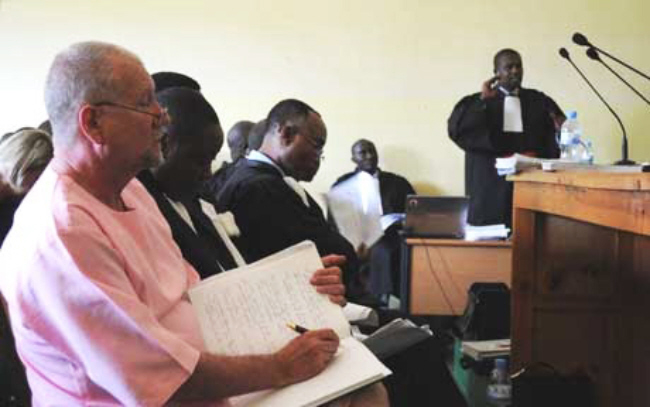
Prof Peter Erlinger appears in court in a prison garb during his imprisonment in Kigali

The London Evening Post:  You say your book – The Accidental Genocide – is the original version made out of UN documents – explaining day-by-day events that followed the 1994 genocide in Rwanda and after.  Please, explain more on this.

Prof. ErlinderDuring the ICTR Bagosora et al trial, I put thousands of pages of original UN documents into evidence that I was able to find in UN files that were not supposed to be released for 100 years.  The UN had dozens of persons reporting daily from Kigali and other places in Rwanda and Dallaire [Roméo Dallaire then UNAMIR Commander] met regularly with Kagame…These documents tell a completely different story than Kagame and the RPF told about the 4 year war and the 100 days of the “genocide”.  As a result, ALL leaders of the Habyarimana government and military were found not guilty of long-term planning of genocide or any other crimes BEFORE the assassination…. this means the mass violence was a reaction to the killing of the president…. NOT planned killing by a “genocidal government.”  The book explains how the mass killing in Burundi in the months before…. made Rwandans susceptible to fear of RPF…and the military superiority of RPF made the fear real.

The LEP: What was the primary objective of the original book?

Prof. Erlinder: To make the evidence that is already on the record at the UN Tribunal for Rwanda that acquitted the members of the Habyarimana government and military of long-planned conspiracy to commit crimes against civilians, including genocide, accessible to the general public using the original documents.

The LEP:  You have persistently rejected the official version about the 1994 Rwandan Genocide. Why? 

Prof. Erlinder: Because I was given access to documents in the UN archives that no other defence lawyer had…and got access to U.S. government documents, which are available to researchers; the documents require a different conclusion than the victors in the four-year war for power in Rwanda would prefer.  Before the Chief UN Prosecutor told the UN Security Council in 2003 that Paul Kagame assassinated President Habyarimana, I got access to these documents…. I believed the same story as everyone else.  The evidence changed my mind and the ICTR judges agreed.  Please see the Appeals Chamber Judgement of December 11, 2011.  Bagosora was found innocent of all crimes except for April 7, 8, 9…and Kagame said he was the “architect” of the genocide…but there was no evidence to support the claim.

The LEP:  The public, which is the majority, would say that you’re on a different page [knowledge about Rwanda Genocide] from what they know or have been told. Are you suggesting the public are disconnected from the truth?

Prof. Erlinder: After every war the winners tell the story – this is normal.  The public has heard the Kagame/RPF story repeatedly for 20-years.  UN and USG (United States Government) documents created at the time events were occurring tell a completely different story.  What is different this time is that documents that were to be secret for 100 years have been exposed, and have been put into evidence in the ICTR to acquit the losing side.

The LEP:  Who is fighting to see that he status quo remains as has been told?

Prof. Erlinder: Certainly the Kagame/RPF side that won the war wants to see that their story dominates.  But they were created and supported by the U.S./U.K…, which have an interest in the story remaining the same.  In 2003, UN Prosecutor Carla del Ponte was removed from her UN position by the U.S./UK when she insisted on prosecuting Kagame for killing Habyarimana and starting the genocide…. according to her own book (Madam Prosecutor) published in 2009.

The LEP: You mention about people in authority who have conspired to hide the truth. How are you prepared if they file a civil suit against you?

Prof. Erlinder: In the US courts, truth is a defense.  All of the statements and conclusions in my published work are supported by documented sources from USG, the UN or sworn testimony.  I merely accumulate and present evidence that is already on the record – which is what makes the publication important, not what I say.

The LEP:  As a human rights lawyer; what is your comment about how justice has been delivered to the perpetrators of the 1994 Rwandan Genocide?

Prof. Erlinder: The UN Tribunal has only prosecuted the crimes of those who lost the war.  The UN Tribunal was supposed to be a neutral body.  This means the Rwanda War was the only war in history in which only ONE side committed crimes OR the UN Tribunal was really a Victor’s Tribunal…. like Nuremberg and the Tokyo Tribunal.  My objection is that it should be recognized AS a victor’s tribunal…. and should NOT be sold to the world as something it was not.

The LEP:  What would you like to see with regards to the dispensing of justice?

Prof. Erlinder: Equal treatment for both sides in the Rwandan War and all national and international conflicts.  This means treating leaders of powerful and weaker nations equally.  The ICC (the International Criminal Court) has prosecuted only African leaders when it is plain that leaders of major powers such as the U.S. U.K, Russia, China, and France are at least as culpable.  We have not yet reached the point in history when the “rule of law” means the same for all leaders.

The LEP:  People would say that you’re on the wrong side. What would you tell such individuals who think, Prof. Peter Erlinder is on the wrong side about the 1994 Rwanda Genocide?

Prof. Erlinder: The evidence put before the ICTR judges caused them to agree with my analysis about whether there was a long-planned genocide by the Habyarimana government.  I have no opinions of my own.  I examine evidence and make conclusions based on the evidence.  It was UN Chief Prosecutor and the evidence that changed my mind…. when others have carefully examined all of the evidence, they might change their minds too.  But this is difficult because the emotions are so strong and it is much easier to respond emotionally than to do the difficult detailed research – which is why the book is based on historical records, not my opinions.

The LEP:  Given the dangers meted to you in Rwanda [experience], what you witnessed and what you’ve gone through as a result of your being involved in Rwanda issues at a level of an attorney in courts, why not just let it go to avoid being hunted by Kagame’s regime and secret agents?

Prof. Erlinder: I believe we all have a responsibility to history, to speak the truth and have to account to our actions to the infinite.  If one happens upon the truth based on evidence and does not speak, no religion in the world can respect that person.

The LEP:  Many people around the world see and consider President Paul Kagame as a saviour who stopped the genocide. In your own words-based on the UN documents you have gone through, how would you describe Kagame to a person who has never had a chance to look at what you have seen?

Prof. Erlinder: My book has a copy of the confession of Paul Kagame’s Chief of Staff Dr. [Theogene] Rudasingwa. He admits he was part of a 20-year cover-up of the killing of Habyarimana.  Former Chief UN Prosecutor Del Ponte has called for his prosecution openly since 2002.  The Chief UN Investigator Michael Hourigan called for his prosecution in 1997.  All of these facts have been covered-up…but they have long been in the public record.  Mr. Kagame tried to assassinate me in 2010 because I put this evidence in the ICTR record.  I think he knows already.

The LEP: Since you published The Accidental Genocide, have you received some kind of threats from Rwanda or from Kagame’s allies? If yes, who are they or what kind of threats did you receive?

Prof. Erlinder: I have been the subject of a personal “Wanted Dead or Alive” order directly from Mr. Kagame since October 1, 2010 after I escaped from Rwanda by pretending I had attempted suicide.  This order was given to all ambassadors, military attaché’ and military leaders.  The book has only refreshed the standing order, I imagine.

The LEP: Has anybody ever contact you to stop the publication of The Accidental Genocide? If yes, who and when?

Prof. Erlinder: No, the method of publication has been taken with precautions.

The LEP:    How do you manage to live this kind of life; watching your back all the time?

 Prof. Erlinder: As the information I have become more public and better understood, I become less important as an individual threat to Kagame. But, it is necessary to take precautions.

The LEP: With such evidences of the Rwanda Genocide coming into public domain, do you see in future; individual (s) taking responsibility to account for the atrocities? If your answer is ‘no’ or ‘yes’, why? 

Prof. Erlinder: In my opinion, Rwanda’s future lies in both sides taking responsibility and both sides mourning their losses.  A South African-style Truth and Reconciliation process is more likely to permit Rwanda to heal than a criminal tribunal process, which will never get the balance exactly right.  MOST important, the US and the UK MUST acknowledge the responsibility for creating and arming the RPF and manipulating the ICTR to make it appear that; the Hutu committed all crimes.  Demonizing a whole people is a form of “political genocide” that must be exposed and denounced as well.  THIS is what the US and UK have done in assisting the cover-up of RPF crimes.

The LEP:  You mean, Mr Paul Kagame issued an order mandating his all-inclusive ambassadors around the world to have you killed or kidnapped?

Prof. Erlinder: This is the report I received from a high-ranking military officer who has defected from the RPF who claimed to have been present at the meeting whose rank was such that he would have been at the meeting, the report was received person to person within days of the meeting from another defector who I know personally.  I must take it seriously just as Gen Nyamwasa [survived two attempt assassination]  and Col Keregeya [his body was discovered on New Year’s Day].


Americans, stop lying! You are as criminal as Kagame since he is your darling!

I have preferred to write the title  as above, and I hope I am not wrong. Read the story below and you will understand why! This means Americans are responsible for all those people killed by Kagame and other war crimes committed by the darling tyrant! Admin

museveni_gives_medal_to_kagame_0

The thing to know about Rwandan President Paul Kagame is not just that he is a dictator responsible for human rights abuses but that, despite this, he has a great many friends.

Kagame, credited with commanding the rebel force that put an end to Rwanda’s genocide 20 years ago, has made himself a global celebrity. Bill Clinton hails him as among “the greatest leaders of our time.” Tony Blair calls him a “visionary.” Bill Gates works closely with him. Kagame has spoken at Harvard and received honorary doctorates from a number of universities in the United States and Europe. U.N. Secretary General Ban Ki-moon is also a fan, telling Kagame in May, “I hope many African nations will emulate what Rwanda is doing. I highly commend you.” The praise inside Rwanda, in the press and public forums, is even more effusive. When I ask Rwandan citizens why there is no criticism of their president, I am told there is nothing to criticize. The political “opposition” consists of parties that refuse to speak out against Kagame even during elections, and there is talk of soon scrapping the constitution’s two-term limit for presidents so he can run in 2017 for a third time.

After all, for Rwandans, it can be lethal to be Kagame’s enemy. When Patrick Karegeya—Kagame’s former spy chief and friend who became one of his fiercest critics—was found dead in a South African hotel room in January, the Rwandan foreign minister, asked for the government’s response, tweeted, “This man was a self-declared enemy of my Gov & my country, U expect pity?” The Rwandan defense minister added, “When you choose to live like a dog, you die like a dog.” And Kagame himself remarked in a speech, “Shouldn’t we have done it?”

Not only was the president justifying a murder—he was warning his critics that betraying Rwanda brings consequences. In fact, in Kagame’s 20 years as the de facto leader of the country, more than a dozen prominent dissidents have been assassinated, imprisoned, exiled and tortured. According to Human Rights Watch and Amnesty International, in recent years perhaps half a dozen well known investigators, journalists and opposition politicians have also been found dead in mysterious circumstances, including, six months ago, a Rwandan Transparency International worker who had been investigating police corruption.

Foreign governments, notably the United States, Britain, Germany and the Netherlands, are nonetheless lining up at Kagame’s door with praise, and money, desperate for a foreign aid success story after 50 barren years in Africa. Total publicly reported foreign aid to Kagame’s government stands at some $1 billion annually, of which the U.S. government provides about a fifth. It’s not surprising that these Western countries, as well as international institutions like the World Bank, believe Rwanda is one of their best hopes in the region: Kagame’s government says it lifted 1 million people out of poverty between 2008 and 2012, and that the country’s economy grew at a remarkable 8 percent clip during the global economic crisis—successes that seem even more remarkable in a country still recovering from the 1994 genocide, which killed nearly a million people and brought the economy to a standstill.

The catch: Kagame administers the Rwandan government’s foreign-funded aid programs with a strict autocratic hand. Political critics have been imprisoned for speaking out when government programs cause harm. In 2011, for instance, a pastor criticized a nationwide housing project to eliminate thatched roofs because it left thousands of people homeless, and in return he was sentenced to 18 months in prison. Foreign-funded media and human rights programs that once reported on Kagame’s excesses, repression or policy failings—including programs run by Transparency International, Lawyers without Borders and the Rwandan League for the Promotion and Defense of Human Rights —have shut down or become toothless under government pressure. The Rwandan people know that to survive in such an environment, and to benefit from any government- or foreign-funded aid, they must be loyal to their president. Few other countries can mimic the results—95 percent participation rates in everything from elections to government health programs. Foreign donors echo the faux optimism, celebrating these programs’ efficiency and praising Kagame as a progressive leader; he is acclaimed, for instance, for promoting gender equality in the Rwandan parliament, where women outnumber men—even though the legislature has little power.

The United States, without doubt, is Kagame’s staunchest ally and oldest supporter, eager to maintain Rwanda as a strategic partner with a powerful army in mineral-rich eastern Africa. In the 1990s, Kagame studied at the U.S. Army Command and General Staff College in Fort Leavenworth, Kans., before he returned to Rwanda and seized power in 1994. (More recently, his son Ivan trained at West Point.) Although the United States typically provides only about half a million dollars in bilateral military aid to Rwanda, high-ranking current and former U.S. officials—including not only Bill Clinton but also national security adviser Susan Rice and Jendayi Frazer, a former top Africa diplomat—have a history of backing Kagame, despite evidence of abuses by his forces.

U.N. documentation implicates senior Rwandan military staff who report directly to Kagame in the large-scale massacre of perhaps tens of thousands of civilians, including unarmed women and children, in 1996 and 1998—acts that the United Nations has said are war crimes and possibly acts of genocide. (Kagame has said in response that his troops were difficult to control just after the genocide.) At the time of the massacres, Rice, then the assistant secretary of state for African affairs, reportedly said in a private conversation, “The only thing we [the United States] have to do is look the other way.” Later, as U.S. ambassador to the United Nations, she reportedly tried to block the publication of a 2010 U.N. report about the killings. (Rice denies that the United States “supported, encouraged or condoned” Rwanda’s invasion of Congo, during which the massacres occurred.) Washington has also shielded Kagame from the International Criminal Tribunal for Rwanda (ICTR), set up to prosecute killings during the genocide: In 2003, the United States pushed to remove Carla del Ponte, an ICTR prosecutor, after she began to investigate crimes linked to Kagame, which the United States feared would destabilize his government.

U.N. evidence also shows that Rwanda long supported rebel groups in the Democratic Republic of the Congo that are accused of crimes against humanity and mass rape, though Kagame officially denies his military’s involvement. A portion of Rwanda’s support stopped last year after warnings from the United States, which suspended some military aid last year, though Washington is now considering reinstating the funds. The mostly symbolic U.S. aid cut, after months of foot-dragging, helped to restore peace in Congo at least temporarily. But millions of dollars in foreign aid continue to flow to the Rwandan government, and Kagame’s supporters seem reluctant to diminish their praise. Bill Clinton, asked last year about Kagame’s tight grip on the press and political opponents, insisted he did not support it but admitted, “I suppose I do make more allowances for a government that produces as much progress as this one.” Or, as Sen. James Inhofe (R-Okla.), visiting Rwanda in January, put it, “I speak on behalf of many fellow senators back home, and I assure you that [the United States] doesn’t have a better friend than Kagame.”

Read more: http://www.politico.com/magazine/story/2014/02/rwanda-paul-kagame-americas-darling-tyrant-103963.html#ixzz2vkfY6imG

Ingabire Victoire, Faustin Twagiramungu and Fr. Thomas Nahimana, the most popular politicians of Rwanda.

ingabire

On February 23rd 2014, the online news outlet theRwandan asked its Rwandan readership to vote from a list of nine names the candidate who could become their next president in 2017.

From the outset, the list of names seemed to be a problem. There were some personalities that were not supposed to be there. I questioned the criteria that had guided the selection. This was my opinion. I decided to ask the editor about that issue. The commissioner of the opinion pool replied saying that the only objective of the exercise was to measure the popularity of preeminent Rwandan politicians.

I was finding that some personalities were even missing from the list. In my views, these individuals were worth being put forward for a popularity contest as well, because they had persistently voiced their concerns about Rwanda. They are as politically ambitious as anybody else and I don’t think they would decline the opportunity of accessing to the top office if they had that chance. Simple popularity contest or not, I could not agree with whatever criteria had guided who to put in the competition or who to exclude.

On March 11th 2014 the ranking of the nine candidates voted by 688 voters stood as this: Paul Rusesabagina [PDR Imanzi] (2%, 14 votes);Theogene Rudasingwa [RNC] (2%, 15 votes); Bernard Ntaganda[PS-Imberakuri] (2%, 15 votes); Deogratias Mushayidi [PDP-Imanzi] (5%, 33 votes); Kigali V Ndahindurwa [Party Inyabutatu] (7%, 48 votes); Paul Kagame [RPF] (18%, 123 votes); Thomas Nahimana[Party Ishema] (18%, 126 votes); Faustin Twagiramungu [RDI-Rwanda Rwiza] (22%, 148 votes); Victoire Umuhoza Ingabire [FDU-Inkingi] (24%, 166 votes).

Back to the listed candidates, according to the Rwandan constitution which provides for only two terms for the president, since Paul Kagame is already in the middle of his second term, we could logically consider that the votes of those who selected him should be considered as invalid. There are as well candidates such as Victoire Umuhoza Ingabire, Deogratias Mushayidi and Bernard Ntaganda who have been sentenced by Rwandan courts for more than six months of imprisonment. We can argue on the fairness of their trials. That is the reality. However, unless the regime which has convicted them through its judiciary system is removed from power, its judgements against these politicians could prevail, come 2017 elections. And because of that they would not be eligible for any public office, this again according to the Rwandan laws. Could we all agree that they have been unfairly treated by RPF which does not respect anybody’s right and always seek to tarnish anyone who could be a threat against them!

With a closer look at the scores, what do we have? What might have influenced people voting for such candidate and not this other one?

Paul Rusesabagina comes last. On the candidate’s credit is the fact that he saved more than one thousand Tutsis by sheltering them at Hotel des Milles Collines, this during the 1994 genocide. Such heroic act has attracted him broad international praise and triggered the production of the movie Hotel Rwanda. He has foreign friends particularly Americans who would like to see him become the future Rwandan President. As the score shows, he however lacks something that the voters see him being unable to deliver to become their leader.

Theogene Rudasingwa is the spokesperson of RNC. Former adviser of Paul Kagame and ambassador to Washington, since the creation of the party, he appears to be the front runner of that grouping of ex-RPF top strategists. He has been instrumental in diminishing the image of FDU-Inkingi which was the main political party of the opposition, but of recent has significantly been weakened despite the incontestable popularity of its leader. Would the weak score in the opinion poll be a result of persistent distrust among voters for the former RPF thinkers and top operatives? This might probably be the case.

Bernard Ntaganda and his party PS-Imberakuri were the only officially registered political party of the opposition until 2010 when it was infiltrated by RPF and split into two factions. Lawyer by profession, Ntaganda is part of the new generation of Rwandan politicians, but probably because of his imprisonment in 2010 which deprived him of freedom of speech for expressing his party’s positions and the personalities of other candidates on the political scene, he could not shine much in the present competition.

Deo Mushayidi is as well a former RPF high rank official, but his early defection to the opposition and his political positions made him more credible than his comrades. He has been sentenced to life imprisonment, apparently because he is ideologically a threat to the very existence of the foundations of RPF regime. He presents intelligently what the RPF regime wrongly stands for, or its contradictions about: protection of the Tutsi minority, democracy, development and justice.

Kigali V Ndahindurwa, is the ex Tutsi monarch, that Paul Kagame cannot stand, because he represents rightly or wrongly a threat to his total authority in the country. That he still gather some supporters, this means that, despite the abolition of the monarchy in 1961, there are sympathisers of what he represents in the Rwandan community.

Paul Kagame should not normally be featured among the competitors for reasons explained above. Sorry that I cannot comment on the score he managed to get. The Rwandan constitution is clear: no third term for a president.

Thomas Nahimana is another member of the younger generation of Rwandan politicians. His party Ishema, though only one year old, has brought on the Rwandan political scene new elements that were lacking: transparency, organization and demand for excellence. Its approaches appear less opportunistic than those of other political formations. For that reason, sometime it has seemed controversial in its positions. For example, though Ishema understands the plight of the Rwandan refugees, particularly those trapped in Eastern Congo, it does not espouse working with the rebel movement FDLR as long as violence could be part of solutions to bring political change in Rwanda.

Faustin Twagiramungu is a politician of the old guard. At some extent he is comparable to the Congolese opponent Etienne Tshisekedi for having served regimes that he fights against today. Always controversial in his views, though still popular in certain circles particularly among the youth which sees him as an opportunity for change, his past alliance with RPF and its disastrous consequences for the country continues to impact negatively on his credibility.

Victoire Umuhoza Ingabire, leader of FDU-Inkingi, is coming on top of the contest of popularity among Rwandan politicians for a number of reasons: she has come a long way and endured a lot of sacrifices; being the first Rwandan woman to want to become president; in her quest she publicly challenged Paul Kagame’s policies and particularly the many injustices that target the Hutu population. Despite the fact that her political party is presently divided and she is imprisoned, she represents for the majority of Rwandans indistinctively a window of hope for peaceful change.

I did not insist on ethnicity in this highlight of the outcome of the opinion poll because if it was of paramount significance, Hutus who are at the bottom of the list could’ve scored better than Tutsis who are higher in the scoring. This is the case of Kigeli V Ndahindurwa, Deogratias Mushayidi, and Theogene Rudasingwa. I think though ethnicity cannot be totally ignored, there seems to be other factors at play which are more important than that.

Between the three top scorers: Victoire Umuhoza Ingabire, Faustin Twagiramungu and Thomas Nahimana are all Hutus. None of them can totally reassure the majority of Tutsis who only feel safe when one of theirs is ruling. But this notion of safety must be understood in the sense that it means when Hutus do have their fundamental rights because that has been the case historically. In other terms, only Tutsis feel safe when Hutus are oppressed.

In order to overcome such situation my suggestion would be for example for Hutu leaders to seek alliance with people like Deogratias Mushayidi, a Tutsi leader who has persistently demonstrated an uncompromising understanding and objectivity in his interpretation of the Rwandan problems: social, economic and political.

Opinion polls like this one are online exercises which imply that to participate one needs to have access to Internet. For example it wouldn’t be wrong to assume that voters who participated into this competition of popularity among Rwandan politicians are significantly Rwandans living in exile, particularly in the West where access to internet is much more spread than in Africa including Rwanda.

Inside Rwanda the scoring could’ve been different for many diverse reasons if voters could’ve been informed about this competition and had access to internet. Some of the factors which could’ve played on their minds are: RPF daily influence and propaganda, level of objective knowledge about the candidates, etcetera.

Source: http://therisingcontinent.files.wordpress.com/2010/11/ingabire.jpg

South Africa takes a tough decision to protect exiled Rwandan politicians

01701201415381800000020140118_kagame

President Kagame has vowed to exterminate whoever dares speak his mind. What he hates the most is when he is reminded that one time he will face trial over his war crimes.

Rwanda and South Africa are still on speaking terms, but only barely – and if Dirco gets its way even this tenuous relationship will be terminated in the next few days. South Africa, finally, has had enough of Rwanda doing its dirty business on South African soil and has expelled three diplomats, with the ambassador to follow shortly. It’s a bold move, but have we thought it through? By SIMON ALLISON.

Relations between South Africa and Rwanda are at an all-time low after South Africa expelled three Rwandan diplomats on Thursday. And relations are about to get even worse.

South Africa, understandably, has had enough of Rwanda doing its dirty business on South African soil. First there was the assassination attempt on the life of Faustin Kayumba Nyamwasa, the former Rwandan general turned vocal critic of President Paul Kagame’s regime, in 2010. Then, earlier this year, there was the murder in a Sandton hotel room of Patrick Karegeya, the one-time head of Rwandan intelligence, who had fled his country looking for political asylum in South Africa.

After this murder, the Daily Maverick observed: “…with that regime’s track record, and South Africa’s undeniable appeal for Rwandan dissidents and exiles, Karegeya’s murder will not be the last such incident to happen within our borders.”

It wasn’t. The final straw came last week, when armed men broke in Nyamwasa’s Johannesburg home in another apparent assassination attempt (Nyamwasa was not home). This time was different, however. Previously, South Africa has not been able to link definitively the Rwandan government to the incidents, which means no public action could be taken against Rwanda – innocent until proven guilty, and all that.

But last week someone must have messed up. According to diplomatic sources, South Africa’s security forces were able to tie the break-in to three Rwandan diplomats working from their embassy in Pretoria (one Burundian diplomat was also involved, apparently).

The department of international relations (Dirco) wasted no time in taking action, revoking the dodgy diplomats’ credentials and sending them packing. Given their diplomatic immunity, this was the most serious punishment available to Dirco. Given that there were only four diplomats in the Rwandan embassy to start with, Ambassador Victor Karega must be feeling a little lonely.

Rwanda was just as quick to respond, with interest. “We have expelled six South African diplomats in reciprocity and concern at South Africa’s harbouring of dissidents responsible for terrorist attacks in Rwanda,” said Rwandan Foreign Minister Louise Mushikiwabo, parroting Rwanda’s official line that South Africa, with its ultra-progressive approach to refugees, provides a safe haven to Rwandan terrorists and genocidaires.

Mushikiwabo may have a point (although not one that justifies extrajudicial, extraterritorial assassination): Neither Nyamwasa or Karega are angels, and are both themselves implicated in the abuses of Kagame’s regime; while there has long been concern that perpetrators of the 1994 Rwandan genocide are hiding out among the Rwandan exile community in Johannesburg.

The row will escalate even further. Speaking anonymously, a senior Dirco official told the Daily Maverick that South Africa was planning to sever all diplomatic ties with Rwanda within 72 hours. “SA will not stand by and watch people be killed on our soil by another government, just because we happen to be opposed to a sitting regime,” the official said, adding that the freeze in relations is likely to continue for as long as the “cowboy” Kagame remains in office.

That could be for quite some time. Kagame’s term expires in 2017, and he’s not constitutionally permitted to run again. However, constitutions can be amended, and Kagame has previously floated the idea of a third term.

The rift between Rwanda and South Africa is likely to have implications far beyond their bilateral relationship. As part of the East African Community, Rwanda maintains very close ties with Kenya and Uganda. If sides must be taken – and it certainly looks like that is what South Africa is angling for – both countries would certainly favour their regional neighbour. Kenya wouldn’t need much convincing, anyway, with the current Kenyan administration already unhappy about South Africa’s stubborn commitment to the International Criminal Court (unsurprising, given that it is led by two men on trial at The Hague),

Of more immediate concern is the Democratic Republic of Congo, where South African troops are part of a United Nations force fighting rebels in the eastern provinces on the border with Rwanda. Those rebels are generally assumed to be supported by Rwanda, making the conflict something of a proxy war. At the moment, the rebels are very much on the back foot, having been overwhelmed by the UN force’s superior military power. The next step is to create some kind of lasting peace, addressing the issues which lie at the root of the conflict – an already difficult task, made exponentially more so if two of the protagonists in the conflict are no longer on speaking terms.

In expelling the three Rwandan diplomats, South Africa has taken a firm, principled stand against an outrageous violation of its sovereignty. But our diplomats must be wary: although they are currently enjoying the moral superiority, this situation could reverberate in uncertain and almost certainly unpleasant ways. Making Kagame an outlaw, and Rwanda a pariah state, risks becoming a self-fulfilling prophecy. DM

Source: http://www.dailymaverick.co.za/article/2014-03-10-south-africa-to-rwanda-dont-touch-us-on-our-sovereignty/#.Ux4WZvl5NLB

South Africa: Rwandan Politician’s home attacked by gunmen.

Kagame has vowed to kill all his political opponents. So many politicians have perished since RPF came in power. Recently, after Colonel Karegeya strangled on new year’s eve in Johanesbourg, General Nyamwasa’s home was attacked by gunmen yesterday (March 4th, 2014). Luckily General and his family were not at home. His computer was taken away. General Nyamwasa has survived death twice. Investigations have revealed that Kagame’s secret operatives were involved. Although politicians who oppose Kagame remain determined, they cannot afford to live like before. 

The blog admin

Read the story: http://www.therwandan.com/blog/general-kayumba-residence-attacked-by-gunmen-in-johannesburg-south-africa/

Vladimir Putin and Barack Obama engage in war of words over Ukraine

Vladimir Putin and Barack Obama traded accusations over the crisis inUkraine on Tuesday, with the Russian leader seeking to blame the Americans for the growing international standoff as the US president all but accused Putin of breaking international law.

The barbed exchanges, a sign of the escalating tensions between Washington and Moscow, came as Putin delivered his first public remarks on the crisis – ruling out a war days after his forces took control of the Ukrainian peninsula of Crimea, but reserving the right to use force to protect Russian speakers in the east of the country “as a last resort”.

Speaking from his country residence outside Moscow, Putin gave a robust performance during which he portrayed Kiev as being in the grip of “terror, extremists and nationalists” rampaging on the streets. Putin described what is broadly seen as a Russian land grab in Crimea as “a humanitarian mission”.

Obama and John Kerry, the US secretary of state, responded in apparent disbelief after Putin maintained there were no Russian forces occupying Crimea. “He really denied there were troops in Crimea?” said Kerry after arriving in Kiev, where he offered $1bn in loan guarantees to the new Ukraine government.

Vladimir Putin and Barack Obama engage in war of words over UkraineUS secretary of state John Kerry lights a candle and lays roses at the ‘shrine of the fallen’ for protesters killed in Kiev. Photograph: Valentyn Ogirenko/ReutersKerry accused the Kremlin of “hiding its hand behind falsehoods, intimidation, and provocations”.

Obama said: “There have been reports that Putin is pausing and reflecting on what’s happened. There is a strong belief that Russian action is violating international law. Putin seems to have a different set of lawyers, but I don’t think that is fooling anyone.”

On the ground in Crimea tensions remained high, with Russian forces firing warning shots at unarmed Ukrainian soldiers marching on an airfield.

Following several days of drama that saw Ukraine’s president toppled, a new government and interim head of state installed, and a Russian military seizure of Crimea, Putin said Moscow did not want to annex the territory.

“Regarding the deployment of troops, the use of armed forces. So far, there is no need for it, but the possibility remains,” he said. “What can serve as a reason to use the armed forces? Such a measure would certainly be the very last resort.”

Armed men in military fatigues block access to Ukrainian military barracks in the small Crimean city of Bakhchisaray.Armed men in military fatigues block access to Ukrainian military barracks in the small Crimean city of Bakhchisaray. Photograph: Genya Savilov/AFP/GettyBut the Americans accused Putin of preparing to expand his control over the country. “It is clear that Russia has been working hard to create a pretext for being able to invade further,” said Kerry.

The Americans are pushing for economic sanctions against the Kremlin elite and an EU emergency summit in Brussels on Thursday is also likely to decide on sanctions unless the Russians “de-escalate”.

It may be that the language employed by Putin will be taken as de-escalation and reduce the pressure for punitive action against Russia – global markets rose in response to tentative signals that the Kremlin was not seeking to escalate the conflict.

Putin also warned that sanctions were a two-way street and that ifEurope decided on that path, there would be a heavy cost to pay. EU trade with Russia is substantial, especially with Germany, more than 10 times the level of US-Russia trade, making it a lot less painful for Washington to decide on sanctions without fear of reprisals.

Link to video: Vladimir Putin: force in Ukraine is ‘last resort’“We are not going to go to war with the Ukrainian people. But there is the Ukrainian army,” Putin stated. “If we make this decision, we will make it for the people of Ukraine … Ukraine is not only our closest neighbour. It is our fraternal neighbour. Our armed forces are brothers in arms, friends. They know each other personally. I’m sure Ukrainian and Russian military will not be on different sides of the barricades but on the same side.”

The Russian leader strongly denounced the new administration in Kiev. He said he would refuse to recognize Ukrainian elections scheduled for the end of May. The acting president and government were illegitimate and Kiev was in the hands of “armed terrorists”, of “nationalists and extremists”.

“Our major concern is the … nationalists and radical extremists that are rampant on the streets of Kiev,” said Putin.

The deposed president, Viktor Yanukovych, who has fled to Russia leaving behind a lavish lifestyle in Kiev, remained the legitimate head of state, Putin insisted, although he also pronounced Yanukovych politically dead.

“There can be only one assessment of what happened in Kiev, in Ukraine in general. This was an anti-constitutional coup and the armed seizure of power,” he said.

A week after Yanukovych’s riot police killed dozens in Kiev and took fleeting control of a city centre square occupied since November by protesters, Putin retained the option of greater intervention on the basis of an alleged request from the toppled Yanukovych for Russian help. He contrasted that position with western behaviour.

“Our position is very different. Our position is completely legitimate. If we use force … we have received a request from a legitimate president. Also we have hisorical and cultural ties with those people. And this is a humanitarian mission. It’s not our goal to conquer somebody.”

Unarmed Ukrainian troops bearing their regiment and the Ukrainian flags march to confront soldiers under Russian command occupying the Belbek airbase in Crimea in Lubimovka, Ukraine.Ukrainian troops march to confront soldiers under Russian command occupying the Belbek airbase. Photograph: Sean Gallup/Getty ImagesThere were also signs of new negotiations on the crisis. Arseniy Yatseniuk, the acting Ukrainian prime minister, said his government was in touch with Russian ministers with a view to holding “consultations”.

Kerry called for negotiations, while it appeared that international observers and mediators would be dispatched by the Organisation for Security and Co-operation in Europe, of which both Russia and Ukraine are members.

“I’ve spoken as directly to President Putin today as I can,” said Kerry. “To invite him to engage in a legitimate and appropriate dialogue, particularly with the current government of Ukraine.”

Obama said: “There is a suggestion that Russia’s actions have been clever, but this has not been a sign of strength, rather a sign that countries near Russia have deep concerns about this kind of meddling and if anything it will push them further away from Russia.”

There are said to be 16,000 Russian troops securing control of Crimea, where they enjoy broad backing from the majority ethnic-Russian population.

Putin said there were no Russian forces, merely local self-defence units. “There are many military uniforms. Go into any local shop and you can find one,” he said. Putin also said he was continuing preparations to host a summit of the G8 countries in Sochi in June. All the other countries have frozen their preparations. While Washington has said Russia could be kicked out of the G8, Berlin is resisting such moves.

Putin was dismissive of the threats. “If the leaders don’t want to come, fair enough,” he said.

source: The Guardian

UNSCR Resolution 2140 on Yemen

usdos-logo-seal

Fact Sheet

Office of the Spokesperson                                                                                                                             Washington, DC                                                                                                                                               February 26, 2014

On February 26, 2014, the UN Security Council adopted a resolution welcoming the conclusion of Yemen’s historic National Dialogue Conference and reaffirming Council support for the implementation of subsequent stages in the country’s political transition process. The Council emphasized the critical need to turn the page on the presidency of former President Saleh and called for a cessation of all actions meant to disrupt the political transition in Yemen.

With this resolution, the Council has taken a significant, forward-leaning step in setting up a sanctions committee, which will allow the Council to respond quickly with targeted sanctions against individuals engaging in or providing support for acts that threaten the peace, security or stability of Yemen.

  • Resolution 2140 continues the Council’s active engagement on Yemen and reaffirms its support for Yemen’s political transition on the basis of the Gulf Cooperation Council (GCC) Initiative and Implementation Mechanism, signed by the Yemenis on November 23, 2011.
  • Resolution 2140 welcomes the outcomes of the comprehensive National Dialogue Conference, which provide a road map for Yemen’s continued democratic transition.
  • Resolution 2140 commends the leadership of President Hadi and the ongoing commitment of the people of Yemen to a peaceful and meaningful transition.
  • Resolution 2140 reaffirms the need for the full and timely implementation of Yemen’s political transition, as outlined in the GCC Initiative and its implementation mechanism, including the drafting of a new constitution and the holding of a referendum on the draft constitution and, ultimately, national elections. It encourages all stakeholders to continue their constructive, nonviolent engagement in implementing the transition.
  • Resolution 2140 establishes a sanctions committee with a mandate to sanction individuals found to be engaging in or providing support for acts that threaten the peace, security or stability of Yemen. The committee will be supported by a four-person panel of UN experts who will compile information about those who may engage in or provide support for such acts.

Source: U.S Department of State


IYICWA RYA PADIRI EVARISTE NAMBAJE. : ARIKO SE FPR IPFA IKI N’ABAYIKEZA !

Kera mu mashuri abanza hari icyivugo cy’umubiri cyatangiraga kivuga ngo ese umpoye iki ruhu rwanjye. Kigasoza kigira kiti “inzoga ya ngeso yanga ababo, aho kuyivumba nzayinywa hambavu”. Ku bato batazi ikinyarwanda cy’abasaza ibi biravuga ngo umuntu wanga abitwa abe, bikugwiririye mwasangira, ariko ntuzamwiyegereze ngo umuvumbe cyangwa se agutumire. Nzinduwe no gufatanya ngo twungurane ibitekerezo ku kibazo kitoroshye: kuki FPR ari ngeso yanga ababo. Kuki FPR irimbura abitwa abayo cyangwa abayikeza, ni ukuvuga abayishakaho ubuhake?.

1. Kugira isano na FPR bibaye nko gutunga urupfu mu mbere.

Turondoye abo FPR yoretse biturutse ku isano bafitanye (yaba isano nyakuri cyangwa se isano abantu bihimbira) urutonde ntirwabona aho rukwirwa. Reka ne kugira icyo mvuga ku bihumbi amagana by’abatutsi batikiye muri jenoside. Muribuka uburyo FPR yakoze ibishoboka ngo urwango hagati y’amoko ruzamuke (stratégie de la tension) bityo izasahurire mu nduru. Siniriwe mvuga uko yarwanye inkundura ngo Loni idatabara igahagarika ubwicanyi n’intambara kandi iyo ntambara ari yo FPR yari itezeho iteme rigana ku gufata ubutegetsi budasangiwe. Ntabwo ndirirwa mvuga amagana y’abasore n’inkumi bavuye za Burundi na Kongo baje kuyifasha urugamba. Batikiriye mu rugano Abasajya bakeka ko nibagera mu gihugu bazabafatana imyanya y’ubuyobozi kuko impunzi z’i Burundi na Kongo zari zarize naho iza Uganda zikumira ku murizo w’inka (abashumba). Ubishidikanya nambonera umujenerali utaravuye Uganda (keretse ba Rwarakabije bo muri FDLR) azambwire.


Abayobozi mu nzego za Leta n'abaturage benshi bitabiriye umuhango wo gushyingura Padiri Nambaje.

Hari  n’abari bazinduwe no kugenzura niba koko igikorwa cyaragenze uko babishakaga !


Twabanje kugira ngo ni ibyo mu ntambara, nyamara uwitegereza abona ko bigikomeje mu zindi nzira: Kuva kuri Seti Sendashonga ukagera kuri Karegeya, ubaruye usangamo ibitambo bitari bike. Ibi nabyibutse ejobundi aho Padiri Evariste Nambaje anigiwe bukoko kandi byari bimaze kugaragara ko ari mu bakeza neza(bashaka ubuhake) FPR. Ubyegeranyije byose usanga FPR yaramaze kwesa umuhigo utarigeze ubaho mu mateka. Abazakora amataka nyuma yacu, bazarwana no kumva no gushaka impamvu FPR, n’ubwo itarebera izuba abayirwanya n’abatayiyoboka, ariko abayiyoboka n’ab’iwayo mu mbere bo ibarimburira kubamara. Igitangaje ariko, bazatungurwa n’uburyo iyo igeze ku bayo ibacura bufuni na buhoro.

2. FPR iyo itagushaka ariko nta mabanga mufitanye, iragufunga. Iyo itakigukeneye ariko mufitanye amabanga, irakwica.

Ibi bishobora gutungura abantu, ariko uwacishamo ijisho yabona uburyo FPR irenganya abantu ku bipimo binyuranye. Iyo uyirwanya, iyo utayiyoboka, ariko mukaba nta mabanga mwigeze mugirana, urafungwa, cyangwa ugahunga, cyangwa ikagukenesha ukaba imbwa. Ariko iyo mwigeze kugirana amabanga nyuma mugashwana cyangwa ukaba utagikenewe: FPR irakwica.Gihamya ni Lizinde, Sendashonga, Rwisereka, Ruzibiza, Majoro Cyiza…urutonde ni rurerure. Uwahera aha yakumva impamvu, n’ubwo Ntaganda na Victoire baregwaga ibyaha bikarishye kurusha ibya Mushayidi, bo FPR yabakatiye ibihano bito (ni binini ku bantu barengana), naho Mushayidi ikamukatira burundu.

Igikomeye ariko ni ukugerageza kumva impamvu FPR ikora itya. Kuvuga gusa ko iba yanga ko bazamena amabanga ntibihagije. Ibyo byaba ukuri ku bo mu mbere nka Karegeya, ariko se amabanga adasanzwe Padiri Evariste yari azi ni ayahe banyarwanda? Hari izindi mpamvu ebyiri mbona ko abantu batakwirengangiza.

3. Impamvu ya mbere: Ubuhake bw’ubucanirambwa.

Ubusanzwe mu kinyarwanda bacanira inka gusa. Mu gushaka ubuhake, umugaragu utiyizeye yarangwaga no guhuzagurika bikabyara gukabya no kurenza, hakaba ubwo acanira inka, agakabya agacanira n’imbwa za shebuja kandi ubundi kizira. Ni ho haturutse kwita ubwo buhake ubucanirambwa. Iyo umuntu ashaka kwemerwa ku ngufu mu kintu iki n’iki ubusanzwe adafitemo ingufu, hari ubwo ashyiramo ubushake agakabya bikazanamukoraho.

JPEG - 125.4 kb

Ngiyo imodoka yasanzwemo umurambo wa padiri Evariste, iparitse muri Nyungwe !

Reka dufate urugero rwa Majoro Cyiza Augustin (aruhukire mu mahoro sinzinduwe no kumunenga cyangwa gukora mu bikomere umuryango we, ariko ibiriho biravugwa munyihanganire). Naganiriye n’abasirikari bato (sous-officiers) binjiranye mu nkotanyi mpavana agace k’igisobanuro cy’iyicwa rye. Ngo bamaze kwi “ripotinga” (ni ko bo babimbwiraga) inkotanyi zarabicaje ziti mutubwire uko igisirikari cyanyu cyakoraga. Abana bato barabigarama. Bati twizanye ariko na none ntituri abagambanyi. None se mwe mwashima ko umunsi twavuye mu gisirikari cyanyu tugenda tuvuga ibyanyu mu mayirabiri? Ngo icyabatangaje ni uko Majoro wari ubakuriye abarusha n’imikorere y’uwo mwuga (déontologie) yafashe ijambo maze agasasa intahe. Ngo yaravuze ageza no ku kari i Murori. Wenda shobora kuba yarabikoze mu rwego rwo gushaka kugirirwa icyizere nk’umuntu witanze wese, ariko hari icyo yiyibagije. Inkotanyi (kimwe n’undi wese) ntizabuze kwibaza ziti uyu Major umena amabanga y’abandi ku buryo bworoshye nta n’umushyizeho agahato, natwe ni ko yazamena ayacu. Ibi byasobanura imwe mu mpamvu z’iyicwa rye.

4. Impamvu ya kabiri: amafaranga.

Kuba inkotanyi ari abacancuro bafashe igihugu si ibanga mvumbuye. Kuri bo , “ifaranga”niyo ndangagaciro iruta izindi : hose baba bahashaka amafaranga !Icyo nshaka kwerekana ni imwe mu ngaruka bifite ku miyoborere y’igihugu. Burya imyumvire n’imikorere y’inkotanyi mu by’ubukungu ni icyo mu masesengura bita “économie de guerre” (ubukungu bushingiye ku ntambara). Ni ukuvuga ngo ibyo zikora byose mu bukungu ziba zitekereza intambara, yaba iy’amasasu cyangwa guhangana n’abazirwanya mu bya politiki. Nintanga ingero murabyumva.

Padiri Rwakabayiza Dieudonne avuga iby'urupfu rwa mugenzi we Nambaje.

Ngo intandaro y’urupfu rwa Evariste  ni imirimo yakoraga yo kubakisha Hoteli !

Amatora yo muri 2003 ajya kuba, mwabonye ko bahaye uruhusa ibigega byinshi by’imari (Microfinances). Byijeje abantu kubaha inguzanyo ku buryo bworoshye maze amafaranga bayavana mu mabanki bayashyira aho. Byoroheye FPR kubona ayo ikoresha amatora kuko abaterankunga bari bayifungiye amayira banenga ubwisanzure buke mu itegurwa ryayo. Iyo amafaranga aguma mu mabanki asanzwe ntibyari kuborohera kuyakoresha uko babonye. Ayo mabanki abaterankunga (FMI, BM) barayagenzura, cyane ko hari n’andi yo mu mahanga ayafitemo imigabane. Naho ibigenga biciriritse ni umwihariko wa Banki Nkuru y’u Rwanda. Mwibuke ko amatora arangiye bya bigega byose byahise bifunga ngo byahombye, nyamara nyuma y’imyaka 11 nta muntu n’umwe uragenzwa mu butabera kubera icyo gihombo. Kugirango bidasakuza, Banki Nkuru yemeye kwishyura abari barabikije muri ibyo bigega, ariko kugeza n’ubu abagombaga kwishyurwa barategereje amaso ahera mu kirere! Ikindi ariko cyari kigamijwe, ni ugukamura amafaranga mu baturage akarundwa aho FPR yizeye igenzura, kuko bikangaga ko hari abayakoresha bashyigikira umukandida Twagiramungu. Mu kwirinda ko hagira na make asaguka, bategetse abacuruzi bose gusiga amarangi mashya ku maduka no kuvugurura igisenge cy’imbere (balzan). Byitwaga umuhate mu isuku ariko impamvu yari ahandi.

Reka nsoreze ku rugero rw’ibigori. Muribuka inkubiri imaze iminsi yo guhingisha abaturage ibigori ku ngufu. Icyo abantu bibanzeho ni uko gukoresha ingufu, no guhingisha abantu igihingwa kimwe. Ariko nta wibajije impamvu icyo gihingwa kigomba kuba ibigori. Igitangaje rero, nta n’ingada nshyashya zubatswe zitunganya ibyo bigori ngo tugire tuti ni umushinga urambuye. Muribuka kandi ukuntu abaturage babujijwe no kugira icyo botsa bagategekwa gusarura no guhinika hamwe, bikitwa kwiteganyiriza. Nyuma basubiraga kubishaka bakabuka inabi. Ni byabindi nyine by’ubukungu bugamije intambara. Hategurwaga intambara ya M23, bari bazi ko izaba ndende ikaba yagera na Kinshasa. Kandi inkotanyi zizi uburyo ibigori ari rudasumbwa mu gutunga abasirikari ku rugamba. Ni byo byazitunze imyaka ine yose. Aho M23 itsindiwe, inkubiri y’igihingwa kimwe yaracogoye, ijambo ikigori ryo ntawe ukiryumva. Keretse hirya mu biturage aho abayobozi b’ibanze bakurikira butama, bagakomeza inyikirizo batazi ko intero yahindutse hambere.

N’inkubiri y’ikigega Agaciro yari muri uru rwego. Abanyarwanda baguze ibikoresho bya M23 batabizi, kandi mu nzira abaterankunga badashobora kugenzura. Aha hadufasha kumva uburyo ministeri iyi n’iyi yadahaga mu mutugo wayo (wa leta) ikamena mu kigega kindi na cyo cya leta, ukibaza agaciro kabyo ukakabura. Iyo uzirikanye ibi, ukibuka ko umusenyeri wa Gatolika Ntagatifu nka Simaragidi yashishimuye ibaruwa ategeka abantu gutanga amafaranga yo gutera Kongo no kurimbura imbaga (Agaciro Fund), yaba yarabikoze abizi cyangwa kubera ubuswa, wumva uzanye urumeza ku mubiri. Uwapfuye yarihuse koko, atabonye aho bavanga amata n’amatezano!

Muri iki gice cy’amafaranga n’ubukungu bushingiye ku rugamba, ni ho humvikanira iyicwa rya Padiri Evariste Nambaje.

5. Padiri Evariste Nambaje, amafaranga, n’ubukungu bwubakiye ku ntambara za FPR.


                                     Uwo bagambaniye , nta garuriro, afumbira umunaba !

Iby’umubano udasanzwe cyangwa se ubuhake hagati ya FPR na Padiri Evariste byatangiye kunugwanugwa mu myaka itatu ishize, ubwo yafataga iya mbere yungikanya impapuro zisaba ko ngo ikinyamakuru leprophete.fr cya Padiri Tomasi cyafungwa ngo na nyiracyo agafatirwa ibihano. Icyaha yamushinjaga ni uko inyandiko asohora zinenga ubutegetsi bwa Kigali zibiba amacakubiri mu banyarwanda kandi zikabangamira politiki ya Leta y’ubwiyunge. Uwazishaka yanaga akajisho aha: (http://leprophete.jimdo.com/2012/12/19/iyo-padiri-evariste-nambaje-ashaka-kwibagiza-rubanda-igihombo-yateje-diyosezi-ya-cyangugu-yitakana-urubuga-leprophete-fr/). Mu kumusubiza, padiri Tomasi yemezaga ko ibi bigamije guhishira igihombo yateye Diyosezi kandi inzira amafaranga yanyuzemo ngo ikaba ica ku irembo kwa FPR. Yaragize ati: “bimaze kugaragarira bose ko iyo ibibazo byamurenze biturutse ku makosa ye bwite no ku rukundo yikundira FPR-Inkotanyi (yagabiye amafaranga atari make ya Diyosezi Cyangugu kugira ngo akunde yemerwe mu Cyama !) aribwo yibuka ko leprophete.fr ikibaho n’abapadiri bayishinze bakaba bagihumeka!”.

Nyuma byaje gukomeza, n’imbuga bizwi ko zivugira FPR nka Rushyashya ya Tom Ndahiro zitangira kwerekana ku mugaragaro ko uyu mupadiri yizewe bidasanzwe. Mu nyandiko Rushyashya yasohoye tariki 10 nzeri 2013, umwanditsi wayo Cyiza Davison yaragize ati:

Padri Eugene yahunze yizeye ko abazungu b’inshuti ze bazahita bamwakira bakamufasha kubona impapuro zo kuba i Burayi,nyamara yagezeyo biramugora ,ubuzima buramusharirira, ahitamo kugaruka mu Rwanda.Yaje ameze nk’umuntu ubebera, usesera kubera ikimwaro.Kubera iryo pfunwe rivanze n’ubwoba bwo gukurikiranwa yitabaje Padri Eric NZAMWITA na Padri Evariste NAMABAJE nk’Abapadri bagenzi be Leta ifitiye icyizere, umucuruzi witwa Alexis NSENGUMUREMYI n’izindi nshuti ze za hafi kugira ngo bamufashe.Bamubaye hafi yongera kujya ahagaragara no gusubira mu buzima busanzwe”.

Ndetse na nyir’ubwite ubwe byageze aho bijya bimucika, akigamba, akiyerekana nk’umuntu ufite imbaraga zitagira bose. Mu butumwa yoherereje mugenzi we padiri Tomasi yamugiriye inama nyinshi harimo no gufunga urubuga leprophete, nyuma mu gusoza ati: “Nyuma y’ibyo niba ushaka kuza mu Rwanda,  nzaguha umusanzu wanjye ushoboka muri iyo gahunda yo gusaba imbabazi no kongera kumenyera”.

6. Imbarutso ntiyaba yarabaye Kongere y’Ishema Party ?

Ibi byose nta wakumva aho bihuriye n’iyicwa rya Padiri Evariste Nambaje arenze kuri Kongere y’ishyaka Ishema. Kuva tariki ya 7 kugera ku ya 9 Gashyantare 2014, hateranye Kongere y’Ishema maze itanga Padiri Tomasi Nahimana nk’umukandida uziyamamariza umwanya wa Perezida wa Repubulika muri 2017. Insiriri y’iyicwa rya Padiri Evariste iba iratangiye. Nk’uko byagenze muri 2003 ubwo hakorwaga ibishoboka byose ngo hatagira amafaranga ajya gushyigikira iyamamaza rya Twagiramungu, FPR ubu na bwo irikanga ko Padiri Tomasi yagira abamushyigikira. Uwa mbere yahise itekereza ni Padiri Nambaje ihitamo kumukuraho.

Imbaga nyamwinshi yitabiriye umuhango wo gushyingura padiri Nambaje.

Padiri Evariste yaherekejwe na bagenzi be benshi.

Hari uwambwira ati urivuguruje kuko umaze kutubwira ko uyu mupadiri yari acuditse na FPR atumvikana na Tomasi. FPR izi ko ubucuti bwayo butamara kabiri. Ni kenshi abayisingiza uyu munsi bucya bayivumbuye bagasigara bayivumira ku gahera. Ibyo byashobokaga no kuri Evariste Nambaje. Ibi bikaba ikibazo cyane ko mu guha FPR iritubutse rya Diyosezi, yagaragaje ko iyo ashyigikiye impamvu yitanga atitangiriye itama. FPR igatinya ko bihindutse yariha na mugenzi we Tomasi. Cyane ko burya abantu babyirukanye, bakigana, bakaba banasangiye ubupadiri aba ari nk’abavandimwe. Ntawe umenya aho biyungira n’igihe biyunga. Kandi rero, FPR yari yaragaragaje kenshi ko n’ubwo bakoranaga, yakekaga ko ashobora no guca ruhande agakorana na padiri Tomasi. Tariki 26 mutarama 2012, igihe.com yagiranye ikiganiro kirambuye na Padiri Eugène Dusabirema ku idindira rya ya Hoteli Ituze. N’ubwo ibibazo byagombaga gusubizwa na Padiri Evariste, byashubijwe na Padiri Eugène. Uyu bari banafatanyije urugamba rwo kurwanya leprophete.fr mu rwego rw’ubuhake. Igihe cyo kibisobanura gitya: “IGIHE yegereye Padiri Evariste Nambaje ari nawe ushinzwe umutungo muri Diyoseze ya Cyangugu kugira ngo rumenye neza iby’iyo nkuru. Padiri Evariste Nambaje yadusobanuriye ko amakuru nyayo twayahabwa na Padiri Eugene Dusabirema, Padiri Mukuru wa Paruwasi ya Mibirizi akaba n’umwe mu bagize inama y’umutungo ya Diyoseze kandi akaba anayimazemo igihe kirekire” (http://leprophete.jimdo.com/2012/04/17/padiri-dusabirema-e-mukuru-wa-pascal-ntiharabayo-aremeza-ko-urubuga-leprophete-fr-rwandika-impuha-zisenya-ubumwe-bw-abanyarwanda/).

 Muri iki kiganiro harimo ikibazo giteye kwibaza.

 “IGIHE : Ibivugwa ko padiri Evariste Nambaje yaba ari umwe mu bapadiri ba Diyoseze ya Cyangugu ukorana na ziriya mbuga ku buryo anazoherereza amakuru byo mubivugaho iki ?

Padiri Dusabirema: Ikigaragara cyo ni uko iyo umuntu yohereza amakuru atizewe, ibihuha, amacakubiri, amakuru atubaka, akenshi ahinduranya amazina. Abavuga rero ko yaba ari umupadiri njye sinabyemeza. Gusa bigaragara ko umukirisitu nabwo adafite amakuru nyayo yatuma atanga n’imibare ifatika y’ibyavugiwe mu nama y’abapadiri. Gusa bigaragara ko hari umuntu certainement wagize utya atanga amakuru na yo adafite ishingiro”.

Ntibyabura gutangaza umuntu kubona mu kiganiro kimwe kigamije kwerekana ko ngo leprophete.fr yasebeje padiri Evariste imushinja guhombya diyosezi, ari na ho bibaza niba ayo makuru atari we uyatanga!!! Uyu se Eugene akeka ko yatanze amakuru azabe ari Evariste agobyoreraho? Wenda byakumvikanisha impamvu yahunze gusubiza ibibazo bimureba akohereza abanyamakuru kwa Eugène. Ikigaragara ni uko FPR yamubeshyaga ko imwizeye, ariko igaca iruhande ikanamwishisha. Mu gihe rero mugenzi we agiye gutaha no gukorera politiki, bizabe aribyo bitumye isaha ye igera ngo atazamuterurira akayabo nk’ako yapfunyikiye FPR ? Kugirira FPR neza ni nko kunywana n’impyisi.

Umwanzuro: Kuri FPR igishobora kubaho (probabilité) kiba cyabaye.

JPEG - 61.1 kb

Nguwo Depite Jeanne d’Arc Nyinawase ngo  winjije Padiri Evariste mu Cyama ! Arajijisha anashinyagurira rubanda ngo “nibahange amaso ubutabera !!” Ubutabera bwa he ?

Mu kwica abo ikeka, FPR ntitandukanya uwakoze ikintu n’ushobora kugikora. Kuri bo iyo ushobora gukora ikintu, uba wagikoze. Ugomba gupfa ngo utazavaho ugishyira mu bikorwa. Evariste ashobora kuba atanarotaga kuzaha Tomasi amafaranga ya Diyosezi mu kwiyamamaza, dore ko nta n’ayo yari agicunga mu by’ukuri, ariko kuba FPR itamushira amakenga birahagije ngo yicwe nk’umugome. Ibi bamye babikora. Mu ntambara y’abacengezi za Gisenyi na Ruhengeri, Kayumba Nyamwasa wari ukuriye Ingabo yigeze gusobanura icyo bitaga“ikinyeganyega”. Ryari itegeko ryo kurasa ikinyeganyega cyose ngo hatagira umucangezi ubacika. Cyaba igiti, umwana, umukecuru, ihene, cyangwa imbwa. Ubwo gishobora kunyeganyega ari umucengezi, kirase naba we uraba umwishe, naba ari ikindi nta shida.

Si njye wahera hahera umugani.

Gusa byumvikane neza ko urupfu rwa Padiri Evariste Nambaje rubabaje benshi kuko mu by’ukuri azize ubusa !Turongeye duhombye undi muntu, nk’uko twabuze n’abandi ibihumbi n’ibihumbi! Musenyeri Mbonyintege yavuze ukuri ubwo yagiraga ati “FPR ntiyica gusa ahubwo irabaga” , none birasa n’aho abayobozi ba FPR baba bariyemeje guhinyuza iyo mvugo : FPR ntikibaga gusa isigaye “iniga” !

Muvandimwe Padiri Evariste, washyinguwe uyu munsi, igendere, Nyagasani aguhe iruhuko ridashira, amaze akwiyereke iteka, uruhukire mu mahoro.

Nta kindi numva nakubwira uretse kukuririmbira aka karirimbo :

Hariho indi si nziza cyane,

Twasezeranyijwe n’Imana

Tuyitegereze twizeye

Yuko Data ayiduhishiye.

R/Aheza ni mu ijuru,

Tuzahurirayo bagenzi!

Munyangaju Edmond