Category Archives: International

Shame on you Tufts, Harvard, MIT, Brandeis, and Stanford! You have sold your credibility to crown Kagame with a tenured professorship of dictatorship of the 21 century.

Image

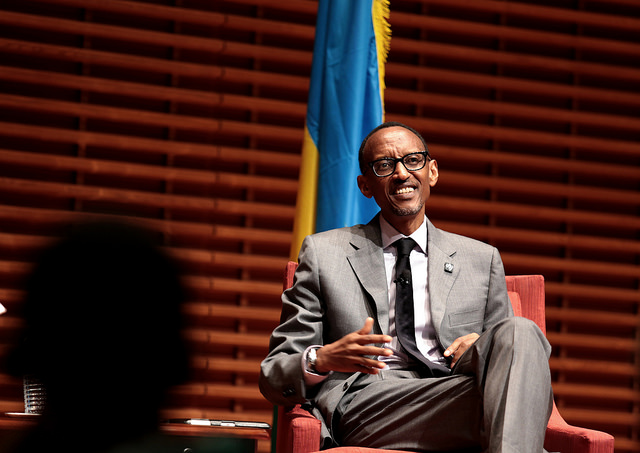
Kagame at Stanford Univeversity on last Friday. By this malign smile he will make you fall for him. Do you really want to know what he has in his mind? All you need is to remind him that he has killed Rwandans since October 1, 1990, sacrificed Tutsi to take the power and captured and sold Eastern Congo to the West to maintain himself finacially sound and wants to change the constitution so that he takes another 7-year term in office. He will show you his real nature which is nothing less than criminality. Admin

By Theogene Rudasingwa

President Kagame addresses Stanford University students last Friday

Paul Kagame has been touring top American universities giving speeches deceiving unsuspecting students and uncaring top brass at these academic institutions about what he calls accomplishments of his reign: peace, human rights, democracy, development, etc. This is vintage Kagame: he has the whole Rwandan population under lock and key, assassinates and imprisons dissenting voices, and then goes to the land of his benefactors to taunt the West as if to say, “I do what I want, you can go to hell!”

Other than his love of a million dollar luxury travel (money that ends in his private pockets because he rents the private jets bought on public money to the Rwandan state) and expensive $20k a night hotel, and an opportunity to visit his children studying here in the USA, Kagame seems to be thrilled to receive honorary doctorates and rub shoulders with academics. For a man who never stepped in a university out of indiscipline, and not lack of intelligence, has he discovered that universities are useful centres of learning, contributing to human progress?

Universities have historically been places where intellectual freedom, openness, and innovation have been nurtured. It is then ironical that Kagame, the enemy of freedom and openness in Rwanda, would be welcomed to Harvard, Tufts, MIT, Brandeis, and Stanford to extol the same values that he lacks and fights. He should be grateful to Tony Blair, Bill Clinton, Michael Porter, Rick Warren, Michael Fairbanks and other hired mercenaries whose greased hands can return favours that enable him to hobnob with academics who do not care about the plight of Africans.

Of late Kagame has not been received with fervour at U.S. State Department and the White House. He must be secretly lamenting that. Universities provide an alternative opportunity to be around here, and to continue his campaign of deceptions and denials. On this particular trip he seems to be indirectly telling his strongest supporter, the United States, that he will change the constitution, and run for as long as he wants, and nobody will stop him.

Nobody should ever not take Kagame’s threats seriously. He has killed and waged wars with impunity. He is fond of saying privately that the West and the so-called international community lack the interest and will to stop him from doing what he wants.  He is right in this regard but wrong in another sense. Rwandans have the interest and will to stop and reverse the effects of his murderous madness.

And when that happens, and Kagame survives the coming change in Rwanda, Tufts, Harvard, Brandeis, MIT and Stanford should perhaps crown him with a tenured professorship of dictatorship. After all, he has stolen enough money to offer generous endowments to these otherwise prestigious but heavily commercialized institutions. Shame on you Tufts, Harvard, MIT, Brandeis, and Stanford!

Dr Theogene Rudasingwa is a former Rwandan ambassador to the United States who now lives in New York after falling out with President Kagame. He is a member of Rwanda National Congress (RNC)one of the opposition political organizations.


North Korea labels South’s president as ‘crafty prostitute’ after Obama visit

Tirade against Park Geun-hye hits new low in unusually personal abuse, which analysts say may indicate Kim Jong-un echoing his grandfather.

Barack Obama and South Korean president Park Geun-hye

Barack Obama with the South Korean president, Park Geun-hye, in Seoul on Saturday. Photograph: Larry Downing/Reuters

North Korea has launched a vitriolic attack on the South Korean president, comparing her to “crafty prostitute” in thrall to her “pimp” Barack Obama.

It also described Park Geun-hye as America’s “comfort woman”, a reference likely to enrage many in South Korea, where anger still runs high over the plight of thousands of women who were enslaved in Japanese military brothels during the second world war.

The comments were issued on Sunday by the Committee for the Peaceful Reunification of Korea (CPRK), which handles cross-border affairs, following the US president’s two-day visit to Seoul. He arrived in Malaysia on Sunday for the penultimate stop on his four-nation tour of Asia.

While Pyongyang is known for its aggressive rhetoric, recent remarks have been unusually personal.

Earlier this month state media ran misogynist articles, including one headlined “We accuse Park the bitch“, labelling her as a lunatic, idiot and “cold-blooded animal” and emphasising the fact that she has never married or had children.

Those remarks were presented in the form of quotes from ordinary North Koreans, while the latest tirade, carried by state news agency KCNA, is presented as a statement from an official body.

It comes days after a homophobic diatribe which described the head of a United Nations commission on human rights in North Korea as a “disgusting old lecher”. Pyongyang was angered by the team’s report, which said it was committing grave and systematic human rights abuseson a scale unparalleled in the modern world.

“What Park did before Obama this time reminds one of an indiscreet girl who earnestly begs a gangster to beat someone or a capricious whore who asks her fancy man [pimp] to do harm to other person while providing sex to him,” North Korea’s CPRK said.

Obama and Park had warned Pyongyang it could face strengthened sanctions if it detonated a fourth nuclear device, after North Korea said it could carry out a new kind of test. Satellite imagery has shown increased activity at a test site.

Those remarks “laid bare her despicable true colours as a wicked sycophant and traitor, a dirty comfort woman for the US and despicable prostitute selling off the nation,” said the CPRK.

It said the trip had shown North Korea was right to have concluded it should deal with the US “by force only, not just talking, and should finally settle accounts with it through an all-out nuclear showdown”.

The committee also accused Obama of being “utterly indifferent to the sorrow of South Koreans” over the sinking of the Sewol ferry, which has left more than 300 people, including many children, missing or dead.

“Had Obama even an iota of ethics and morality, he should have postponed or shelved his trip,” it said.

The US president expressed his condolences and offered South Korea any help required within 24 hours of the disaster. In contrast, North Korea expressed no sympathy until a full week later.

The statement also suggested that Park would be assassinated like her father, the late South Korean dictator Park Chung-hee. “Genes remain unchanged,” it said.

But experts do not believe the attacks are propelled by lingering animosity towards her father.

“It’s not so much about her personally, but rather a symbol of a new rhetoric … I think this is an attempt to use the same kind of emotional abuse as [Kim Jong-un‘s] grandfather,” said Tatiana Gabroussenko, an expert on the regime’s ideology and propaganda at Korea University in Seoul.

She said that while North Korea always attacked its southern neighbour’s politicians, the “loud, personalised” tone of recent abuse seemed to echo the approach of the 1950s and early 60s. It might be part of emphasising his likeness to his grandfather, with a return to “proletarian candour”, she said.

“That was something used in Kim Il-sung’s time and applauded; it meant he was ‘one of us’, not an elite intellectual, speaking from his heart,” she added.

John Delury of Yonsei University described the remarks as “a new low point in the misogyny”.

He added that Pyongyang’s “deeply counterproductive” methods showed how ignorant it was of South Korea.

“There are deep fractures in South Korea and a lot of ways that North Korea could manipulate that,” he said.

Using the “comfort women” comparison in particular touched on an extremely sensitive issue, not only insulting Park but also the survivors of the second world war brothels, he noted.

Source: The guardian April 28, 2014.

John Paul II, John XXIII declared saints.

Image

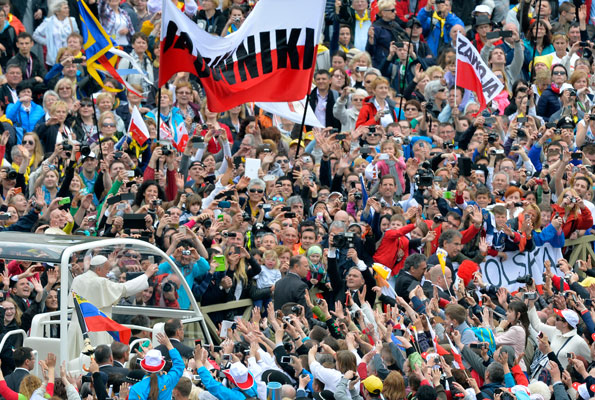
VATICAN CITY – Pope Francis on Sunday proclaimed John Paul II and John XXIII as the Catholic Church’s newest saints at a ceremony joined by hundreds of thousands of pilgrims for the two pontiffs who helped shape 20th century history.

“We declare and define as saints the blessed John XXIII and John Paul II,” the Catholic leader said in a Latin prayer, as pilgrims and foreign dignitaries massed in St Peter’s Square applauded and chanted: “Amen!”

In his homily, Francis praised them as “men of courage” who worked “in renewing and updating the Church”.

“They were priests, bishops and popes of the 20th century. They lived through the tragic events of that century but they were not overwhelmed by them.

“For them, God was more powerful,” he said.

Pope emeritus Benedict XVI, 87, who last year became the first pontiff to step down since the Middle Ages, made a rare public appearance in his white papal cassock and Francis embraced him before the ceremony.

Francis was co-celebrating the mass with Benedict XVI and hundreds of bishops and cardinals — the first time that two living popes said mass together.

It was also the first time that two Catholic Church leaders were being declared saints on the same day.

Commentators defined the event as a “four-pope day” and the Vatican said 800,000 people followed the event in Rome, including 500,000 in and around St Peter’s Square.

Many faithful waved the red-and-white flags from John Paul II’s native Poland and some wore Polish folk costumes while one pilgrim held a banner reading: “Two pope saints in heaven, two in St Peter’s Square”.

“We are followers of all four popes who have all been close to the people. This is an historic day but one that you really feel inside,” said Luisa Tomolo, an Italian revelling in the festival atmosphere.

Thousands watched the ceremony on giant screens set up in picturesque spots of Rome, witnessing an unprecedented event seen as a way of uniting conservative and reformist wings of Catholicism.

John Paul II was hugely popular but was also a divisive figure who alienated many leftist Catholics during his 27-year reign and has been criticised for turning a blind eye to revelations of child sex crimes by priests.

His support for Marcial Maciel, the Mexican founder of the Legion of Christ movement who was revealed to be a serial sexual predator, was particularly controversial.

‘Fighter for freedom’

Source: http://www.monitor.co.ug/News/World/-Popes-John-Paul-II-and-John-XXIII–declared–saints/-/688340/2295048/-/dptlms/-/index.html

Narrative Shift: U.S. Lawyer Highlights Kagame’s Role In Rwanda Genocide And Habyarimana Assassination

Kagame

Gen. Paul Kagame — even corporate media are now re-evaluating the narrative placing him as “savior”

[The Rwanda Calamity In Perspective]

April 6 marks exactly 20 years since the cataclysmic massacres that claimed hundreds of thousands of lives in Rwanda.

Rwandan Refugees in other East African countries and Diaspora who had enrolled into Uganda President Yoweri Museveni’s National Resistance Army (NRA), now the Uganda People’s Defense Force (UPDF) invaded Rwanda on October 1, 1990.

At the time of the invasion Paul Kagame, who is now President of Rwanda, was the chief of Military Intelligence in Uganda and had been sent by Museveni for U.S. training at Fort Leavenworth, Kansas.

The invasion sparked a destructive chain, including the recurrent invasions of the Democratic Republic of Congo (DRC), that all told may have cost the lives of six million or more Rwandans and Congolese.

To contextualize the calamity, this writer caught up with Peter Erlinder, a law professor at William Mitchell Law College in Saint Paul, Minnesota. Erlinder has a new book “The Accidental Genocide,” that covers the period before and after the massacres that started on April 7, 1994 after the plane carrying the president of Rwanda Juvenal Habyarimana, and Burundi’s Cyprien Ntaryamira was shot down with a missile. Prof. Erlinder’s book relies on U.S. documents and documents from the International Criminal Tribunal for Rwanda (ICTR) where he was a lead defense counsel for the Hutu defendants tried after the war.

The American law professor has been critical of what he calls the “victors’ justice in Rwanda,” contending that RPF soldiers and commanders were never tried for the war crimes that they committed and only the defeated army of Habyarimana were brought to book.

Erlinder had been arrested in Rwanda where he had traveled to defend the presidential aspiring candidate Victoire Ingabire Umuhoza who had been charged with “genocide denial ideology”. She remains incarcerated.

He tells me: “The winners of the war have told their side of the story, but there is another story, which is reflected in the UN, and the US documents but never came to light”.

Erlinder contends both sides committed the crimes but that a story told by the winner doesn’t reflect the level of culpability.

That’s what he says his book does. The book contains evidence used in the ICTR trials and copies of the originally suppressed UN and US Government documents related to the assassination of two heads of state, President Habyarimana of Rwanda and Ntaryamira.

The day after the assassination large-scale massacres started and estimates of those killed in the next 100 days range from 800,000 to a million. Later the genocidal killings were exported to the neighbouring Democratic Republic of Congo (DRC), the former Zaire; the killings continue in the Congo.

The assassination and the 100 days of killings shattered the Arusha Peace Accord which had established a transitional government of national unity with power-sharing between Habyarimana’s party, another opposition party, and the RPF, which ultimately seized the power.

Q: As we are getting closer to the 20th anniversary of Rwandan Genocide; what does this mean to you?

A: During the past 20 years, we have learned that a UN Tribunal charged with prosecuting all crimes that were committed in Rwanda during 1994 has prosecuted only crimes charged to the defeated and none have been charged to the victors.  This means the four-year war of aggression and invasion of the RPF supported by Uganda [about which there is no dispute] is the first in history in which only the defending side committed crimes, or like Nuremberg and the Tokyo Tribunals, the supposedly neutral UN Tribunal was actually a victor’s tribunal.  As former U.S. Secretary of [Defense] Robert McNamara admitted in the documentary The Fog of War ‘Had the Japanese won the war, those of us who planned the gasoline bombing of Tokyo would have been the war criminals.’ Until a fair assignment of mutual responsibility is reached, long-lasting peace in Rwanda and central Africa will be difficult to achieve.

Q: How would you like people to look at this eventful day April 6 which many believe to have triggered the 1994 genocide and today’s debate and narrative?

A: As early as 1997 UN Prosecutors recommended that Paul Kagame be prosecuted for the assassinations of Presidents Habyarimana and Ntaryamira. The U.S. removed U.N Prosecutor Del Ponte from office when she insisted on doing so on May 15, 2003.  Former Chief of Staff to Kagame, Dr. Theogene Rudesingwa has admitted being involved in the cover-up. The detailed testimony in the ICTR Military-1 case resulted in every Trial Chamber, and the Appeal Chamber, agreeing that the former Rwandan military were not engaged in any criminal conspiracy before the assassination of President Habyarimana…. that would include the assassination itself.  I would like people to look at the same evidence that convinced ALL of the ICTR judges.

Q: People wonder and would like to understand why very few people accused of being perpetrators of Rwandan Genocide have actually been convicted?

A: Many, if not most, have been convicted of crimes committed after the assassination of President Habyarimana. All national leaders have been acquitted of crimes of conspiracy and planning before the assassination because the Kagame regime and UN Prosecutors have no evidence to support their claim that a long-planned conspiracy to commit genocide against Tutsi, or any other civilians actually existed.

Q: Since you were privy to a lot of documents regarding the events that were taking place during the 100 days. Can you give a brief picture of what could have happened based on the documents you managed to access?

A: The main point, according to the UN documents, not me, is that the RPF was the dominant military force capable of seizing power as of February 1993.  This is confirmed by Gen. Dallaire’s Recon Report of September 1993 long before UNAMIR arrived in Rwanda. U.S. documents show it was the RPF that blocked power-sharing in late March 1994, not Habyarimana. The assassinations were committed on the order of Kagame which he was told by the U.S. Ambassador would bring mass violence like Burundi after President Ndadaye was assassinated in October 1993. The RPF assault from April 6 to April 20 took over eastern half of country in a long-planned Blitzkrieg. Only RPF had military power to stop the killings by stopping their military advance….Dallaire said they refused to do so because Kagame was winning the war.

Q: There are people wondering that — how come that the winners of the 1990s Rwandan war lost many people than the losers. How can you explain this theory that, the winner lost many people in the battle whilst the loser lost very few?

A: Actual numbers from Rwandan government and all NGO reports, compiled by [Christian] Davenport and [Allan] Stamm, show that twice as many Hutus were victims as Tutsi — these are best numbers I am aware of.

Q: There are people who still want to get a clear picture. By April 6, what percentage of the country was occupied by the RPF?

A: Less than 10% on April 6.  About  half on April 20th…entire eastern half.

Q: There were these disturbing images; which I believe you have seen before. If you revisit your TV images of bodies of Rwandese were floating on Lake Victoria. People who witnessed these bodies claim this style was common during the National Resistance Army (NRA). There is a general belief that this style of killing could have been borrowed from the NRA war of Luwero in Uganda in the early 1980s. As a person who has gone through many documents that include intelligence information is there a possibility that the RPF could have borrowed this style? Or who trained the Hutus to use the same Luwero style?

A: I am not aware of this comparison but I have heard reports from former RPF fighters that using farm implements rather than bullets was preferred to save ammunition for military battles.

Q: Knowing the geographic area of River Akagera in Rwanda and how its waters flow how did the Hutu manage to kill the Tutsi, ferry the bodies into Akagera River, which is in an area then occupied by the RPF?

A: Because RPF controlled eastern half of Rwanda no later than April 20, it is reasonable that bodies in Akagera are RPF’s responsibility. On May 17, 1994, a UNHCR report makes this explicit by reporting mass killings and bodies floating in the river. The document is in my book.

Q:  There are people out there who want to get the facts, which are consistent with realities. Do you know what was the population of Rwanda? Do you have the knowledge of what was the percentage of Hutus out of the entire population before the genocide?

A: Yes this is in my book, too. And, in the Dallaire Recon Report. The 1991 census and estimates given Dallaire by the parties in 1993 are not too different.

Q: As a person who accessed several documents during your time at the ICTR Court, what arrangements have you made to enable people to know what really transpired in Rwanda?

A: Accidental Genocidewww.rwandadocumentsproject.net

Q: Some people claim that the current Rwandan authority has invested hugely to hunt down and eliminate those perceived to be with the different version from the official known version. How true is this claim? Are there some examples to backup this claim that Kagame has invested hugely to hunt down those who disagree with his views that the Hutus committed the genocide?

Madam Victoire Ingabire Umuhoza’s analysis of the Rwandan genocide. She believes there were double genocide and all the perpetrators should be held to account for their respective actions. Ms. Ingabire also believes that most Gacaca Courts have been used or influenced by Kagame to settle political scores than bringing justice. What is your comment about Ingabire’s analysis?

A: Ms. Ingabire is essentially correct. The problem with the double genocide theory is that it implies planning on both sides. There is no evidence this is true. There is evidence for mass violence committed against Tutsi after the assassination of Habyarimana and Ntaryamira which was predicted to occur, as it did, after the assassination of Ndadaye, but this was not planned, in Burundi or Rwanda. The mass killing of Hutu in Burundi was a government operation and was genocide by the army. The RPF consciously planned for the mass-violence against Tutsi to occur in Rwanda to justify resuming the war and making use of their superior military power, rather than give-up power through the Arusha peace process…This is clear from U.S. State Department documents of April 1, 1994.

Q: Madam Carla De Ponte wrote a book in which she claimed to have advised the arrest and prosecution of RPF officials but was removed from office. It is also believed she went to Washington to tell Obama to investigate Clinton’s behavior and role in the 1994 Rwandan genocide. Why do you think Madam Carla Del Ponte was ignored?

A: She was not only ignored, we know she was removed from office. Her press conference in Arusha announcing Kagame had killed Habyarimana and the RPF had committed mass crimes is what got me interested in the ICTR in the first place in 2003.

Q: We know that the International Criminal Court for Rwanda (ICTR) tried almost all the former Hutu Military and political leaders, but why didn’t it convict anybody of organizing the genocide?

A: Because there is no evidence that the ‘genocide was organized.’ Col Bagosora the supposed architect was convicted of crimes committed by soldiers he did not command, committed on April 7, 8, 9.

Q: For those who want to access the literature of the Rwandan War where can they find it?

A: Most tells the common story, but can be read for background. Robin Philpot’s recent book, Dr. [Helmut[ Strizek, Dr. Davenport, Dr. Stam, Dr. Filip Reyntjens‘ articles and my recent book are the beginning of the narrative based on the acquittals at the ICTR and solid evidence.

The BBC documentary on assassinations in South Africa was quite good, on March 27th I think.

The Accidental Genocide is available for public purchase in hardcopy Research Edition format on Amazon.com

– See more at: http://www.blackstarnews.com/global-politics/africa/narrative-shift-us-lawyer-highlights-kagames-role-in-rwanda-genocide-and#sthash.qKmwGNzg.wf5kpG8U.dpuf

”Short of inter-Rwandan dialogue, 20 years on after the genocide, Rwanda remains not only “an appeased expansionist bloody dictatorship”, but also “a powder keg, a time-ticking bomb waiting to explode”!

By Antoine Roger Lokongo

lupeee  01701201415381800000020140118_kagame


Carla Del Ponte and Paul Kagame were increasingly at loggerheads.

Del Ponte, a former Chief Prosecutor of two United Nations international criminal law tribunals: the International Criminal Tribunal for the former Yugoslavia (ICTY) and the International Criminal Tribunal for Rwanda (ICTR) fell out with Kagame after she insisted that crimes committed by the Tutsi during the genocide should also be investigated.

Cameroon investigative journalist Charles Onana has published many books about the real culprits of the assassination of President Juvenal Habyarimana who are still being shielded from accountability and they are not those who have been “officially accused” as perpetrators so far, according to him.

Pierre Péan, a renowned French investigative journalist and Keith Harmon Snow, an American Investigative journalist, all have factually point out that the Rwandan Patriotic Front (RPF) and Paul Kagame were responsible for the assassination of Juvénal Habyarimana, and therefore of having sparked the inter-ethnic killings in 1994! The list is long!

In this special call for articles by Pambazuka about “Rwanda – 20 years on after the genocide”, I would like to take this opportunity to highlight, provide and share with Pambazuka readers the new facts about Rwanda and the Kagame regime that have emerged recently and which prove that the last 20 years have been years of wasted efforts by the Kagame and the Museveni regimes to try to cover up the truth, but in vain, about what happened in Rwanda in 1994!
They are helped in this endeavour by powerful friends in high places in the West, including, former US President Bill Clinton, Susan Rice, former UK Prime Minister Tony Blair, Bono, Howard Buffett, Evangelical Pastor Rick Warren, Rabbi Shmuley Boteach, Bill Gates, and so on (see, Judi Rever, “Paul Kagame’s trips to the West not worth the headache,” Digital Journal, Oct 17, 2013).
 
First of all, from a Congolese perspective, new facts have merged that in April 1994, immediately after the RPF came to power in Kigali, the DRC’s main opposition leader Etienne Tshisekedi sent a telegram to Paul Kagane then Vice-President, congratulating him for “having overthrown Juvenal Habyarimana out of power” (See, “Lettre ouverte” envoyée par 13 Intellectuels du Grand Kasaï (R.D.Congo) à M. Etienne TSHISEKEDI wa MULUMBA, Président National de l’UDPS en prévision de l’échéance du 30 juin 2006).
For us Congolese, Etienne Tshisekedi, a popular Congolese politician who has visited Kigali many times at the invitation of President Kagame and who came second in the 2011 presidential elections, must have known what he was saying. He is not just a man of the street. He uncovered the truth, according to which, what happened in Rwanda was a civil war: a Tutsi rebel movement backed by Uganda and Anglo-Saxon powers overthrew a Hutu dominated regime, notwithstanding the waves of inter-ethnic killings that ensued, and which that overthrow unleashed!
 
Secondly, Kagame is now put under pressure by his Western powerful backers who have finally realized that when Kagame boasted in an interview granted to the Financial Times of London on 19 August 2010 that “Rwanda’s democracy is still the model for Africa”, that “model” does not square with human rights let alone with democracy itself!
They are now urging him to stop harassing, jailing and assassinating Rwandan opposition leaders, including Opposition leader Victoire Ingabire who was sentenced to 8 years in prison on 30 October 2012 for saying that “Hutu too were killed during the genocide”, but then her sentence was increased to 15 years in prison on 1 December 2013. Former Rwandan Intelligence chief Patrick Karegeya turned opposition figure was found dead in a South African hotel room, having been hanged or strangled by killers sent from Rwanda, four of whom were arrested in neighbouring Mozambique (see, Chimp Investigations Team, “Karegeya Murder Suspects ‘Arrested’ In  Mozambique,”  Chimpreports.com, 7 January 2014); as well as former Rwandan army chief Kayumba Nyamwasa, turned opposition figure who was shot by a lone gunman in South Africa; Kagame’s Western backers are also privately advising him to hold political dialogue with the FDLR, Hutu fighters roaming the hills of eastern Congo and who announced recently that they have laid down their arms and are ready to return to Rwanda provided the regime was open to political dialogue.
In fact, the British who back Kagame held peace talks with the IRA in Northern Ireland, the Afghan regime which is backed by the United States is encouraged to hold talks with the terrorist Talibans, Nelson Mandela held talks with White apartheid leaders, the Congolese government held talks with “Tutsi Congolese rebels” most of whom are Rwandans and Ugandans sent to the DRC to kill, rape and loot and Kinshasa will go so far as integrating them into the Congolese army (…). So why should the Kagame regime be an exception? Inter-Uganda dialogue including with the LRA, inter-Rwandan dialogue, including with the FDLR is the way forward for lasting peace in the region.
But Kagame does not want to hear that! So, the so-called “stability in Rwanda” has been achieved at the expense of Congo where Kagame continues and to stock the fire and “mucking” the Congo, as Tony Blair put it in a “supporting Kagame” article he co-authored with American billionaire Howard G. Buffett (Foreign Policy, 21 February 2013).
Recently Kagame threw a tantrum at his erstwhile Western backers, calling them “former colonial masters who do not stop lecturing Africans”. But recently Kagame was caught in his own trap when he boycotted the “Summit on Peace and Security in the African Continent” convened by the French President François Hollande in Paris on 6 December 2013. For Rwanda, it was no question of attending the summit.
“Those who feel they still need the protection of the former colonial master will go to this meeting. This is not our case,” a close associate of Paul Kagame told Jeune Afrique (see, Jean Mitari, “Sommet sur la paix et la sécurité à Paris : le Rwanda décline l’invitation, ” Jambonews.net, 19 juin 2013).
At the same time, Kigali favorably welcomed the invitation of U.S. President Barack Obama to attend a historic summit of leaders from across sub-Saharan Africa – the first of its kind – to be held in Washington in August 2014. The White House announced the invitation on 30 June 2013 (Stephen Collinson, “Obama to host summit of African leaders next year,” AFP, 30 June 2013).
Kagame was indeed caught in his own trap! Rwanda declined the invitation of the former French colonial master, but accepted that of Obama to all African Heads of State!
For Kagame, it is worth taking the orders coming from the White House than those coming from the Champs-Elysées! So what is the difference when you decline the invitation of one Western master and then you accept that of the other? That is because it is from the United States that Kagame is shielded from accountability after perpetrating genocide in Congo! After all, he is only playing the role of “an Anglo-American proxy” in Congo. That is the role he has played “so well” in the last 20 years!
Thirdly, in the last 20 years, Kagame and Museveni as well as their cronies and their foreign masters who arms them, have enriched themselves out of predatory wars for natural and mineral resources in Congo. The so-called “post-genocide economic progress in Rwanda” is based on such predatory wars!
But at the same time, Museveni and Kagame have enjoyed impunity, getting away with heinous crimes of genocide, war crimes and crimes against humanity both in Rwanda and in Congo, basically, trampling on international law or bending it in their favour when it suits their interests at home and abroad. When it comes to  extraditing  “Congolese Tutsi rebels”, including Laurent Nkunda, Mutebusi, Runiga and others who have found refuge in Rwanda to the DRC “their country of origin”, Paul Kagame evokes the Geneva Convention, allows himself to lecture the DRC, “which has not yet abolished the death penalty”, therefore he cannot extradite “Congolese Tutsi rebels” to “their country of origin only to be executed! If they are Congolese and Congo is their country of origin, why must they not be extradited there to face justice in their own country?
After the murder of Karegeya, President Kagame warned Rwandans who find themselves in the opposition camp that “There are consequences for betraying your country”. Why should there be no consequences for the “Tutsi Congolese rebels” who had betrayed their country then?
There is a saying which goes like this: Lie, lie, there will always be something left to lie about: the truth!
Recently, Joel Mutabazi, a former Rwandan officer (a former bodyguard of Kagame) accused of terrorism, formation of an armed group, murder and illegal possession of firearms, etc., and who sought political asylum in Uganda was unlawfully – that is to say, very much against the Geneva Convention – transferred to Rwanda from Uganda to face justice in his country! Among the other accused are several members of the opposition Rwandan National Congress (RNC) and eight students (see, “Paul Kagame ex-guard Joel Mutabazi rejects Rwanda trial,” BBC, 28 January 2014).
Mutabazi pleaded not guilty at his trial but he faces a death sentence as Patrick Karegeya did! Although the UN refugee agency (UNHCR) has condemned Kampala’s decision to extradite him as a “clear violation of the asylum principle”, nevertheless, the United States and Britain remained silent in the face of such a flagrant violation of international law! Is Tony Blair, Kagame’s “special adviser” not a British lawyer who should defend international law in this case?
However, this makes the “cause” the Tutsi say they are fighting for, that is inclusion, in the Great Lakes Region of Africa unjust, unfair to other people in the region and a lost one because the Tutsi are the ones who are now “mucking” other people in the region, to quote Tony Blair again. One day, Museveni and Kagame will have to answer for all these crimes!
Short of inter-Rwandan dialogue, 20 years on after the genocide, Rwanda remains not only “an appeased expansionist bloody dictatorship”, but also “a powder keg, a time-ticking bomb waiting to explode”!
Copyright Antoine Roger Lokongo 2014
Source: http://www.globalresearch.ca/the-rwanda-genocide-coverup-twenty-years-of-lies-and-fabrications-the-anglo-saxon-powers-vs-france/5378854

Kagame didn’t end it, he started it.

kagame290511

Kagame did not attack Rwanda to stop genocide but to cause it, which he successifully achieved.

Please stop saying “Paul Kagame ended a genocide in which mostly Tutsis (and a few moderate Hutus) were killed”!

• He did not come riding in to stop killing in 1994; he was already in Kigali since November 93 with his 600 men battalion and between 3000 to 6000 infiltrated agents across the country.

• His gang invaded Rwanda in 1990 (yes, 1990, 4 years before) to begin the genocide. They started referring to the genocide of Tutsi in 1992 with the help of international NGOs. The deceased Alice Des Forces was part of the team.

• He orchestrated and accomplished much of the killing (including killing of Tutsis by Hutus and by his own men).

• The [overwhelming] evidence suggests more Hutus than Tutsis were killed.

• And that was from 1990 until the end of 1994.

• He continued beyond this, in Rwanda and in Congo where more than 6 million lives have been decimated.

Did the UN and others “fail” to act? This is another question that people should phrase differently, because not intervening was US, UK and other profiteers’ best strategy to achieve what they did today: getting Congolese minerals at the cheap.

Kagame threatened to kill UN officials or others who stood in his way to the conquest of Kigali, his long-planned base for stealing Congo’s resources.

Google “Ann Garrison” or “Taylor report”, Robin Philpot or “Gersony report” or Davenport and Stam or “Mapping exercise”, UN or “Peter Erlinder” or “Keith Harmon Snow,” etc.

Some direct link:

http://kroc.nd.edu/newsevents/events/2010/04/08/638

http://www.taylor-report.com/Rwanda_1994/index.php?id=ch1

http://www.rwandadocumentsproject.net/gsdl/cgi-bin/library

http://commdocs.house.gov/committees/intlrel/hfa72638.000/hfa72638_0f.htm

http://www.friendsofthecongo.org/united-nations-report.html

http://www.therwandan.com/blog/remarks-by-dr-theogene-rudasingwa-the-colloque-au-palais-du-luxemburg-paris-france-april-1st-2014/

Source: http://therisingcontinent.wordpress.com/2014/04/04/

Was Clinton’s “No Genocide” Dictate On Rwanda Meant To Ensure Kagame’s Military Victory In 1994?

By Milton Allimadi

Who killed Juvenal Habyarimana?
[Black Star News Commentary]

It’s generally accepted that Bill Clinton opposed a vigorous international community- and American armed intervention when the massacres erupted in Rwanda in 1994 because he feared this country could get bogged down in a messy operation with unpredictable outcome.

There has never been an internationally supervised research to estimate the numbers of civilians murdered in Rwanda however the figure of “nearly 800,000″ has been widely quoted and accepted for years.

It’s also generally accepted that Clinton wouldn’t allow his administration officials to use the term “genocide” to describe the mass killings in Rwanda because the word carries legal connotations that would have obligated intervention.

But how credible is this explanation as to why Clinton opposed use of the word and outside intervention?

If that was indeed the true motive for barring the use of the term and opposing intervention how did Clinton hope for the killings to come to an end? He was president of the United States, the world’s only remaining superpower.

Is it conceivable that Clinton was willing to let the U.S. stand aside and risk the possibility of Hutus, the 85% majority population in Rwanda, annihilating all Tutsis?

This is a difficult proposition to accept or believe.

The killings had been triggered when on April 6, 1994 the plane carrying Rwanda’s Hutu president Juvenal Habyarimana and Burundi’s Cyprian Ntaryamira was downed by two missiles as it approached Kigali airport.
Is it more likely that Clinton in fact knew that the massacres would come to an end — with victory by the RPF, under its leader Paul Kagame?

So, in fact, by refraining from calling the massacres a “genocide” and triggering an international armed intervention did Clinton’s decision at the time actually buy time for Kagame and allow his RPF to seize power?

Former Rwandan President Juvenal Habyarimana assassinated by current president Paul Kagame

Habyarimana was returning from Tanzania, where regional leaders were pressing the warring parties to carry out the Arusha Peace Accord to halt fighting between his army and the opposing force, which included units of Uganda’s army and the Rwanda Patriotic Front (RPF).

The Arusha deal was detrimental to the RPF’s goal and U.S. interests which included displacing France’s influence in the region.

Arusha called for a Transitional government, power-sharing between Habyarimana’s party, Kagame’s RPF, and other parties. It also called for elections and given that Hutus comprised 85% of the population, Kagame wouldn’t have become president.

Kagame stood to gain the most from the assassination of President Habyarimana and to lose the most from negotiated peace. The use of the term “genocide” by the Clinton administration and robust outside intervention most likely would have saved hundreds of thousands of lives.

It also would have closed Kagame’s path to presidential powers in Rwanda.
So was it mere coincidence that Clinton’s withholding the use of the term “genocide” benefitted Kagame?

Consider some points that indicate U.S. preference of an RPF/Kagame victory at the time.

1) At the time of the October 1, 1990 invasion of Rwanda from Uganda, Paul Kagame was being trained at the U.S. Military Academy at Fort Leavenworth, Kansas. He had been sent here by Uganda’s ruler Gen. Yoweri Museveni.

He came on a Ugandan passport because at the time he was chief of Uganda’s Military Intelligence. He and many Tutsis of his generation had grown up in Uganda; his family had fled the massacres of 1959 when the monarchy under King Kigeri V in Rwanda was overthrown by the Hutu majority.

When the first commander of the 1990 invading force from Uganda, Gen. Fred Rwigyema, who had been Uganda’s deputy defense minister, was killed under questionable circumstances, Museveni recalled Kagame and installed him commander of the invading army which initially included 4,000 regular Ugandan army soldiers. Later the force became the Rwanda Patriotic Front.

2) The U.S. took no action to censure Uganda or to denounce the invasion, which was a war of aggression which has consequences under international law. Moreover the U.S. allowed Uganda to keep sending more officers for U.S. training under the International Military Education Training (IMET) program that had brought Kagame to Fort Leavenworth.

In 1995 when I was a reporter at The City Sun newspaper, I asked then Vice President Al Gore about this and he told me Uganda “deceived” the U.S. It was a disingenuous response since in subsequent years after I asked the question the number of officers sent for IMET training by Uganda actually increased.

3) France, a supporter of the Habyarimana government, when Francois Mitterand was president, tried to bring action against Uganda for launching a war of aggression against Rwanda on October 1, 1990, through the United Nations Security Council. The U.S. opposed this move.

So a battlefield stalemate maintained from 1991 to 1994, with the RPF controlling much of the areas of Rwanda towards Uganda — the supply route for recruiting fighters and for obtaining arms. During this period, while abuses by Habyarimana’s army was widely quoted in media those of the RPF, including massacres documented by Human Rights Watch, were rarely mentioned.

The stalemate ended after the assassination of Habyarimana.
According to documents from French archives “Mitterrand and his advisers” believed “that the Rwandan Patriotic Front wanted to use its superior military position to restore a Tutsi-dominated regime in Rwanda. French military advisers reported that the rebel movement had acquired surface-to-air missiles from Uganda. When President Habyarimana’s plane was shot down by a SAM missile on April 6, 1994, triggering the genocide, French officials immediately suspected the RPF.”

In recent years, Theogene Rudasingwa, who had been Kagame’s chief of staff and then Rwanda’s ambassador to the United States has said Kagame in fact was the one who ordered the assassination of Habyarimana. A French government minister had claimed that the U.S. gave the missiles to Uganda, from stockpiles seized in Iraq; Uganda then provided them to the RPF — the U.S. denied the allegation.

According to Rudasingwa, the purpose was strategic. Knowing the ethnic volatility in Rwanda, Kagame was aware the Hutu civilian majority would unleash vengeful massacres after Habyarimana’s death. The power vacuum and the bloody mayhem would create the excuse for Kagame seizing power.

Kagame would then be hailed as Rwanda’s “savior.” Kagame would no longer have to fulfill the requirements of Arusha including the elections the RPF could not have won.

In subsequent years the United Nations and Human Rights Watch repory that Kagame has exported the war into the Democratic Republic of Congo (DRC).

Was Clinton, given U.S. intelligence capabilities, unaware of the alleged Machiavellian scheme by Kagame in 1990?

– See more at: http://www.blackstarnews.com/global-politics/africa/was-clintons-no-genocide-dictate-on-rwanda-meant-to-ensure-kagames-military#sthash.qdQsOlMj.rNTRfch1.dpuf

Source: Black Star News

What the author of this article forgets to mention is that the Arusha Peace Accord which was signed on August 3rd, 1993 recommended the presence of 5,000 UN peacekeepers to supervise its implementation. Though it was initially difficult to assemble such force, by mi-December of that year there were already in Rwanda near 2,500 for that contingent. However, surprisingly, even that number was going to be reduced significantly to the point that when the plane of President Juvenal Habyarimana was shot down on April 6th, 1994, there were only 297 UN peacekeepers left. Prior to that, the CIA Kigali desk had sent to Washington an analysis of the political situation prevailing in Rwanda around January 1994. One of the main points the report highlighted was the fact that the assassination of Habyarimana could cause between 300,000 and 500,000 casualties. And this prediction was apparently based on what had happened in neighboring Burundi when president Melchior Ndadaye had been assassinated in October 1993. In summary, when Washington resisted declaring the massacres of Rwanda genocide and probably ensured that there were not enough external forces to intervene, they knew what they were doing. This made the former UN secretary Boutros Boutros Ghali to say that the Rwandan genocide was a 100% US responsibility.

Was Clinton’s “No Genocide” Dictate On Rwanda Meant To Ensure Kagame’s Military Victory In 1994?

“Sauver un maximum de vies… c’est le défi que beaucoup jugeaient impossible et que les troupes françaises de Turquoise ont pourtant relevé”, Jean-Yves Le Drian.

Génocide rwandais : pour Le Drian, “certaines accusations ne peuvent rester sans réponse”

11/04/2014 à 14:36 Par Jeune Afrique
Le ministre français de la Défense, Jean-Yves Le Drian.
Le ministre français de la Défense, Jean-Yves Le Drian. © AFP

Jean-Yves Le Drian a tenu vendredi à défendre l'”honneur” de l’armée française lors de l’opération Turquoise en 1994, après les accusations de complicité de génocide réitérées par le président rwandais, Paul Kagamé. Car, pour le ministre français de la Défense, “certaines accusations ne peuvent rester sans réponse”. Explications.

Après le Premier ministre Manuel Valls, c’est au tour du ministre de la Défense, Jean-Yves Le Drian, de réagir à la polémique entre la France et le Rwanda relancée par Paul Kagamé dans une interview à Jeune Afrique publiée le 7 avril. Dans un message aux armées, diffusé vendredi 11 avril, Jean-Yves Le Drian a défendu l'”honneur” de l’armée française lors de l’opération Turquoise en 1994, après les accusations de complicité de génocide réitérées par le président rwandais.

“Les mots ont un sens et, dans ces circonstances, certaines accusations ne peuvent rester sans réponse”, écrit Le Drian, sans mentionner le nom du chef de l’État rwandais. Selon le ministre, “l’honneur de la France et de ses armées, c’est d’avoir, avant les autres, réagi au drame qui se déroulait sous le regard d’une communauté internationale paralysée”.

“Sauver un maximum de vies sans prendre parti dans la lutte pour le pouvoir qui était alors engagée: c’est le défi que beaucoup jugeaient impossible et que les troupes françaises de Turquoise ont pourtant relevé”, poursuit Jean-Yves Le Drian.

>> Lire aussi : “L’histoire mythique de l’opération Turquoise ne correspond pas à la réalité” (Guillaume Ancel)

“Accusations inacceptables”

La France “ne s’est pas dérobée à son devoir”, affirme-t-il encore. “Les conclusions de la mission [menée par Paul Quilès en 1998, NDLR], indépendante et pluraliste, ne laissaient aucune place aux accusations inacceptables qui ont été proférées à l’encontre de l’armée française ces derniers jours”, insiste-t-il, en soulignant que “plus de 1 100 documents” ont été déclassifiés en vingt ans par le ministère de la Défense, dans le cadre des procédures judiciaires.

Lors de sa déclaration de politique générale mardi à l’Assemblée nationale, Manuel Valls avait déjà rejeté ces accusations, selon lui “injustes” et “indignes”.

Dans une interview à Jeune Afrique, le président rwandais Paul Kagamé avait accusé la France d’avoir eu un “rôle direct” dans “la préparation politique du génocide” et dans “son exécution même”.

Réagissant à ces déclarations, Paris avait annulé le voyage de la ministre de la Justice, Christiane Taubira, qui devait représenter la France à la commémoration du vingtième anniversaire du génocide, à Kigali le 7 avril. Après que Paris avait annoncé la participation de l’ambassadeur de France à Kigali, Michel Flesch, le ministère rwandais des Affaires étrangères avait fait savoir à ce dernier qu’il n’était pas le bienvenu.

(Avec AFP)

U.N. to Send Peacekeepers to Central African Republic

UNITED NATIONS — The United Nations Security Council on Thursday voted unanimously to send 12,000 peacekeepers authorized to do whatever necessary to protect civilians in the Central African Republic, where a vicious sectarian conflict has effectively partitioned the country into Christian and Muslim swaths and left a trail of gruesome killings.

France, which wrote the resolution, has said it will keep its 2,000-member force in the Central African Republic, a former French colony, until the new peacekeeping force can be deployed in full. How long that will take remains unclear, as does the question of how capable the troops will be of protecting civilians without abusing them.

Peacekeepers from neighboring Chad pulled outfrom the Central African Republic this month after some of them were accused of shooting civilians in a busy market in the capital, Bangui. Many of the roughly 5,000 African Union peacekeeping troops in the country now could be incorporated into the United Nations peacekeeping mission.

The resolution calls for 10,000 soldiers and nearly 2,000 police officers. Rights groups that have been pressing the United Nations to take a more assertive role in the crisis welcomed its passage.

“Precious time wasted but #CARcrisis resolution creates strong UN mission to protect civilians, monitor human rights, help rule of law,” wrote Philippe Bolopion, the United Nations director at Human Rights Watch, on Twitter.

Rare for a United Nations mission, due to start in September, the peacekeepers are additionally authorized to support law and order in the country, at a time when its police and court system have basically collapsed.

They are also supposed to monitor human rights abuses and help the national authorities arrest war criminals. The Central African Republic is a signatory to the treaty that created the International Criminal Court, which has already opened an investigation into atrocities in the course of the conflict. “Justice is necessary to the process. Impunity led us to where we are now,” its foreign minister, Toussaint Kongo-Doudou, told reporters after the Security Council vote.