Category Archives: Analysis

From Victim to Victimizer, Kagame’s Becoming a Not-So-Benevolent Authoritarian

170806-kagame-election-hero_b2zhgd

MR. 99 PERCENT

Elections are a mere ‘formality’ for Paul Kagame. He brought stability in the wake of atrocity, but does that make him any more a democrat, or any less an authoritarian?

“When the elections were announced in Kagame’s favor this weekend, world leaders—including those Americans and Britons who often sing his praises—were expected to rush to congratulate him. But as the State Department statement about voting irregularities made clear, even Washington is having its doubts. Now who will actually confront him over the deaths of so many thousands? Who will call him out as the dictator that he is?”

CALABAR, Nigeria—For decades, he has been sliding towardauthoritarianism, and his name has been synonymous with Africa’s bloodiest wars. Having put an end to one genocide, he has since shared responsibility for the death of hundreds of thousands of people.

Yet this man who helped force leaders of Uganda, Rwanda, and Congo (which was then called Zaire) out of power, and now oppresses many of his own people, somehow manages to win the applause of the West.

Because Rwandans were the victims of horrendous massacres before he took over, he has sympathy; because his economy has prospered since, he has admiration. He has brought stability in the wake of atrocity, but does that make him any more a democrat, or any less a tyrant?

On Friday, in elections where the U.S. State Department said it was “disturbed by irregularities in the voting, Paul Kagame won a third seven-year term, this time with 99 percent of the suffrage. No wonder he said earlier that the polling was a “formality.”

One is hard pressed to think of any tyrants of recent vintage, from Fidel Castro to Saddam Hussein, who would claim such phenomenal numbers. (Close, yes, but not quite 99 percent.) Yet for years, Kagame has won effusive praise from the democratic West.

“I am clear, Rwanda has been, and continues to be, a success story of a country that has gone from genocide and disaster to being a role model for development and lifting people out of poverty in Africa,” said Britain’s then-Prime Minister David Cameron, speaking to the House of Commons in 2012. “I am proud of the fact that the last [British] Government, and this Government, have continued to invest in that success.” 

That’s the typical language Western leaders like to use to describe Rwanda under Kagame, especially when lavishing torrents of foreign aid on the tiny African nation. Yet Cameron’s comments came just after the United Nationsreleased a devastating report (PDF) that accused Rwanda of effectively masterminding a murderous rebellion in the neighboring Democratic Republic of the Congo (DRC) which forced half a million people from their homes. Despite being aware of Kagame’s human rights atrocities, Cameron said it was “right” to continue pouring aid into his regime. And he isn’t the only leader to think highly of Kagame.

Tony Blair, who has made Rwanda the focus of the work of his charity, Africa Governance Initiative (AGI), referred to Kagame as a “visionary leader” and a friend. Bill Clinton once said he is “one of the greatest leaders of our time.” Bill Gates, who works with Kagame on various projects, says “Rwanda is doing something right.” Gates’s wife, Melinda, believes the country has “figured things out.” Even the U.N. has asked African nations to “emulate what Rwanda is doing.”

It doesn’t just end in praise. An estimated $1 billion is spent annually on foreign aid to Kagame’s government. The United States provides close to a fifth, followed by the U.K. which has so far this year given £64 million (about $84 million) in aid. Germany and the Netherlands give substantial aid to Rwanda as well.

One can run down a checklist of the good that Kagame has done, and it is considerable. His investment in agriculture in the last two decades has yielded positive returns. The country has had an annual growth rate of 8 percent since 2000, becoming one of the fastest growing economies in the world. Tea and coffee exports are soaring, thanks to reforms in the agricultural sector. Life expectancy, literacy, primary school enrolment and spending on healthcare have all improved, partly due to foreign aid that often is used judiciously. Rwanda has succeeded in reducing poverty levels from 57 percent in 2005 to 45 percent in 2010, although 63 percent of the population still live in extreme poverty.

Rwanda has become, as well, the most female friendly nation in the world, especially in the area of politics. Close to 64 percent of parliamentarians are women compared to about 22 percent worldwide. Women are now able to own land and girls can inherit from their parents, which wasn’t the case some years back.

But the good that’s been done does not make the bad any less sinister. And often when things appear great in Rwanda, someone else is paying the price.

For instance, on the streets of the capital, Kigali, there are no beggars, no hawkers, and no prostitutes operating in the open. According to Human Rights Watch (HRW), Kagame’s men have rounded them up and put them in “transit centers” where they are held without charge and beaten with sticks.

A new HRW report shows that officials summarily executed “at least 37 suspected petty offenders” in Rwanda’s Western Province between July 2016 and March 2017, as part of an official strategy to “spread fear, enforce order, and deter any resistance to government orders or policies.”

Executions were carried out by soldiers who accused the victims of stealing items like bananas, a cow, or a motorcycle; smuggling marijuana; illegally crossing the border from the Democratic Republic of Congo into Rwanda, or of using illegal fishing nets. Witnesses who saw the bodies soon after the executions told HRW that they saw bullet wounds and injuries that seemed to have been caused by beatings or stabbings. One victim had been stabbed in the heart; another had a cord around his neck.

“Instead of investigating the executions and disappearances and providing information or assistance to the families, local authorities threatened some who dared to ask questions,” reports Daniel Bekele, senior director for Africa advocacy at Human Rights Watch. “The government should focus on investigating and prosecuting those responsible for the crimes, and not allow a cover-up.”

HRW also found that residents followed orders from authorities to kill suspected thieves, and many were beaten to death. In public meetings, authorities reportedly declared that they were following “new orders” which called for the killing of thieves and other criminals.

Some of these killings were carried out in front of multiple witnesses, but they are rarely discussed in public. No local media outlets have reported about them, and local human rights groups are too afraid to publish any information on such issues due to the the strict restrictions on independent media and civil society in Rwanda. Even HRW, which revealed the atrocities, can’t operate freely in the country.

“We have a Memorandum of Understanding with the government of Rwanda (through the Ministry of Justice), but we do not have an INGO (International Non-Governmental Organization) registration,” Lewis Mudge, HRW senior researcher focusing on Central Africa, told The Daily Beast. But he insists, “That has not affected our ability to enter the country to conduct research.”

Talk of extrajudicial killings in Rwanda should not come as a surprise to anyone, not even to liberal supporters of the regime. After all, President Kagame’s life has been full of wars, executions, oppression, and conspiracies.

When Paul Kagame was two years old, violence began in Rwanda between the Hutu and the Tutsi, two of the three major ethnic groups in the country. The conflict led to the Rwandan Revolution, which saw the country transition from a Belgian colony to an independent Hutu-dominated republic that was hostile to the Tutsi people, forcing more than 100,000 to seek refuge in neighboring countries. Kagame’s family fled to Uganda, where he spent the rest of his childhood.

At 24, Kagame joined a tiny group of Ugandan rebels led by Yoweri Museveni. Years later, he helped Museveni topple the government of Uganda. Museveni then became president (a position he has held now for 31 years), and Kagame was appointed his head of military intelligence. Kagame used that opportunity to build a network of Rwandan Tutsi refugees within the Ugandan military, with the eventual goal of invading Rwanda. Three years later, Museveni demoted Kagame after facing huge criticisms in Uganda over his appointment of Rwandan refugees to major positions in his government.

Kagame then joined forces with the rebel group Rwandan Patriotic Front (RPF) to oust President Juvénal Habyarimana, a Hutu, whose regime was hostile to the Tutsi. When the leader of the group, Fred Rwigyema, was killed three days after the RPF began its uprising, Kagame—who was in the U.S. attending a course at the Command and General Staff College in Fort Leavenworth—flew back to take charge.

Kagame’s RPF fought the government’s Hutu forces for three years until 1993 when a ceasefire was reached, but that didn’t last long as Hutu officers, plotted the extermination of every Tutsi in Rwanda. When a plane carrying Habyarimana, was shot down by unknown assassins in April 1994, a military committee that took immediate control of the country started right away murdering Tutsis and also Hutus who were opposed to the regime in what became the Rwandan Genocide. Within three months more than 800,000 Tutsi and politically moderate Hutu were killed in coordinated attacks.

A year later, the genocide ended. Kagame had successfully taken thegénocidaires out of power and pushed them into Congo (then known as Zaire). When they regrouped and began to carry out little raids in Rwanda with the support of long-time Zaire dictator President Mobutu Sese Seko, Kagame responded by invading—pitching his tent with the newly created rebel group, the Alliance of Democratic Forces for the Liberation of Congo (ADFL)—aiming to oust Mobutu and install Kagame’s ally, Laurent-Désiré Kabila, as his successor. At the end of what was known as the First Congo War, about 222,000 Rwandan Hutu refugees were either killed or missing. The atrocities were blamed on the Rwandan Defense Forces and the ADFL, which were determined to eliminate any military threat to the Kagame government.

But a short time after Kabila took power from Mobutu, the new Congo leader fell out with Kagame, and—like Mobutu—began to support the génocidaires. This time, Kagame responded by throwing his weight behind a new rebel group, the Rally for Congolese Democracy (RCD), and launching the Second Congo War in 1998. Within 12 days, the Rwandan-backed forces had made advances toward the Congolese capital, Kinshasa, and would probably have ousted Kabila but for the intervention of Angola and Zimbabwe.

Kabila eventually was killed in 2001 by a bodyguard, in what was reported in some quarters to be an assassination masterminded by Rwanda. Two years after his death, the conflict ended. At this time, between three million and 7.6 million people had lost their lives, mostly through starvation and disease,based on figures attributed to the International Rescue Committee (IRC).

Kagame has kept insisting he fought both wars in Congo to keep Rwanda safe, but he’s been accused in a number of reports of tapping the mineral resources of Congo and collecting taxes from companies licensed to mine minerals in the east of the country.

From the point of view of Rwandan security, Kagame’s strategy appears to have worked. He has not been involved in any foreign war since his country pulled out of Congo in 2009, but it’s hard to think that he doesn’t have a close eye on his neighbors, especially with elections at hand and external interference very likely.

Kagame was running for a third term as Rwandan president on Friday, August 4. He wouldn’t have been eligible, but a 2015 referendum that passed with 98.4 percent of the vote allows him to stay in power until 2034, if he keeps being elected—and so he was, with that implausible 99 percent. In the 2003 presidential elections, he racked up more than 95 percent of the vote. In 2010 he garnered 93 percent. No doubt he is very popular, still, among many Rwandans, but in virtually any other country in the world, such numbers would be considered risible measures of tyranny.

Despite not having a strong opposition, Kagame didn’t want to take chances. In May, the National Electoral Commission (NEC) published new regulations that required parties or individuals who wish to campaign on Facebook, Twitter, WhatsApp, Instagram, YouTube, or other websites to submit the content for approval to the electoral body two days in advance. But a month later, the decision was reversed after the U.S., the U.K., the Netherlands, Germany, and the E.U. issued strong statements against the restrictions on social media.

Elsewhere, it appears Kagame may have done far worse than trying to stop free speech. His opponents have a way of meeting untimely ends at home and even when they flee abroad.

As documented by Amnesty International, one—who served as intelligence chief—was strangled in South Africa. Another—who served as cabinet minister—was assassinated in Kenya. Rwandan death squads allegedly have tried to infiltrate Europe. Criticisms can easily be interpreted as insults to the lanky leader, and Kagame wouldn’t accept any of that.

“The climate in which the upcoming elections take place is the culmination of years of repression,” Muthoni Wanyeki, Amnesty International’s Regional Director for East Africa, the Horn and the Great Lakes, said in the report last month, before Friday’s elections. “Rwanda’s history of political repression, attacks on opposition figures and dissenting voices in the context of previous elections, stifles political debate and makes those who might speak out think twice before taking the risk.”

When the elections were announced in Kagame’s favor this weekend, world leaders—including those Americans and Britons who often sing his praises—were expected to rush to congratulate him. But as the State Department statement about voting irregularities made clear, even Washington is having its doubts. Now who will actually confront him over the deaths of so many thousands? Who will call him out as the dictator that he is?

Source: The Daily Beast

Umunyagitugu Paul KAGAME acyuye igihe. Ni iki kitezwe muri politiki y’u Rwanda ?

kagame

Guhera tariki ya 05 /08/2017 Paul Kagame waranzwe no gutegekana igitugu guhera mu mwaka wa 1994 azaba atakiri Perezida wa Repubulika y’u Rwanda. Itegekonshinga yarahiriyeho ryamwemereraga kugeza kuri manda ebyiri gusa kuko nta narimwe umuntu yemererwa kuyobora manda zirenze izo. Umunyagitugu abonye manda ebyiri zirangiye yashatse gukora itekinika ngo itegekonshinga rihindurwe bityo yemererwe kwiyamamaza indi nshuro. Cyakora na nyuma ya referendumu ififitse, Paul Kagame ntiyemerewe kwiyamamaza. Abaza gusoma ibi baribaza bati none se ko tumaze minsi tubona Kagame yiyamamaza, ubwo si uko abyemerewe?

Igisubizo kuri iki kibazo kigaragararira mu gisobanuro, imyitwarire n’imikorere y’umunyagitugu. Kagame nk’umunyagitugu wakuye agahu ku nnyo ntakeneye itegeko iryo ariryo ryose ngo yiyamamaze. Ni umunyagitugu utagendera ku mategeko. Kuri we amategeko icyo amaze ni ukwiyerekana mu rubuga mpuzamahanga ariko mu by’ukuri igifite agaciro ni amabwiriza we yishyiriraho ngo agere kubyo ashatse. None se Abanyapolitiki ntibafungwa mu Rwanda kandi itegekonshinga ribemerara gukora umurimo wa politiki? Kwandikisha amashyaka atavuga rumwe na FPR se ntibyabaye ikibazo kandi nyamara u Rwanda rwemera amashyaka menshi? Abaharanira uburenganzira bw’ikiremwamuntu se bo basiba guhungetwa kandi nyamara u Rwanda rwarasinye amasezerano mpuzamahanga agena uburenganzira bw’amashyirahamwe guhera mu mwaka wa 1975? Abantu se birirwa bicwa buri munsi kandi nyamara igihano cy’urupfu kitaravanyweho mu mategeko y’u Rwanda? Kagame ntacyo amategeko amubwiye we ashaka kwigumanira ubutegetsi ngo akomeze ahonyore abenegihugu uko yishakiye ari nako akomeza kwikubira ibyiza by’igihugu. Na manda Paul KAGAME azategeka guhera ku itariki ya 05/08/2017 ntizaba yemewe n’amategeko niyo mpamvu azaba ari umuperezida utemewe, ufite ubutegetsi butemewe, bugomba gusimburwa vuba na bwangu.

Ni iki kitezwe muri iyi manda ?

  1. Mu rubuga mpuzamahanga: Kagame azaba yamaze guta ibara yitwa umunyagitugu nk’abandi bose, umujura, umunyakinyoma ndetse na bya byaha bye benshi bajyaga batinya kuvuga bazabigarukaho. Bya bigwi n’imidari yajyaga yambikwa ngo yahagaritse jenoside bizahagarara kuko iyo umuntu akoze ibyiza akabirenzaho ibibi byose biba bibi gusa. Niko isi ikora, ni nako tuyibamo.

Cyakora kubera ko Paul Kagame yaryohewe n’ibyo yabonye, azatanga amafranga y’umurengera agure abanyamakuru n’ibigo bikomeye kugira ngo bigerageze kwerekana ko isura ye itari mbi nk’uko igaragara! Hari ibintu bimwe na bimwe batazashobora gukiza Kagame : Nko kuba atihanganira abatavuga rumwe n’ubutegetsi bwe ntazashobora kubihindura. Kuba mu myaka amaze ku butegetsi atarashoboye kureka ngo abandi bagaragaze impano zabo mu miyoborere ntazapfa kubishobora ngo nibura afungure imfungwa za demokarasi Ingabire Victoire, Deo Mushayidi n’abandi. Kuba mu bo batangiranye umugambi benshi baramucitseho bizakomeza kumwokama.

Kagame azakomeza kugerageza kwiyegereza abahutu b’inkomamashyi agamije kugaragaza ko atavangura ariko ntazashyiraho chef d’état-major cyangwa ministiri w’ingabo utari uwo muri FPR. Abatutsi batinyuka kwamagana politiki ya Kagame nka Kizito Mihigo na Diane Rwigara bazakomeza kwitwa abanzi b’igihugu.

  1. Mu rubuga rwa politiki nyarwanda: Abaturage bazakomeza guceceka ngo bategereje ko Imana izabakuriraho Kagame. Amashyaka ya opozisiyo akorera hanze azakomeza kwamagana ubutegetsi bwa Kagame ariko arasabwa gushaka udushya. Abalideri bazakomeza kuba bakeya ndetse abazifuza kuva mu mahanga ngo batashye mu Rwanda gufatanya na rubanda Kagame ntazabemerera. Guverinoma y’u Rwanda ikorera mu buhungiro izarushaho kumvikanisha ibibazo by’u Rwanda ari nako yotsa igitutu ubutegetsi bw’umunyagitugu ngo bwemere gufungura urubuga rwa politiki. Urukiko Mpanabyaha rwa Rubanda rwashyizweho na rubanda ruzakira ibirego rukore kandi ruburanishe amadosiye y’abayobozi bakekwaho ibyaha bya jenoside, ibyibasiye inyokomuntu n’ibyaha by’intambara. Ibihano bazabahwa bizashyikirizwa ibihugu n’umuryango mpuzamahanga kugira ngo aba bantu bafatirwe ibihano. Abazaba bahamwe n’ibyo byaha bazagira ibibazo mu kubona visa zo kwinjira mu bindi bihugu, imitungo yabo iri hanze izafatirwa, kandi ntibazemererwa ubuhungiro mu gihe bazaba babusabye. Uzagerageza gusohoka azafatwa maze ashyirwe aho agomba kurangiriza ibihano. Abitwaje intwaro barwanya Kagame bazaba bafite impamvu yo kugaba ibitero ariko imbaraga zabo zizakomeza kuba nkeya ku mpamvu nyinshi zitandukanye. Ku ruhande rwa APR, abasirikare benshi batangiye urugamba rwa 1990 bazaba bageze mu gihe cy’iza bukuru, bityo Kagame azajya yirukana uwo ashatse yitwaje ibyo.

Ubutegetsi bwa Kagame buzaba butemewe ariko nta munyamahanga uzabukuraho uretse kubuvuga nabi. Abemera iby’ubuhanuzi n’indagu bahamya ko Kgame atazabasha gutegeka iyi myka irindwi igiye kuza, cyakora umupira uri mu kibuga cy’abanyarwanda ubwacu. Turasabwa gukora ibirushije ubukana ibyo twakoraga mbere, gufata ibyemezo bisharira no kwirinda utunyungu tw’abantu ku giti cyabo.

Biracyaza…

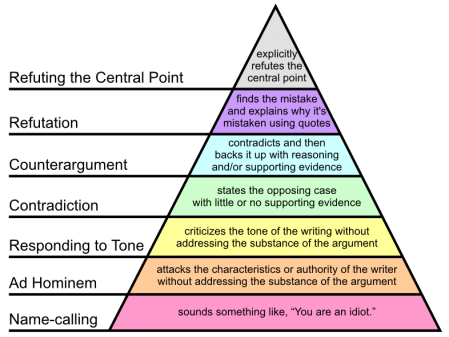
Learn How to Disagree

Grahams_Hierarchy_of_Disagreement1-449x337

Graham’s Hierarchy of disagreement

How to disagree?

The web is turning writing into a conversation. Twenty years ago, writers wrote and readers read. The web lets readers respond, and increasingly they do—in comment threads, on forums, and in their own blog posts.

Many who respond to something disagree with it. That’s to be expected. Agreeing tends to motivate people less than disagreeing. And when you agree there’s less to say. You could expand on something the author said, but he has probably already explored the most interesting implications. When you disagree you’re entering territory he may not have explored.

The result is there’s a lot more disagreeing going on, especially measured by the word. That doesn’t mean people are getting angrier. The structural change in the way we communicate is enough to account for it. But though it’s not anger that’s driving the increase in disagreement, there’s a danger that the increase in disagreement will make people angrier. Particularly online, where it’s easy to say things you’d never say face to face.

If we’re all going to be disagreeing more, we should be careful to do it well. What does it mean to disagree well? Most readers can tell the difference between mere name-calling and a carefully reasoned refutation, but I think it would help to put names on the intermediate stages. So here’s an attempt at a disagreement hierarchy:

DH0. Name-calling.

This is the lowest form of disagreement, and probably also the most common. We’ve all seen comments like this:

u r a fag!!!!!!!!!!

But it’s important to realize that more articulate name-calling has just as little weight. A comment like

The author is a self-important dilettante.

is really nothing more than a pretentious version of “u r a fag.”

DH1. Ad Hominem.

An ad hominem attack is not quite as weak as mere name-calling. It might actually carry some weight. For example, if a senator wrote an article saying senators’ salaries should be increased, one could respond:

Of course he would say that. He’s a senator.

This wouldn’t refute the author’s argument, but it may at least be relevant to the case. It’s still a very weak form of disagreement, though. If there’s something wrong with the senator’s argument, you should say what it is; and if there isn’t, what difference does it make that he’s a senator?

Saying that an author lacks the authority to write about a topic is a variant of ad hominem—and a particularly useless sort, because good ideas often come from outsiders. The question is whether the author is correct or not. If his lack of authority caused him to make mistakes, point those out. And if it didn’t, it’s not a problem.

DH2. Responding to Tone.

The next level up we start to see responses to the writing, rather than the writer. The lowest form of these is to disagree with the author’s tone. E.g.

I can’t believe the author dismisses intelligent design in such a cavalier fashion.

Though better than attacking the author, this is still a weak form of disagreement. It matters much more whether the author is wrong or right than what his tone is. Especially since tone is so hard to judge. Someone who has a chip on their shoulder about some topic might be offended by a tone that to other readers seemed neutral.

So if the worst thing you can say about something is to criticize its tone, you’re not saying much. Is the author flippant, but correct? Better that than grave and wrong. And if the author is incorrect somewhere, say where.

DH3. Contradiction.

In this stage we finally get responses to what was said, rather than how or by whom. The lowest form of response to an argument is simply to state the opposing case, with little or no supporting evidence.

This is often combined with DH2 statements, as in:

I can’t believe the author dismisses intelligent design in such a cavalier fashion. Intelligent design is a legitimate scientific theory.

Contradiction can sometimes have some weight. Sometimes merely seeing the opposing case stated explicitly is enough to see that it’s right. But usually evidence will help.

DH4. Counterargument.

At level 4 we reach the first form of convincing disagreement: counterargument. Forms up to this point can usually be ignored as proving nothing. Counterargument might prove something. The problem is, it’s hard to say exactly what.

Counterargument is contradiction plus reasoning and/or evidence. When aimed squarely at the original argument, it can be convincing. But unfortunately it’s common for counterarguments to be aimed at something slightly different. More often than not, two people arguing passionately about something are actually arguing about two different things. Sometimes they even agree with one another, but are so caught up in their squabble they don’t realize it.

There could be a legitimate reason for arguing against something slightly different from what the original author said: when you feel they missed the heart of the matter. But when you do that, you should say explicitly you’re doing it.

DH5. Refutation.

The most convincing form of disagreement is refutation. It’s also the rarest, because it’s the most work. Indeed, the disagreement hierarchy forms a kind of pyramid, in the sense that the higher you go the fewer instances you find.

To refute someone you probably have to quote them. You have to find a “smoking gun,” a passage in whatever you disagree with that you feel is mistaken, and then explain why it’s mistaken. If you can’t find an actual quote to disagree with, you may be arguing with a straw man.

While refutation generally entails quoting, quoting doesn’t necessarily imply refutation. Some writers quote parts of things they disagree with to give the appearance of legitimate refutation, then follow with a response as low as DH3 or even DH0.

DH6. Refuting the Central Point.

The force of a refutation depends on what you refute. The most powerful form of disagreement is to refute someone’s central point.

Even as high as DH5 we still sometimes see deliberate dishonesty, as when someone picks out minor points of an argument and refutes those. Sometimes the spirit in which this is done makes it more of a sophisticated form of ad hominem than actual refutation. For example, correcting someone’s grammar, or harping on minor mistakes in names or numbers. Unless the opposing argument actually depends on such things, the only purpose of correcting them is to discredit one’s opponent.

Truly refuting something requires one to refute its central point, or at least one of them. And that means one has to commit explicitly to what the central point is. So a truly effective refutation would look like:

The author’s main point seems to be x. As he says:

<quotation>

But this is wrong for the following reasons…

The quotation you point out as mistaken need not be the actual statement of the author’s main point. It’s enough to refute something it depends upon.

What It Means

Now we have a way of classifying forms of disagreement. What good is it? One thing the disagreement hierarchy doesn’t give us is a way of picking a winner. DH levels merely describe the form of a statement, not whether it’s correct. A DH6 response could still be completely mistaken.

But while DH levels don’t set a lower bound on the convincingness of a reply, they do set an upper bound. A DH6 response might be unconvincing, but a DH2 or lower response is always unconvincing.

The most obvious advantage of classifying the forms of disagreement is that it will help people to evaluate what they read. In particular, it will help them to see through intellectually dishonest arguments. An eloquent speaker or writer can give the impression of vanquishing an opponent merely by using forceful words. In fact that is probably the defining quality of a demagogue. By giving names to the different forms of disagreement, we give critical readers a pin for popping such balloons.

Such labels may help writers too. Most intellectual dishonesty is unintentional. Someone arguing against the tone of something he disagrees with may believe he’s really saying something. Zooming out and seeing his current position on the disagreement hierarchy may inspire him to try moving up to counterargument or refutation.

But the greatest benefit of disagreeing well is not just that it will make conversations better, but that it will make the people who have them happier. If you study conversations, you find there is a lot more meanness down in DH1 than up in DH6. You don’t have to be mean when you have a real point to make. In fact, you don’t want to. If you have something real to say, being mean just gets in the way.

If moving up the disagreement hierarchy makes people less mean, that will make most of them happier. Most people don’t really enjoy being mean; they do it because they can’t help it.

Thanks to Trevor Blackwell and Jessica Livingston for reading drafts of this.

Paul Graham, March 2008

Source: How to disagree

Revealed: Despot Rwanda dictator labelled a ‘visionary’ by Tony Blair falsifies poverty numbers to get more foreign aid and ‘even sent hitmen to Britain to take out rivals’


Priti Patel

Duped: The Department for International Development, overseen by Priti Patel, issued a report boasting of ‘investing’ £64 million aid this year in Rwanda.

president-paul-kagame-7

  • Paul Kagame is the President of Rwanda and commanded a rebel force before
  • Britain is the second biggest bilateral donor to Rwanda, giving £64 million a year
  • The Mail on Sunday found that the regime twists records, lying about poverty 
  • Human Rights activist Rene Mugenzi was warned by police that a hit squad from Rwanda had come to the UK to kill him

Emmanuel Gasakure could have enjoyed a comfortable life as a cardiologist in France. But when his native Rwanda was ripped apart by genocide in 1994, he returned to the country.

He helped revive the health service as the nation recovered from terrible trauma and served as President Paul Kagame’s adviser and personal physician for 14 years.

But Gasakure grew disturbed by dark forces wrecking his lifetime’s work. So he confronted the country’s health minister, a friend of Kagame’s wife, over missing funds, stray medical supplies and a mismanaged human resources project. Days later, this patriotic physician was arrested, tortured and then shot dead – by a police officer, reportedly in self-defence, inside a Kigali police station. One more dissident wiped out by a despotic regime. ‘He was executed because he was denouncing corruption in the health sector,’ said a friend. ‘Kagame is a killer.’

Few would now dispute this claim, given Kagame’s lethal interventions in neighbouring nations and the constant stream of critics who have died or disappeared after falling out with his regime.

His foes are not even safe abroad: one was strangled in South Africa, others have been eliminated in East Africa, while British and US authorities have issued warnings over Rwandan death squads.

Yet this bloodstained dictator at the helm of a ruthless one-party state is hailed a hero by Western leaders lavishing torrents of foreign aid on his tiny nation as he prepares for his latest electoral coronation next month.

Tony Blair says Kagame is a ‘visionary’. Bill Clinton called him one of the ‘greatest leaders of our time’. David Cameron proclaimed Rwanda ‘a success story’ that offers ‘a role model for development’.

The United Nations tells other African nations to ‘emulate’ Rwanda. The billionaire philanthropist Bill Gates works with him, the Davos elite fall at his feet and leading universities provide prestigious platforms for him to speak.

Britain is among the biggest cheerleaders, handing over huge sums from taxpayers and ushering Rwanda into the Commonwealth eight years ago.

Rwanda is the ultimate ‘donor darling’, where the barbarity of its vicious regime is brushed aside in a desperate search for an aid success story. And Britain backed the regime even after Kagame overturned the constitution to retain power for another 17 years.

Now, The Mail on Sunday can reveal devastating evidence that Rwanda may have distorted data, exaggerated claims of rapid development and lied about levels of poverty in its bid to shore up its credentials for foreign aid.

Our investigation reveals:

  1. Deaths of mothers and infants have been deliberately ‘unlogged’ to boost mortality statistics, exaggerating health improvements;
  2. Britain boasts its aid helped fund near-universal use of mosquito bed nets, yet corruption and mismanagement by health officials led to a massive malaria outbreak;
  3. Experts allege statistics on poverty are being manipulated to show improvements when it is actually growing worse, not better;
  4. A British firm has withdrawn from helping analyse a key national study used to measure poverty, reportedly due to concerns over data manipulation;
  5. Multilateral partners have confronted Rwanda after discovering its health data is ‘not credible’;
  6. World Bank sources say a famine caused by drought and failed agricultural policies is being covered up by the state;
  7. Dissidents claim Western donors are being duped. ‘Britain ignores reality and chooses to play an openly propagandistic role for the regime,’ said David Himbara, a former Kagame aide.

Some of the most shocking evidence uncovered by this newspaper comes from senior regime insiders who have fled the country. One said he saw the president personally beat a colleague with sticks for buying curtains from a store not owned by the ruling party, which has vast assets and is controlled by Kagame. The victim remains behind bars nine years later.

The MoS investigation was aided by a whistleblowing senior official at a global multilateral agency. ‘I feel like an accomplice to murder,’ said the source.

‘I thought I was working with God but it turned out I was working with the Devil. This kind of regime is pure evil.’

President Kagame sells himself as saviour of Rwanda after ousting Hutu militia accused of slaughtering about 800,000 mainly Tutsi citizens in the genocide, then salvaging a shattered nation. He skilfully exploited Western guilt over the genocide, despite sparking war in the Democratic Republic of Congo that led to possibly five million deaths. His forces carried out terrible atrocities, even on refugees, women and children.

He was due to stand down this year. But Kagame held a referendum to overturn limits on how long he could serve, claiming to be reacting to public opinion and winning almost all the votes. He could now stay in power until 2034.

His last election in 2010 was a sham, with rivals jailed and newspapers closed using state bodies backed by British aid.

One opponent was beheaded – yet Tony Blair, who has borrowed Kagame’s private jet, sent the dictator effusive congratulations. In May this year, an activist called Diane Rwigara declared she would stand against Kagame, bravely arguing ‘people are tired, people are angry’. Her industrialist father died two years ago in a car crash the family fear was a politically-linked murder. Two days later, nude photographs of the 35-year-old were leaked to a newspaper and circulated on social media. Then the electoral commission rejected her bid.

‘Since the ruling Rwandan Patriotic Front took power 23 years ago, Rwandans have faced huge – and often deadly – obstacles to participating in public life and voicing criticism of government policy,’ said Amnesty International regional director Muthoni Wanyeki.

The roll call of dead critics includes an opposition figure who was ordered to meet his village security official in May. A few days later his family were called to collect his corpse from a hospital.

Human Rights Watch also revealed why visitors admire capital Kigali’s neat streets: the police execute petty criminals while ‘undesirables’ such as hawkers and the homeless are held in camps. The group says there is official strategy to spread fear. Yet on Thursday, the Department for International Development, overseen by Priti Patel, issued a report boasting of ‘investing’ £64 million aid this year in Rwanda to ‘build effective government institutions’ and support ‘development of an open and inclusive society’.

It praised Kagame’s ‘strong record of using aid effectively to… produce impressive results’ and insisted his regime ‘plays a progressive role on the world stage’.

Britain is the second biggest bilateral donor to Rwanda. The nation of nearly 12 million people receives the highest levels of aid support per capita in its region – about twice as much per head as Burundi, Kenya or Uganda.

Kagame and his fans love to reel off figures highlighting how he has transformed his country in areas such as healthcare, with life expectancy soaring and sharp falls in child and maternal mortality. But according to former insiders such as Himbara, who served as Kagame’s principal private secretary and then his head of policy and strategy, ‘statistical manipulation is so widespread that hardly anyone knows what the reality is’.

Another well-placed source explained how Rwanda twists child mortality figures. ‘If a researcher goes to a household and finds a child has died, they just go to the next one. This is easy in such a tightly controlled society since no one can complain.’

Vincent DeGennaro, an American doctor, spent 18 months working in Rwanda with a charity and saw how neonatal and maternal deaths went unrecorded. ‘When I first got there, I bought into the narrative,’ he said. But he soon realised there was deliberate miscollection of data.

‘I was seeing babies dying in a hospital that did not get recorded and mothers in health centres whose deaths were not recorded. That was enough to show they were lying.’

Himbara claims Rwanda has only 684 doctors and 99 pharmacists, far lower than both official figures and rates per capita across Africa.

Britain boasts of aiding Rwanda’s health sector and funding distribution of bed nets. But a malaria epidemic with two million cases exposed corruption and purchase of shoddy nets, leading to the dismissal of the health minister and charging of officials.

‘This is proof that whatever statistics they provided were fake,’ said a senior World Bank official. ‘It is impossible to have this size of malaria outbreak if 95 per cent of the population are sleeping under proper bed nets as claimed.

‘Then they covered this up by blaming climate change but there was no other epidemic then in neighbouring countries. We are sure the statistics are false.’

This newspaper understands World Health Organisation officials have also disputed Rwandan statistics. ‘They challenged the data because it was not credible,’ said a source. Filip Reyntjens, a renowned Belgian expert on Rwanda, also raised questions over abuse of statistics. He argued the regime deliberated engineered a decline in poverty figures by changing goods used in a household budget survey.

Oxford Policy Management, a British firm of consultants, withdrew from helping analyse the study reportedly due to ‘a disagreement’ over data manipulation.

Reyntjens said results would otherwise have revealed a significant rise in the proportion of people living below the minimum poverty line between 2010 and 2014.

‘It is surprising the international aid community does not seem to be bothered by major flaws in the evidence on Rwanda’s achievements in two major pet areas of donors: poverty and inequality,’ he wrote on the African Arguments website.

‘This makes clear again that donors and recipients need each other. Donors need success stories, recipients need money and neither wants to rock the boat.’

Reyntjens told me he fears the repression is building dangerous resentments. ‘My concern is Rwanda will explode again.’

His claims were endorsed last month in the Review of African Political Economy.

The fact that two researchers arrive – independently from each other – at the same conclusion, strengthens my belief that… poverty in Rwanda has increased,’ wrote economist Sam Desiere.

There have also been reports of severe hunger in parts of the country, partly blamed on centralised agricultural policies promoting crops such as coffee, tea and flowers to sell abroad. ‘It is a typical famine of a totalitarian state,’ said the World Bank source.

‘They try to hide it but the situation is very serious.’

The author Anjan Sundaram spent almost five years in Rwanda on a journalism training project funded by British and European aid. In Bad News, his devastating exposé of dictatorship, he quotes a diplomat ‘proud’ to be giving money to Kagame.

Yet Sundaram told me donors should have no doubt their cash fuels repression and diminishes hopes of democracy. ‘Rwandans benefit from aid on condition that they do not criticise the Rwandan government,’ he said. ‘Critics are routinely denied benefits of aid-financed healthcare.

‘Worse, they often find themselves imprisoned, tortured, forced to flee the country or dead. Aid money strengthens the government’s repressive machinery.’

Kagame has officials with his Tutsi-dominated party monitoring every household and every village. This can be a force for good – seen with the elimination of plastic bags – but also creates a climate of compliant fear.

The president is thought to control $500 million of assets in Rwanda, from property to milk processing, through Crystal Ventures, the ruling party’s company. Confidants of Kagame were named in the Panama Papers leak of secretive offshore holdings.

Dissidents are dismayed by Western support for a savage and duplicitous regime. ‘Britain knows exactly what is going on,’ said Robert Higiro, a former army major who was asked to kill two of the president’s most hated enemies – one of whom was later murdered. ‘I have friends at DFID. They know the truth.’

Rene Mugenzi, a father of three and human rights activist, was warned six years ago by Scotland Yard that a Kigali hit squad had been sent after him.

‘British support to Rwanda is sustaining an oppressive government, totally contrary to development and aid principles,’ he said. ‘I am a British taxpayer but my government is funding a totalitarian regime that wants my assassination.’

DFID insists that Rwanda uses aid effectively and says it is funding work in the country to improve collection of statistics and reduce poverty. It argues that Britain’s ability to effect change is boosted by engagement.

‘All UK financial support in Rwanda is earmarked for specific programmes only, such as education,’ said a spokesman.

‘In all its dealing with the government of Rwanda, the British Government holds them to account on governance, human rights and development issues.’

Source: Mail Online


Rwandan Genocide: What really happened in 1994?

téléchargement

In 1998 and 1999, we went to Rwanda and returned several times in subsequent years for a simple reason: We wanted to discover what had happened there during the 100 days in 1994 when civil war and genocide killed an estimated 1 million individuals. What was the source of our curiosity? Well, our motivations were complex. In part, we felt guilty about ignoring the events when they took place and were largely overshadowed in the U.S. by such “news” as the O.J. Simpson murder case. We felt that at least we could do something to clarify what had occurred in an effort to respect the dead and assist in preventing this kind of mass atrocity in the future. We were both also in need of something new, professionally speaking. Although tenured, our research agendas felt staid. Rwanda was a way out of the rut and into something significant.

Although well-intentioned, we were not at all ready for what we would encounter. Retrospectively, it was naïve of us to think that we would be. As we end the project 10 years later, our views are completely at odds with what we believed at the outset, as well as what passes for conventional wisdom about what took place.

We worked for both the prosecution and the defense at the International Criminal Tribunal for Rwanda, trying to perform the same task — that is, to find data that demonstrate what actually happened during the 100 days of killing. Because of our findings, we have been threatened by members of the Rwandan government and individuals around the world. And we have been labeled “genocide deniers” in both the popular press as well as the Tutsi expatriate community because we refused to say that the only form of political violence that took place in 1994 was genocide. It was not, and understanding what happened is crucial if the international community is to respond properly the next time it becomes aware of such a horrific spasm of mass violence.

Like most people with an unsophisticated understanding of Rwandan history and politics, we began our research believing that what we were dealing with was one of the most straightforward cases of political violence in recent times, and it came in two forms: On the one hand was the much-highlighted genocide, in which the dominant, ruling ethnic group — the Hutu — targeted the minority ethnic group known as the Tutsi. The behavior toward the minority group was extremely violent — taking place all over Rwanda — and the objective of the government’s effort appeared to be the eradication of the Tutsi, so the genocide label was easy to apply. On the other hand, there was the much-neglected international or civil war, which had rebels (the Rwandan Patriotic Front or RPF) invading from Uganda on one side and the Rwandan government (the Armed Forces of Rwanda or FAR) on the other. They fought this war for four years, until the RPF took control of the country.

We also went in believing that the Western community — especially the United States — had dropped the ball in failing to intervene, in large part because the West had failed to classify expeditiously the relevant events as genocide.

Finally, we went in believing that the Rwandan Patriotic Front, then rebels but now the ruling party in Rwanda, had stopped the genocide by ending the civil war and taking control of the country.

At the time, the points identified above stood as the conventional wisdom about the 100 days of slaughter. But the conventional wisdom was only partly correct.

The violence did seem to begin with Hutu extremists, including militia groups such as the Interahamwe, who focused their efforts against the Tutsi. But as our data came to reveal, from there violence spread quickly, with Hutu and Tutsi playing the roles of both attackers and victims, and many people of both ethnic backgrounds systematically using the mass killing to settle political, economic and personal scores.

Against conventional wisdom, we came to believe that the victims of this violence were fairly evenly distributed between Tutsi and Hutu; among other things, it appears that there simply weren’t enough Tutsi in Rwanda at the time to account for all the reported deaths.

We also came to understand just how uncomfortable it can be to question conventional wisdom.

We began our research while working on a U.S. Agency for International Development project that had proposed to deliver some methodological training to Rwandan students completing their graduate theses in the social sciences. While engaged in this effort, we came across a wide variety of nongovernmental organizations that had compiled information about the 100 days. Many of these organizations had records that were detailed, identifying precisely who died where and under what circumstances; the records included information about who had been attacked by whom. The harder we pushed the question of what had happened and who was responsible, the more access we gained to information and data.

There were a number of reasons that we were given wide-ranging access to groups that had data on the 100 days of killing. First, for their part of the USAID program, our hosts at the National University of Rwanda in Butare arranged many public talks, one of which took place at the U.S. embassy in Kigali. Presumably put together to assist Rwandan NGOs with “state-of-the-art” measurement of human rights violations, these talks — the embassy talk, in particular — turned the situation on its head. The Rwandans at the embassy ended up doing the teaching, bringing up any number of events and publications that dealt with the violence. We met with representatives of several of the institutions involved, whose members discussed with us in greater detail the data they had compiled.

Second, the U.S. ambassador at the time, George McDade Staples, helped us gain access to Rwanda government elites —directly and indirectly through staff members.

Third, the Rwandan assigned to assist the USAID project was extremely helpful in identifying potential sources of information. That she was closely related to a member of the former Tutsi royal family was a welcome plus.

Once we returned to the U.S., we began to code events during the 100 days by times, places, perpetrators, victims, weapon type and actions. Essentially, we compiled a listing of who did what to whom, and when and where they did it — what Charles Tilly, the late political sociologist, called an “event catalog.” This catalog would allow us to identify patterns and conduct more rigorous statistical investigations.

Looking at the material across space and time, it became apparent that not all of Rwanda was engulfed in violence at the same time. Rather, the violence spread from one locale to another, and there seemed to be a definite sequence to the spread. But we didn’t understand the sequence.

At National University of Rwanda, we spent a week preparing students to conduct a household survey of the province. As we taught the students how to design a survey instrument, a common question came up repeatedly: “What actually happened in Butare during the summer of 1994?” No one seemed to know; we found this lack of awareness puzzling and guided the students in building a set of questions for their survey, which eventually revealed several interesting pieces of information.

First, and perhaps most important, was confirmation that the vast majority of the population in the Butare province had been on the move between 1993 and 1995, particularly during early 1994. Almost no one stayed put. We also found that the RPF rebels had blocked the border leading south out of the province to Burundi. The numbers of households that provided information consistent with these facts raised significant questions in our minds regarding the culpability of the RPF relative to the FAR for killing in the area.

During this period, we confirmed Human Rights Watch findings that many killings were organized by the Hutu-led FAR, but we also found that many of the killings were spontaneous, the type of violence that we would expect with a complete breakdown of civil order. Our work further revealed that, some nine years later, a great deal of hostility remained. There was little communication between the two ethnic groups. The Tutsi, now under RPF leadership and President Paul Kagame, dominated all aspects of the political, economic and social systems.

Lastly, it became apparent to us that members of the Tutsi diaspora who returned to Rwanda after the conflict were woefully out of touch with the country that they had returned to. Indeed, one Tutsi woman with whom we spent a day in the hills around Butare broke down in tears in our car as we drove back to the university. When asked why, she replied, “I have never seen such poverty and destitution.” We were quite surprised at the degree of disconnect between the elite students drawn from the wealthy strata of the Tutsi diaspora, who were largely English-speaking, and the poorer Rwandans, who spoke Kinyarwanda and perhaps a bit of French. It was not surprising that the poor and the wealthy in the country did not mix; what struck both of us as surprising was the utter lack of empathy and knowledge about each other’s condition. After all, the Tutsi outside the country claimed to have invaded Rwanda from Uganda on behalf of the Tutsi inside — a group that the former seemed to have little awareness of or interest in. Our work has led us to conclude that the invading force had a primary goal of conquest and little regard for the lives of resident Tutsis.

As the students proceeded with the survey, asking questions that were politically awkward for the RPF-led government, we found our position in the country increasingly untenable. One member of our team was detained and held for the better part of a day while being interrogated by a district police chief. The putative reason was a lack of permissions from the local authorities; permissions were required for everything in Rwanda, and we generally had few problems obtaining them in the beginning. The real reason for the interrogation, however, seemed to be that we were asking uncomfortable questions about who the killers were.

A couple of weeks later, two members of our team were on a tourist trip in the northern part of the country when they were again detained and questioned for the better part of a day at an RPF military facility. There the questioners wanted to know why we were asking difficult questions, what we were doing in the country, whether we were working for the American CIA, if we were guests of the Europeans and, in general, why we were trying to cause trouble.

On one of our trips to Rwanda, Alison Des Forges, the pre-eminent scholar of Rwandan politics who has since died in an airplane crash, suggested that we go to the International Criminal Tribunal for Rwanda in Tanzania to seek answers to the questions we were raising. Des Forges even called on our behalf.

With appointments set and with Mount Kilimanjaro in the distance, we arrived in Arusha, Tanzania, for our meeting with Donald Webster, the lead prosecutor for the political trials, Barbara Mulvaney, the lead prosecutor for the military trial, and others from their respective teams. As we began to talk, we initially found that the prosecutors in the two sets of cases — one set of defendants were former members of the FAR military, the other set of trials focused on the members of the Hutu political machine — had great interest in our project.

Eventually, Webster and Mulvaney asked us to help them contextualize the cases that they were investigating. Needless to say, we were thrilled with the possibility. Now, we were working directly with those trying to bring about justice.

The prosecutors showed us a preliminary database that they had compiled from thousands of eyewitness statements associated with the 1994 violence. They did not have the resources to code all of the statements for computer analysis; they wanted us to do the coding and compare the statements against the data we had already compiled. We returned to the U.S. with real enthusiasm; we had access to data that no one else had seen and direct interaction with one of the most important legal bodies of the era.

Interest by and cooperation with the ICTR did not last as long as we thought it would, in no small part because it quickly became clear that our research was going to uncover killings committed not just by the Hutu-led former government, or FAR, but by the Tutsi-led rebel force, the RPF, as well. Until then, we had been trying to identify all deaths that had taken place; beyond confidentiality issues, it did not occur to us that the identity of perpetrators would be problematic (in part because we thought that all or almost all of them would be associated with the Hutu government). But then we tried to obtain detailed maps that contained information on the location of FAR military bases at the beginning of the civil war. We had seen copies of these maps pinned to the wall in Mulvaney’s office. In fact, during our interview with Mulvaney, the prosecutor explained how her office had used these maps. We took detailed notes, even going so far as to write down map grid coordinates and important map grid sheet identifiers.

After the prosecution indicated it was no longer interested in reconstructing a broad conception of what had taken place —prosecutors said they’d changed their legal strategy to focus exclusively on information directly related to people charged with crimes — we asked the court for a copy of the maps. To our great dismay, the prosecution claimed that the maps did not exist. Unfortunately for the prosecutors, we had our notes. After two years of negotiations, a sympathetic Canadian colonel in a Canadian mapping agency produced the maps we requested.

As part of the process of trying to work out the culpability of the various defendants charged with planning to carry out genocidal policies, the ICTR conducted interviews with witnesses to the violence over some five years, beginning in 1996. Ultimately, the court deposed some 12,000 different people. The witness statements represent a highly biased sample; the Kagame administration prevented ICTR investigators from interviewing many who might provide information implicating members of the RPF or who were otherwise deemed by the government to be either unimportant or a threat to the regime.

All the same, the witness statements were important to our project; they could help corroborate information found in CIA documents, other witness statements, academic studies of the violence and other authoritative sources.

As with the maps, however, when we asked for the statements, we were told they did not exist. Eventually, defense attorneys —who were surprised by the statements’ existence, there being no formal discovery process in the ICTR — requested them. After a year or so, we obtained the witness statements, in the form of computer image files that we converted into optically readable computer documents. We then wrote software to search through these 12,000 statements in our attempts to locate violence and killing throughout Rwanda.

The first significant negative publicity associated with our project occurred in November 2003 at an academic conference in Kigali. The National University of Rwanda had invited a select group of academics, including our team, to present the results of research into the 1994 murders. We had been led to believe that the conference would be a private affair, with an audience composed of academics and a small number of policymakers.

As it turned out, the conference was anything but small or private. It was held at a municipal facility in downtown Kigali, and our remarks would be simultaneously translated from English into French and the Rwandan language, Kinyarwanda. There were hundreds of people present, including not just academics but members of the military, the cabinet and other members of the business and political elite.

We presented two main findings, the first derived from spatial and temporal maps of data obtained from the different sources already mentioned. The maps showed that, while killing took place in different parts of the country, it did so at different rates and magnitudes — begging for an explanation we did not yet have. The second finding came out of a comparison of official census data from 1991 to the violence data we had collected. According to the census, there were approximately 600,000 Tutsi in the country in 1991; according to the survival organization Ibuka, about 300,000 survived the 1994 slaughter. This suggested that out of the 800,000 to 1 million believed to have been killed then, more than half were Hutu. The finding was significant; it suggested that the majority of the victims of 1994 were of the same ethnicity as the government in power. It also suggested that genocide — that is, a government’s attempts to exterminate an ethnic group — was hardly the only motive for some, and perhaps most, of the killing that occurred in the 100 days of 1994.

Halfway into our presentation, a military man in a green uniform stood up and interrupted. The Minister of Internal Affairs, he announced, took great exception to our findings. We were told that our passport numbers had been documented, that we were expected to leave the country the next day and that we would not be welcomed back into Rwanda — ever. Abruptly, our presentation was over, as was, it seemed, our fieldwork in Rwanda.

The results of our initial paper and media interviews became widely known throughout the community of those who study genocides in general and the Rwandan genocide in particular. The main offshoot was that we became labeled, paradoxically, as genocide “deniers,” even though our research documents that genocide had occurred. Both of us have received significant quantities of hate mail and hostile e-mail. In the Tutsi community and diaspora, our work is anathema. Over the past several years, as we have refined our results, becoming more confident about our findings, our critics’ voices have become louder and increasingly strident.

Of course, we have never denied that a genocide took place; we just noted that genocide was only one among several forms of violence that occured at the time. In the context of post-genocide Rwandan politics, however, the divergence from common wisdom was considered political heresy.

Following the debacle at the Kigali conference, the ICTR prosecution teams of Webster and Mulvaney let us know in no uncertain terms that they had no further use of our services. The reasons for our dismissal struck us as somewhat outrageous. From the outset, the prosecution claimed it was not interested in anything that would prove or disprove the culpability of any individuals in the mass killings. Now, they said, the findings we’d announced in the Kigali conference made our future efforts superfluous.

Shortly after our dismissal, however, Peter Erlinder, a defense attorney for former members of the FAR military who were to be tried, contacted us. This was after several others from the defense had also attempted to contact us, with no success.

We had misgivings about cooperating or working with the defense, the gravest being that such work might be seen as supporting the claim we were genocide deniers. After months of negotiating, we finally met Erlinder at a Starbucks in Philadelphia, Pa. The defense could have made a better choice for roping us in. Erlinder, a professor at the William Mitchell College of Law, was an academic turned defender for the least likable suspects.

After we obtained lattes and quiet seats in the back of the coffee shop, Erlinder came straight to the point: He was, of course, interested in establishing his client’s innocence, but he felt it would help the defense to establish a baseline history of what had taken place in the war in 1994. As he explained, “My client may be guilty of some things, but he is not guilty of all the things that any in the Rwandan government and military during 1994 is accused of. They have all been made out to be devils.”

What he asked was reasonable. In fact, he made the same essential offer the prosecution had: In exchange for our efforts at contextualizing the events of 1994, Erlinder would do the best he could to assist us in getting data on what took place. With Erlinder’s assistance, we were able to obtain the maps we’d seen in Mulvaney’s office and the 12,000 witness statements. With this information, we were able to better establish the true positions of both the FAR and RPF during the civil war. This greater confidence of the location of the two sides’ militaries made — and makes — us more certain about the culpability of the FAR for the majority of the killings during the 100 days of 1994. At the same time, however, we also began to develop a stronger understanding of the not insignificant role played by the RPF in the mass murders.

About this time, we were approached by an individual associated with Arcview-GIS, a spatial mapping software firm that wanted to take the rather simplistic maps that we had developed and improve them, thereby showing what the company’s program was capable of. Our consultant at Arcview-GIS said the software could layer information on the map, providing, among other things, a line that showed, day by day, where the battlefront of the civil war was located, relative to the killings we had already documented.

This was a major step. In line with the conventional wisdom, we had assumed that the government was responsible for most all of the people killed in Rwanda during 1994; we initially paid no attention to where RPF forces were located. But it soon became clear that the killings occurred not just in territory controlled by the government’s FAR but also in RPF-captured territory, as well as along the front between the two forces. It seemed possible to us that the three zones of engagement (the FAR-controlled area, the RPF-controlled area and the battlefront between the two) somehow influenced one another.

In his book, The Limits of Humanitarian Intervention, Alan Kuperman argued that given the logistical challenges of mounting a military operation in deep central Africa, there was little the U.S. or Europe could have done to limit the 1994 killings. To support his position, Kuperman used U.S. Defense Intelligence Agency information to document approximate positions of the RPF units over the course of the war. We updated this information on troop locations with data from CIA national intelligence estimates that others had obtained through the Freedom of Information Act and then updated it again, incorporating interviews with former RPF members, whose recollections we corroborated with information from the FAR.

Our research showed the vast majority of the 1994 killing had been conducted by the FAR, the Interahamwe and their associates. Another significant proportion of the killing was committed not by government forces but by citizens engaged in opportunistic killing as part of the breakdown of civil order associated with the civil war. But the RPF was clearly responsible for another significant portion of the killings.

In some instances, the RPF killings were, very likely, spontaneous retribution. In other cases, though, the RPF has been directly implicated in large-scale killings associated with refugee camps, as well as individual households. Large numbers of individuals died at roadblocks and in municipal centers, households, swamps and fields, many of them trying to make their way to borders.

Perhaps the most shocking result of our combination of information on troop locations involved the invasion itself: The killings in the zone controlled by the FAR seemed to escalate as the RPF moved into the country and acquired more territory. When the RPF advanced, large-scale killings escalated. When the RPF stopped, large-scale killings largely decreased. The data revealed in our maps was consistent with FAR claims that it would have stopped much of the killing if the RPF had simply called a halt to its invasion. This conclusion runs counter to the Kagame administration’s claims that the RPF continued its invasion to bring a halt to the killings.

In terms of ethnicity, the short answer to the question, “Who died?” is, “We’ll probably never know.” By and large, the Hutu and the Tutsi are physically indistinct from one another. They share a common language. They have no identifiable accent. They have had significant levels of intermarriage through their histories, and they have lived in similar locations for the past several hundred years. In the 1920s and 1930s, the Belgians, in their role as occupying power, put together a national program to try to identify individuals’ ethnic identity through phrenology, an abortive attempt to create an ethnicity scale based on measurable physical features such as height, nose width and weight, with the hope that colonial administrators would not have to rely on identity cards.

One result of the Belgian efforts was to show — convincingly — that there is no observable difference on average between the typical Hutu Rwandan and the typical Tutsi Rwandan. Some clans — such as those of the current president, Paul Kagame, or the earlier Hutu president,Juvenal Habyarimana — do share distinctive physical traits. But the typical Rwandan shares a mix of such archetypal traits, making ethnic identity outside of local knowledge about an individual household’s identity difficult if not impossible to ascertain — especially in mass graves containing no identifying information. (For example, Physicians for Human Rights exhumed a mass grave in western Rwanda and found the remains of more than 450 people, but only six identity cards.)
In court transcripts for multiple trials at the ICTR, witnesses described surviving the killings that took place around them by simply hiding among members of the opposite ethnic group. It is clear that in 1994, killers would have had a difficult time ascertaining the ethnic identity of their putative victims, unless they were targeting neighbors.

Complicating matters is the displacement that accompanied the RPF invasion. During 1994, some 2 million Rwandan citizens became external refugees, 1 million to 2 million became internal refugees, and about 1 million eventually became victims of civil war and genocide.

Ethnic identity in Rwanda is local knowledge, in much the same way that caste is local knowledge in India. With the majority of the population on the move, local knowledge and ethnic identity disappeared. This is not to say that the indigenous Tutsi were not sought out deliberately for extermination. But in their killing rampages, FAR, the Interahamwe and private citizens engaged in killing victims of both ethnic groups. And people from both ethnic groups were on the move, trying to stay out in front of the fighting as the RPF advanced.

In the end, our best estimate of who died during the 1994 massacre was, really, an educated guess based on an estimate of the number of Tutsi in the country at the outset of the war and the number who survived the war. Using a simple method —subtracting the survivors from the number of Tutsi residents at the outset of the violence — we arrived at an estimated total of somewhere between 300,000 and 500,000 Tutsi victims. If we believe the estimate of close to 1 million total civilian deaths in the war and genocide, we are then left with between 500,000 and 700,000 Hutu deaths, and a best guess that the majority of victims were in fact Hutu, not Tutsi.

This conclusion — which has drawn criticism from the Kagame regime and its supporters — is buttressed by the maps that we painstakingly constructed from the best available data and that show significant numbers of people killed in areas under control of the Tutsi-led RPF.

One fact is now becoming increasingly well understood: During the genocide and civil war that took place in Rwanda in 1994, multiple processes of violence took place simultaneously. Clearly there was a genocidal campaign, directed to some degree by the Hutu government, resulting directly in the deaths of some 100,000 or more Tutsi. At the same time, a civil war raged — a war that began in 1990, if the focus is on only the most recent and intense violence, but had roots that extend all the way back to the 1950s. Clearly, there was also random, wanton violence associated with the breakdown of order during the civil war. There’s also no question that large-scale retribution killings took place throughout the country — retribution killings by Hutu of Tutsi, and vice versa.

From the beginning, the ICTR’s investigation into the mass killings and crimes against humanity in Rwanda in 1994 has focused myopically on the culpability of Hutu leaders and other presumed participants. The Kagame administration has worked assiduously to prevent any investigation into RPF culpability for either mass killings or the random violence associated with the civil war. By raising the possibility that in addition to Hutu/FAR wrongdoing, the RPF was involved, either directly or indirectly, in many deaths, we became in effect persona non grata in Rwanda and at the ICTR.

The most commonly invoked metaphor for the 1994 Rwandan violence is the Holocaust. Elsewhere, we have suggested that perhaps the English civil war, the Greek civil war, the Chinese civil war or the Russian civil war might be more apt comparisons because they all involved some combination of ethnic-based violence and the random slaughter and retribution that can occur when civil society breaks down altogether.

Actually, though, it is difficult to make authoritative comparisons when it remains unclear exactly what happened in the Rwandan civil war and genocide.

Contemporary observers — including Romeo Dallaire, the commander of the ineffective U.N. peacekeeping force for Rwanda in 1993 and 1994 — claim that much of the genocidal killing had been planned by the Hutu government as early as two years in advance of the actual RPF invasion. Unfortunately, we have not been able to gain access to the individuals who have information on that score to either corroborate or to refute the hypothesis. The reason? Convicted genocidaires who have been implicated in the planning of the slaughter now reside out of contact with potential interviewers in a U.N.-sponsored prison in Mali.

We wanted to put questions to these planners, specifically to ask them what their goals were. Was the genocide plan an attempt at deterrence, an effort that the FAR leadership thought might keep the RPF at bay in Uganda and elsewhere? Did the FAR government actually hope for war, believing — incorrectly as it turned out — that it would win? Was the scale of the killing beyond its expectations? If so, why do FAR leaders believe events spun so badly out of control, compared to previous spasms of violence in the 1960s, ’70s and ’80s?

Unfortunately, the U.N. prosecutors in Tanzania told us they could not arrange a meeting with the convicted planners and killers, but we were free to go to Mali on our own. We were told we would probably get in to see the prisoners, but the prison is in the middle of nowhere, in a country where we had no contacts. We had to let go.

Even without access to convicted genocidaires, we continued to piece together what had happened in 1994 with the help of a grant from the National Science Foundation. The grant allowed us to be more ambitious in our pursuit of diverse informants who started popping up all over the globe, to refine our mapping and to explore alternative ways of generating estimates about what had taken place. While our understanding has advanced a great deal since our first days in Kigali, it is hard not to see irony in a current reality: Some of the most important information about what occurred in Rwanda in 1994 has been sent — by the very authorities responsible for investigating the violence and preventing its recurrence, in Rwanda and elsewhere — to an isolated prison, where it sits unexamined, like some artifact in the final scene of an Indiana Jones movie.


Published first on October 6, 2009 .