Category Archives: Human rights

Rwanda : le génocide des tutsi, révisionnisme des tutsi !

diane

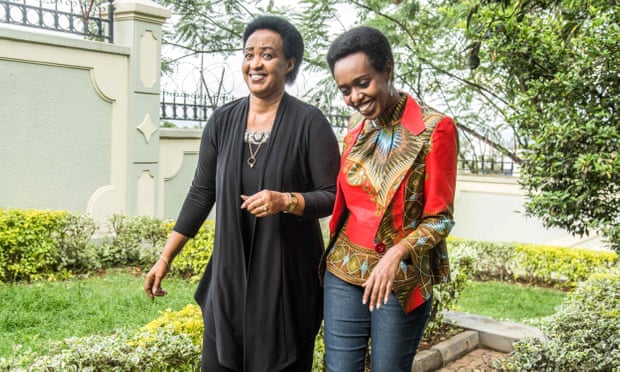
« Le fait d’avoir arrêté le génocide ne vous donne pas le droit de terroriser et de tuer ceux qui en ont été rescapés. C’est insensé de tout le temps célébrer les morts, tout en tuant les vivants… »  Ainsi parlait, hier encore, Diane Rwigara, jeune fille universitaire tutsie.

« Vous avez déclenché intentionnellement le génocide tutsi en descendant l’avion du Président hutu. Puis vous avez massacré des innocents hutu qui nous avaient cachés, avant de vous en prendre aujourd’hui à nous… » Ainsi parlait, l’année dernière, Callixte Nsabimana, jeune homme universitaire tutsi. Plus encore que les quelques balles tirées aux abords de Nyungwe et (bêtement) revendiquées par ses soins depuis une chambre close des bas-fonds de Moroni, voilà d’ailleurs la phrase qui avait poussé Kigali à mettre sur sa tête 12 millions de dollars, mort ou vif ! Car l’enjeu est de taille…

Seulement voilà, à ce rythme, les caisses risquent de se vider bientôt puisque, comme on le voit aujourd’hui et comme on l’a vu hier et avant-hier, le pauvre « Sankara » n’est pas le seul tutsi à vibrer sur cette longueur d’onde. Y a même comme une hémorragie, et tout porte à croire que le phénomène ira crescendo ! Des tutsi de tous horizons sont fermement engagés dans ce « révisionnisme » d’un genre inédit, et pas des moindres : intellectuels de haut vol, médecins, journalistes ayant pignon su rue, professeurs d’universités, anciens haut- gradés, grands hommes d’affaires, religieux,…

Tous « questionnent » ce génocide, chacun à sa manière: y a ceux qui en attribuent le déclenchement, conscient et cynique, à Paul Kagame et son mouvement politique et armé, ceux qui dénoncent sa concomitance avec un autre, celui des hutu, entamé bien avant et perpétré par l’armée tutsie, d’autres qui dénoncent la gestion m’enfoutiste de l’après génocide, etc. Ce phénomène est tellement extraordinaire qu’il appelle cette question inévitable : comment diable en sommes-nous arrivés là?!

Au commencement était une erreur fatale de calcul politique, quand des stratèges mal inspirés ont décidé l’instrumentalisation outrancière de ce drame humain, jusqu’à faire du génocide le mythe fondateur du nouveau régime. Comme il fallait s’y attendre, cette machine implacable à « broyer du hutu » allait se révéler, à terme, le véritable tendon d’Achille sur lequel toute personne en rupture avec le FPR- hutu, tutsi ou même étranger- se doit tout naturellement de cibler!

L’autre énormité qu’on peut relever, parmi tant d’autres, c’est d’avoir fait preuve d’une méconnaissance inouïe de la société rwandaise d’après 1959. Dans ce Rwanda en effet, qui est tout sauf un ramassis de tribus, et « hutsisé » à outrance (biologiquement et sociologiquement), comment imaginer que tu peux globaliser les Hutu sans faire souffrir les Tutsi ?! Comment « se venger » sur un « juste » hutu et rêver faire le bonheur de ses protégés tutsis qu’il vient de sauver au risque de sa propre vie et celle de sa famille ? Comment tuer ou faire souffrir gratuitement un homme hutu innocent, et penser rassurer ainsi sa femme tutsie et sa famille ?! Comment parquer deux millions de hutu dans des prisons-mourroirs, et espérer que leurs « partenaires » tutsis de tous bords se tueront à la tâche, le cœur léger, pour leur apporter tous les jours à manger?!

La liste serait longue de ces « conneries » fatales qui nous conduisent là où nous en sommes, et qui nous rappellent étrangement les Interahamwe qui, dans leur délire génocidaire, avaient fini par massacrer plus de Hutu et de Hutsi, que de Tutsi! Et maintenant alors? Maintenant, avec certainement beaucoup d’autres, je m’interroge: qu’en serait-il advenu si, après guerre, des personnalités juives de premier plan avaient défié l’Agence Juive Mondiale sur la question fondamentale de la gestion de la mémoire de la Shoah? Ou si Aznavour, Manoukian et bien d’autres, avaient « questionné » le génocide arménien?!

Avant de me rendre compte que la réponse, effrayante, se trouve dans la question: l’extinction probable, à moyen ou long terme, de la mémoire ! Ne voit-on pas, d’ailleurs, déjà venir? Dans des pays où les Tutsi sont libres, c’est à dire à l’étranger, les commémorations ont commencé à tourner au pathétique. Ainsi par exemple en avril dernier, j’assistais d’une terrasse de café à un de ces rassemblements, auxquels bien évidemment même les Hutsi sont regardés de travers (encore une connerie)! La foule était tellement éparse que le pauvre reporter photographe de Igihe.com en était réduit à se contorsionner, tel un gymnaste de haut niveau, pour essayer des angles de vues improbables de nature à produire des clichés donnant l’illusion du nombre! Ça promet d’ailleurs encore du sport l’année prochaine puisque, après ce « cirque », l’un des participants me rejoignit, pour me confier: on ne m’y reprendra plus, c’est ma dernière fois ! Avant d’ajouter : et je suis loin d’être le seul…


Sylvestre NSENGIYUMVA

Rick Warren’s Saddleback Church hosts Rwandan President, Spurring Outcry

By ANH DO

Rick Warren’s Saddleback Church hosts Rwandan president, spurring outcry
Rick Warren is pastor at Saddleback Church. (Stan Hope / AFP/Getty Images)

Activists are upset that Pastor Rick Warren’s Saddleback Church in Orange County is hosting Rwandan President Paul Kagame at Sunday’s service in remembrance of the 1994 genocide in the east African country, blaming the country’s leader for brutally suppressing his opponents “to save his dictatorship.”


Warren invited Kagame to speak “as we join our Rwandan brothers and sisters in remembering the 1994 genocide against the Tutsi and thank God together for the renewal the country has experienced over the last 25 years,” according to an announcement of the event. The president was scheduled to speak at morning services and then a reception afterward.


Warren, bestselling author of “The Purpose Driven Life” who has hosted presidents at his Christian megachurch in Lake Forest, was scheduled to interview Kagame on stage.

“Why would he give attention to someone who has closed thousands of churches and who has consistently denied human rights to his own people?” questioned Aristide Rwigara, the younger brother of Diane Rwigara, who ran against Kagame for president and whom he imprisoned along with her mother and sister after he came to power, according to her family.


“This cannot go unchallenged. Warren is a global figure, and if you want to wear the mantle of spiritual leadership, why would you do this? I used to think he was the real deal, and then I found out that he backed the government — a government that stifles all manner of opposition, that has no humanity,” said Rwigara, who lives in Los Angeles where he works as a translator.

A spokesperson for the church could not be reached for comment.


Kagame has ruled Rwanda since 2000. He led the Rwandan Patriotic Front, a rebel force that took control of the capital, Kigali, during the 1994 genocide and ended the massacre in which 800,000 people were killed by dominant Hutu forces over a three-month period.

Kagame has been credited with revitalizing his country’s economy, boosting access to healthcare and education and pushing for more women to get involved in politics — 64% of Rwandan legislators are women, the highest around the world.


But critics say he is also the driver of an authoritarian regime where opponents are routinely jailed or killed under mysterious circumstances. In 2016, Kagame announced to the nation that he would seek a third presidential term after Rwanda’s parliament voted in favor of changes to the constitution that could allow him to seek additional terms and stay in power until 2034.

Critics say Warren serves as a personal advisor to Kagame, noting that his own son lived and was educated in Rwanda.

“They think this guy is a savior, but they’re wrong. To invite him is like inviting Hitler to a Holocaust remembrance event,” said Christine Coleman, a pastor and human rights activist from Rwanda who now leads the Blazing Holy Fire Church in suburban Denver.


Coleman had been organizing opposition against the Saddleback gathering and said she didn’t believe “a pastor should invite such a wicked person into his church. Why should people listen to a man who does not even allow his own citizens to dissent freely?”


Ishema Party ryihanganishije FDU -Inkingi ku rupfu rwa MUTUYIMANA

Banyarwanda, banyarwandakazi,

Nyuma y’inkuru y’incamugongo y’iyicwa ry’umurwanashyaka wa FDU Inkingi Anselme MUTUYIMANA, ishyaka Ishema ry’u Rwanda, ryihanganishije abanyarwanda bose bakunda igihugu cyabo kandi bagishakira ineza. Cyane cyane ariko, abataripfana, twihanganishje abarwanashyaka b’ishyaka FDU Inkingi, by’umwihariko umuryango wa nyakwigendera, intwari Anselme MUTUYIMANA.

  1. Abanyarwanda benshi bakomeje guhohoterwa no gucuzwa ubuzima n’inzego z’iterabwoba za FPR Inkotanyi ziyitirira inzego z’umutekano kandi mu by’ukuri arizo zihungabanya umutekano w’abanyagihugu.
  2. Nk’uko bimaze kugaragarira abanyarwanda ndetse n’abanyamahanga ba hafi n’aba kure, FPR Inkotanyi ikomeje gukoresha iterabwoba rishingiye ku ntwaro n’iyicarubozo nk’uburyo bwo gucuza abenegihugu uburenganzira bwabo no kwikubira ibyiza byose by’igihugu.
  3. Mu myaka 25 y’akarengane, iyicwarubozo n’iterabwoba bidashira, abanyarwanda bakomeje kugaragariza FPR ko n’ubwo bwose ibakandagiye ku gakanu, batazigera bahwema guharanira uburenganzira bwabo mu buryo bwose bushoboka kugeza bivunnye umubisha.
  4. Ishyaka ishema ry’u Rwanda riboneyeho gushimangira ko inzira y’amahoro ariyo yonyine ishobora, icyarimwe, gutsinsura inkoramaraso za FPR Inkotanyi, ikanagarura ituze n’ubwunvikane hagati y’abana b’u Rwanda. Tukaba tuboneyeho kandi gushimangira ko abishe Anselme MUTUYIMANA batishe ingufu n’ubushake bye byo kurwanya karengane no guharanira ineza rusange, ko ahubwo bashimangiye ingufu nke zabo imbere y’umwenegihugu uharanira uburenganzira bwe mugihugu cye.
  5. Banyarwanda banyarwandakazi dukunda igihugu cyacu kandi tukifuriza amahoro n’ituze hagati y’abana bacyo, nimucyo duhagarare twemye turwanye akarengane twivuye inyuma bitubere intambwe y’ibanze yo guharura ikibanza cyo kubakiraho ejo hazaza h’u Rwanda abanyarwanda twese twiyumvamo.
  6. Turasaba FPR Inkotanyi kwakira ibitekerezo bijyanye n’igihe tugezemo ikareka gukomeza gutsimbarara ku mitekerereze ishaje yo kumva ko ishobora kumara inyota abanyagihugu bafite yo guharanira uburengazira bwabo ikoresheje iterabwoba. Tukaba twibusta FPR ko ababigerageje bose mu mateka ya muntu barangiye nabi kandi batsinzwe.
  7. Turibusta kandi FPR inkotanyi ko twese turi abana b’u Rwanda, bityo ko kumva ko bashobora gukemura ibibazo bamenamena amaraso y’abavandimwe babo ari ukwibeshya, ahubwo bari kwandika amateka mabi y’inyongera azakurikirana ejo hazaza h’abanyagihugu.
  8. Twifurije iruhuko ridashira Anselme MUTUYIMANA; ingufu z’ubushake bwe zisigare nk’inyenyeyeri imurika mu kirere cy’icuraburindi n’amacakubiri by’amateka y’u Rwanda.

Bikorewe Montreal, tariki ya 11/03/2019

Nadine Claire KASINGE

Présidente

Ishyaka Ishema ry’u Rwanda

logo ishema


Rwanda: A Year On, No Justice for Refugee killings

Police Shot Dead at Least 12 During Protest

Rwandan who challenged president faces 22 years in jail as trial opens

Diane Rwigara denies forgery and inciting insurrection in court in Kigali as prosecutors call for 22-year jail term

The trial of Rwanda’s leading dissident politician has opened with a demand from prosecutors that she be sentenced to 22 years in prison for inciting insurrection and forgery.

Diane Rwigara denies the charges, dismissing them as politically motivated after her blocked attempt to challenge the country’s president, Paul Kagame, in last year’s elections.

The 37-year-old appeared in court in Kigali, the capital, on Wednesday alongside her mother, who faces a similar sentence for alleged insurrection and promoting ethnic hatred.

The two women had spent more than a year behind bars before being released on bail last month ahead of their trial.

Kagame has won international praise for the stability and economic development he has brought to Rwanda since the 1994 genocide, when an estimated 800,000 people were killed, but he has also been accused of running an authoritarian, one-party state.

The 61-year-old former soldier won a landslide victory last year, securing a third term in office with 99% of the vote. His ruling Rwandan Patriotic Front remains unchallenged, and has developed substantial economic interests.

In court, Rwigara was defiant, insisting she had only spoken the truth about Rwanda and so could not be guilty of inciting the masses through falsehoods as the prosecution alleged.

“I stand by my remarks,” she told the court’s three judges. “They reflect my political journey, coupled with calling on Rwandans to resist fear and speak for our country.”

Rwigara denied forging signatures on electoral documents in an attempt to win a place on last year’s presidential ballot, an accusation she says was designed to derail her challenge to Kagame.

Watching proceedings in court was Victoire Ingabire, another woman who sought to run for the presidency in 2010, but was blocked from competing, arrested, tried and spent six years in jail before her release in September.

Ingabire was among more than 2,000 prisoners freed this month

Since Rwigara’s arrest last year, her brothers and sister have been interrogated, family assets have been forcibly auctioned to pay off a multi-million dollar tax claim, while a hotel the family owned was demolished for allegedly failing to abide by city guidelines.

Despite some discontent over unemployment and other domestic issues, and a controversial reputation overseas, Kagame appears to be genuinely popular in Rwanda, which has had some of the fastest economic growth rates in Africa and has become known for its stability in a deeply troubled region.

However, opposition activists, many in exile, say he runs a “police state”, jailing journalists and assassinating dissidents, even overseas. Others question the reliability of the economic statistics showing growth and allege that increasing cronyism could undermine economic progress.

Speaking to AFP earlier this week, Rwigara said Rwanda felt “like a prison”.

“The prison guard is none other than the ruling party … dictating to us how to live, what to do and what to say,” she said in an interview at her home in the capital Kigali.

Although the opposition Green party won its first-ever parliamentary seats earlier this year, Kagame and his party dominate and Rwigara is one of the very few openly critical voices in the country.

The high court is due to issue its verdict, and any sentence, on 6 December.

The Guardian

Guverinoma y’u Rwanda ikorera mu buhungiro yishimiye ifungurwa rya Ministre wayo Victoire INGABIRE UMUHOZA.

Ingabire released

Itangazo rigenewe itangazamakuru

Guverinoma y’u Rwanda ikorera mu buhungiro yishimiye ifungurwa rya Ministre wayo Victoire INGABIRE UMUHOZA.
1.Taliki ya 20 Gashyantare 2017 , abanyarwanda b’ingeri zitandukanye bahuriye mu mujyi wa Paris mu gihugu cy’Ubufaransa bashyiraho Guverinoma y’u Rwanda ikorera mu buhungiro.
2.Bamaze kubisuzumana ubushishozi, basubije amaso inyuma bareba urugendo rwa politiki rwa Madame Victoire Ingabire Umuhoza n’akarengane gakabije yakorewe n’Umunyagitugu Paul Kagame , bashima ubutwari uwo mutegarugori yagaragaje,  bamugenera umwanya w’icyubahiro nka Ministre w’umuryango n’iterambere ry’umwari n’umutegarugori.
3.Icyari kigamijwe kwari ukumukorera ubuvugizi bwose bushoboka kugeza afunguwe.
4.Taliki ya 15 /9/2018,nyuma y’imyaka isaga 8 yose arenganira muri Gereza , Madame Victoire Ingabire yafunguwe.
5.Guverinoma y’u Rwanda ikorera mu buhungiro yishimiye ifungurwa rye ikaba kandi izakomeza guharanira ko asubizwa uburenganzira bwe bwose nk’umwenegihugu w’umunyapolitiki.
6.Guverinoma y’u Rwanda ikorera mu buhungiro yishimiye kandi ifungurwa ry’umuhanzi Kizito Mihigo n’izindi mbohe zaboreraga mu mabohero atandukanye. Ibabajwe kandi n’abandi benegihugu benshi bacyicirwa rubozo hirya no hino mu mabohero azwi n’atazwi,  harimo  Ministri Deogratias  Mushayidi.
Inama idasanzwe  ya Guverinoma y’uRwanda ikorera mu buhungiro yateranye taliki ya 15/9/2018 iyobowe na Perezida wayo Padiri Thomas Nahimana,yafashe ibyemezo bikurikira:
I. Umwanya  w’icyubahiro Madame  Victoire Ingabire yari afite ntukiri ngombwa, uvanyweho. Inshingano za Ministeri y’Umuryango n’iterambere ry’umwari n’umutegarugori zizakomeza gusohozwa ku buryo bwuzuye na Ministre Nadine Claire Kasinge.
II.Guverinoma ikomeje umushinga wayo wo kwihutisha REVOLISIYO ya rubanda izakuraho burundu ubutegetsi bw’igitugu bwa Paul Kagame ikazana impinduka nziza rubanda isonzeye.
III.Ibikorwa byihutirwa Guverinoma igiye kwibandaho ni ibi bikurikira :
1.Gutangiza Ishuri rikuru ry’icurabwenge ryitwa  » INSTITUT GITERA « .
2.Gukoresha IBARURA rusange ry’impunzi z’abanyarwanda
3.Gusohora urupapuro rw’inzira ruzwi nka Pasiporo ruzahabwa impunzi.
4.Gutangira kuburanisha amadosiye yashyikirijwe Urukiko rwa Rubanda
5.Gutegura Ihuriro mpuzamahanga ry’urubyiruko rw’Abanyarwanda
6.Gutegura no guhamagaza INAMA MBONEZAMIGAMBI ya Opozisiyo nyarwanda  (Les États généraux de l’Opposition rwandaise )
7.Gusubukura ingendo zo gusura impunzi z’Abanyarwanda mu bihugu bibacumbikiye no kuganira ku nzira zo gusubira mu Urwababyaye twemye.
8.Gukomeza kuvuganira imfungwa za politiki kugeza zose zifunguwe
9.Guhamagaza inama mpuzamahanga ku bwicanyi ndengakamere Leta y’umunyagitugu Paul yakoreye impunzi zari i Kibeho mu 1995.
10.Gukomeza kwamagana akarengane n’urugomo bikorerwa RUBANDIGOKA.
Umwanzuro
Tuributsa Abanyarwanda ko umwanya w’umukuru w’igihugu  Bwana Paul Kagame yicayemo YAWIBYE abinyujije mu matora afifitse bityo rubanda ikaba ifite uburenganzira n’inshingano zo kutemera kugirwa inkomamashyi n’abagereerwa mu gihugu cyabo.
Harakabaho ubutegetsi bwa rubanda,  bushyizweho na rubanda kandi bukorera rubanda.
Bikorewe i Paris taliki ya 15/9/2018.
Chaste GAHUNDE,
Ministre w’itangazamakuru no guhugura rubanda,
Umuvugizi wa Guverinoma y’u Rwanda ikorera mu buhungiro.
IMG-20170619-WA0005

Kigali refuses cooperation with the UN anti-torture team

detention

The United Nations Subcommittee on Prevention of Torture (SPT) has cancelled its mission to Rwanda after suspending the visit last October.

The UN body accuses Kigali of lack of cooperation.

“In 11 years of exercising its mandate and more than 60 visits, it is the first time the SPT is terminating a visit before its completion. There was no realistic prospect of the visit being successfully resumed and concluded within a reasonable timeframe,” the agency said in a statement on July 4.

The decision has irked Kigali which accuses the body of acting in bad faith.

“The allegations of lack of cooperation are untrue, unfounded and in bad faith and the Government of Rwanda rejects them now as it has rejected them previously,” the administration said in a statement last Tuesday.

The UN body regularly visits countries that have ratified the Optional Protocol to the Convention against Torture to investigate torture allegations and assess implementation of measures aimed at preventing torture and other forms of ill-treatment.

The mission was first suspended in October last year, when members of the subcommittee cut short their visit in Kigali citing a “series of obstructions imposed by authorities”.

The team also said it was denied confidentiality to certain interviewees who it argued could face reprisals.

“The Government of Rwanda acceded to and fully facilitated the visit of the SPT, including granting full and unimpeded access to places of detention and to detainees,” the government responded.

Termination of the mission now undermines UN’s recognition of Rwanda’s Human Rights Commission, which was granted the mandate by Parliament in February to serve as the national preventive mechanism against torture.

In a report by the Human Rights Watch last year, the watchdog alleged that the military routinely tortures detainees with beatings, asphyxiations, mock executions and electric shocks.

HRW said it had confirmed hundreds of people who were illegally detained and tortured in army detention centres between 2010 and 2016.

But Kigali dismissed the report as fake, arguing that the watchdog was “desperate for attention”.

Source: The East African

Inquiétudes autour de la candidature rwandaise à la tête de l’OIF

louise_mushikiwabo_0
Louise MUSHIKIWABO, la ministre rwandaise des affaires étrangères 
Après avoir reçu d’importants soutiens et en l’absence d’autres concurrents déclarés, Louise Mushikiwabo, la ministre des Affaires étrangères du Rwanda, a toutes les chances de devenir la prochaine secrétaire générale de l’Organisation internationale de la francophonie (OIF). Reporters sans frontières (RSF) s’inquiète de cette candidature issue de l’un des pires régimes en matière de liberté de la presse.

Louise Mushikiwabo est à ce jour la seule candidate en lice pour contester un deuxième mandat à Michaëlle Jean à la tête de l’Organisation internationale de la francophonie. L’actuelle ministre des Affaires étrangères et porte-parole du gouvernement rwandais a déjà reçu le soutien public du président français Emmanuel Macron et de l’Union africaine. Le prochain secrétaire général de l’organisation sera désigné lors d’un sommet à Erevan en Arménie prévu les 11 et 12 octobre prochains.

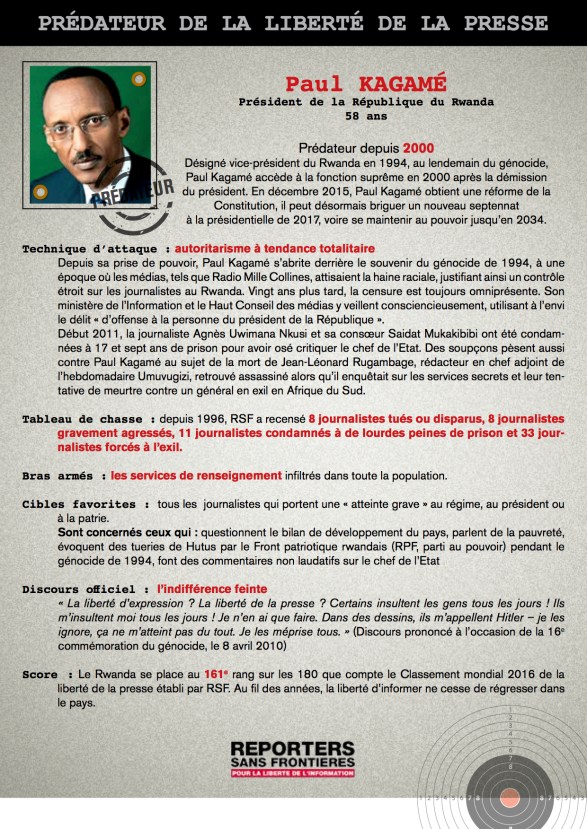
Au Classement mondial de la liberté de la presse établi par RSF en 2018, le Rwanda est 154e. Parmi les 58 Etats membres de l’OIF, seuls cinq pays ont un bilan pire que le Rwanda en matière de liberté d’information. Censure, menaces, arrestations, violences, assassinats… Le régime dirigé d’une main de fer par Paul Kagamé depuis 2000, et dont Louise Mushikiwabo est ministre depuis près de 10 ans, dispose de l’un des pires systèmes de répression à l’égard des médias et des journalistes. Son président occupe une place de choix dans la galerie des prédateurs de la presse constituée par RSF.

Kagame Prédateur

“Comment l’Organisation internationale de la francophonie (OIF) va-t-elle pouvoir favoriser le pluralisme des médias et la liberté de la presse conformément à ses objectifs en matière de droits de l’Homme, si elle est dirigée par l’une des principales dirigeantes d’un Etat qui piétine le droit à l’information et réprime les journalistes depuis 18 ans, s’inquiète Christophe Deloire, secrétaire général de RSF. C’est la capacité de l’OIF à défendre les médias et les journalistes libres comme acteurs incontournables du développement dans l’espace francophone qui est en jeu”.

Depuis 1996, huit journalistes ont été tués ou sont portés disparus et 35 ont été contraints à l’exil. Ces dernières années, le nombre d’exactions enregistrées par notre organisation a baissé mais la censure reste omniprésente et l’autocensure la règle pour éviter de faire partie du tableau de chasse du régime. Les programmes très écoutés de la BBC en Kinyarwanda sont suspendus depuis 2015, après que la chaîne a diffusé un documentaire évoquant des massacres provoqués par le Front patriotique rwandais (FPR) au moment du génocide des Tutsis de 1994.

Lors du XVIe sommet de la Francophonie à Antananarivo en novembre 2016, les chefs d’Etat et de gouvernement avaient rappelé leur engagement à “garantir la protection effective des journalistes et la liberté de la presse”.

Chaque année, l’OIF décerne le Prix francophone de l’innovation dans les médias avec RSF et RFI.

Source: Reporters Sans Frontières

Non-lieu confirmé en appel pour le prêtre Wenceslas Munyeshyaka dans le génocide rwandais

1444853176Wenceslas-Munyeshyaka

Abbé Wenceslas MUNYESHYAKA

La justice a confirmé jeudi 21 juin 2018 le non-lieu dont a bénéficié Wenceslas Munyeshyaka, un prêtre rwandais installé en Normandie et qui était visé par la plus ancienne plainte en France concernant le génocide de 1994 au Rwanda.

La justice a confirmé jeudi 21 juin 2018 le non-lieu dont a bénéficié Wenceslas Munyeshyaka, un prêtre rwandais installé en Normandie et qui était visé par la plus ancienne plainte en France concernant le génocide de 1994 au Rwanda.

La cour d’appel de Paris a ainsi confirmé l’ordonnance rendue, en octobre 2015, par les juges du pôle Crimes contre l’humanité au sujet de ce prêtre de 59 ans, dont les parties civiles avaient fait appel.

Les juges d’instruction avaient estimé que sa passivité face aux massacres ne pouvait suffire à l’accuser de « génocide » et à le juger devant la cour d’assises de Paris, malgré le rôle « trouble » qu’il avait joué dans sa paroisse de Kigali.

Un non-lieu requis par le parquet

Le parquet de Paris avait requis ce non-lieu, faute de charges suffisantes au terme d’une enquête de vingt ans, nourrie de centaines de témoignages et de plusieurs confrontations, ainsi que des déplacements sur place des juges et des gendarmes spécialisés.

« C’est au-delà de l’acquittement, cela signifie qu’il n’y a pas de charges », s’est félicité auprès de l’AFP Me Jean-Yves Dupeux, l’avocat de l’ecclésiastique. « Voilà un homme qui est mis en cause depuis 23 ans pour des faits gravissimes, qui s’est défendu pied à pied et qui a réussi à démontrer qu’il s’agissait d’accusations mensongères », a-t-il ajouté, dénonçant « une procédure mise en œuvre par des associations proches du pouvoir rwandais et sous pression politique permanente ».

« Nous allons envisager sérieusement la possibilité d’un pourvoi en cassation », a réagi Alain Gauthier, président du Collectif des parties civiles pour le Rwanda (CPCR), association en pointe dans les poursuites de possibles génocidaires réfugiés en France.

Une absence de réactions mais pas une participation active

L’enquête avait démarré dès les premières plaintes en 1995 en France, où s’était installé le prêtre. Le Tribunal pénal international pour le Rwanda, qui souhaitait le juger, s’était désisté au profit des juridictions françaises, dont la loi reconnaît une compétence universelle pour les crimes les plus graves. À l’époque des massacres, le prêtre était vicaire de la paroisse de la Sainte-Famille à Kigali, où furent accueillis des milliers de civils. Il y circulait armé et protégé d’un gilet pare-balles pendant le génocide qui a fait, selon l’ONU, quelque 800 000 morts entre avril et juillet 1994, principalement au sein de la minorité tutsi.

L’accusation des témoins la plus fréquente « était son absence de réaction lors de ces exactions » mais « peu de témoins rapportaient une contribution active du mis en examen » aux intrusions meurtrières des miliciens hutus, avaient souligné les juges d’instruction dans leur ordonnance.

Paris-Normandie

“CHOGM is coming to Rwanda”: Once again the Commonwealth got it wrong.

Commonwealth_Flag_-_2013.svg

The chorus has just begun. Surely, it will be relentlessly repeated for at least two next years until the CHOGM takes place in Rwanda, in 2020. Every observer would realise that a decision to keep the CHOGM in Rwanda constitutes an indication of the unequivocal support the United Kingdom is rendering to the dictator of Rwanda. It takes us to reflect on values and principles of the organization, and how it can influence good governance and democracy in country members.

How I know the CHOGM…

In 2007, I was in Uganda where I sought exile (2006-2008). It was a year of a lot of noise about a near thing, “Chogam”. [Tshogam], that is how it sounds in vernacular Ugandan accent. At least that is what I caught. A simple explanation to and by the ordinary citizen, was that “Chogam” was the arrival of Queen of England. Uganda was colonized by England.  Ugandans respect the Queen, and so, President Museveni took credit to have succeeded to convince Her Majesty to accept that invitation.  Everything turned around “Chogam”: From Entebbe airport to Kampala, the capital, the road surroundings had to be clean. I was living in Kitubulu, near Katabi military barracks, a few kilometres from the today Entebbe State House, formerly, Idi Amin’s palace. Every night, Police kept unusual patrols and arrested many youngsters suspected to smoke ‘enjaga’, marijuana in local language. TV and radio stations talked about “chogam”, local farmers said about it, every ordinary resident was getting ready. Even Semanda, a local mental ill man knew that Queen of England was coming. Some confused “chogam” and Queen!

In Kampala things took another level: traffic directions were changed, “esawa ya Queen”, the Queen’s Clock located at the city’s entrance from Entebbe side was repaired and repainted. The Road Police was given a new uniform. They had to put on white colour in order to hail the Queen. Imagine white uniform in Kampala’s dust!!!

Later on, we learnt that a special order of high calibre cars was ordered, just for the “chogam”. Among these, was a bullet proof brand new Range Rover to carry Her Majesty the Queen. All these expensive cars were sold later after the three-day event.

…And the Commonwealth.

On my arrival in Guyana, I got an opportunity to learn more about the Commonwealth.  As a senior leader in the University of Guyana Students’ Society (UGSS), I got closer to the Commonwealth office’s directorate especially during the preparation and host of the Caribbean Commonwealth Students meeting held in 2011. In 2012 I studied a short study programme run by the Commonwealth of Learning (COL) after which I got a diploma in Commonwealth Values and Youth Development. Afterwards I either participated into activities of the Commonwealth Youth Programme, or I followed closely.

About the CHOGM

The CHOGM is the Commonwealth Heads of Governments Meeting, one of organs of the Commonwealth of Nations. The Commonwealth of Nations is an organization in which the United Kingdom meets and exchanges with the England’s former colonies. In fact, apart from Rwanda that joined in 2009 the rest of country members were colonized by England.

Values and Principles

Looking at it from another perspective, the Commonwealth could be seen as a strategy of the UK to keep a colonizer’s hand on the so called independent countries. It is very tough to explain the togetherness of the non-longer colonized countries and their former master, keeping in minds the scars of that sad past. To me, the Commonwealth reason d’être should be of repairing the damages of colonization.

However, its values and principles are very attractive. They include democracy, human rights, freedom of expression, separation of powers, good governance, inter alia.

In the wake of 2009 CHOGM, Tom Porteous takes us into what was going on inside the organisation. In the article still relevant today and rightly titled “The Commonwealth is a jamboree of repression”, Porteous reminds us how in the past the Commonwealth played a major role in keeping checks and balances in the governance of country members. For instance, Porteous recalls  that South Africa was excluded due to the apartheid rule; in 1995 Nigeria was suspended following the execution of Ken Saro Wiwa; Pakistan was suspended after after General Musharraf’s coup d’etat in 1999; in 2002 Zimbabwe was suspended and withdrew from the organisation the following year; in 2007 Pakistan was once again suspended a decision taken during CHOGM held in Kampala. Fiji was suspended from attending the 2009 meeting in Trinidad.

Today, all the human right abusers are welcome to attend even to host and chair the meetings of the organization. Dictators forge arguments that will justify their abuses while their counterparts look aside. Pakistan and Bangladesh claimed to be threatened by terrorism to justify abuses and torture. Rwanda uses either genocide or threat to national security to intimidate or even extrajudicially execute political opponents.


Can the Commonwealth play the Police’s role? A testimony

In 2014, my political organization Ishema Party based in France decided to participate into the 2017 presidential elections in Rwanda. We chose Rev Father Thomas NAHIMANA as our flagbearer for that historical civic duty and right. We knew that Paul Kagame, as reckless as he is, would do whatever it took to discourage our nonviolence movement. We met different diplomats for two main reasons: First, we wanted to send our message to Paul Kagame that Rwanda could be built even with opposition. We had no weapons and were open to dialogue and peace talks. Second, we wanted to see at which extent the organizations such as the Commonwealth to which Rwanda freely adhered would play the police’s role.

Our message reached. Kagame responded that we were bluffing, that we only wanted to make our political portrait in the media. At some point of the process the same diplomats asked us to provide the proof that we had applied for visa to go to Kigali! On November 23rd , 2016 our team led by Fr Thomas NAHIMANA was denied to board a plane from Nairobi to Kigali. In a letter I addressed to the diplomatic corps in Rwanda and copied to the Commonwealth secretariat and to Louise MUSHIKIWABO the following morning, I asked their intervention to make Kagame understand that they should let us enter without hindrance. Neither the Commonwealth nor any diplomat was able to do it! Talking to the media, Kagame seemed to give a green light. We took the next flight on January 22nd 2017 and this time our team was blocked at Brussels international Airport on orders emanating from the Rwanda Immigration Directorate. All these took place after Kagame forced the parliament to amend the Constitution so that he can remain in power. All the time Kagame got away free. And the Queen knows this.

Conclusion

Designating Rwanda as the next CHOGM host should serve as a call to act. In fact, despite numerous reports including the organization’s own reports on human rights abuses by Kagame’s regime, Kigali was given an opportunity. It is high time for the next host country to abide with the minimal core values and principles of the Commonwealth without which a country cannot pretend to a membership. It would be shameless to Her Majesty the Queen to talk about democracy in Kigali while a woman like her, INGABIRE Victoire, is languishing in prison for having expressed herself. It will be of no use talking about good governance while Thomas NAHIMANA and other political opponents who demonstrated their will to contribute to the country’s political development are banned from their motherland.

Let the following take place before the 2020 CHOGM:

  1. Release of all political prisoners: Mrs Victoire INGABIRE, Déogratias MUSHAYIDI, Mihigo KIZITO, Ms Diane RWIGARA, Mrs Adeline RWIGARA, Théonetse NIYITEGEKA.
  2. An inclusive national dialogue between the Government of Rwanda, the opposition and all key social players of the nation.


The CHOGM might take place without considering the above-mentioned actions. But once again, the Commonwealth will have failed us.

Chaste GAHUNDE

chaste.gahunde@gmail.com