Author Archives: Chaste Gahunde

‘Rwanda is like a pretty girl with a lot of makeup, but the inside is dark and dirty’

Diane Rwigara

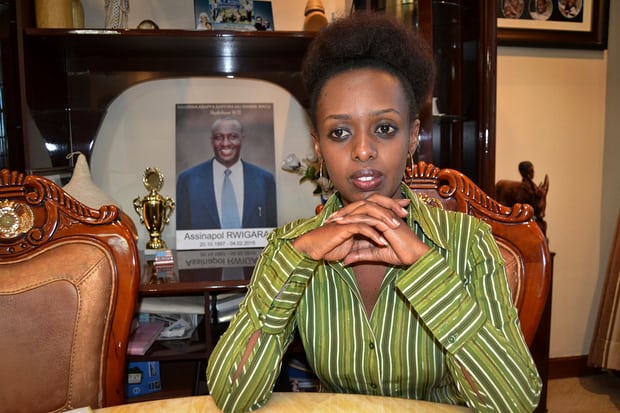
Diane Rwigara asks to postpone the interview. “My personal adviser is missing,” explains the text message. This is the new normal for Rwigara, who was until recently a loyal scion of Rwanda’s ruling elite.

Since the death of her father in 2015, the 35-year-old businesswoman has become a fierce critic of Paul Kagame, the country’s all-powerful president, and the ruling Rwandan Patriotic Front (RPF).

In May she announced her intention to run against him in the country’s electionon 4 August. For this, she has paid a heavy price.

In her grand, heavily fortified home in the heart of Kigali, the Rwandan capital, the interview goes ahead after her adviser – a close friend – turns up safe.

“He didn’t come home last night,” she explains. A stranger had called the night before and asked him to come for a drink. “He said he could give him some publicity for his newspaper. And you know how it is here: if you’re not part of the government, it’s hard to get publicity.”

He woke up the next day in a hotel room, his phone missing, remembering nothing from the previous night. “I’m used to it,” Rwigara says. Her best friend disappeared last December after she started speaking out against Kagame and the RPF. He has still not reappeared. “That’s life here. I’m just happy this one came back.”

Rwigara’s presidential bid was stillborn. On 7 July the National Electoral Commission barred her from standing on technical grounds, a move that came as little surprise to most. Kagame has ruled the country with an iron fist since sweeping to power after the genocide against Rwanda’s Tutsi minority in 1994. Criticism is barely tolerated, and the history of the past 15 or so years is littered with the names of opponents silenced and dissenters muzzled. To that list Rwigara adds her father, a prominent Tutsi businessman known to have been close to the RPF, at least early on.

“He was targeted because he did not want to continue to do business as usual,” she says. “If you have successful business, the RPF has to be part of it – and eventually get you out. But he did not want to let them in; he did not want to end up working for them. And he did not want to flee the country, though they did all they could to make him. So they had no choice.”

The US-educated Rwigara publicly accused the government of foul play after her father died in a road accident, contacting foreign embassies in Kigali and international human rights organisations, as well as petitioning the president. Many question the allegation, but there has been no official investigation. It is the family’s word against that of the police.

Rwigara’s thwarted candidacy was a brief flash of colour in the otherwise drab landscape of contemporary Rwandan politics. Kagame’s re-election is so certain that he himself claimed victory on the first day of campaigning, citing the overwhelming verdict of a controversial constitutional referendum in 2015 that permitted him to stand for a third term.

The proposed changes passed with a thumping 98% majority. “Pretending not to know the will expressed by the people during the referendum would be a lie, not democracy,” he told cheering crowds at a rally.

But Rwigara exposed cracks in the RPF’s confident facade. Most doubt that she would have been a significant electoral threat, but the lengths to which the authorities went to frustrate her – she claims her supporters were repeatedly threatened, beaten and jailed as they toured the country drumming up support – suggested a nervousness that belied Kagame’s breezy rhetoric.

“The RPF are scared,” Rwigara says. “If they are loved by the people, as they claim, why is that when someone like me announces an intention to run they resort to all these dirty tricks to try to discourage me and silence me? If they were really popular, then they would have let me compete.”

Many in Kigali agree. “Every week that she is not in trouble is progress,” confides one foreign diplomat. “She, not the official opposition, is the ultimate test for them.”

Rwigara represents young, prosperous urbanites who grew up under the RPF and whom it sees as essential to the country’s future. The busloads of young Rwandans who arrived to watch her announce her candidacy, and her packed press conferences, unnerved Kagame and his allies, according to insiders. Nude photos, apparently of her, soon flooded the internet – assumed to be a well-orchestrated smear.

She believes her fearlessness in speaking out is a headache for the RPF, which fastidiously cultivates a rosy image of Rwanda for the outside world. “Rwanda is like a very pretty girl with a lot of makeup,” she says. “Perfect teeth, perfect hair, perfect everything. They spend so much time on the image because they know the inside is dark and dirty.”

Since her candidacy failed, Rwigara has launched what she calls a “movement” to challenge the regime on its human rights record. While her political awakening could be attributed to her father’s death, she makes allegations that go beyond personal grievance. Nobody else inside Rwanda has spoken more frankly about the extrajudicial assassinations that exiled critics and international organisations such as Human Rights Watch claim the government frequently carries out against its enemies.

“Everybody knows somebody who has disappeared, who has been killed,” Rwigara says. “The personal doctor of the president and an army major both died in the same week as my father. And those are the well-known people. You don’t hear about the other people.”

Yet she is also a former insider, and her candidacy could be seen as evidence of emerging fractures within the Tutsi elite who dominate politics and business. The government has made enemies of some of its natural supporters, such as the Rwigara family. After her father’s death, the family’s properties in central Kigali were seized and their hotel demolished.

Diane Rwigara gives a press conference after announcing her plans to run for president
Pinterest
Diane Rwigara gives a press conference in May after announcing her plans to run for president. She was later barred on a technicality. Photograph: Cyril Ndegeya/AFP/Getty Images

If she makes an unlikely spokesperson for the poor farmers who make up the majority of Rwandans, she may be more persuasive as an advocate for women. Kagame is something of a “donor darling” for his commitment to gender equality – half of the supreme court judges are women, and the country’s parliament is 61% female, the highest proportion in the world – but Rwigara dismisses such headline achievements as window-dressing.

“So what if Rwanda has the highest percentage of women in parliament? It’s really just part of the image. Because what do these women do?” she asks.

She says the parliament is little more than a rubber-stamp. There are women in senior positions in government, but none wield real power. And despite its impressive strides, academics have questioned the substance of Rwanda’s gender-equality drive, especially for unmarried women.

“Diane took big risks just being a woman in Rwandan politics – Rwanda is just not ready for that,” says Susan Thomson, assistant professor of peace and conflict studies at Colgate University in the US, adding that the “the way the government sexualised her with those nude photos was frankly disgusting”. But she and others have also noted that it is precisely women like Rwigara – wealthy, predominantly Tutsi, often English-speaking – who have benefited most from the RPF’s empowerment measures.

Rwigara doesn’t see her gender as a hindrance. “They used my being a woman to get to me,” she says. “But even if I’d been a man they’d have found other ways.” In fact, it was her family that had the problem with the idea of women in politics. “Growing up I remember my family members – my mum and my aunt – saying that a girl should not have a political opinion; that a girl should not be politically active. It took me a while to make peace with being a girl who likes politics.”

Is Rwanda ready for a female president? “I think Rwandans themselves are,” she answers. “Because if the regime thought the people would not listen to me because I’m a woman, then they would not have tried to find all these ways to stop me.”

She says she doesn’t fear for her life. “Not for the moment. They know killing me will make too much noise. It’s harder to kill you once you are known, once you’ve been seen.”

Source: The Guardian

Umunyagitugu Paul KAGAME acyuye igihe. Ni iki kitezwe muri politiki y’u Rwanda ?

kagame

Guhera tariki ya 05 /08/2017 Paul Kagame waranzwe no gutegekana igitugu guhera mu mwaka wa 1994 azaba atakiri Perezida wa Repubulika y’u Rwanda. Itegekonshinga yarahiriyeho ryamwemereraga kugeza kuri manda ebyiri gusa kuko nta narimwe umuntu yemererwa kuyobora manda zirenze izo. Umunyagitugu abonye manda ebyiri zirangiye yashatse gukora itekinika ngo itegekonshinga rihindurwe bityo yemererwe kwiyamamaza indi nshuro. Cyakora na nyuma ya referendumu ififitse, Paul Kagame ntiyemerewe kwiyamamaza. Abaza gusoma ibi baribaza bati none se ko tumaze minsi tubona Kagame yiyamamaza, ubwo si uko abyemerewe?

Igisubizo kuri iki kibazo kigaragararira mu gisobanuro, imyitwarire n’imikorere y’umunyagitugu. Kagame nk’umunyagitugu wakuye agahu ku nnyo ntakeneye itegeko iryo ariryo ryose ngo yiyamamaze. Ni umunyagitugu utagendera ku mategeko. Kuri we amategeko icyo amaze ni ukwiyerekana mu rubuga mpuzamahanga ariko mu by’ukuri igifite agaciro ni amabwiriza we yishyiriraho ngo agere kubyo ashatse. None se Abanyapolitiki ntibafungwa mu Rwanda kandi itegekonshinga ribemerara gukora umurimo wa politiki? Kwandikisha amashyaka atavuga rumwe na FPR se ntibyabaye ikibazo kandi nyamara u Rwanda rwemera amashyaka menshi? Abaharanira uburenganzira bw’ikiremwamuntu se bo basiba guhungetwa kandi nyamara u Rwanda rwarasinye amasezerano mpuzamahanga agena uburenganzira bw’amashyirahamwe guhera mu mwaka wa 1975? Abantu se birirwa bicwa buri munsi kandi nyamara igihano cy’urupfu kitaravanyweho mu mategeko y’u Rwanda? Kagame ntacyo amategeko amubwiye we ashaka kwigumanira ubutegetsi ngo akomeze ahonyore abenegihugu uko yishakiye ari nako akomeza kwikubira ibyiza by’igihugu. Na manda Paul KAGAME azategeka guhera ku itariki ya 05/08/2017 ntizaba yemewe n’amategeko niyo mpamvu azaba ari umuperezida utemewe, ufite ubutegetsi butemewe, bugomba gusimburwa vuba na bwangu.

Ni iki kitezwe muri iyi manda ?

  1. Mu rubuga mpuzamahanga: Kagame azaba yamaze guta ibara yitwa umunyagitugu nk’abandi bose, umujura, umunyakinyoma ndetse na bya byaha bye benshi bajyaga batinya kuvuga bazabigarukaho. Bya bigwi n’imidari yajyaga yambikwa ngo yahagaritse jenoside bizahagarara kuko iyo umuntu akoze ibyiza akabirenzaho ibibi byose biba bibi gusa. Niko isi ikora, ni nako tuyibamo.

Cyakora kubera ko Paul Kagame yaryohewe n’ibyo yabonye, azatanga amafranga y’umurengera agure abanyamakuru n’ibigo bikomeye kugira ngo bigerageze kwerekana ko isura ye itari mbi nk’uko igaragara! Hari ibintu bimwe na bimwe batazashobora gukiza Kagame : Nko kuba atihanganira abatavuga rumwe n’ubutegetsi bwe ntazashobora kubihindura. Kuba mu myaka amaze ku butegetsi atarashoboye kureka ngo abandi bagaragaze impano zabo mu miyoborere ntazapfa kubishobora ngo nibura afungure imfungwa za demokarasi Ingabire Victoire, Deo Mushayidi n’abandi. Kuba mu bo batangiranye umugambi benshi baramucitseho bizakomeza kumwokama.

Kagame azakomeza kugerageza kwiyegereza abahutu b’inkomamashyi agamije kugaragaza ko atavangura ariko ntazashyiraho chef d’état-major cyangwa ministiri w’ingabo utari uwo muri FPR. Abatutsi batinyuka kwamagana politiki ya Kagame nka Kizito Mihigo na Diane Rwigara bazakomeza kwitwa abanzi b’igihugu.

  1. Mu rubuga rwa politiki nyarwanda: Abaturage bazakomeza guceceka ngo bategereje ko Imana izabakuriraho Kagame. Amashyaka ya opozisiyo akorera hanze azakomeza kwamagana ubutegetsi bwa Kagame ariko arasabwa gushaka udushya. Abalideri bazakomeza kuba bakeya ndetse abazifuza kuva mu mahanga ngo batashye mu Rwanda gufatanya na rubanda Kagame ntazabemerera. Guverinoma y’u Rwanda ikorera mu buhungiro izarushaho kumvikanisha ibibazo by’u Rwanda ari nako yotsa igitutu ubutegetsi bw’umunyagitugu ngo bwemere gufungura urubuga rwa politiki. Urukiko Mpanabyaha rwa Rubanda rwashyizweho na rubanda ruzakira ibirego rukore kandi ruburanishe amadosiye y’abayobozi bakekwaho ibyaha bya jenoside, ibyibasiye inyokomuntu n’ibyaha by’intambara. Ibihano bazabahwa bizashyikirizwa ibihugu n’umuryango mpuzamahanga kugira ngo aba bantu bafatirwe ibihano. Abazaba bahamwe n’ibyo byaha bazagira ibibazo mu kubona visa zo kwinjira mu bindi bihugu, imitungo yabo iri hanze izafatirwa, kandi ntibazemererwa ubuhungiro mu gihe bazaba babusabye. Uzagerageza gusohoka azafatwa maze ashyirwe aho agomba kurangiriza ibihano. Abitwaje intwaro barwanya Kagame bazaba bafite impamvu yo kugaba ibitero ariko imbaraga zabo zizakomeza kuba nkeya ku mpamvu nyinshi zitandukanye. Ku ruhande rwa APR, abasirikare benshi batangiye urugamba rwa 1990 bazaba bageze mu gihe cy’iza bukuru, bityo Kagame azajya yirukana uwo ashatse yitwaje ibyo.

Ubutegetsi bwa Kagame buzaba butemewe ariko nta munyamahanga uzabukuraho uretse kubuvuga nabi. Abemera iby’ubuhanuzi n’indagu bahamya ko Kgame atazabasha gutegeka iyi myka irindwi igiye kuza, cyakora umupira uri mu kibuga cy’abanyarwanda ubwacu. Turasabwa gukora ibirushije ubukana ibyo twakoraga mbere, gufata ibyemezo bisharira no kwirinda utunyungu tw’abantu ku giti cyabo.

Biracyaza…

Rwanda’s Forever President

kagame-fpr-bureau-politiqueANTWERP, Belgium — There is an election in Rwanda on Friday, but its outcome already is nearly certain: President Paul Kagame will win a third seven-year term. Elections there are not a contest for power. They are the ritual confirmation of the power in place.
Mr. Kagame generally wins by margins that would make a dictator proud: In 2010, he scored some 93 percent of the vote. He is the only ruler most Rwandans born since the 1994 genocide know. The Rwandans who remember leaders before him have reason to wonder if they will ever see another: The state’s mighty security apparatus is quietly eloquent, with all those soldiers and police officers routinely patrolling both city streets and the countryside.

Mr. Kagame is up against two innocuous candidates after the national election commission disqualified Diane Rwigara, his strongest opponent, and two other independent contenders. The opposition leader Victoire Ingabire, who was placed under house arrest in the lead-up to the 2010 election, is now in jail serving a dubious 15-year sentence for threatening state security, among other things. Journalists have also been intimidated and stifled; Freedom House categorizes Rwanda as “not free.”

Mr. Kagame wasn’t supposed to run this time because he would be coming up against the two-term limit set by the Constitution. But in 2015 the government proposed an amendment and had it sanctioned in a referendum (roundly criticized by human rights groups), opening the way for Mr. Kagame to stand for re-election this year — and again until 2034.

Burundi was condemned internationally in 2015 after President Pierre Nkurunziza flouted term limits to run for a third mandate. Last year, President Joseph Kabila of the Democratic Republic of Congo skirted term restrictions by simply delaying the next election, triggering protests and then a crackdown that led to sanctions against his government. Yet nothing of the sort has happened to Mr. Kagame or his administration despite its ploys to keep him in power basically unchallenged.

Why? Because Mr. Kagame has been masterful at deflecting criticism of his illiberalism by pointing to Rwanda’s economic performance. The country is touted as a model: The government claims that the economy grew by an average of about 8 percent a year between 2001 and 2014, and that the rate of poverty dropped from nearly 57 percent in 2006 to less than 40 percent in 2014. Neither Mr. Nkurunziza nor Mr. Kabila could proffer such results.

Mr. Kagame’s supporters, in Rwanda and beyond, sing to his tune. In a way, they have to. Western donors and international organizations may well prefer democratic values to big-man politics. But having poured great sums of money into Rwanda since the 1994 genocide, they want to be impressed by the headway Mr. Kagame claims to have made — on economic growth and poverty reduction, but also maternal health care and the prosecution of suspected mass killers. Asia has tigers; now Africa has found its lion. Many want to believe that while Mr. Kagame may have been cutting corners on democracy, he has delivered on development.

Has he, though?

In fact, his government’s record is shakier than it looks, including on some of the major achievements it is credited with.

Consider poverty reduction. Back in 2005, I was stationed in Rwanda with a World Bank team, working on a large-scale study of poverty. Six months into it, after we had collected hundreds of survey questionnaires about the well-being of ordinary Rwandans and conducted hundreds of discussions with villagers, the Rwandan security forces seized half of our files on the pretext that our research’s design was tainted by “genocide ideology” — a vague notion supposedly something like sectarianism that the government often invokes to criminalize what it sees as challenges to its authority. After lengthy negotiations between World Bank and Rwandan officials, the project was abandoned. We never determined what the poverty trends were: The information we had collected was destroyed before it could be analyzed.

Matters have hardly improved. Major studies can only be carried out by the Rwandan authorities or under their close supervision. Independent researchers have come to question the government’s methodology for analyzing data.

Officially, the poverty rate decreased by nearly 6 percentage points between 2011 and 2014. But Filip Reyntjens, a Rwanda expert at the University of Antwerp, has argued that it might actually have increased by about 6 percentage points during that period. Several articles published by the Review of African Political Economy also challenge Rwanda’s official poverty figures, as well as its G.D.P. growth rates.

I’m of the view that expanding individual freedoms is essential, not incidental, to a country’s long-term development. As Angus Deaton, a Nobel laureate in economics, said to a Rwandan minister in 2015, “improvements in public health can never be truly secure in nondemocratic states.” But I concede that Rwanda has made remarkable economic progress since facing near-total destruction in 1994, and that some think it is still worth debating the merits of trade-offs between democracy and development.

Whatever one thinks of these issues, however, everyone should be concerned that the Kagame government has been fudging, hiding or selectively presenting the raw facts of its economic record. Rwanda may be forgoing democracy for development only to wind up with no democracy and far less development than many think.

Don’t be fooled by those happy campaign rallies. Rwandans live in fear.

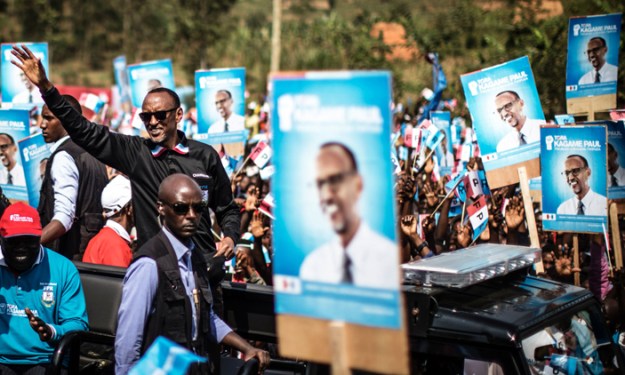
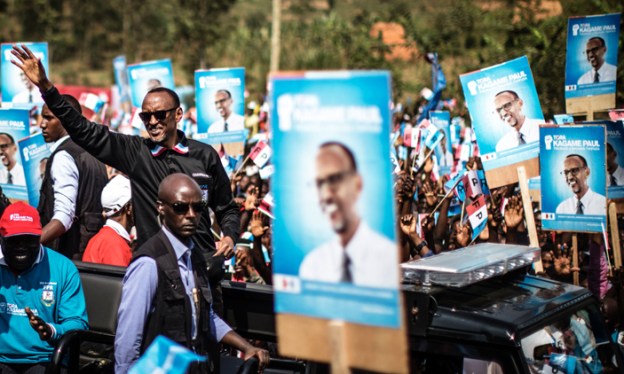
Kagame rally Gakenke

Rwandan President Paul Kagame, left, greets a crowd of supporters as he arrives for a campaign rally on Monday in Gakenke. (Marco Longari/AFP via Getty Images)

By Fred MUVUNYI

Fred Muvunyi, a former chairman of the Rwanda Media Commission, is an editor at Deutsche Welle, Germany’s international broadcaster.

On Friday, Rwandan voters will go to the polls and overwhelmingly reelect Paul Kagame as their president. Kagame himself has said that the result is a foregone conclusion. So where does he get his remarkable self-confidence?

One important clue comes from campaign rallies. Thousands of people, joyously singing and dancing, routinely flock to events staged for the incumbent president by the ruling party. There are two other officially allowed candidates, but almost no one shows up to see them speak.

The stark difference is easily explained. Show up at an opposition rally and you can bet that the authorities will note your presence. Attendance at Kagame’s events, by contrast, is expected — since the president has given orders to all local officials to ensure turnout. The key, in both cases, is one simple word: fear. Anyone who doesn’t show loyalty to Kagame is considered to be “an enemy of the state.”

The supporters of the regime sneer at those who claim that Kagame’s popular support is buttressed by intimidation. The president, they say, is genuinely loved by Rwandans for his success in bringing economic growth, reliable health care and a relatively fair court system, all while reducing corruption to levels many other countries would envy. Plus, through sheer force of personality, he has managed to unite the country after the horrific genocide of 1994, in which close to a million Rwandans — overwhelmingly members of the Tutsi minority — were slaughtered in just 100 days.

Kagame’s positive achievements are genuine. But they can also be seen as the more palatable side of an all-encompassing system of social control that knows few equals in the world. Rwanda’s government, led by Kagame’s ruling Rwandan Patriotic Front (RPF), is a finely meshed organization that reaches down into the smallest villages. Local government officials maintain detailed files on every household, and a dense network of informers keeps track of citizens’ behavior and thinking. Visiting foreigners are rarely aware of this reality, but Rwandans know it well. People from my country often use an idiom in our native language of Kinyarwanda that captures it well: “Even the trees are listening,” they say.

Rwanda has a long history of intrusive government, but it is the experience of genocide — which was finally brought to an end by the invading RPF, then an insurgent group based in neighboring countries — that has given birth to what can only be described as a form of institutionalized paranoia. Kagame and his comrades in the Tutsi-dominated RPF are only too aware that many members of the majority Hutus were once active participants in mass murder. As a result, the current government tends to view any attempt to question the existing system as subversion at best, and often as a first step to a new genocidal conspiracy at worst.

This mentality is reinforced by Kagame’s own background as a former military intelligence officer and rebel leader. During his long years in Ugandan exile, he knew that he and his party would never be able to come to power by peaceful means, and events bore that prediction out. For him, “constructive opposition” is a contradiction in terms. To Kagame and his entourage, criticism always entails a security threat.

Kagame has correspondingly tightened his control of the armed forces. Today, the most respected and outspoken military officers are in prison, exile or dead. To name but one of the most recent examples, Patrick Karegeya, Rwanda’s former intelligence chief, was killed in South African exile on Jan. 1, 2014.

But this grim fate is not restricted to former military men. Journalists, independent businessmen and members of the opposition have all faced various degrees of state-sponsored terror. They range from Charles Ingabire, a reporter who was shot to death in Uganda in 2011, to Pasteur Bizimungu, Kagame’s predecessor as president, who stepped down in 2000, and was later arrested and sentenced to 15 years in prison on charges of embezzlement, inciting ethnic hatred and attempting to form a militia. His defenders say that his real crime was attempting to form his own opposition party. When Rwandans see what can happen to people who once enjoyed power and prestige, they rightly conclude that they are better off keeping their mouths shut.

In 2012, three years before I was forced to leave for an exile of my own, I had the privilege to pay a visit in prison to Victoire Ingabire Umuhoza. In 2010, Ingabire, an outspoken and eloquent woman, had returned to Rwanda from the Netherlands, where she had lived for the previous 17 years, to challenge Kagame. But, as she told me in a voice strikingly subdued, she had failed to reckon with the nature of the Rwandan regime. After four months in Kigali, she was thrown in jail, where she remains today.

Kagame is smart. He knows how to turn his country’s dark history to his own advantage. When westerners try to criticize him for his failure to uphold human rights, Kagame points out that their countries either failed to prevent the genocide or actively abetted it, skillfully using their own feelings of guilt to silence them. So far it’s been a highly effective strategy. But that doesn’t change the reality that Rwanda is a country where fear reigns supreme.

Source: Washington Post


The Government of Rwandan People in Exile: Reshuffle and People’s Tribunal

SAFARI Justin

Mr. Justin SAFARI enters Ministry of Justice which is symbolically led by Déo MUSHAYIDI (in Rwanda’s Prison). The Former Prime Minister, Abdallah AKISHULI becomes the Attorney General of the People’s Tribunal while Ms Immaculée KANSIIME UWIZEYE replaces him keeping at same time the diplomacy portfolio.

DSC_0019

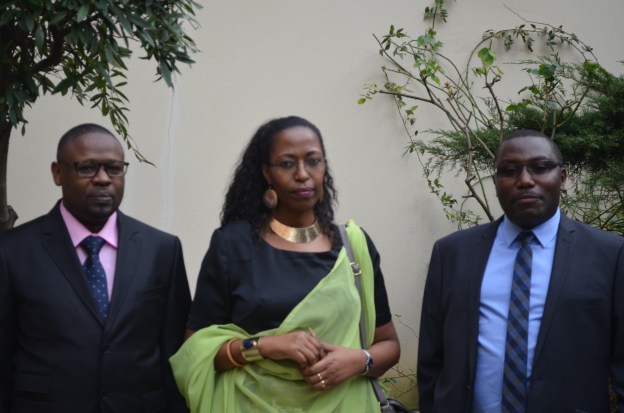
From left: Abdallah AKISHULI, Immaculée KANSIIME UWIZEYE and Thomas NAHIMANA. Photo archives Mininfo GREX.

Press Statement

Cabinet reshuffle within the Government of Rwanda in Exile

  1. By the virtue of the powers conferred upon him by Articles 14, 15 and 16 of the Charter governing the Government of the Rwandese People in Exile signed on 23 February 2017 in Paris, France;
  2. Considering the unbecoming behavior of the Rwandan dictator Paul Kagame who rejected the proposals for the urgent need for the opening up of political space in Rwanda made by the Government of the Rwandan people in exile, thus opting de facto for the way of “an absolute monarchy” under the deceptive image of a republic actually emptied of its true substance;
  3. Implementing the resolution of the Government Council of 23 April 2017, which established the “People’s Tribunal” to investigate crimes against humanity, war crimes and crimes of genocide committed by certain senior political and military officials since 1 October 1990, which until now enjoy unacceptable impunity;
  4. His Excellency the President of the Government of the Rwandese People in Exile, Thomas Nahimana, appointed the High Authorities of the People’s Tribunal as follows:
    1. The Attorney General of the People’s Tribunal: Mr. Abdallah AKISHULI
    2. The Presiding Judge of the People’s Tribunal: Mr. Vénant NKURUNZIZA

5. His Excellency the President of the Rwandan People’s Government in Exile has appointed members of the cabinet of ministers as follows:

    1. Prime Minister: Mrs. Immaculée KANSIIME UWIZEYE
    2. Vice-Prime Minister: Mrs. Nadine Claire KASINGE
    3. Minister of Justice: Mr. Déogratias Mushayidi represented by Minister Justin SAFARI
    4. Minister of Culture, Family and Women Empowerment: Mrs. Victoire INGABIRE UMUHOZA represented by Mrs. Nadine Claire KASINGE
    5. Minister of Information: Mr. Chaste GAHUNDE
    6. Minister of Education: Mrs. Chantal MUKAMANA MUTEGA
    7. Minister of Interior and Local Development: Mr. Daniel NDUWIMANA
    8. Minister of Commerce and Finance: Mrs. Marine UWIMANA
    9. Minister of Agriculture, Livestock and Land: Mr. Jean Léonard SEBURANGA
    10. Minister of Refugee Condition and Eradication of Causes of Asylum: Mrs. Virginie NAKURE
    11. Minister of Infrastructure and Habitat: Reverend Father Gaspard NTAKIRUTIMANA
    12. Minister of Health and Citizen’s Well-fare: Mrs. Spéciose MUJAWAYEZU

6. GOVERNMENTSPOKESPERSONS :

  1. Chaste GAHUNDE
  2. Immaculée KANSIIME UWIZEYE
  3. Marine UWIMANA

Done in Paris on July 31, 2017
Chaste GAHUNDE
Minister of Information, Government Spokesperson

IMG-20170227-WA0049

EU supports multilateral global governance, based on international law, human rights and strong international institutions

Mogherini

EU High representative Federica MOGHERINI

Declaration by the High Representative, Federica Mogherini, on behalf of the European Union on the occasion of the Day of International Criminal Justice, 17 July 2017

The 17th of July marks the date of the adoption of the Rome Statute of the International Criminal Court in 1998. This day is dedicated to celebrating the developments and achievements of international criminal justice institutions and to remind us that we need to continue working, at both national and international levels, to ensure that the perpetrators of the most serious crimes are brought to justice and held to account.

On this occasion, the European Union and its Member States reaffirm their full support to the International Criminal Court and to the strengthening of an international criminal justice system committed to deter the commission of crimes, to fight impunity and to ensure the protection of the victims’ rights.

Justice is one of the core elements towards reconciliation and sustainable peace. Without justice, the most heinous crimes go unpunished, victims are unable to obtain redress and peace remains an elusive goal, since impunity generates more hatred, leading to acts of revenge and more suffering.

The European Union is one of the main donors in support of justice sector reform worldwide, strengthening law enforcement and justice institutions, promoting independent and impartial justice, and supporting access to justice for all. Since 2000, we have committed €37 million in direct support of the International Criminal Court.

The European Union has been also supporting transitional justice initiatives and international justice mechanisms related to specific countries. In the case of Syria, the EU has recently allocated funding amounting to €1,5 million to the International, Impartial and Independent Mechanism to Assist in the Investigation and Prosecution of Persons Responsible for the Most Serious Crimes under International Law Committed in Syria. The EU calls on the international community to support to the Mechanism, including through adequate financial means, to ensure that it would be able to start work as soon as possible and fulfil its mandate, in line with the principles of universality and at the highest level of professionalism.

The European Union will continue to fully support multilateral global governance, based on international law, human rights and strong international institutions. In this regard, we remain committed to advance our fight against impunity, and to promote the universal ratification of the Rome Statute.

Source: European Union

COMMUNIQUE DE PRESSE: Remaniement ministériel au sein du gouvernement du peuple rwandais en exil

SAFARI Justin

Monsieur Justin SAFARI est le nouveau Ministre au sein du Ministère de la Justice de Monsieur Déo MUSHAYIDI. L’ancien Premier Ministre, Abdallah AKISHULI cède la place à Mme Immaculée KANSIIME UWIZEYE pour devenir le Procureur général du Tribunal du Peuple dont la mission est juger les crimes contre l’humanité, crimes de guerre et de génocide commis par les hautes autorités militaires et politiques qui jusq’aujourd’hui jouissent d’une impunité inacceptable.

 Communiqué de Presse

  1. En vertu des pouvoirs qui lui sont conférés par les articles 14, 15 et 16 de la Charte régissant le Gouvernement du Peuple Rwandais en Exil signé en date du 23 février 2017 à Paris en France ;
  2. Tenant compte du comportement indigne du dictateur rwandais Paul Kagame qui a rejeté les propositions en rapport avec l’urgente nécessité de l’ouverture de l’espace politique au Rwanda formulées par le Gouvernement du peuple rwandais en exil, optant de facto pour la voie « d’une monarchie absolue » sous les dehors trompeurs d’une république en réalité vidée de sa substance ;
  3. Mettant en application la résolution du conseil gouvernemental du 23 avril 2017 qui a institué le « Tribunal du Peuple » avec mission de juger les crimes contre l’humanité, les crimes de guerre et crimes de génocide commis par certains hauts responsables politiques et militaires depuis le 1 octobre 1990 qui, jusqu’aujourd’hui, jouissent d’une impunité inacceptable ;
  4. Son Excellence le Président du Gouvernement du peuple rwandais en exil, Thomas Nahimana, a nommé les hautes autorités du « Tribunal du Peuple » comme suit :
  • Le Procureur Général du « Tribunal du Peuple » : Monsieur Abdallah AKISHULI
  • Le Juge Président du « Tribunal du Peuple » : Monsieur Vénant NKURUNZIZA

5. Son Excellence le Président du Gouvernement du peuple rwandais en exil a remanié le gouvernement comme suit :

  1. Premier Ministre : Madame Immaculée KANSIIME UWIZEYE
  2. Vice – Premier Ministre : Madame Nadine Claire KASINGE
  3. Ministre de la Justice : Monsieur Déogratias MUSHAYIDI représenté par le Ministre Justin SAFARI
  4. Ministre de la Culture, Famille et Promotion de la Condition Féminine : Madame Victoire INGABIRE UMUHOZA représentée par Madame Nadine Claire KASINGE
  5. Ministre de l’Information : Monsieur Chaste GAHUNDE
  6. Ministre de l’Education : Madame Chantal MUKAMANA MUTEGA
  7. Ministre de l’Intérieur et du Développement local : Monsieur Daniel NDUWIMANA
  8. Ministre du Commerce et des Finances : Madame Marine UWIMANA
  9. Ministre de l’Agriculture, Elevage et des Terres : Monsieur Jean Léonard SEBURANGA
  10. Ministre de la Condition des Réfugiés et Eradication des Causes de l’Asile : Madame Virginie NAKURE
  11. Ministre de l’Infrastructure et Habitat : Révérend Père Gaspard NTAKIRUTIMANA
  12. Ministre de la Santé et du Bien-être du citoyen : Madame Spéciose MUJAWAYEZU

DSC_0019

 De gauche à droite: Abdallah AKISHULI? Procureur général, Immaculée KANSIIME UWIZEYE, Premier Ministre et Thomas NAHIMANA, Président .

6. LES PORTE-PAROLES DU GOUVERNEMENT :

  1. Monsieur Chaste GAHUNDE
  2. Madame Immaculée KANSIIME UWIZEYE
  3. Madame Marine UWIMANA


Fait à Paris le 31/07/17

Chaste GAHUNDE
Ministre de l’Information, Porte-Parole du Gouvernement

IMG-20170227-WA0049

IVUGURURWA RYA GUVERINOMA Y’URWANDA IKORERA MU BUHUNGIRO

DSC_0019

Uhereye i bumoso: Bwana Abdallah AKISHULI, umushinjacyaha mukuru w’urukiko rwa rubanda, Madame Immaculée KANSIIME UWIZEYE, Ministre w’intebe, Padiri Thomas NAHIMANA, Perezida.

Itangazo rigenewe Itangazamakuru

IVUGURURWA RYA GUVERINOMA Y’URWANDA IKORERA MU BUHUNGIRO

  1. Ashingiye ku bubasha ahabwa na « CHARTE » igenga Guverinoma y’u Rwanda ikorera mu buhungiro yasinyiwe i Paris taliki ya 23 Gashyantare 2017 cyane cyane mu ngingo zayo 14,15 na 16 ;
  2. Ashingiye ku myitwarire igayitse y’Umunyagitugu Paul Kagame wakomeje kunangira umutima ntiyite ku nama nziza yo gukingura urubuga rwa politiki yagiriwe na Guverinoma ya rubanda ikorera mu buhungiro ahubwo akiyemeza kugundira ubutegetsi mu nyungu ze bwite agamije kuzabukurwaho n’urupfu gusa ;
  3. Ashingiye ku byemezo by’inama ya Guverinoma ya rubanda yo kuwa 23/04/2017 yashyizeho « Urukiko Rwa Rubanda » rushinzwe gukurikirana « abayobozi » bashinjwa ibyaha by’intambara, ibyibasiye inyoko-muntu n’ibyaha bya jenoside byakorewe abanyarwanda guhera taliki ya 1 Ukwakira 1990, bikaba kugeza ubu bitarahanwa n’inkiko ;
  4. Nyakubahwa Perezida wa Guverinoma y’u Rwanda ikorera mu buhungiro Padiri Thomas NAHIMANA yashyizeho  abayobozi b’inzego nkuru z’ « Urukiko Rwa Rubanda » ku buryo bukurikira:
    1. Umushinjacyaha Mukuru w’Urukiko rwa Rubanda (Procureur Général): Bwana Abdallah AKISHULI
    2. Umucamanza Mukuru w’Urukiko rwa Rubanda: Bwana Vénant NKURUNZIZA
  5. Nyakubahwa Perezida wa Guverinoma y’u Rwanda Padiri Thomas NAHIMANA ikorera mu buhungiro yashyize mu myanya aba Ministre ku buryo bukurikira:
    1. Ministre w’Intebe ufite n’Ububanyi n’Amahanga mu nshingano : Madame Immaculée Kansiime UWIZEYE
    2. Ministre w’Intebe wungirije: Madame Nadine Claire KASINGE
    3. Minisitiri w’Ubutabera: Bwana Déogratias Mushayidi uhagarariwe na Ministre Justin SAFARI

SAFARI Justin

Min.Justin SAFARI (Kentuchy, USA)

4. Minisitiri w’Umuco, Umuryango, Guteza imbere umwari n’umutegarugori: Madame Victoire INGABIRE UMUHOZA uhagarariwe na Madame Nadine Claire KASINGE

5. Minisitiri w’Itangazamakuru : Bwana Chaste GAHUNDE

6. Ministre w’Uburezi : Madame Chantal MUKAMANA MUTEGA

7. Minisitiri w’Ubutegetsi bw’igihugu n’Iterambere ry’Umurenge: Bwana Daniel NDUWIMANA

8. Minisitiri w’Imari n’Ubucuruzi: Madame Marine UWIMANA

9. Minisitiri w’Ubuhinzi, Ubworozi n’Ubutaka : Bwana Jean Léonard SEBURANGA

10. Minisitiri ushinzwe Kurengera Impunzi no gukemura ikibazo gitera ubuhunzi : Madame Virginie NAKURE

11. Minisitiri w’Ibikorwa-remezo n’Imiturire : Padiri Gaspard NTAKIRUTIMANA

12. Minisitiri w’Ubuzima n’Imibereho myiza y’Abaturage : Madame Spéciose MUJAWAYEZU

ABAVUGIZI BA GUVERINOMA :

  1. Bwana Chaste GAHUNDE
  2. Madame Immaculée KANSIIME UWIZEYE
  3. Madame Marine UWIMANA

Bikorewe i Paris tariki ya 31/07/17
Chaste GAHUNDE
Minisitiri ushinzwe itangazamakuru, umuvugizi wa Guverinoma

IMG-20170227-WA0049

Short of arguments, Rwanda Diplomacy Chief threatens the critics!

LMUs

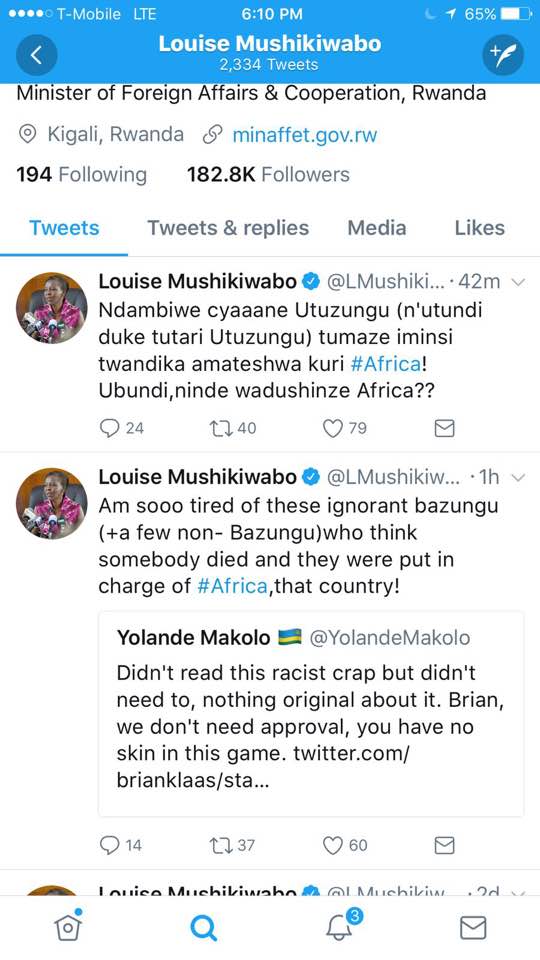
This is what Minister Louise Mushikiwabo tweeted in Kinyarwanda. The derogatory, very racist tweet was aimed at whites and other non-whites who have been critical of the regime she works for as Foreign Minister, led by dictator Paul Kagame.

I am sick and tired of utuzungu said Mushikiwabo. In Kinyarwanda, Umuzungu means a white person. When you replace the first 3 letters “umu” by “utu”, then the word becomes pejorative. It is a common way of formulating an insult  in Kinyarwanda. In this case it means that those whites are subhumans, small (insignificant)  and beneath her. Rwandans do this a lot. They call people they don’t like subhumans. Before the genocide, Tutsis were called cockroaches and subhumans. It is sad that Rwanda’s Foreign Affairs Minister used the same language, same rhetoric as genocidaires. Of all people, Minister Mushikiwabo should know how labeling other races subhumans simply because they shed some light on your government’s human rights abuses is wrong. Instead of refuting those accusatory reports by facts, she resulted to attacks and insults. She chose Kinyarwanda hoping they will never know maybe!

Here is more Kinyarwanda lesson. Abagabo means men. If you want to insult a bunch of men, you can call them utugabo. It is a disrespectful way of saying that they are a bunch of useless nobodies. In Rwandan culture, there is no grave insult than this, especially when this insult is uttered by a woman. Rwanda is still a society where a woman is supposed be genteel and to have ladylike behavior all the time especially the bourgeoisie and higher ups.

The kind of language Minister Mushikiwabo used, normally is for street walkers and thugs. It is the equivalent of ghetto or hood talk in the US. This is why the tweet was scandalous. Many Rwandans were flabbergasted even shocked by that bad language coming from someone in charge of diplomacy and foreign relations, the government spokeswoman. A woman who uses that kind of language in Rwanda is called “inshinzi” (Huchi mama, vulgar with no self worth) and it is normally not proper for a high ranking official to use that kind of language!

Minister Mushikiwabo accused those whites she qualified of subhumans of writing “amateshwa” about Rwanda. Here she was referring to recent reports condemning human rights abuses by the government of dictator Paul Kagame. In Kinyarwanda amateshwa means rubbish, nonsense, words coming out of a mouth of someone who is stupid, dumb, non important, demented, someone so irrelevant that you have no time for whatever they are saying.

Finally, Mushikiwabo asked “utuzungu”, those insignificant white subhumans who put them in charge of Africa? They need to butt out of african affairs she said!

Source: Iwacuheza.com

Learn How to Disagree

Grahams_Hierarchy_of_Disagreement1-449x337

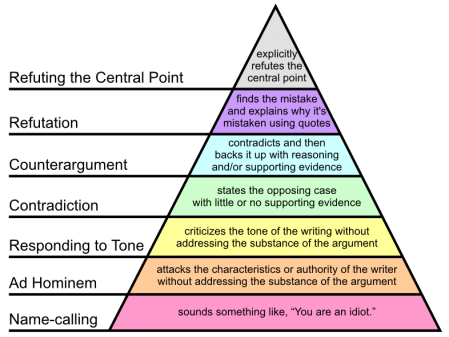
Graham’s Hierarchy of disagreement

How to disagree?

The web is turning writing into a conversation. Twenty years ago, writers wrote and readers read. The web lets readers respond, and increasingly they do—in comment threads, on forums, and in their own blog posts.

Many who respond to something disagree with it. That’s to be expected. Agreeing tends to motivate people less than disagreeing. And when you agree there’s less to say. You could expand on something the author said, but he has probably already explored the most interesting implications. When you disagree you’re entering territory he may not have explored.

The result is there’s a lot more disagreeing going on, especially measured by the word. That doesn’t mean people are getting angrier. The structural change in the way we communicate is enough to account for it. But though it’s not anger that’s driving the increase in disagreement, there’s a danger that the increase in disagreement will make people angrier. Particularly online, where it’s easy to say things you’d never say face to face.

If we’re all going to be disagreeing more, we should be careful to do it well. What does it mean to disagree well? Most readers can tell the difference between mere name-calling and a carefully reasoned refutation, but I think it would help to put names on the intermediate stages. So here’s an attempt at a disagreement hierarchy:

DH0. Name-calling.

This is the lowest form of disagreement, and probably also the most common. We’ve all seen comments like this:

u r a fag!!!!!!!!!!

But it’s important to realize that more articulate name-calling has just as little weight. A comment like

The author is a self-important dilettante.

is really nothing more than a pretentious version of “u r a fag.”

DH1. Ad Hominem.

An ad hominem attack is not quite as weak as mere name-calling. It might actually carry some weight. For example, if a senator wrote an article saying senators’ salaries should be increased, one could respond:

Of course he would say that. He’s a senator.

This wouldn’t refute the author’s argument, but it may at least be relevant to the case. It’s still a very weak form of disagreement, though. If there’s something wrong with the senator’s argument, you should say what it is; and if there isn’t, what difference does it make that he’s a senator?

Saying that an author lacks the authority to write about a topic is a variant of ad hominem—and a particularly useless sort, because good ideas often come from outsiders. The question is whether the author is correct or not. If his lack of authority caused him to make mistakes, point those out. And if it didn’t, it’s not a problem.

DH2. Responding to Tone.

The next level up we start to see responses to the writing, rather than the writer. The lowest form of these is to disagree with the author’s tone. E.g.

I can’t believe the author dismisses intelligent design in such a cavalier fashion.

Though better than attacking the author, this is still a weak form of disagreement. It matters much more whether the author is wrong or right than what his tone is. Especially since tone is so hard to judge. Someone who has a chip on their shoulder about some topic might be offended by a tone that to other readers seemed neutral.

So if the worst thing you can say about something is to criticize its tone, you’re not saying much. Is the author flippant, but correct? Better that than grave and wrong. And if the author is incorrect somewhere, say where.

DH3. Contradiction.

In this stage we finally get responses to what was said, rather than how or by whom. The lowest form of response to an argument is simply to state the opposing case, with little or no supporting evidence.

This is often combined with DH2 statements, as in:

I can’t believe the author dismisses intelligent design in such a cavalier fashion. Intelligent design is a legitimate scientific theory.

Contradiction can sometimes have some weight. Sometimes merely seeing the opposing case stated explicitly is enough to see that it’s right. But usually evidence will help.

DH4. Counterargument.

At level 4 we reach the first form of convincing disagreement: counterargument. Forms up to this point can usually be ignored as proving nothing. Counterargument might prove something. The problem is, it’s hard to say exactly what.

Counterargument is contradiction plus reasoning and/or evidence. When aimed squarely at the original argument, it can be convincing. But unfortunately it’s common for counterarguments to be aimed at something slightly different. More often than not, two people arguing passionately about something are actually arguing about two different things. Sometimes they even agree with one another, but are so caught up in their squabble they don’t realize it.

There could be a legitimate reason for arguing against something slightly different from what the original author said: when you feel they missed the heart of the matter. But when you do that, you should say explicitly you’re doing it.

DH5. Refutation.

The most convincing form of disagreement is refutation. It’s also the rarest, because it’s the most work. Indeed, the disagreement hierarchy forms a kind of pyramid, in the sense that the higher you go the fewer instances you find.

To refute someone you probably have to quote them. You have to find a “smoking gun,” a passage in whatever you disagree with that you feel is mistaken, and then explain why it’s mistaken. If you can’t find an actual quote to disagree with, you may be arguing with a straw man.

While refutation generally entails quoting, quoting doesn’t necessarily imply refutation. Some writers quote parts of things they disagree with to give the appearance of legitimate refutation, then follow with a response as low as DH3 or even DH0.

DH6. Refuting the Central Point.

The force of a refutation depends on what you refute. The most powerful form of disagreement is to refute someone’s central point.

Even as high as DH5 we still sometimes see deliberate dishonesty, as when someone picks out minor points of an argument and refutes those. Sometimes the spirit in which this is done makes it more of a sophisticated form of ad hominem than actual refutation. For example, correcting someone’s grammar, or harping on minor mistakes in names or numbers. Unless the opposing argument actually depends on such things, the only purpose of correcting them is to discredit one’s opponent.

Truly refuting something requires one to refute its central point, or at least one of them. And that means one has to commit explicitly to what the central point is. So a truly effective refutation would look like:

The author’s main point seems to be x. As he says:

<quotation>

But this is wrong for the following reasons…

The quotation you point out as mistaken need not be the actual statement of the author’s main point. It’s enough to refute something it depends upon.

What It Means

Now we have a way of classifying forms of disagreement. What good is it? One thing the disagreement hierarchy doesn’t give us is a way of picking a winner. DH levels merely describe the form of a statement, not whether it’s correct. A DH6 response could still be completely mistaken.

But while DH levels don’t set a lower bound on the convincingness of a reply, they do set an upper bound. A DH6 response might be unconvincing, but a DH2 or lower response is always unconvincing.

The most obvious advantage of classifying the forms of disagreement is that it will help people to evaluate what they read. In particular, it will help them to see through intellectually dishonest arguments. An eloquent speaker or writer can give the impression of vanquishing an opponent merely by using forceful words. In fact that is probably the defining quality of a demagogue. By giving names to the different forms of disagreement, we give critical readers a pin for popping such balloons.

Such labels may help writers too. Most intellectual dishonesty is unintentional. Someone arguing against the tone of something he disagrees with may believe he’s really saying something. Zooming out and seeing his current position on the disagreement hierarchy may inspire him to try moving up to counterargument or refutation.

But the greatest benefit of disagreeing well is not just that it will make conversations better, but that it will make the people who have them happier. If you study conversations, you find there is a lot more meanness down in DH1 than up in DH6. You don’t have to be mean when you have a real point to make. In fact, you don’t want to. If you have something real to say, being mean just gets in the way.

If moving up the disagreement hierarchy makes people less mean, that will make most of them happier. Most people don’t really enjoy being mean; they do it because they can’t help it.

Thanks to Trevor Blackwell and Jessica Livingston for reading drafts of this.

Paul Graham, March 2008

Source: How to disagree