Tag Archives: genocide

Rwanda: a fake researcher, Tom NDAHIRO Alias RUTWE.

Over the years, the satanic regime has wasted resources in promoting this kagamist sycophant – Tom Ndahiro as a researcher. How can a senior three dropout become a researcher?

Tom NDAHIRO, a self proclaimed Researcher in Genocide studies

Research is an expertise field that requires immense training, you can’t wake up in the morning and start referring to yourself as a researcher. To become a researcher you must have the training and education, but not self anointing as in the case of this sick Kagamist sycophant Tom Ndahiro alias Rutwe.

During Rwanda Patriotic Army/F liberation war, Tom Ndahiro alias Rutwe was a photographer, most of the photos you see of RPA/F soldiers and cadres were taken by Tom Ndahiro alias Rutwe. And when Rwanda Patriotic Army/F radio – Radio Muhabura started, Tom Ndahiro was given air time slot to yap on behalf of RPA/F.

During the RPA/F liberation war, young rebel soldiers nicknamed him Rutwe or Mbariga, he was nicknamed Mbariga because of his feet’s awkward way during Mucaka Mucaka running with other political cadres. For Rutwe nickname, you can all tell why they nicknamed him that.

After the war in 1994, Tom Ndahiro ventured in media becoming chief editor of Imvaho, but due to his incompetence and lack of skills, he failed to build a career in the media, this is when he woke up and started referring himself as a researcher of Rwanda’s history and 1994 Tutsi genocide. With the help of the satanic regime’s public Relations team, Tom Ndahiro’s researcher tag was publicised, promoted and referred. And he started representing the satanic regime in all genocide related conferences, and now, oppressed and enslaved Rwandans believe that this semiliterate Kagamist sycophant is a researcher.

Forget about the fake and fabricated researcher tag on him; Tom Ndahiro’s real job is being a state informer under National Intelligence and Security Services (NISS). He receives operation funds and monthly salary from NISS. His only source of income is through his dirty work of being an NISS agent, his fake research yapping are for propaganda purpose rather than real serious research work.

He is a notorious agent, and leads one of the several Intelligence team that operates on social media. We all know what has happened to those he has negatively written or talked about, and they happen to be living in Rwanda. Lecturer Aimable Karasira is a good case study.

His fake and fabricated intelligence information have led to kidnapping, incarceration, torture and elimination of several innocent people, especially those who post comments that he isn’t happy about or deem to be anti Kagame and his satanic regime.

From RPFGakwerere

Rwanda : Le recyclage de l’usage de listes par CNLG. C’est du déjà vu.

Sur son site web, Rwanda Broadcasting Agency (RBA) a sorti une liste d’une trentaine de médecins de l’Hôpital universitaire de Butare censés avoir participé dans le génocide rwandais de 1994. Cette liste est un recyclage d’une vieille liste sortie par une certaine Rakiya Omaar d’Africa Rights et qui était payée par le gouvernement rwandais pour fabriquer ces accusations. Les compromissions entre Rakiya Omaar et le FPR furent découvertes et étalés au grand public. Prise de honte, elle qui se disait militer pour les droits de l’homme, Rakiya Omaar disparut dans la nature. Que Jean Damascène Bizimana  du CNLG (Commission nationale de lutte contre le génocide) sorte de nouveau la liste, c’est de bonne guerre mais ça ne convainc personne. C’est plutôt la loi du moindre effort et une façon ostentatoire de montrer qu’il travaille et que le budget colossal alloué au  Centre qu’il préside se justifie.

Une petite historique de l’usage de listes montre que le FPR (Front patriotique rwandais, parti au pouvoir au Rwanda) y fait régulièrement recours pour traquer ses opposants politiques ou ceux dont il soupçonne de n’être pas d’accord avec sa politique. Il a donc imaginé ce raccourci de listes de « génocidaires ». C’est une arme politique redoutable et qui a été utilisée avec succès par l’UNAR (Union Nationale Rwandaise) ancêtre du FPR.

L’usage de listes à des fins criminelles date de novembre 1959. Cette année, des extrémistes du parti UNAR (Union Nationale Rwandaise, ancêtre du FPR) y ont eu recours pour désigner les Hutu à abattre. Ceux qui avaient commencé à manifester leur ras-le-bol avec le système féodal en vigueur furent listés et qualifiés d’« abaporosoma », membres du parti APROSOMA (Association pour la Promotion Sociale de la Masse) de Joseph Habyarimana Gitera (Temps Nouveaux, 1/11/1959). Il est vrai que bon nombre des ces avant-gardistes étaient des leaders de ce parti. Ils furent pourchassés et assassinés atrocement.

Le système de listes ayant fait ses preuves, il fut adopté par le FPR durant la préparation de la guerre. Ainsi, parallèlement aux attaques qu’il menait, le FPR élaborait des listes des personnes à abattre. Déjà en mars 1993, en pleine négociation d’Arusha, il avait fourni une liste des autorités administratives et politiques à relever de leurs fonctions. La plupart ont été assassinées. Après la descente de l’avion du Président Habyarimana, tout au début du mois d’avril 1994, le FPR envoya à bon nombre de pays et de chancelleries ce qu’il appela la « CDR list », contenant selon lui les noms de ceux qui étaient impliqués dans des massacres. La liste comprend même des personnes inexistantes ou qui ne vivaient pas au pays depuis de longues années.

Après sa prise de pouvoir en 1994, le FPR officialisa le système de listes. En 1995, un projet de loi révisant le code pénal pour y introduire le crime de génocide fut préparé par feu Alphonse Marie Nkubito, alors ministre de la justice. Parallèlement, un autre projet fut initié par les services du FPR. Ils proposaient la mise sur liste des suspects du génocide, leur catégorisation et le principe de plaidoyer de culpabilité. Pour donner une force à son projet et enterrer celui du ministère de la justice, le FPR organisa à Kigali un symposium international en décembre 1995 dont les recommandations allaient dans le sens de son projet de loi. Après l’éviction de Nkubito, sa remplaçante, Marthe Mukamurenzi, endossa le projet mais au moment d’aller le défendre au Parlement, elle fut remplacée par Charles Muligande, alors Ministre des Transports et Secrétaire Général du FPR.

Sitôt arrivé à Kigali, le FPR lança une liste de 428 personnes. Elle fut revue et enrichie jusqu’à 1946 personnes et publiée au Journal Officiel la République Rwandaise comme «  Liste n°1 de la première catégorie prescrite par la loi organique n°8/96 du 30/08/1996 ».

La liste du 30/08/1996, comme par ailleurs toutes les précédentes, condamne avant même de juger et pêche contre le principe de la présomption d’innocence. Elle a fait des ravages en particulier dans l’intelligentsia hutu. Pourtant, les critiques qui lui sont faites lui ôte pratiquement toute sa valeur.

En effet, on y retrouve par exemple des personnes mortes avant 1990 et d’autres mortes avant 1994. Parmi celles-ci se retrouvent même des victimes du FPR d’avril 1994 dont notamment Théoneste Mujyanama assassiné par le FPR à Kigali, ancien ministre de la justice; Sylvestre Baliyanga, ancien Préfet de Kibuye et de Ruhengeri, assassiné par le FPR avec sa famille chez lui à Remera, à Kigali; Jean Hategekimana, ancien Président du Tribunal de Première Instance de Kigali et sa famille assassinés par le FPR à Kigali.

La liste contient aussi par des fautes de forme inexcusables dans une matière aussi grave. A certains endroits, la numérotation manque ou les numéros sont repris deux fois. L’identification des personnes est incomplète vu qu’elle ne fait mention, dans la plupart des cas, que des noms et prénoms sans autres coordonnées. Certaines personnes sont même identifiées uniquement par leurs prénoms. A certains numéros, on retrouve les mêmes personnes mais identifiées avec des données différentes.

Appelé à s’expliquer par une certaine opinion nationale choquée par la grossièreté des erreurs de la liste qui dépassaient tout entendement, le Procureur Général Siméon Rwagasore, signataire de la liste, a été obligé d’avouer, dans une interview au journal Intego (n° 25, décembre II, 1996), que la liste n’avait pas la valeur qu’on voulait lui prêter. Pourtant au Rwanda, des centaines de personnes ont été arrêtées et emprisonnées par le fait même qu’elles figuraient sur la liste, malgré des discours officiels rassurants (Amiel Nkuliza, Le Partisan, n° 40, janvier 1997).

Fort heureusement, certains Etats démocratiques se sont aperçus du manque de sérieux de cette liste et ont accordé l’asile politique à certaines personnes qu’elle reprend. Pouvait-il en être autrement puisque même le pouvoir de Kigali a affecté aux hautes fonctions des personnalités figurant sur la liste.

La liste du 30/08/1996 a été actualisée le 31 décembre 1999. Elle contenait les mêmes erreurs que la précédente malgré un vernis qui ne pouvait tromper personne. Elle pêchait toujours contre la présomption d’innocence. Elle condamnait avant jugement.

La liste mentionnait même le nom de Juvénal Habyarimana. Pourtant le FPR est désigné par plusieurs sources comme le commanditaire de son assassinat.

Le 19 mars 2001 la liste fut portée à 2898 noms. 36 noms avaient disparu et 801 nouveaux noms y étaient apparus ; Pierre Célestin Rwigema qui a été chef du gouvernement du FPR pendant 5 ans y figurait en bonne place.

Au fil des années, le FPR n’a pas désarmé. Il a envoyé des agents de la DMI dans bon nombre de pays africains et européens. Ils avaient une couverture d’étudiants ou de diplomates ou se présentaient eux aussi comme des réfugiés.

Leur rôle était de recenser les réfugiés hutu se trouvant dans ces pays. A partir des informations qu’ils transmettaient régulièrement, une liste de 93 hutu vivant à l’étranger fut élaborée et transmise à bon nombre de pays ainsi qu’à INTERPOL.

Le système de listes fut utilisé dans les Tribunaux Gacaca. Un million de personnes furent recensées : des hommes et des femmes encore valides, des leaders d’opinion, des intellectuels (enseignants, agronomes, infirmiers,…). Le même travail fut fait à l’étranger et la liste arrêtée contenait plus de 40000 personnes.

Le système de listes a fait ses preuves. Le FPR y fait recours pour maintenir et consolider son pouvoir dictatorial et criminel, en tentant d’intimider quiconque est susceptible de porter un jugement sur sa gestion bananière du pouvoir.

Gaspard Musabyimana
23/5/2020

Kagame and his RPF were not interested in saving Tutsi lives.

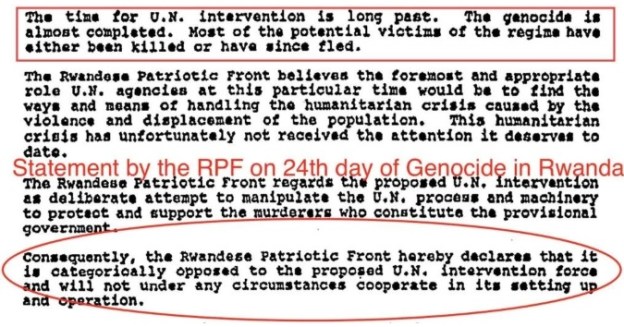
Statement by the RPF on the proposed deployment of a U.N. intervention force in Rwanda on 30th April 1994.

Original UN archive is available here.

The United Nations Security Council has been urged by the U.N. Secretary General to authorize the deployment of a U.N. intervention force in Rwanda for the purpose of stopping massacres of innocent civilians.

The massacres have been going on for several years but particularly become intense after the death of President Habyarimana on April 6, 1994.

The Rwandese Patriotic Front wishes to make the following observations regarding the massacres:

1. The massacres ware carefully planned in advance and systematically executed to ensure the complete extermination of those perceived as opponents of the regime. The plans for these massacres were hatched during President Habyarimana’s own life time with his knowledge and active participation.

2. RPF has very firm evidence indicating that the massacres were but for the death of the President originally intended to take place during the transition period after the Rwandese Patriotic Army forces had handed over their weapons to the United Nations and gone to the assembly points where they would be easy prey.

3. The occurrence of these massacres did not come as a surprise to RPF. Indeed, the RPF consistently brought the alarming preparations for these massacres to the attention of the international community for many months prior to their outbreak. The Secretary General of U.N. and the governments of all the countries which were represented at Arusha during the peace talks were duly informed about the preparations for these massacres through their accredited representatives in Kigali and various high ranking officials who have visited RPF both at Kigali and Mulindi ever since the signing of the peace agreement to discuss the possibilities of facilitating implementation of the peace agreement.

The international community was fore warned but did not find it possible or necessary to take any measures to prevent these massacres.

4. There is a misleading impression that the atrocities which have been committed were committed in course of armed conflict between two fighting groups. There are two groups alright but only one is armed and is committing the atrocities. The group of the victims is unarmed and defenseless. This is simply a case of state inspired violence against innocent citizens on account of their perceived political beliefs or ethnic origins.

The massacres are above all not a result of fighting between two different ethnic groups as the statement of the U.N. Secretary General would appear to indicate.

5. Although the Tutsi community has been singled out as a candidate for extermination, Rwandese of other ethnicities have equally been victims of the atrocities. Tens of thousands of Hutus have died because they belonged to opposition parties. Indeed, the majority of prominent public personalities who were executed were Hutus. The false perception that this is an ethnic conflict needs to be corrected.

6. These massacres are not new in Rwanda’s history. They are a repeat of similar massacres which were committed by the very same security apparatus headed by President Habyarimana between 1959 and 1966, between 1972 and 1973 and between 1990 and 1994.

7. The atrocities in Rwanda have been committed exclusively by the regime. The Rwandese Patriotic Front has not, contrary to what some have implied from the contents of the letter of the U.N. Secretary General addressed to the U.N. Security Council on April 29, 1994, been involved in committing and is not planning to carry out any atrocities. It has instead fallen upon us to rescue many Rwandese from such atrocities. The Rwandese Patriotic Front reiterates that all areas under its control are completely secure and open to inspection by the International community.

8. President Habyarimana and his collaborators planned and prepared for these massacres by taking advantage of the cease-fire arrangements which RPF had agreed to for the purpose of providing a suitable environment for promoting national reconciliation, restoring peace and democratizing our country.

RPF is firmly convinced that the international community has exhibited double standards by insisting that RPF must abide by the peace process agreed upon while doing nothing whatsoever about Habyarimana’s evident preparations to wreck the very peace process which they were promoting.

The United Nations mission (UNAMIR) which was in Rwanda, with a force of more than 2,500 personnel, at the outbreak of the current crisis was unable to offer protection to Rwandese Citizens who were threatened with violence. It did not intervene to stop the massacres, citing the constraints imposed by their mandate, although the mandate could have been changed by the U.N. Security Council at short notice. The force was instead withdrawn leaving the Rwando8s population at the mercy of the murderers.

The International Community stood by and helplessly watched while hundreds of thousands of innocent Rwandese Citizens perished. Few have dared to come out in public to condemn the authors of the atrocities which are being committed, let alone taken any steps to actively assist the actual and potential victims.

As a result of the massacres, it is reported (OXFAM) that more than a half million people (500,000) may have already died.

The manner and scale of the massacres clearly leave no doubt whatsoever that the atrocities which have been committed amount to genocide as defined by the relevant U.N. Conventions. We feel that the debate in some circles, including the U.N. Security Council, about whether genocide has really been committed is academic if not cynical. We the Rwandese and other people who have witnessed the atrocities first hand know for sure that genocide has indeed taken place.

The massacres have been orchestred by the so-called provisional government using the following:

1. The Presidential Guard.

2. Members of the regular National Army.

3. The Para-military Police (Gendarmerie Nationale),

4. Armed civilians and militia under the control of the late President’s party, the MRND and its allies, particularly the extremist CDR party.

The International Community owes the Rwandese people an obligation to condemn and ostracize the perpetrators of these massacres and to help in bringing them to justice. Some countries have, instead, lent legitimacy to these murderers and are already plotting to create a future role for them in the politics of our country. We would mention in particular the governments of France and Egypt which have hosted high level talks with members of the so-called provisional government and appear to be master-minding the current proposal for the deployment of a U.N. intervention force as a result of those talks.

The United Nations should take a leading role in ensuring that the members of the regime responsible for the massacres are not accorded legitimacy by any government or International organization. Should the U.N. itself receive and accord legitimacy to members of the said regime, the Rwandese Patriotic Front will have no option but to request that even the 270 member remnant of UNAMIR be recalled.

The Special Representative of the U.N. Secretary General to Rwanda, Dr. Jacques Roger Boon-Booh has throughout his stay in our country behaved in a very partisan manner and is not up to task entrusted to him. The Rwandese Patriotic Front will not participate in any future U.N. effort to resolve the Rwanda conflict unless and until the said Special Representative and his Assistant are recalled.

The time for U.N. intervention is long past. The genocide is almost completed. Most of the potential victims of the regime have either been killed or have since fled.

The Rwandese Patriotic Front believes the foremost and appropriate role U.N. agencies at this particular time would be to find the ways and means of handling the humanitarian crisis caused by the violence and displacement of the population. This humanitarian crisis has unfortunately not received the attention it deserves to date.

The Rwandese Patriotic Front regards the proposed U.N. intervention as deliberate attempt to manipulate the U.N. process and machinery to protect and support the murderers who constitute the provisional government.

Consequently, the Rwandese Patriotic Front hereby declares that it is categorically opposed to the proposed U.N. intervention force and will not under any circumstances cooperate in its setting up and operation.

In view of the forgoing the Rwandese Patriotic Front:

a. Calls upon the U.N. Security Council not to authorize the deployment of the proposed force as U.N. intervention at this stage can no longer serve any useful purpose as far as stopping the massacres is concerned.

b. Requests International Community to exert pressure on the murderers who constitute the so-called provisional government and are responsible for the massacres by:

1. Withholding recognition for the so-called provisional government which has taken power by unconstitutional means.

2. Condemning in person the prominent personalities of the regime who have been involved in committing atrocities.

3. Imposing punitive sanctions against the so called provisional government.

4. Setting in motion the process of establishing without delay war crimes tribunals and other mechanisms for bringing the persons responsible for the atrocities to justice.

c. Requests the U.N. Secretary General to replace his Special Representative in Rwanda without delay by someone more competent.

d. Calls upon the international community to urgently respond to the humanitarian crisis in Rwanda by providing assistance to the needy and gives its assurances that it shall cooperate fully in all efforts to alleviate the currant humanitarian crisis.

e. Calls upon the United Nations to immediately send a mission to areas of Rwanda controlled by RPF to confirm that no massacres or human rights of any nature have been committed by RPP forces as implied in the above-mentioned letter by the U.N. Secretary General to the Security council.

For: The Political Bureau of The Rwandese Patriotic Front

Mr. Gerald Gahima
Mr. Claude Dusaidi

Content was OCRed from original archive of the letter: http://nsarchive.gwu.edu/NSAEBB/NSAEBB117/Rw29.pdf 


Avis aux lecteurs: Nos articles peuvent être reproduits à condition de citer le nom d’auteur et le site web source.                                                                                              Notice to readers: Our articles may be reproduced provided the author’s name and the source website are cited.

UN List of Suspected Congolese Civil War Criminals to Stay Secret

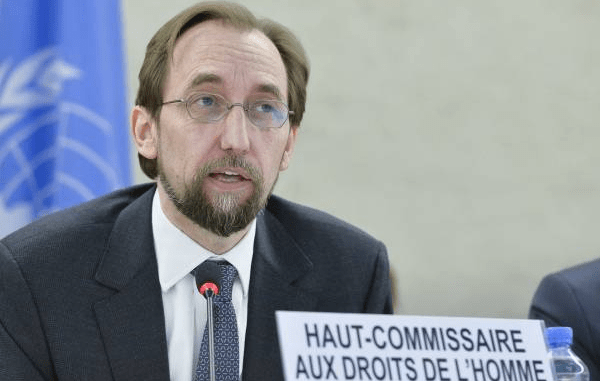
The UN High Commissioner for Human Rights declared in Kinshasa on Thursday that his office’s data base on suspected perpetrators of serious crimes committed in the Democratic Republic of Congo (DRC) from 1993 to 2003 will remain secret. He said this was because measures are lacking to protect victims and witnesses, but a senior UN official who wishes to remain anonymous claimed African countries are exerting pressure to stop the list being published.

In October 2010, the Office of the UN High Commissioner on Human Rights published its “Mapping” report on serious crimes committed in the DRC between March 1993 and June 2003. This 550-page document covers mainly the two Congo wars in which, between 1996 and 2003, as many as nine countries – Rwanda, Uganda, Burundi, Angola, Namibia, Zimbabwe, Chad, Libya and Sudan – were involved. It documents 617 serious incidents over a decade, including massacres and sexual violence, committed mainly by the Congolese army, foreign armies and rebel groups.

This report has fed a secret data base of suspected perpetrators of abuses, most of which could be categorized as war crimes, crimes against humanity and genocide. Congolese and international NGOs like Human Rights Watch and Amnesty International have frequently called for justice. Pressure is mounting. On March 8, International Women’s Day, an open letter entitled “No to impunity for rapes and massacres in the DRC” was submitted to Zeid Ra’ad al Hussein, the UN High Commissioner for Human Rights.

Massacres of Rwandan Hutu refugees in the DRC by Paul Kagame’s army

This letter signed by nearly 200 Congolese associations – whose October 20 petition gathered 450 signatures – calls for the “embargo” on the database to be lifted. Those supporting the call include gynaecologist Denis Mukwege, famous for his work treating thousands of rape victims in the eastern DRC, which has been unstable for 20 years. “Fighting impunity is a way to protect the women we look after, but also to bring peace,” he told JusticeInfo. “Wherever people have tried to make peace without justice, we can see that it has failed!

Caution

But the UN deems it too dangerous to reveal everything. “This case in particular must always be handled extremely cautiously,” Zeid Ra’ad al Hussein told the press on Thursday in Kinshasa. He said his office has “very sensitive information on a number of different investigations”. “Before disclosing the information to any judicial body investigating the alleged crimes, we need to make sure that there is adequate protection for witnesses and victims,” he continued. “If there is no framework for protection of victims and witnesses, we need to exercise caution.

Dr Mukwege understands these arguments but stresses that “perpetrators of these crimes must not be allowed to escape justice”. “We still need to launch a process fairly quickly to have a judicial body that can try these crimes – war crimes and crimes against humanity – that have been committed in the DRC,” he insists. His remarks come as people are still waiting for the DRC to set up special mixed courts with national and international judges and prosecutors to try the crimes committed in the 1990s in the former Belgian colony.

For the UN, keeping the database secret is also meant to prevent any interference with the administration of justice. In a response to the associations’ open letter, Zeid Ra’ad al Hussein says that unveiling the list could “contribute to the destruction of evidence and compromise future actions and initiatives, in particular trials aimed at holding the perpetrators of serious crimes accountable”. At UN headquarters in New-York, a senior official says that the deadlock is also the result of strong pressure from States.

So who is exerting pressure? According to him, African countries at the UN are “mobilizing to ensure that nothing is revealed `before being sure of the facts`, but in order to be sure of the facts, States need to launch investigations”. They are not in a hurry to do so. “Some States seem to think that [committing serious crimes] is part of war and that it’s a Western speciality to get upset about it,” he says. “Other States do not want their army’s image tarnished by these accusations. So it’s partly nationalism but also the desire to keep power, since they rely on the army to remain in government.”

Pressure from the DRC, Chad and Rwanda

He says States including the DRC, Chad and Rwanda “have all exerted pressure in different ways” to ensure that the list remains secret, including “threats” to withdraw troops deployed in UN peacekeeping missions or to “create administrative difficulties for UN agencies”. In this context and given the high stakes, he thinks it is unlikely the database will be published. “The issue is very sensitive,” he says. “It’s closely guarded, so unless there is a leak or a `UN Snowden`, it is unlikely the list will be revealed.”

Dr Mukwege regrets this pressure. “If we let it go on, it’s a way of saying also that someone else, another army, another organization can commit crimes and then use blackmail!” he says. “I do not think you can have a pretext for war crimes, crimes against humanity and crimes of genocide. There is no pretext. The day must come when the people who have committed these crimes in the DRC are brought to justice. That is the only way, the way that has been used across the world when war crimes and crimes against humanity have been committed. The DRC should not be an exception.

The database is nevertheless used in the wings. According to Zeid Ra’ad al Hussein’s letter, it has allowed “some prosecutions to be initiated” at the International Criminal Court (ICC), at foreign courts that can act under universal jurisdiction and Congolese courts such as the Military High Court. “But,” says the UN human rights chief, “these efforts at various levels are insufficient, and so we will persist in our work, notably through regular exchanges with the Congolese authorities.”

Source : justiceinfo.net


Avis aux lecteurs: Nos articles peuvent être reproduits à condition de citer le nom d’auteur et le site web source.

Notice to readers: Our articles may be reproduced provided the author’s name and the source website are cited.


Le 6 avril 2020, le génocide du Rwanda sera une fois encore commémoré à travers une histoire fabriquée

Le 6 avril 2020, c’est une nouvelle fois à travers l’histoire fabriquée par le régime du général Kagamé que va être commémoré le 26° anniversaire du génocide du Rwanda. Une histoire dont les trois principaux piliers ont pourtant été pulvérisés par l’historiographie. Ainsi :

1) Contrairement à ce qu’affirme cette histoire fabriquée, ce ne sont pas les « extrémistes hutu » qui ont abattu l’avion du président Habyarimana.

Le génocide du Rwanda ayant été déclenché par l’assassinat du président Habyarimana, l’impératif était donc de connaître les auteurs de ce crime. Or, les alliés du général Kagamé, Etats-Unis et Grande-Bretagne, ont interdit au TPIR (Tribunal pénal international pour le Rwanda) dépendant du Conseil de Sécurité de l’ONU (Résolution 955 du 8 novembre 1994), de chercher à les identifier.

Quant à la justice française, seule à avoir enquêté sur cet attentat, elle s’est prudemment défaussée après 21 ans d’accumulation d’éléments semblant pourtant désigner le camp du général Kagamé. Le 21 décembre 2018, suivant en cela les réquisitions du Parquet, elle a ainsi rendu un insolite non-lieu concernant les hauts cadres du général Kagamé que  le juge Bruguière accusait d’être les auteurs ou les commanditaires de l’attentat du 6 avril 1994. Insolite en effet car :

1) Les magistrats écartent la piste des « extrémistes hutu », innocentant ces derniers  de toute responsabilité dans l’attentat qui déclencha le génocide.

2) Ils énumèrent en revanche, et en détail, les nombreux éléments du dossier paraissant désigner à leurs yeux l’équipe du général Kagamé comme étant à l’origine de cet attentat.

3) Mais, in fine, les deux magistrats instructeurs prennent étrangement le contre-pied du déroulé de leur propre argumentation pour conclure que « L’accumulation (je souligne) des charges pesant sur les mis en examen (les membres du premier cercle du général Kagamé mis en examen par le juge Bruguière le 17 novembre 2006) (…) ne peut pas constituer des charges graves et concordantes permettant de les renvoyer devant la cour d’assises ».

Utilisant la seule conclusion de ce singulier non-lieu en taisant soigneusement la liste des charges l’impliquant  énumérées par les magistrats français, le régime de Kigali affirme avec un singulier aplomb qu’il n’est donc pour rien dans l’attentat du 6 avril 1994. Cela lui permet de continuer à soutenir que ce furent les « extrémistes hutu » qui commirent l’attentat alors que rien, ni dans le dossier de la justice française ainsi que nous venons de le voir, ni dans la monumentale masse de documentation étudiée par le TPIR, ne conduit à cette piste. D’autant plus que, présenté par l’histoire fabriquée comme étant l’ « architecte du génocide », donc comme celui qui l’aurait déclenché en faisant abattre l’avion du président Habyarimana, le colonel Bagosora a été totalement lavé de cette accusation par  le TPIR :

« No allegation implicating the Accused (Bagosora) in the assassination of the President is to be found in the indictment, the Pre-Trial Brief or any other Prosecution communication. Indeed, no actual evidence in support of that allegation was heard during the Prosecution case. » (TPIR- Decision on Request for Disclosure and Investigations Concerning the Assassination of President Habyarimana (TC) 17 october 2006).

2) Contrairement à ce qu’affirme l’histoire fabriquée, le génocide n’était pas programmé.

Si le régime de Kigali continue à affirmer contre toute vérité que ce furent les « extrémistes hutu » qui commirent l’attentat du 6 avril 1994, c’est parce que ce postulat couvre le cœur de leur mensonge historique qui est que ces mêmes « extrémistes hutu » ayant programmé le génocide, l’assassinat du président Habyarimana allait leur permettre d’avoir les mains libres pour le déclencher.

Or, ces « extrémistes hutu » qui, comme nous l’avons vu, ne sont pas les auteurs de l’attentat qui coûta la vie au président Habyarimana, n’avaient pas davantage programmé le génocide.

Ce point essentiel a été définitivement  établi devant le TPIR dont le Procureur n’a pas été en mesure de prouver l’existence d’une entente antérieure au 6 avril 1994 en vue de planifier et d’exécuter le dit génocide, ce qui a naturellement conduit à l’acquittement des principaux accusés de ce chef d’accusation majeur. Pour plus de détails à ce sujet on se reportera aux jugements dans les affaires Bagosora, Zigiranyirazo, Bizimungu, Ngirumpatse et Karemera que je présente dans Dix ans d’expertises devant le Tribunal Pénal International pour le Rwanda.

Dans ces conditions, comme le génocide du Rwanda n’était pas programmé, nous en revenons donc à la question essentielle qui est de savoir qui a tué le président Habyarimana puisque ce meurtre fut l’élément déclencheur d’un génocide « improvisé » après le 6 avril 1994 par certains de ses partisans rendus hystériques par son assassinat.

3) Contrairement à ce qu’affirme l’histoire fabriquée, dans la nuit du 6 au 7 avril 1994, quand il reprit unilatéralement la guerre, le but du général Kagamé n’était pas de sauver des vies, mais de conquérir militairement le pouvoir.

Toujours selon l’histoire fabriquée, le général Kagamé fut contraint de violer le cessez-le-feu en vigueur afin de sauver les populations du génocide. Or, une fois encore devant le TPIR, il a été établi que :

– Cette offensive fut lancée dès l’annonce de la mort du président Habyarimana, donc plusieurs heures avant les premiers massacres.

– Cette offensive contre l’armée nationale rwandaise désemparée par la mort de son chef d’état-major tué dans l’explosion de l’avion présidentiel, et dont l’armement avait été consigné par l’ONU dans le cadre du cessez-le-feu et des accords de paix, avait été minutieusement préparée depuis plusieurs semaines, les forces du général Kagamé n’attendant qu’un signal pour marcher sur Kigali.

– Afin de provoquer le chaos, les forces du général Kagamé attaquèrent en priorité les casernements de la gendarmerie afin d’interdire à cette dernière de rétablir la sécurité dans la ville de Kigali, ce qui était sa mission. Voilà pourquoi, dès le 7 avril, avant la vague des premiers massacres, le poste de gendarmerie hautement stratégique de Remera fut pris d’assaut. Quant au camp Kami, principale emprise de la gendarmerie à Kigali, fixée dans sa défense, sa garnison fut donc dans l’incapacité d’intervenir dans la ville pour y mettre un  terme aux massacres.

Ces  points fondamentaux réduisent à néant l’histoire officielle fabriquée par le régime du général Kagamé. Or, comme ils sont systématiquement ignorés par les médias, c’est donc une fausse histoire du génocide du Rwanda qui sera une fois de plus commémorée le 6 avril 2020.

Pour en savoir plus sur la construction et la déconstruction de cette fausse histoire, en plus du PDF : Dix ans d’expertises devant le Tribunal Pénal International pour le Rwanda, on se reportera à mon livre intitulé Rwanda : un génocide en questions.

Bernard Lugan

Source : http://bernardlugan.blogspot.com/


Avis aux lecteurs: Nos articles peuvent être reproduits à condition de citer le nom d’auteur et le site web source.
Notice to readers: Our articles may be reproduced provided the author’s name and the source website are cited.

‘My conscience is clear’: Former Rwanda PM Jean Kambanda tells ITV News he was tricked into genocide confession

More than any nation, Rwanda is still haunted by a malign past. That can be no surprise. An estimated 800,000 people died in the genocide of 1994.

The country’s Hutu majority, whipped into a frenzy of hatred by their leaders, sought to eradicate the Tutsi minority.

Armed with machetes, they killed at a rate faster even than the Nazis. For twenty one years, one of the leading figures of that blood-soaked time has barely spoken of his role.

Memorials around the country stand as a reminder of the massacre.

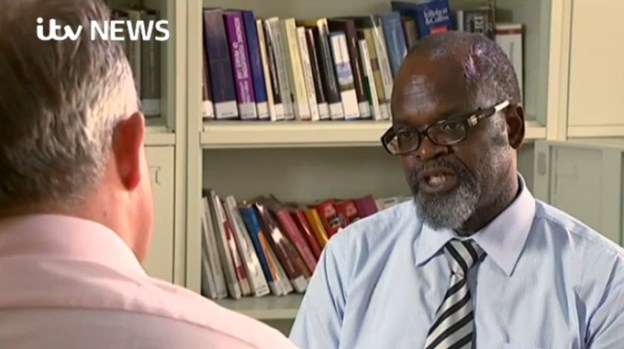
Jean Kambanda was the Prime Minister during one hundred days of almost unimaginable horror.

Now from his high security prison cell in Mali he has given ITV News his first interview.

He claims, despite his conviction by a UN tribunal for crimes against humanity, that he is innocent after all.

Kambanda speaks to us in his prison in Mali.
Kambanda speaks to us in his prison in Mali. Credit: ITV News

He claims he was effectively tricked into confessing; that at his trial he was denied a lawyer of his choice.

We also travelled to Rwanda and spoke to a witness of one of the many atrocities perpetrated during Kambanda’s period in power.

You can decide for yourself which version of history you think is more credible.

Kambanda was given a life sentence after confessing to crimes against humanity at a UN tribunal in 1998.

But the problem with Rwanda is that history cannot be consigned to the past; try as the modern Tutsi-led government of Paul Kagame might.

Great economic and social progress is widely acknowledged. The government claims it has healed the lethal ethnic divide. But what of its record on human rights?

The verdict of, among others, Human Rights Watch is damming. Rwanda, it says, “imposes severe restrictions on freedom of expression and does not tolerate dissent”.

Pictures of genocide victims donated by survivors at a memorial in Kigali.
Pictures of genocide victims donated by survivors at a memorial in Kigali. Credit: Radu Sigheti/Reuters

It claims “opponents and critics insides and outside the country have been killed, attacked or threatened.”

Last month in London, the head of Rwanda’s intelligence services, Emmanuel Karenzi Karake, appeared in court.

He is fighting extradition to Spain where he faces allegations relating to crimes against humanity.

Question marks surround the human rights record of current Rwandan prime minister.
Question marks surround the human rights record of current Rwandan prime minister. Credit: Adam Hunger/Reuters

The story, denied by the Rwandan authorities, is that many unarmed Hutu civilians were the victims of revenge killings by the advancing Tutsi army in the wake of the genocide.

Meanwhile, against opposition of his backers in the west, Paul Kagame is now thought to be considering changing the constitution to seek a third term in office.

Burundi President Pierre Nkurunziza's bid for a third term has prompted huge unrest.
Burundi President Pierre Nkurunziza’s bid for a third term has prompted huge unrest. Credit: Goran Tomasevic/Reuters

In neighbouring Burundi, beset by the same ethnic split, the same decision by the serving president has set off weeks of violence and strife.

So when Kambanda tells us that in Rwanda dangerous divisions between Hutu and Tutsi remain and that the country is “like a volcano that will one day expode again’’ here at least he is not simply trying to re-write history, but to point out the real perils that persist.

Source:itv.com

THE BBC MUST BE CONGRATULATED FOR LAUNCHING SCRUTINY WITH “RWANDA’S UNTOLD STORY”

Paul Kagame– wants only the victor’s side of the story to be heard

[Commentary: Open Letter to the BBC]

The letter objecting to the BBC documentary “Rwanda’s Untold Story” signed by a list of formerly credible academics and public figures reveals​ their inability to accept the fact that, after any major conflict the “victor’s tale” is not completely accurate, and that is particularly the case for the four-year war for power in Rwanda the last 100 days ​of which ​is called “the Rwanda genocide.”

This is a lesson taught to those of us in the U.S. ​who remember Vietnam by Robert S. McNamara in another documentary “The Fog of War” about another war built on half-truths​.

He also noted that​, had the Japanese won WWII, he and others who planned the gasoline bombing of Tokyo would be the war criminals.  It is quite amazing that “the myths of the victors” continue to be so easy to swallow — initially.  It is as if the signers of the letter seeking to suppress journalism have suspended disbelief despite what ​even the British must remember about the Weapons of Mass Destruction.

​But, the signatories are sticking to the Kagame/RPF victors’ saga long after the lack of evidence to support the “myth” has been exposed and contemporaneous data reported by third parties present in Rwanda has begun to create a new narrative.  The notables signing the letter have to ignore written judgments entered by the UN Tribunal for Rwanda, after Trial Chambers heard the best evidence the Rwandan government could muster for more than a decade, on exactly the same three issues raised in the letter, the UN Tribunal rejected all three.

Here are the facts:

First, IF there was any evidence to support the assertion that “30,000 interahamwe were trained as killers,” it was not introduced by the Prosecution as evidence in the trials of the government or military leaders of the Habyarimana government. The proponents of the letter cite no source.  In fact, the leaders of the government and military were acquitted of planning, conspiring, training, organizing, preparing, or any other sort of “planification” of any criminal acts against Tutsi civilians at all, prior to the assassination of President Habyarimana in the April 6, 1994 shootdown of the President’s plane.

This means that there was no evidence of planning to shoot down the President’s plane by his own forces, either.  This is what Trial Chamber-​found in the Bagosora Trial, Military-1:

When viewed against the backdrop of targeted killings and massive slaughter perpetrated by civilian and assailants between April and July 1994 as well as earlier cycles of violence, it is understandable why for many this evidence…shows a prior conspiracy to commit genocide….However, they are also consistent with preparations for a political or military power struggle…when confronted with circumstantial evidence [the Chamber] can only convict where it is the only reasonable inference…the Prosecution has not shown that the only reasonable inference based on credible evidence…was that [genocidal] intention was shared by the Accused.

…the Chamber is not satisfied that the Prosecution has proven beyond a reasonable doubt that the four Accused conspired among themselves, or with others to commit genocide before it unfolded on 7 April 1994. (emphasis added)

Second, according to ​the letter’s signatory ​Gen. Dallaire, in his ​own​ Sept 1993 Reconnaissance Report to the Security Council,  the RPF reported the total number of Tutsi in Rwanda was about 667,000, a number which the RPF did not consider an undercount in a UN estimate pre-Genocide. (see p. 30).

After July 1994,  IBUKA, the RPF survivors organization estimated 300,000 Tutsi survived in Rwanda.  This means that according to contemporaneous numbers from the RPF ​via Gen. Dallaire​, total Tutsi deaths must have been a blood-chilling 337,000 and even less than Davenport and Stam estimate and means even more Hutu deaths would be required to reach 800,000 to 1,000,000 total or some 460,000 to 660,000 Hutus. Please take note:  these numbers come from General Dallaire and the RPF. (Moreover, Gen. Dallaire has been a Kagame admirer for a long time, as far back as 1994 telling The New York Times, “He is absolutely brilliant,” and “He has an exceptionally disciplined mind.”)

Third, the shooting down of the plane was the conclusion reached in 1997 the elite International Criminal Tribunal for Rwanda (ICTR) Prosecutor’s Investigative Team by: Michael Hourigan, Australian Queen’s Prosecutor; frmr. FBI Special Agent, James Lyons; Gen. Dallaires Chief Mil. Int. Ofcr. Col. Amadou Deme; Chief ICTR Prosecutor Carla del Ponte; French Investigating Judge Bruggiere; Spanish Investigating Judge Merelles; the subject of confessions by frmr Kagame Chiefs of Staff Theogene Rudesingwa, M.D.; Gen. Rudesingwa; Lt. Joshua Abdul Rusebiza(ICTR testimony); Lt. Ruyenzi; and supported by ICTR testimony from eyewitnesses including Fr. Col. DeSanQuentin in Kanombe Base and first at the crash site with Maj. Ntabakuze on April 6, 1004.All of the above is documented in the film, in documents cited in my book “The Accidental Genocide,” or in the evidence and transcripts at the ICTR.

Davenport, Stam and Reyntjens were all Prosecution witnesses, not defense witnesses, who stopped being called by the Prosecution as their conclusions began to contradict the RPF myths.  Interahamwe leaders…witnesses A and BY in the Military-1 Trial both testified as Prosecution witnesses after guilty pleas in Belgium and both claimed to be trained ONLY as self-defense forces.  This evidence is IN the ICTR record.  Please confirm the assertion.

Please read the Trevidic Report, it does not say what is alleged by the letter.  It’s conclusions are far more ambiguous than the letter suggests and are based on an analysis of re-produced sound recordings, not on the testimonies of any individuals involved in the shootdown team, itself. Without studying and understanding:

the four-year war that began as an invasion from Uganda in October 1990;

that resumed with a full assault in Feb. 1993 that displaced nearly 1.5 million Rwandans from the Byumba breadbasket that nearly took power;

the Burundi genocide that drove 300,000 refugees into Rwanda; and the U.S. ambassador telling Kagame in Nov. 1993 that if he resumed the war, he would be responsible for a second Burundi genocide in Rwanda  (ICTR Testimony of Amb. Robert Flaten, July 2005):

As Dr. Stam stated, discussing the 100 days of the “Rwanda genocide” without discussing the 4-year war following the RPF invasion is like discussing the Holocaust without discussing WW-II.

Please note, none of the allegations in the letter signed by so many cite to any hard evidence in support.  At the ICTR, this same lack of support required the Trial and Appeal Chambers to reject the allegations of the ICTR Prosecutor, the Rwandan Government, and the several Prosecutors on loan from the U.S. Dept of Justice which pursued the issue for more than a decade without success.

The letter fails to note the incontrovertible evidence of RPF crimes in Congo from 1993-2003 documented in the October 2010 UNHCR “Mapping Report;” the UNS/C Expert Reports on Illegal Resource Extraction from Congo, 2002, 2003, 2004, 2008, 20012; Rwandan support for M23 and other occupying groups illegally extracting resources from Congo; the excess deaths in Congo and Central Africa between 5 and 10 million ​deaths attributed to invasions of 1996, 1998 and continual warfare over two decades.

In 2010, the Obama administration declared the Kagame election ​unfree and unfair, while Victoire Ingabire and other potential candidates were imprisoned and prevented from meaningful campaigning. In March 2014, HRW Reported the history of assassination of political opponents of Kagame dating back to 1993, and attempts on current opponents in exile.

In 2012, the U.S. War Crimes Ambassador, Stephen Rapp THREATENED with prosecution ala Charles Taylor for his support of M23 crimes in Congo.​ All of the foregoing are in the public record.​

The existence of this massive bloodshed, and its authorship in Kigali ​with assistance from Kampala cannot be denied by any honest signatories of the letter submitted to BBC.

The BBC documentary is true to the documentary record, and to the investigations and judgments of the United Nations ICTR despite the impunity enjoyed by Kagame and the RPF for crimes committed during the Rwanda genocide, described by former Chief ICTR Prosecutor Carla del Ponte.

The BBC is to be congratulated for following the story where the evidence leads.

Sincerely,

Prof. Peter Erlinder

Director, Int. Humanitarian Law Institute

Former Lead Counsel, Military-1, Ntabakuze Defense

Past-pres. ICTR-ADAD, Association des Avocat de la Defense

Source: http://www.blackstarnews.com/global-politics/africa/the-bbc-must-be-congratulated-for-launching-scrutiny-with-rwandas-untold

Rwanda’s Untold Story Documentary

Twenty years on from the Rwandan genocide, This World reveals evidence that challenges the accepted story of one of the most horrifying events of the late 20th century. The current president of Rwanda, Paul Kagame, has long been portrayed as the man who brought an end to the killing and rescued his country from oblivion. Now there are increasing questions about the role of Kagame’s Rwandan Patriotic Front forces in the dark days of 1994 and in the 20 years since.

The film investigates evidence of Kagame’s role in the shooting down of the presidential plane that sparked the killings in 1994 and questions his claims to have ended the genocide. It also examines claims of war crimes committed by Kagame’s forces and their allies in the wars in the Democratic Republic of Congo and allegations of human rights abuses in today’s Rwanda.

Continue reading

Kagame has revealed his greates fear: Reconciliation among Hutu and Tutsi

By: Emmanuel Hakizimana and Gallican Gasana

mihigo

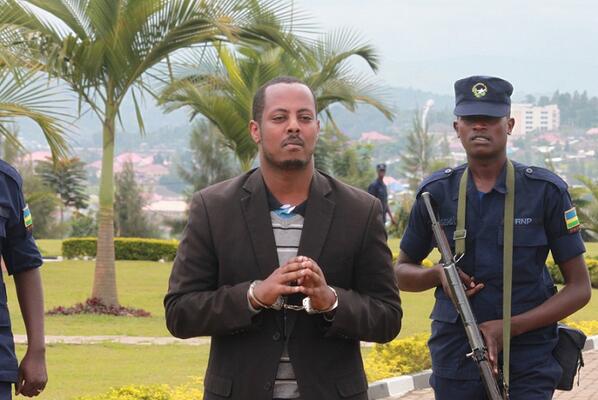
The alarm clock has been brutal for many Rwandans this Monday, April 14, 2014: Rwandan police had announced the arrest of a young Rwandan renowned musician, Mr. Kizito Mihigo, a young journalist, Mr Cassian and Ntamuhanga a young demobilized Rwandan army (RDF), Paul Dukuzumuremyi.

Beyond the fact that they are survivors of the 1994 genocide Tutsis who were arrested during the commemoration of the 20 th anniversary of the genocide, it is mainly the charges brought against them leaders who spread the excitement and stupor in all Rwandan media.

All three are accused of being involved in organizing terrorist attacks against Rwanda, want to overthrow the government by violence, to plan the murder of members of the government to encourage people to violence and have participated in a network of leading grenade attacks.

He is also accused of collaborating with the FDLR (Rwandan rebels in Congo installed) and the leaders of the opposition organization Rwanda National Congress (RNC).

During their court appearance the next day Tuesday, April 15, police also brought a young woman, Mrs. Agnes Niyibizi, which was presented as their accom.

To silence the voices of reconciliation

Accusations that the Kigali regime door against these young genocide survivors are among the worst he had ever brought against someone and there is reason to wonder why.

On closer inspection, the weight of these charges equaled the extent of their commitment to reconciliation and the magnitude of the fear of Kagame to see Hutu and Tutsi reconcile and fight together against his oppression.

In fact, the young musician Kizito Mihigo began to put his talent to the service of true reconciliation, which is diametrically opposed to the Kagame regime policies.

In a recent song entitled “The meaning of death”, he made two recommendations that have angered President Kagame. First, it recommended to honor not only the victims of the genocide of Tutsis, but also the victims of war crimes, revenge and other attacks in Rwanda or outside the country. Then he considered that human dignity takes precedence over being Rwandans.

It should be noted that this inclusive vision of Mr. Kizito is in perfect harmony with other Rwandan personalities who preached peace and reconciliation, and who paid a heavy price.

For illustrative purposes, it corresponds to that of Ms. Victoire Ingabire, president of the opposition party FDU-Inkingi, currently languishing in prison, having been sentenced to 15 years in prison after trying to run against President Kagame in elections the 2010 presidential election.

In his speech at the genocide memorial in Gisozi, she said: “For us to achieve genuine reconciliation, we need to empathize with the suffering of everyone.”

Similarly, the position of Mr. Kizito agrees with that of Mr. Patrick Karegeya, founding member and former RNC aide to President Kagame, who was murdered in South Africa earlier this year by agents of the regime Kigali.

In his letter to Mr. Douglass E. Coe associate director of the American Fellowship organization, just three days before his assassination, asking for his support in organizing an inter-Rwandan dialogue, Mr. Karegeya wrote: [I]” [/I][I]For a company like ours that has experienced trauma as now, since all our communities were in turn victims and executioners, it is impossible to overstate the issue of forgiveness and grace …… We can not look to the future only if we speak in truth and learn to forgive us. “[/I]

President Kagame has a completely opposite to that of Mr. Kizito, why he tried to stifle his voice position as it did for Ms. Victoire Ingabire, Patrick Karegeya and others he murdered or imprisoned.

Its policy has been to exclude Hutu any form of commemoration; they do not have the right to their cry. Worse, through a government program called “I am Rwandan,” the song refers implicitly Kizito, the Kigali regime calls on all Hutus, even those who were not yet born in 1994, to apologize for crimes conspecifics.

President Kagame also not hesitate to publicly affirm its opposition to the pacifist approach Mr. Kizito. A few days after the release of the song mentioned above, he said that he was not a musician and he was not there to please everybody.

What future for Rwanda?

The drama of these young survivors clear to those who still had doubts that Rwanda will never know peace and reconciliation under the regime of President Kagame.

For him, reconciliation refers to the end of its oppressive power based on the division between Rwandans (Hutu, Tutsi, Twa) and the scapegoat strategy.

Regarding this last aspect, we will remember the serious charges of complicity in genocide made by Kagame against French military and prevented France to send a delegation to the 20 th commemoration of the Tutsi genocide.

Being fully aware of its great responsibility in the crimes committed in Rwanda and the Great Lakes region of Africa since the 1990s, President Kagame is terribly frightened by anything that would bring Rwandans to sit together and establish the truth about their drama.

In this context, the future of Rwanda depend on the choice of orientation of the support, not only from the Rwandans themselves, but also from the international community.

The regime of President Kagame is clearly inconsistent with the peace and reconciliation, this choice could be ambiguous.

Source: http://lautjournal.info

(Note: Translated from French by Jennifer Fierberg)

Narrative Shift: U.S. Lawyer Highlights Kagame’s Role In Rwanda Genocide And Habyarimana Assassination

Kagame

Gen. Paul Kagame — even corporate media are now re-evaluating the narrative placing him as “savior”

[The Rwanda Calamity In Perspective]

April 6 marks exactly 20 years since the cataclysmic massacres that claimed hundreds of thousands of lives in Rwanda.

Rwandan Refugees in other East African countries and Diaspora who had enrolled into Uganda President Yoweri Museveni’s National Resistance Army (NRA), now the Uganda People’s Defense Force (UPDF) invaded Rwanda on October 1, 1990.

At the time of the invasion Paul Kagame, who is now President of Rwanda, was the chief of Military Intelligence in Uganda and had been sent by Museveni for U.S. training at Fort Leavenworth, Kansas.

The invasion sparked a destructive chain, including the recurrent invasions of the Democratic Republic of Congo (DRC), that all told may have cost the lives of six million or more Rwandans and Congolese.

To contextualize the calamity, this writer caught up with Peter Erlinder, a law professor at William Mitchell Law College in Saint Paul, Minnesota. Erlinder has a new book “The Accidental Genocide,” that covers the period before and after the massacres that started on April 7, 1994 after the plane carrying the president of Rwanda Juvenal Habyarimana, and Burundi’s Cyprien Ntaryamira was shot down with a missile. Prof. Erlinder’s book relies on U.S. documents and documents from the International Criminal Tribunal for Rwanda (ICTR) where he was a lead defense counsel for the Hutu defendants tried after the war.

The American law professor has been critical of what he calls the “victors’ justice in Rwanda,” contending that RPF soldiers and commanders were never tried for the war crimes that they committed and only the defeated army of Habyarimana were brought to book.

Erlinder had been arrested in Rwanda where he had traveled to defend the presidential aspiring candidate Victoire Ingabire Umuhoza who had been charged with “genocide denial ideology”. She remains incarcerated.

He tells me: “The winners of the war have told their side of the story, but there is another story, which is reflected in the UN, and the US documents but never came to light”.

Erlinder contends both sides committed the crimes but that a story told by the winner doesn’t reflect the level of culpability.

That’s what he says his book does. The book contains evidence used in the ICTR trials and copies of the originally suppressed UN and US Government documents related to the assassination of two heads of state, President Habyarimana of Rwanda and Ntaryamira.

The day after the assassination large-scale massacres started and estimates of those killed in the next 100 days range from 800,000 to a million. Later the genocidal killings were exported to the neighbouring Democratic Republic of Congo (DRC), the former Zaire; the killings continue in the Congo.

The assassination and the 100 days of killings shattered the Arusha Peace Accord which had established a transitional government of national unity with power-sharing between Habyarimana’s party, another opposition party, and the RPF, which ultimately seized the power.

Q: As we are getting closer to the 20th anniversary of Rwandan Genocide; what does this mean to you?

A: During the past 20 years, we have learned that a UN Tribunal charged with prosecuting all crimes that were committed in Rwanda during 1994 has prosecuted only crimes charged to the defeated and none have been charged to the victors.  This means the four-year war of aggression and invasion of the RPF supported by Uganda [about which there is no dispute] is the first in history in which only the defending side committed crimes, or like Nuremberg and the Tokyo Tribunals, the supposedly neutral UN Tribunal was actually a victor’s tribunal.  As former U.S. Secretary of [Defense] Robert McNamara admitted in the documentary The Fog of War ‘Had the Japanese won the war, those of us who planned the gasoline bombing of Tokyo would have been the war criminals.’ Until a fair assignment of mutual responsibility is reached, long-lasting peace in Rwanda and central Africa will be difficult to achieve.

Q: How would you like people to look at this eventful day April 6 which many believe to have triggered the 1994 genocide and today’s debate and narrative?

A: As early as 1997 UN Prosecutors recommended that Paul Kagame be prosecuted for the assassinations of Presidents Habyarimana and Ntaryamira. The U.S. removed U.N Prosecutor Del Ponte from office when she insisted on doing so on May 15, 2003.  Former Chief of Staff to Kagame, Dr. Theogene Rudesingwa has admitted being involved in the cover-up. The detailed testimony in the ICTR Military-1 case resulted in every Trial Chamber, and the Appeal Chamber, agreeing that the former Rwandan military were not engaged in any criminal conspiracy before the assassination of President Habyarimana…. that would include the assassination itself.  I would like people to look at the same evidence that convinced ALL of the ICTR judges.

Q: People wonder and would like to understand why very few people accused of being perpetrators of Rwandan Genocide have actually been convicted?

A: Many, if not most, have been convicted of crimes committed after the assassination of President Habyarimana. All national leaders have been acquitted of crimes of conspiracy and planning before the assassination because the Kagame regime and UN Prosecutors have no evidence to support their claim that a long-planned conspiracy to commit genocide against Tutsi, or any other civilians actually existed.

Q: Since you were privy to a lot of documents regarding the events that were taking place during the 100 days. Can you give a brief picture of what could have happened based on the documents you managed to access?

A: The main point, according to the UN documents, not me, is that the RPF was the dominant military force capable of seizing power as of February 1993.  This is confirmed by Gen. Dallaire’s Recon Report of September 1993 long before UNAMIR arrived in Rwanda. U.S. documents show it was the RPF that blocked power-sharing in late March 1994, not Habyarimana. The assassinations were committed on the order of Kagame which he was told by the U.S. Ambassador would bring mass violence like Burundi after President Ndadaye was assassinated in October 1993. The RPF assault from April 6 to April 20 took over eastern half of country in a long-planned Blitzkrieg. Only RPF had military power to stop the killings by stopping their military advance….Dallaire said they refused to do so because Kagame was winning the war.

Q: There are people wondering that — how come that the winners of the 1990s Rwandan war lost many people than the losers. How can you explain this theory that, the winner lost many people in the battle whilst the loser lost very few?

A: Actual numbers from Rwandan government and all NGO reports, compiled by [Christian] Davenport and [Allan] Stamm, show that twice as many Hutus were victims as Tutsi — these are best numbers I am aware of.

Q: There are people who still want to get a clear picture. By April 6, what percentage of the country was occupied by the RPF?

A: Less than 10% on April 6.  About  half on April 20th…entire eastern half.

Q: There were these disturbing images; which I believe you have seen before. If you revisit your TV images of bodies of Rwandese were floating on Lake Victoria. People who witnessed these bodies claim this style was common during the National Resistance Army (NRA). There is a general belief that this style of killing could have been borrowed from the NRA war of Luwero in Uganda in the early 1980s. As a person who has gone through many documents that include intelligence information is there a possibility that the RPF could have borrowed this style? Or who trained the Hutus to use the same Luwero style?

A: I am not aware of this comparison but I have heard reports from former RPF fighters that using farm implements rather than bullets was preferred to save ammunition for military battles.

Q: Knowing the geographic area of River Akagera in Rwanda and how its waters flow how did the Hutu manage to kill the Tutsi, ferry the bodies into Akagera River, which is in an area then occupied by the RPF?

A: Because RPF controlled eastern half of Rwanda no later than April 20, it is reasonable that bodies in Akagera are RPF’s responsibility. On May 17, 1994, a UNHCR report makes this explicit by reporting mass killings and bodies floating in the river. The document is in my book.

Q:  There are people out there who want to get the facts, which are consistent with realities. Do you know what was the population of Rwanda? Do you have the knowledge of what was the percentage of Hutus out of the entire population before the genocide?

A: Yes this is in my book, too. And, in the Dallaire Recon Report. The 1991 census and estimates given Dallaire by the parties in 1993 are not too different.

Q: As a person who accessed several documents during your time at the ICTR Court, what arrangements have you made to enable people to know what really transpired in Rwanda?

A: Accidental Genocidewww.rwandadocumentsproject.net

Q: Some people claim that the current Rwandan authority has invested hugely to hunt down and eliminate those perceived to be with the different version from the official known version. How true is this claim? Are there some examples to backup this claim that Kagame has invested hugely to hunt down those who disagree with his views that the Hutus committed the genocide?

Madam Victoire Ingabire Umuhoza’s analysis of the Rwandan genocide. She believes there were double genocide and all the perpetrators should be held to account for their respective actions. Ms. Ingabire also believes that most Gacaca Courts have been used or influenced by Kagame to settle political scores than bringing justice. What is your comment about Ingabire’s analysis?

A: Ms. Ingabire is essentially correct. The problem with the double genocide theory is that it implies planning on both sides. There is no evidence this is true. There is evidence for mass violence committed against Tutsi after the assassination of Habyarimana and Ntaryamira which was predicted to occur, as it did, after the assassination of Ndadaye, but this was not planned, in Burundi or Rwanda. The mass killing of Hutu in Burundi was a government operation and was genocide by the army. The RPF consciously planned for the mass-violence against Tutsi to occur in Rwanda to justify resuming the war and making use of their superior military power, rather than give-up power through the Arusha peace process…This is clear from U.S. State Department documents of April 1, 1994.

Q: Madam Carla De Ponte wrote a book in which she claimed to have advised the arrest and prosecution of RPF officials but was removed from office. It is also believed she went to Washington to tell Obama to investigate Clinton’s behavior and role in the 1994 Rwandan genocide. Why do you think Madam Carla Del Ponte was ignored?

A: She was not only ignored, we know she was removed from office. Her press conference in Arusha announcing Kagame had killed Habyarimana and the RPF had committed mass crimes is what got me interested in the ICTR in the first place in 2003.

Q: We know that the International Criminal Court for Rwanda (ICTR) tried almost all the former Hutu Military and political leaders, but why didn’t it convict anybody of organizing the genocide?

A: Because there is no evidence that the ‘genocide was organized.’ Col Bagosora the supposed architect was convicted of crimes committed by soldiers he did not command, committed on April 7, 8, 9.

Q: For those who want to access the literature of the Rwandan War where can they find it?

A: Most tells the common story, but can be read for background. Robin Philpot’s recent book, Dr. [Helmut[ Strizek, Dr. Davenport, Dr. Stam, Dr. Filip Reyntjens‘ articles and my recent book are the beginning of the narrative based on the acquittals at the ICTR and solid evidence.

The BBC documentary on assassinations in South Africa was quite good, on March 27th I think.

The Accidental Genocide is available for public purchase in hardcopy Research Edition format on Amazon.com

– See more at: http://www.blackstarnews.com/global-politics/africa/narrative-shift-us-lawyer-highlights-kagames-role-in-rwanda-genocide-and#sthash.qKmwGNzg.wf5kpG8U.dpuf