Category Archives: Africa

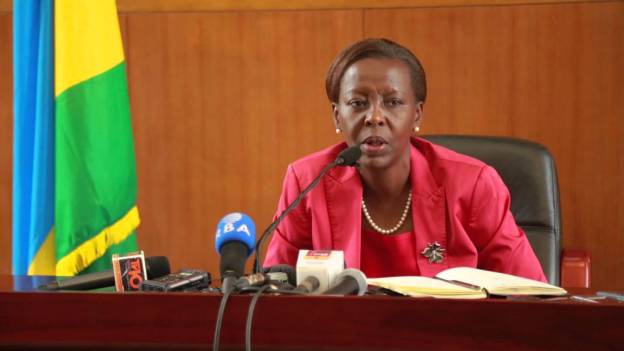
Mushikiwabo à la tête de la Francophonie?! À moins qu’on veuille lui conférer de mandats autres que ceux de promouvoir la langue française et les droits et libertés de la personne.

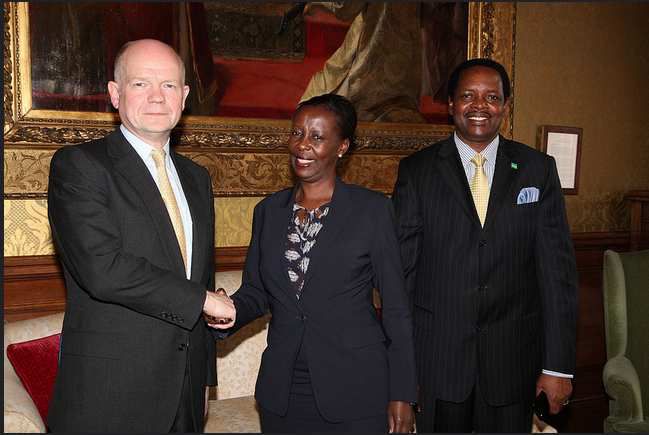
Louise Mushikiwabo dans le commenwealth

Louise Mushikiwabo dans le commenwealth

Le Canada, le Québec et le Nouveau Brunswick ont réitéré vivement leur soutien à Michaëlle Jean. Depuis l’annonce de la candidature de Louise Mushikiwabo à la tête de l’Organisation internationale de la Francophonie (OIF) et le soutien officiel du président Emmanuel Macron, plusieurs médias ont relevé de nombreuses faiblesses de cette candidature, tant en ce qui a trait à son leadership pour la promotion de la langue française que pour la promotion des valeurs démocratiques prônées par l’organisation.
Une autre faiblesse majeure que les médias n’ont pas mentionnée assez, qui pointe déjà à l’horizon et risque de mettre à mal l’action de la Francophonie, est celle de la mobilisation des ressources financières nécessaires à la planification et à l’exécution de programmes et activités de l’OIF, au moment où la France annonce des coupures drastiques dans le budget de TV5, un opérateur de l’OIF. Comme on le sait, le financement de la Francophonie est assuré par les contributions statutaires des États, ainsi que par des contributions volontaires, transitant par le Fonds multilatéral unique (FMU) et dédiées aux programmes de coopération de l’OIF, de l’Agence universitaire, de l’Association des maires francophones, de l’Université Senghor d’Alexandrie et de TV5 Afrique.

Depuis près dix ans, Louise Mushikiwabo est ministre des Affaires étrangères du Rwanda et, en tant que telle, siège régulièrement au Conseil des ministres de la Francophonie (CMF), une instance chargée du suivi de l’action politique, diplomatique, économique, de coopération, ainsi que des questions administratives et financières de l’organisation. Et pourtant, son pays a toujours fait preuve d’une certaine nonchalance et de laxisme dans l’acquittement de sa contribution statutaire à l’OIF dans les temps requis, et ce, pendant des années. Malgré le fait que l’OIF a dû lui accorder une réduction de 50 % et s’entendre sur un calendrier de paiement régulier des sommes dues, le compte du Rwanda est resté en souffrance les années 2015, 2016, 2017 et 2018, pour une modique contribution annuelle de 30 000 euros, pour un pays que l’on considère comme le modèle de réussite économique en Afrique.

Comment Mme Mushikiwabo pourra-t-elle convaincre les États membres d’en faire un peu plus et de s’acquitter à temps de leurs obligations financières envers l’Organisation, alors qu’elle-même n’a pas daigné répondre favorablement aux rappelles de l’OIF à honorer le paiement des arriérés de son pays? En fait, le Rwanda de Paul Kagame n’a jamais cru en l’efficacité de cette organisation, pas plus qu’il ne lui a jamais fait confiance. Il est curieux de voir aujourd’hui la même ministre qui, hier avait critiqué les méthodes de la France d’imposer sa volonté au sein de cette organisation, et aujourd’hui se targuer du même soutien de la France pour accéder à la tête de la Francophonie !
Les chefs d’État africains ne sont pas dupes. Hier c’était la BAD, aujourd’hui l’UA, maintenant on convoite la Francophonie, en 2020 ce serait le Commonwealth. La seule motivation qui justifie le désir du Rwanda de prendre la direction de toutes les organisations qui comptent, répond à une logique qui est la tienne : avoir la mainmise de ces organisations pour l’intérêt personnel et national. La majorité silencieuse francophone croit profondément que Louise Mushikiwabo n’incarne pas les valeurs de la Francophonie et sa désignation serait une grande erreur de casting lourde de conséquences pour l’OIF. Comme disait Christophe Boisbouvier de RFI, ce serait de : « Faire entrer le loup dans la bergerie ». Cette désignation va sérieusement entamer le capital de crédibilité dont l’OIF bénéficiait encore auprès de l’opinion francophone et même internationale, mais surtout contribuerait à long terme à l’affaiblir complètement.
Désignation de Louise Mushikiwabo, un camouflet pour le Canada
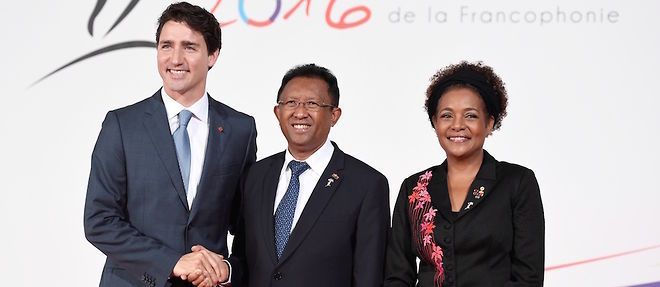
Premier Ministre Trudeau accueilli à Paris par Madame Jean

Premier Ministre Trudeau accueilli à Paris par Madame Jean

Le Canada, le Québec et le Nouveau Brunswick ont réitéré vivement leur soutien à Michaëlle Jean. Et, le Premier ministre du Canada continue d’encourager les chefs d’État et de gouvernement membres à user de leur pouvoir, en reconduisant Mme Jean pour un second mandat à l’OIF. L’échec de la tentative de la faire réélire sera considéré, pas comme un échec personnel de Michaëlle Jean, mais bien comme un sérieux camouflet pour le Canada et sa diplomatie, ce qui ne serait pas sans conséquence. En effet, le Canada, en tant que l’un des membres fondateurs de l’Agence de coopération culturelle et technique en 1970, devenue par la suite l’OIF en 2005, est un acteur majeur au sein de cette organisation, tant par sa représentation que par sa contribution financière substantielle.

Hormis les contributions volontaires dans les domaines spécifiques tels que l’égalité des sexes, l’insertion économique des jeunes et des femmes dans le marché du travail et la lutte contre le chômagela contribution statutaire du Canada, avec ses trois provinces membres (Québec, Nouveau Brunswick et Ontario), aux institutions de l’OIF avoisine les 50 millions de dollars, soit plus de 30 % de l’ensemble du budget annuel de l’organisation. Quand on sait que les gouvernements canadiens membres de l’OIF tiennent beaucoup au respect des valeurs chères aux Canadiens, qui sont prônées autant par la Francophonie, à savoir les libertés publiques, la démocratie, l’État de droit et le respect de la dignité humaine, il est moins sûr qu’ils puissent continuer à verser de l’argent des contribuables canadiens à une organisation qui va fermer les yeux sur les violations des droits de la personne et les comportements antidémocratiques de certains États membres.

Quoi qu’il en soit, si on veut bien d’une Francophonie aussi ambitieuse, dynamique et cohérente avec ses missions légendaires notamment de promouvoir la langue française, l’éducation et les nouvelles technologies en français, ainsi que les valeurs démocratiques, d’une voix forte, il est évident que ce n’est pas avec Louise Mushikiwabo qu’on va réaliser ces objectifs. Ce qui est sûr, c’est que la Francophonie va, non seulement perdre son âme et sa raison d’être, mais va aussi perdre de son lustre qui la caractérisait, en tant qu’organisation vouée à la promotion des droits humains, de la démocratie et des libertés fondamentales. À moins qu’on veuille lui conférer d’autres mandats qui n’ont rien à voir avec les mandats traditionnels de la Francophonie et qui n’ont pas pour but de promouvoir la langue française et les droits et libertés de la personne.

I love Donald Trump says Ugandan President Museveni

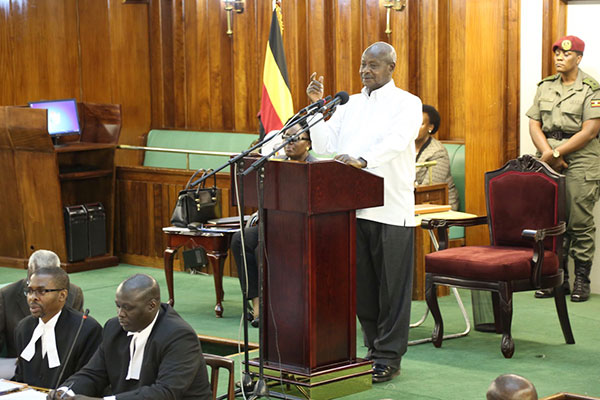
M7

Ugandan President Yoweri Museveni has said he loves the United States President Donald Trump who was recently reported to have referred to Africa countries as “shithole”.

Addressing members of the East African Legislative Assembly (Eala) at its opening in Kampala on Tuesday, Mr Museveni said the US president was frank.

“I love Trump because he tells Africans frankly. I don’t know whether he’s misquoted or whatever. He talks to Africans frankly,” he said.

He said Africans need to solve their own problems through integration.

“You can’t survive if you are weak. It is the Africans’ fault that they are weak… that’s why we need East African integration.

“We are 12 times the size of India, but why are we not strong?” He posed.

The East African Community has six member states — Uganda, Kenya, Tanzania, Rwanda, Burundi and South Sudan. Somalia is also seeking admission to the bloc.

Apology

Meanwhile, earlier Tuesday, the US ambassador to Uganda Ms Deborah Malac apologised over Mr Trump’s comments terming them insensitive.

“For people like me and many of my colleagues who have spent many years working in Africa, we have many relationships and friendships across the continent, [the comments] are obviously quite disturbing and upsetting…” Ms Malac told Uganda’s Speaker of Parliament Rebecca Kadaga.

“…I can assure you that we remain engaged and committed to working not just in Uganda but in all the other countries that we work with on the continent and our programmes continue,” she added.

Ms Malac was responding to Ms Kadaga’s query about the comments attributed to Mr Trump.

President Trump, in a meeting with US lawmakers on January 18 is reported to have dismissed Haiti, El Salvador and Africa as “shithole countries” whose inhabitants are not desirable to immigrate to America. But Mr Trump later denied using the derogatory term saying that he only used “tough language”.

His remarks were criticised across the world with many African nations calling for his apology.

Uganda’s neighbour Kenya said it had no problem with Mr Trump’s comments since he did not necessarily direct them at the country.

Eala

The regional assembly began its plenary session in Kampala this week amid division over the election of the Speaker with Burundi refusing to recognise Rwanda’s Martin Ngoga as the new Speaker.

“In a nutshell, integration is about the future of our people,” Mr Museveni told the MPs, adding that “It’s not about positions. When I hear you quarrel about positions, I feel sorry.”

Nelson Wesonga The East African

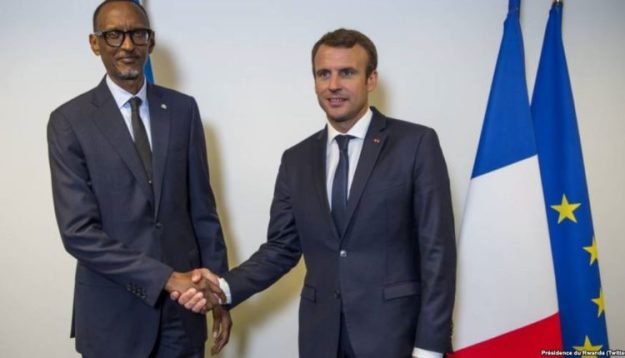
Diplomatie : Le torchon brûle à nouveau entre Paris et Kigali… Macron répond à Paul Kagame

KAGAME-MACRON

Le torchon brule à nouveau entre Paris et Kigali. Les fragiles relations entre la France et le Rwanda viennent, une fois de plus, de connaitre un regain de tensions. En cause, la relance de l’enquête française sur l’attentat contre le président rwandais Juvénal Habyarimana en 1994. Cette enquête avait déjà provoqué une rupture des relations diplomatiques entre 2006 et 2009 et en 2016.

On apprend aujourd’hui, par une source proche du dossier citée par l’Agence France-presse sous couvert d’anonymat, que le juge français a ordonné la confrontation de ce nouveau témoin avec deux personnes déjà mises en examen en 2010 : James Kabarebe, actuel ministre de la Défense du Rwanda, et un certain Franck Nziza, tireur présumé qui, selon Kigali, n’a jamais appartenu à l’APR (Armée patriotique Rwandaise, branche militaire de la rébellion tutsie avant 1994).

Selon la source citée par l’AFP, la confrontation est prévue – par la justice française – pour la mi-décembre.

De quoi Paul Kagame a-t-il peur ?

 « Il est exclu que le ministre de la Défense réponde à cette convocation de la justice française. » À Kigali, l’entourage présidentiel est unanime : pas question que James Kabarebe, ministre depuis 2010 et ancien aide de camp de Paul Kagame au temps de la rébellion, se rende à Paris afin d’y être confronté à un témoin de la dernière heure qui accuse le FPR (aujourd’hui au pouvoir) d’avoir abattu, le 6 avril 1994, l’avion du président hutu Juvénal Habyarimana.

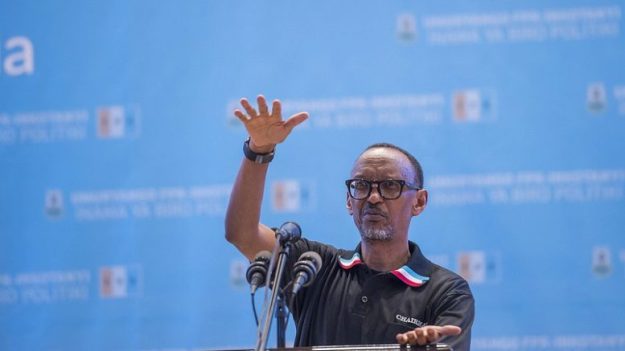
Dans un discours à Kigali le 10 octobre, le président rwandais Paul Kagame a en effet évoqué la possibilité d’une nouvelle rupture des relations diplomatiques entre les deux pays. Et effectivement, l’ambassadeur du Rwanda à Paris, Jacques Kabale, vient d »être rappelé à Kigali « pour consultation ».

Le 7 octobre 2017, le juge français chargé de l’instruction sur l’attentat du 6 avril 1994 visant l’avion du président hutu Juvénal Habyarimana a ordonné la confrontation d’un nouveau témoin avec deux personnes mises en examen dans ce dossier. Ce témoin accrédite la thèse selon laquelle l’attentat aurait été commis sur ordre de Paul Kagame. En effet, un nouveau témoin dans l’instruction menée en France depuis près de 20 ans sur l’attentat du 6 avril 1994 visant l’avion du président hutu Juvénal Habyarimana a été entendu par le juge d’instruction français en mars, à deux reprises, dans la plus grande discrétion.

Selon une source proche de Paul Kagame, une rupture des relations diplomatiques serait « une éventualité ».Un diplomate rwandais ajoute que « c’est un scénario probable, à moins que la cause de ce rappel ne disparaisse »

À un chef d’État d’Afrique de l’Ouest exprimant son embarras face à cette détérioration des relations entre Kigali et Paris, Emmanuel Macron a adressé, en substance, ce message : il ne s’agit pas de l’ouverture d’une nouvelle instruction, mais de la poursuite de l’ancienne ; merci de rappeler au président Paul Kagame que la justice française est indépendante. La France, elle, n’a plus d’ambassadeur au Rwanda depuis le départ de Michel Flesch, en 2015, Kigali n’ayant jamais accordé d’agrément à son successeur.

Merci de rappeler au président Paul Kagame que la justice française est indépendante. La France, elle, n’a plus d’ambassadeur au Rwanda depuis le départ de Michel Flesch, en 2015, Kigali n’ayant jamais accordé d’agrément à son successeur.
Emmanuel Macron
Source: BeninWeb TV

Rwanda’s Forever President

kagame-fpr-bureau-politiqueANTWERP, Belgium — There is an election in Rwanda on Friday, but its outcome already is nearly certain: President Paul Kagame will win a third seven-year term. Elections there are not a contest for power. They are the ritual confirmation of the power in place.

Mr. Kagame generally wins by margins that would make a dictator proud: In 2010, he scored some 93 percent of the vote. He is the only ruler most Rwandans born since the 1994 genocide know. The Rwandans who remember leaders before him have reason to wonder if they will ever see another: The state’s mighty security apparatus is quietly eloquent, with all those soldiers and police officers routinely patrolling both city streets and the countryside.

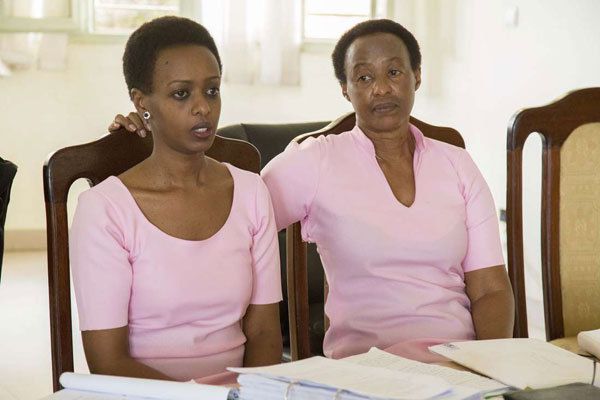
Mr. Kagame is up against two innocuous candidates after the national election commission disqualified Diane Rwigara, his strongest opponent, and two other independent contenders. The opposition leader Victoire Ingabire, who was placed under house arrest in the lead-up to the 2010 election, is now in jail serving a dubious 15-year sentence for threatening state security, among other things. Journalists have also been intimidated and stifled; Freedom House categorizes Rwanda as “not free.”

Mr. Kagame wasn’t supposed to run this time because he would be coming up against the two-term limit set by the Constitution. But in 2015 the government proposed an amendment and had it sanctioned in a referendum (roundly criticized by human rights groups), opening the way for Mr. Kagame to stand for re-election this year — and again until 2034.

Burundi was condemned internationally in 2015 after President Pierre Nkurunziza flouted term limits to run for a third mandate. Last year, President Joseph Kabila of the Democratic Republic of Congo skirted term restrictions by simply delaying the next election, triggering protests and then a crackdown that led to sanctions against his government. Yet nothing of the sort has happened to Mr. Kagame or his administration despite its ploys to keep him in power basically unchallenged.

Why? Because Mr. Kagame has been masterful at deflecting criticism of his illiberalism by pointing to Rwanda’s economic performance. The country is touted as a model: The government claims that the economy grew by an average of about 8 percent a year between 2001 and 2014, and that the rate of poverty dropped from nearly 57 percent in 2006 to less than 40 percent in 2014. Neither Mr. Nkurunziza nor Mr. Kabila could proffer such results.

Mr. Kagame’s supporters, in Rwanda and beyond, sing to his tune. In a way, they have to. Western donors and international organizations may well prefer democratic values to big-man politics. But having poured great sums of money into Rwanda since the 1994 genocide, they want to be impressed by the headway Mr. Kagame claims to have made — on economic growth and poverty reduction, but also maternal health care and the prosecution of suspected mass killers. Asia has tigers; now Africa has found its lion. Many want to believe that while Mr. Kagame may have been cutting corners on democracy, he has delivered on development.

Has he, though?

In fact, his government’s record is shakier than it looks, including on some of the major achievements it is credited with.

Consider poverty reduction. Back in 2005, I was stationed in Rwanda with a World Bank team, working on a large-scale study of poverty. Six months into it, after we had collected hundreds of survey questionnaires about the well-being of ordinary Rwandans and conducted hundreds of discussions with villagers, the Rwandan security forces seized half of our files on the pretext that our research’s design was tainted by “genocide ideology” — a vague notion supposedly something like sectarianism that the government often invokes to criminalize what it sees as challenges to its authority. After lengthy negotiations between World Bank and Rwandan officials, the project was abandoned. We never determined what the poverty trends were: The information we had collected was destroyed before it could be analyzed.

Matters have hardly improved. Major studies can only be carried out by the Rwandan authorities or under their close supervision. Independent researchers have come to question the government’s methodology for analyzing data.

Officially, the poverty rate decreased by nearly 6 percentage points between 2011 and 2014. But Filip Reyntjens, a Rwanda expert at the University of Antwerp, has argued that it might actually have increased by about 6 percentage points during that period. Several articles published by the Review of African Political Economy also challenge Rwanda’s official poverty figures, as well as its G.D.P. growth rates.

I’m of the view that expanding individual freedoms is essential, not incidental, to a country’s long-term development. As Angus Deaton, a Nobel laureate in economics, said to a Rwandan minister in 2015, “improvements in public health can never be truly secure in nondemocratic states.” But I concede that Rwanda has made remarkable economic progress since facing near-total destruction in 1994, and that some think it is still worth debating the merits of trade-offs between democracy and development.

Whatever one thinks of these issues, however, everyone should be concerned that the Kagame government has been fudging, hiding or selectively presenting the raw facts of its economic record. Rwanda may be forgoing democracy for development only to wind up with no democracy and far less development than many think.

World is plundering Africa’s wealth of ‘billions of dollars a year’

More wealth leaves Africa every year than enters it – by more than $40bn (£31bn) – according to research that challenges “misleading” perceptions of foreign aid.

By 

Analysis by a coalition of UK and African equality and development campaigners including Global Justice Now, published on Wednesday (May 24th, 2017 ndlr ), claims the rest of the world is profiting more than most African citizens from the continent’s wealth.

It said African countries received $162bn in 2015, mainly in loans, aid and personal remittances. But in the same year, $203bn was taken from the continent, either directly through multinationals repatriating profits and illegally moving money into tax havens, or by costs imposed by the rest of the world through climate change adaptation and mitigation.

This led to an annual financial deficit of $41.3bn from the 47 African countries where many people remain trapped in poverty, according to the report, Honest Accounts 2017.

The campaigners said illicit financial flows, defined as the illegal movement of cash between countries, account for $68bn a year, three times as much as the $19bn Africa receives in aid.

Tim Jones, an economist from the Jubilee Debt Campaign, said: “The key message we want to get across is that more money flows out of Africa than goes in, and if we are to address poverty and income inequality we have to help to get it back.”

The key factors contributing to this inequality include unjust debt payments and multinational companies hiding proceeds through tax avoidance and corruption, he said.

African governments received $32bn in loans in 2015, but paid more than half of that – $18bn – in debt interest, with the level of debt rising rapidly.

The prevailing narrative, where rich country governments say their foreign aid is helping Africa, is “a distraction and misleading”, the campaigners said.

Aisha Dodwell, a campaigner for Global Justice Now, said: “There’s such a powerful narrative in western societies that Africa is poor and that it needs our help. This research shows that what African countries really need is for the rest of the world to stop systematically looting them. While the form of colonial plunder may have changed over time, its basic nature remains unchanged.”

The report points out that Africa has considerable riches. South Africa’s potential mineral wealth is estimated to be around $2.5tn, while the mineral reserves of the Democratic Republic of the Congo are thought to be worth $24tn.

However, the continent’s natural resources are owned and exploited by foreign, private corporations, the report said.

Bernard Adaba, policy analyst with Isodec (Integrated Social Development Centre) in Ghana said: “Development is a lost cause in Africa while we are haemorrhaging billions every year to extractive industries, western tax havens and illegal logging and fishing. Some serious structural changes need to be made to promote economic policies that enable African countries to best serve the needs of their people, rather than simply being cash cows for western corporations and governments. The bleeding of Africa must stop!”

However, Maya Forstater, a visiting fellow for the Centre for Global Development, a development thinktank, said the report did not provide a meaningful look at the issues.

Forstater said: “There are 1.2 billion people in Africa. This report seems to view these people and their institutions as an inert bucket into which money is poured or stolen away, rather than as part of dynamic and growing economies. The $41bn headline they come up with needs to be put into context that the overall GDP of Africa is some $7.7tn. Economies do not grow by stockpiling inflows and preventing outflows but by enabling people to invest and learn, adapt technologies and access markets.

“Some of the issues that the report raises – such as illegal logging, fishing and the cost of adapting to climate change – are important, but adding together all apparent inflows and outflows is meaningless.”

Forstater also questioned some of the report’s methodology.

The coalition of campaigners, including Jubilee Debt Campaign, Health Poverty Action, and Uganda Debt Network, said those claiming to help Africa “need to rethink their role”, and singled out the British government as bearing special responsibility because of its position as the head of a network of overseas tax havens.

Dr Jason Hickel, an economic anthropologist at the London School of Economics, commenting on the report, agreed that the prevailing view of foreign aid was skewed. Hickel said: “One of the many problems with the aid narrative is it leads the public to believe that rich countries are helping developing countries, but that narrative skews the often extractive relationship that exists between rich and poor countries.”

A key issue, he said, was illicit financial flows, via multinational corporations, to overseas tax havens. “Britain has a direct responsibility to fix the problem if they want to claim to care about international poverty at all,” he said.

The report makes a series of recommendations, including preventing companies with subsidiaries based in tax havens from operations in African countries, transforming aid into a process that genuinely benefits the continent, and reconfiguring aid from a system of voluntary donations to one of repatriation for damage caused.

Source: https://www.theguardian.com/global-development/2017/may/24/world-is-plundering-africa-wealth-billions-of-dollars-a-year

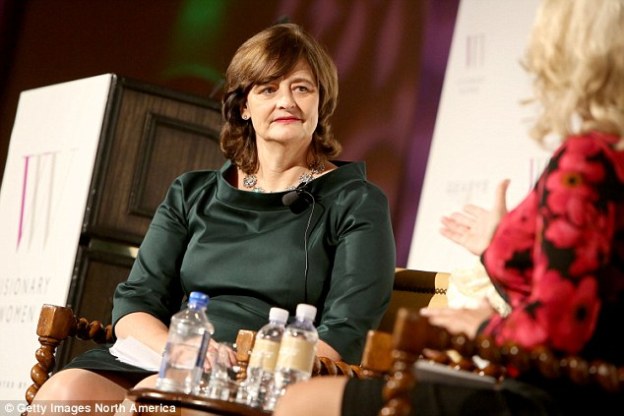
How Cherie cashed in by acting for a ‘war criminal’: Blair’s wife represented Rwandan General accused of ordering massacres

Trading on his impeccable connections in order to earn millions of pounds, Blair soon discovered that life after Downing Street could be a dangerously grubby business.

So when dealing with corrupt governments and companies, he took care to try to distance himself from any public controversy.

Notably, he initally denied having dealings with Qatar — a corrupt dictatorship that supported extremist Muslim groups, suppressed freedom of the Press and was accused of offering bribes to win the FIFA football World Cup in 2022.cherie

In fact, the Qataris had hired Cherie. Amid some acrimony, she resigned from Matrix Chambers — where she worked as a barrister — after her husband ceased to be Prime Minister.

Like him, she’d established two charities — in her case, the Cherie Blair Foundation For Women and the Africa Justice Foundation — alongside a lucrative money- making venture.

With Omnia Strategy, her new commercial business, she then reinvented herself as a consultant advising Middle Eastern and African governments.

Among those grateful for her help was Sheikha Mozah bint Nasser al-Missned, the wife of a Qatari royal.

In 2009, on her behalf, Cherie bombarded Hillary Clinton, then U.S. Secretary of State, with requests to engage in a woman-to-woman meeting to improve relations between the countries.

After an exchange of 19 emails, Clinton finally agreed.

Cherie was jubilant. ‘When I see what a difference you are making,’ she wrote unctuously to Clinton, ‘it reminds me why politics is too important to be left to the bad people.’

Making millions — for their charities or their swelling bank accounts — is a family business for the Blairs.

With her husband’s help, Cherie made it onto the Albanian payroll — an honour she shared with Alastair Campbell — for advice to prime minister Edi Rama.

KARENZI

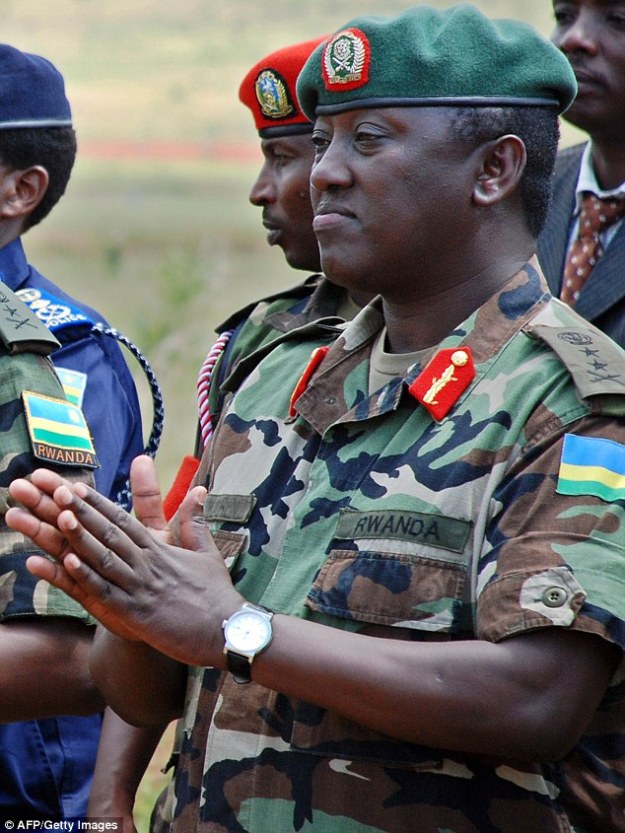
Cherie also represented Rwandan General Karenzi Karake in court following his arrest for on international warrant for ‘war crimes against civilians.

One of the Blairs’ earliest clients was bagged in October 2007.

Cherie had been due to meet the President of Rwanda, Paul Kagame, who was widely accused of being a mass murderer, to discuss the creation of a justice ministry in his impoverished country.

But she didn’t show up to their planned dinner in London. Instead she explained she had an ‘emergency’. ‘I can’t come,’ she said, ‘but Tony says he’d happily join you.’

At the dinner, Blair set out his stall. ‘You are a man with a vision, a leader I’ve always admired,’ he told Kagame. ‘Now you need advisers to show you how to run a government, and I’m your man.’

Kagame agreed to welcome Blair’s team. In return, he was also introduced to the international circuit of leaders’ conferences across America and in Davos, where Blair presented him as Africa’s ‘Mr Clean’.

No one mentioned the continuing massacre of Hutus in the neighbouring Congo by militia dispatched by Kagame.

Nor did they refer to the systematic theft by Kagame’s armed forces of diamonds and gold from Congo.

The following year, Blair visited Kigali, the Rwandan capital, and was flown home on Kagame’s $30 million Bombardier BD-700 ‘Global Express’.

The cost of the round-trip flight? About £280,000. Rwanda’s 11 million people earn an average daily wage of £1.40.

By the time he returned to Kigali again in 2009, the country was in uproar. Any journalist or businessman who was critical of the government was being beaten up, and a UN investigation was due to report that the President was guilty of genocide in Congo.

Blair’s friend won the Rwanda election in 2010 — but the beheaded corpses of leaders of the small opposition party were found strewn about the countryside.

Blair ignored all this and hailed his protégé’s success.

And what of Cherie? Did she see the report sent to Blair by the U.S. Department of State in 2014, describing the murderous oppression in Rwanda? Did she follow the 2015 Congressional hearings in Washington, which denounced the murder of Kagame’s opponents?

That year, General Karenzi Karake, the head of Rwanda’s intelligence service, arrived at Heathrow on an official visit.

To his surprise, he was arrested on an international warrant for ‘war crimes against civilians’, issued in Spain.

To resist his extradition to Spain, he hired… Cherie Blair. She told the magistrate that Karake was ‘a hero in Rwanda and they want him home as soon as possible’.

Karake was released on bail of £1 million. Two months later, he was freed on a legal technicality before the charges could be heard, and flew home.

His opponents were shocked. But Cherie, like her husband, was hailed by Kagame as a hero.

Source: http://www.dailymail.co.uk/news/article-3470400/How-Cherie-cashed-acting-war-criminal.html

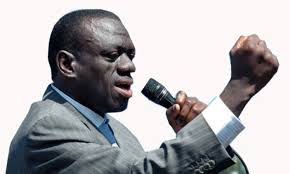
Dushyigikiye DR KIZZA BESIGYE, INTWARI izahora iratwa n’ urubyiruko rw’Abaharanira Demokarasi muri Afurika.

Besigye

Dr KIIZA BESIGYE, Umukandida wa FDC

Twakomeje gukurikiranira hafi akarasisi karanze amatora aherutse kuba mu gihugu cy’abaturanyi cya UGANDA, hari taliki ya 18/2/2016.Twashimye by’umwihariko ibiganiro-mpaka bibiri byahuje abakandida bahataniraga umwanya wa Perezida wa Repubulika : Icyambere cyabaye taliki ya 15/1/2016, icyakabiri kiba ku itariki ya 13/2/2016. Twaribwiraga tuti wabona igihugu cya Uganda giciye agahigo kikaba intangarugero muri demokarasi, abaturage bagasubizwa uburenganzira bwabo bwo kwihitiramo abayobozi bashatse binyuze mu matora adafifitse. Twarishukaga ngo wabona Perezida KAGUTA Museveni umaze imyaka 30 yose ku butegetsi noneho yibutse rya jambo rikomeye yavuze mu mwaka w’1986 ngo » Icyorezo gikomeye kizahaje Afurika si abaturage b’ibihugu ahubwo ni abaperezida bihambira ku butegetsi mu buryo buteye isoni « . Twari twaheranywe n’inzozi twihenda ngo n’ubwo Museveni yahindaguye itegekonshinshinga rya Uganda kenshi kugirango arambe ku butegetsi, ubu noneho nk’umukambwe wabonye ibipfa n’ibikira yashyira mu gaciro akereka abanya Uganda n’isi yose ko inyota y’ubutegetsi nayo igira iherezo.

Twarihendaga.

Nk’uko bigaragarira buri wese, Museveni yiyatse amahirwe yo gusezera ku butegetsi mu nzira yari kuzamuhesha icyubahiro mu minsi itari myinshi asigaje kuri iyi si, none ahisemo kwiyandikisha bidasubirwaho ku rutonde rw’abakuru b’ibihugu badashobotse, barangwa n’ikinyoma gusa, bubakira byose ku kwikunda, igitugu n’iterabwoba, badashishikajwe n’inyungu rusange, batunzwe no gusahura ibya rubanda, bahonyora uburenganzira shingiro bw’abenegihugu, mbese bene babandi bazahora bibukirwa ku mahano y’urukozasoni yaranze ubutegetsi bwabo.

Mu gutekinika amatora yo mu 2016 , mu kogera uburimiro ku mukandida DR KIIZA BESIGYE no guhohotera abo muri Opozisiyo , abarasa, abakubita, abafungira ubusa… Museveni yeretse urubyiruko rwa Uganda ndetse n’urw’Akarere kose k’Ibiyaga bigari ko nta cyizere na gito bakwiye kongera kugirira aba bayobozi bafashe ubutegetsi bamaze kugarika ingogo ! Ahubwo Museveni abaye nk’uhagamariye urubyiruko rukunda Dr KIIZA BESIGYE kurushaho kwisuganya no guhagurukana umuriri bagahangana bagashyirwa bahangamuye ubutegetsi BWIBA AMAJWI izuba riva, bugasuzugura ibyifuzo nyakuri by’abenegihugu.

M7VSDRBESIGYE

Dr Besigye (ibumoso) na Kaguta Museveni

Muri make, ibidakorwa Perezida Museveni ariho akora i Bugande muri iki gihe, bimutesheje agaciro bidasubirwaho ndetse birasa n’ibitangije ibihe bidasanzwe bya Revolisiyo ya rubanda itazabura guhitana umukambwe Kaguta Museveni ndetse n’abandi banyagitugu nka we bo mu Karere.

Nanone kandi byumvikane ko ibiri kubera mu gihugu cya Uganda bifite igisobanuro n’amasomo menshi arenga kure imbibi z’icyo gihugu . Umuryango mpuzamahanga wo warangije kurunguruka umunyagitugu Museveni no kumukura ho amaboko. Ariko igiteye inkeke kurushaho ni uko Urubyiruko rw’ibihugu bigize Akarere ka Afurika y’Uburasirazuba (EAC) rwarangije kumva neza ko ari ngombwa kwitabaza INTWARO kugira ngo bariya bategetsi bigize INDAKOREKA n’IBIGIRWAMANA bashobore kwigizwayo no gushyirwa mu mwanya bakwiye .

Umwanzuro

KAGAME NA SEWABO

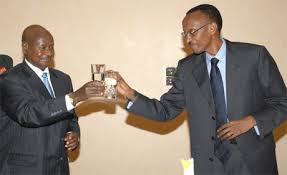
Kaguta Museveni na Kagame Pahulo (iburyo)

Nkatwe twiyemeje guharanira gufasha Abanyarwanda kugera ku mpinduka nziza bakeneye dushyize imbere inzira y’amahoro , turareba tugasanga ibiriho kubera i Bugande bigenura urudutegereje! Niba mu mpera z’umwaka wa 2015, Perezida Pahulo Kagame yarariye isoni akagerageza guhindura Itegekonshinga ( n ‘ubwo byakozwe uko atabishakaga!)kugirango azagwe ku butegetsi, nta cyemeza ko mu matora ya 2017 azibuza kugenza nka Sewabo KAGUTA Museveni ndetse no gukora ibirenzeho kugirango akunde anige ijwi rya rubanda itakimukeneye, bityo akomeze ategeke abatamushaka.Niyo mpamvu rero abifuza kwitangira impinduka nzima mu Rwanda dukwiye gukomeza urugendo nta mususu ariko tukanakura isomo ku biri kubera i Bugande maze tukarushaho kunoza intego n’ingendo kugira ngo tutazatungurwa! Ndongera guhamagarira cyane cyane urubyiruko rw’u Rwanda, ari abari mu gihugu no hanze yacyo, kwitabira  » « RASSEMBLEMENT ANTI-TROISIEME MANDAT » kugira ngo duhamye « Stratégies » zikwiye guhangamura ingoma y’igitugu y’Agatsiko kiyemeje kuduhindura Indorerezi n’Abagereerwa mu gihugu cyacu.


Turashima UBUTWARI bwa Dr BESIGYE n’urubyiruko rwa Uganda rumushyigikiye kandi tukaba tubifuriza ko bakomeza umutsi bagaharanira uburenganzira bwabo batitaye ku bikangisho bya Perezida Museveni kandi ntibakangwa ubugome bwose bashobora kagirirwa. Abafaransa babivuze ukuri ngo : « A vaincre sans péril on triomphe sans gloire ». Tubahanze amaso kandi turabashyigikiye.

Padiri Thomas Nahimana,
Umukandida w’Ishyaka ISHEMA na Nouvelle Génération mu matora ya Perezida wa Repubulika yo mu mwaka wa 2017.

Uganda elections: Like Kagame in Rwanda, Museveni sets a poor example for African democracy and governance.

m7

President Yoweri Museveni displays his inked finger after casting his vote during presidential elections on 18 February. Photograph: James Akena/Reuters

Yoweri Museveni has had a good run. Having seized power in Uganda in 1986, he has held the presidency ever since. As guerrilla leader turned politician-statesman, Museveni fitted the late 20th-century leadership profile that predominated in post-colonial Africa. Where once the heinous dictatorship of Idi Amin held sway, the Museveni era brought a democratic reformation. Where once chaos reigned, his strong grip on the fledgling state brought stability and, for many Ugandans, a degree of economic security and gradual social progress.

It is a pity Museveni is jeopardising all that now. By grabbing at a fifth consecutive term at the age of 71, while security forces simultaneously oppress his rivals, beat their supporters and disrupt voting, he risks tarnishing a legacy of achievement that, though modest, might have ensured him a respected place in Uganda’s history. He just cannot let go of power, it seems. He may thus come to be remembered for less creditable reasons.

The disconnect between Uganda’s past and present is obvious. The average age of the country’s 38 million people is 15. Most Ugandans were not even born when Museveni took office. The priorities of this electorate include jobs, education, free speech and open debate, an end to corruption and engagement with the world. They barely know the old man in the State House. His outlook and prejudices, including his notorious anti-gay record, belong to another age. These new citizens take the stability he established for granted, while increasingly balking at the means used to maintain it.

Kizza Besigye, who apparently came second to Museveni in last week’s presidential election, was briefly arrested shortly before the vote. He has already promised a campaign of “defiance” if, as seems certain, he deems the polls not free and fair. Opposition rallies have been disrupted, social media shut down and independent news organisations intimidated and harassed. There appear to have been serious irregularities in the opposition strongholds of Kampala and Wakiso, where voting was delayed or did not proceed at all. On Friday, police raided Besigye’s party headquarters, detaining him again for specious reasons.

Uganda has been here before. Protests after the previous presidential election in 2011 produced a violent security crackdown. Given the apparent margin of the president’s victory, stemming from his traditional, strong support in rural areas where 80% of Ugandans live, and given the extensive state security apparatus – 150,000 military, police and auxiliaries were deployed during the polls – it seems unlikely at this stage that Uganda will suffer the sort of lethal meltdown witnessed in nearby Burundi after elections last year. Besigye and the other leading opposition candidate, Amama Mbabazi, a former prime minister sacked by Museveni, will certainly strive to avoid the sort of extreme divisions seen in South Sudan.

But if the situation deteriorates, and given Museveni’s high-handedness, it is possible that Uganda will face the sort of long-running, damaging post-election instability seen in neighbouring Kenya in 2007 and 2013. Addressing a rally in eastern Uganda last month, Besigye indicated his Forum for Democratic Change party would continue to challenge what he characterised as a complacent, corrupt presidency for life. Besigye lampooned Museveni’s famous slogan celebrating Uganda’s steady progress. “I have not met someone as cynical as Museveni,” he said. “This massive poverty all over the country, he calls it ‘steady progress’. When you go to a hospital and there are no drugs, ‘steady progress’. All the roads are bad, ‘steady progress’.” As Kenyans might testify, making a mockery of a humourless hardman such as Museveni, a latter-day Daniel arap Moi, is a dangerous game.

Museveni’s clinging to power would not matter so much if he were offering a fresh programme mapping Uganda’s road ahead. Instead, he offers more of the same. By dismissing Mbabazi, a respected party technocrat once seen as his heir, he squandered the chance of an orderly transition within the ruling National Resistance Movement. By failing to quash suspicions that he may promote his wife, Janet, or son, Muhoozi Kainerugaba, as successor, he risks accusations of dynasty politics like the Mugabes in Zimbabwe (or the Bushes and Clintons). Like another eternal president, Paul Kagame in next-door Rwanda, Museveni sets a poor example for African democracy and governance. By obstructing Uganda’s changing needs and aspirations with his grimly immovable presence, he does the nation a disservice.

Source: http://www.theguardian.com/commentisfree/2016/feb/21/observer-view-presidential-elections-uganda-museveni

Burundi: CNDD/FDD Uragiriza Perezida Kagame

cnddUmugambwe uri ku butegetsi mu Burundi CNDD/FDD wagiriza Umukuru w’ igihugu c’u Rwanda Paul Kagame ko ariwe yishe Perezida Cyprien Ntaryamira yararongoye Uburundi mu mwaka w’i 1994.

Perezida Ntaryamira yaguye mu mpanuka y’indege imwe na mugenzi we w’u Rwanda Juvenal Havyarimana kw’igenekerezo rya gatandatu y’ukwezi kwa kane 1994 mu micungararo y’umugwa mukuru w’u Rwanda Kigali.

Ivyo birego bikubiye mw’itangazo umugambwe CNDD/FDD uhejeje gusohora ku muhingamo wo kuruyu wa gatatu. Umushingantahe Gelase Daniel Ndabirabe, Umuvugizi wa CNDD/FDD ni we yashyikirije iryo tangazo.

Le Burundi et la RDC demandent au Conseil de sécurité de dénoncer le Rwanda.

conseil-de-securite-de-l-onu
Réunion du conseil de sécurité de l’ONU, le 1er mars, à New York. (archives)

Le Burundi et la République démocratique du Congo (RDC) ont demandé au Conseil de sécurité de rappeler à l’ordre le Rwanda, accusé de recruter des réfugiés burundais pour déstabiliser Bujumbura, dans des lettres rendues publiques mercredi.

L’ambassadeur burundais Albert Shingiro a réclamé une réunion d’urgence du Conseil afin de “prendre des mesures appropriées” pour s’assurer que Kigali ne cherche pas à déstabiliser le Burundi.

Dans une autre lettre au Conseil, l’ambassadeur de RDC Ignace Gata Mavita demande, lui, “d’inviter le Rwanda à respecter (ses) engagements internationaux et à arrêter sans délai ces recrutements et toutes les opérations qui s’en suivent”. Le Conseil doit “condamner sans atermoiements ce comportement” de Kigali, ajoute la lettre.

Des experts de l’ONU avaient accusé dans un récent rapport le Rwanda de recruter et d’entraîner des réfugiés du Burundi afin de renverser son président Pierre Nkurunziza.

Le gouvernement rwandais a toujours nié ces accusations.

Selon la lettre de la RDC, ces réfugiés, une fois entraînés au Rwanda, “sont infiltrés en RDC”, avec des fausses cartes d’électeurs “pour les faire passer comme des habitants de ce pays”, puis introduits ensuite au Burundi.

Le Burundi est plongé dans une profonde crise politique depuis la candidature fin avril 2015 du président Nkurunziza – réélu en juillet – à un troisième mandat, que l’opposition, la société civile et une partie de son camp jugent contraire à la Constitution et à l’Accord d’Arusha, qui avait mis fin à la guerre civile (1993-2006).

Plus de 400 personnes ont été tuées depuis le début de la crise, qui a poussé 230.000 personnes à l’exil.

Selon des diplomates, le secrétaire général de l’ONU Ban Ki-moon doit se rendre lundi au Burundi pour pousser Bujumbura à dialoguer avec l’opposition et à accepter une présence internationale accrue dans le pays afin d’apaiser les violences


– See more at: http://fr.africatime.com/rwanda/articles/le-burundi-et-la-rdc-demandent-au-conseil-de-securite-de-denoncer-le-rwanda#sthash.VonNxwvK.VWBQTNYT.dpuf