Category Archives: Rwanda

The time for US timidity is over: Rwanda should meet Magnitsky

As I write this, Paul Rusesabagina, the real-life hero of the Oscar-nominated film “Hotel Rwanda,” has been unjustly imprisoned in Kigali, Rwanda, for more than 280 days. In all that time, the administrations of two American presidents have failed to make so much as a statement in support of this humanitarian, who also happens to be a U.S. Permanent Resident and a recipient of the Presidential Medal of Freedom. 

Rusesabagina, an outspoken critic of Rwandan President Paul Kagame, had no intention of going back to his native country. He publicly stated on several occasions that he could not return for fear of retribution. Nevertheless, that is where he found himself last August, when an associate secretly working with the Rwandan government tricked him into getting on a private jet he thought was bound for Burundi. Instead, the plane landed in Kigali, Rusesabagina was held for three days incommunicado, and finally reappeared handcuffed and in the custody of the Rwanda Investigation Bureau (RIB). 

This was a textbook case of enforced disappearance, a clear violation of Rusesabagina’s basic human rights and of the United Nations’ International Convention for the Protection of All Persons from Enforced Disappearance. Put in simpler terms, Rusesabagina was kidnapped. 

These events prompted some outrage among human rights groups and certain lawmakers in the U.S. and Europe, as it well should. But the deafening silence from official government channels has drowned out the chorus of voices calling for action. And what has that silence enabled? More than just the continued abuse and imprisonment of a Belgian citizen and U.S. Permanent Resident, as in the case of Rusesabagina. It has created a template for other dictators and apparently has given them carte blanche to use increasingly audacious methods to capture and arrest their most vocal critics. 

Consider what just happened in Belarus, where President Alexander Lukashenko used military jets to divert – some say hijack – a flight carrying 26-year-old dissident journalist Roman Proasevich, so that he could be arrested and thrown in jail. Only days after this incident, Russian President Vladimir Putin decided to try his own “airplane ploy” and had opposition leader Andrey Pivovarov hauled off an outgoing flight at St. Petersburg Airport.

The Belarusian event took place on May 23; in less than a week, the United States had raised its travel advisory for Belarus to a level 4, “Do not travel” warning and had announced forthcoming sanctions on Belarusian officials involved in the incident. All these actions were warranted and well justified. But it’s worth noting that it took no more than a few days for the U.S. to spring into action and censure Belarus on behalf of a Belarusian national; Rusesabagina, who renounced his Rwandan citizenship in 1996, has languished in prison for the better part of a year without any meaningful action from the countries he calls home.

The U.S. silence in the case of Paul Rusesabagina, and its unwillingness to call Rwanda to account for its human rights abuses, undoubtedly has much to do with the status of President Kagame as the so-called “darling tyrant.” Some hold him up as a paragon of democratic leadership, even against an ever-growing list of critics who have been forcibly disappeared, imprisoned or killed. But the time for timidity is over – we have seen its fruits in Belarus and Russia – and the U.S. no longer can afford to turn a blind eye to Rwanda’s crimes. 

For this reason, the Lantos Foundation for Human Rights & Justice has filed a formal submission to the State Department and Department of Treasury urging Global Magnitsky sanctions to be imposed on two Rwandan officials reportedly complicit in Rusesabagina’s kidnapping: Justice Minister Johnston Busingye and head of the RIB, Col. Jeannot Ruhunga.

Proving culpability in human rights abuses, such as an enforced disappearance, can be challenging. But in this instance, the Rwandan officials named in the sanctions submission have made it surprisingly easy to prove their guilt. Busingye admitted during a televised interview that the Rwandan government paid for the private plane that took Rusesabagina from Dubai to Kigali. Ruhunga not only made public comments about the unilateral “operation” carried out by the RIB (after initially, and falsely, claiming that the arrest was made with international cooperation), but he also was named in the sworn affidavit of Rusesabagina’s jailhouse testimony as one of only two people who had contact with him in an unknown facility during the three days between the flight leaving Dubai and the public news conference announcing the arrest in Kigali.

Rusesabagina faces terrorism charges in a show trial that began in late January and is ongoing. I mention this almost in passing because the charges, which I believe to be trumped up by Kagame and his supporters, are immaterial to this indisputable fact: Paul Rusesabagina was brought to Rwanda illegally under international law. Any individual, government or organization that truly values human rights and the rule of law must recognize this fact and acknowledge that whatever follows Rusesabagina’s kidnapping – the charges or any eventual, predetermined, conviction – is simply fruit of the poisoned tree. 

It is beyond time for the United States to stand up and lead on behalf of a man who once risked his own life to save more than 1,200 people amid the horror of the Rwandan genocide. It is beyond time to put President Kagame on notice that Rwanda’s free pass on human rights abuses has finally, and deservedly, expired. It is time to use targeted Magnitsky sanctions – one of the most potent and powerful tools for human rights – to hold accountable the men responsible for kidnapping Paul Rusesabagina.

Thehill.com

Katrina Lantos Swett, Ph.D., J.D., is president of the Lantos Foundation for Human Rights & Justice. She is a human rights professor at Tufts University and the former chair of the U.S. Commission for International Religious Freedom. Follow her on Twitter @LantosSwettK.
Global Magnitsky sanctions called against Rwandan Justice Minister and investigation chief

Lantos Foundation Calls for Magnitsky Sanctions in Paul Rusesabagina Case

FORMAL PETITION FILED FOR U.S. ACTION AGAINST RWANDAN OFFICIALS COMPLICIT IN HIS KIDNAPPING


June 7, 2021 – The Lantos Foundation for Human Rights & Justice today announced that it has filed a formal submission to the U.S. Department of State and U.S. Department of Treasury recommending Global Magnitsky sanctions against Rwandan Justice Minister Johnston Busingye and head of the Rwanda Investigation Bureau (RIB) Colonel Jeannot Ruhunga for their role in human rights violations committed against Paul Rusesabagina – namely his extraordinary rendition and kidnapping in August 2020.

Paul Rusesabagina, the real-life hero of the Oscar-nominated film Hotel Rwanda and a Presidential Medal of Freedom awardee, was lured to Rwanda last August by an associate secretly working with the Rwandan government. Rusesabagina, a Belgian citizen and U.S. Permanent Resident, has been an outspoken critic of Rwandan President Paul Kagame, who human rights organizations, journalists and policymakers have increasingly characterized as a brutal dictator. Rusesabagina had stated publicly on several occasions that he could not return to his native country for fear of retribution, and last August he believed he was traveling from his home in Texas to a speaking engagement in Burundi. The private jet he boarded after a layover in Dubai in fact transported him to Kigali, the capital of Rwanda, whereupon he was disappeared for three full days before reappearing in the custody of the RIB.

It can sometimes prove difficult to build a case that establishes government officials’ direct involvement in and responsibility for human rights abuses. However, in the case of Paul Rusesabagina’s kidnapping, the complicity and responsibility of both Busingye and Ruhunga is crystal clear. Minister Busingye admitted during a televised interview on Al Jazeera in February 2021 that the Rwandan government had paid for the plane that transported Rusesabagina, without his knowledge, to Kigali. Likewise, Colonel Ruhunga, as head of the RIB, not only oversaw the operation to kidnap Rusesabagina but was also named in a recent jailhouse transcript as one of two people who visited Rusesabagina when he was held incommunicado in an unknown location during the three days between the time he was kidnapped and when he was presented in handcuffs in Kigali.

“For too long, the appalling actions of the Rwandan government under the leadership of Paul Kagame have gone without consequence,” said Lantos Foundation President Dr. Katrina Lantos Swett. “In this instance, there is unequivocal evidence that Minister Busingye and Colonel Ruhunga violated the basic human rights of a humanitarian hero. A strong response by the United States is fully warranted and anything less would only embolden the Rwandan government to continue its abuse.”

The Lantos Foundation’s submission to State and Treasury presents the overwhelming evidence that these two individuals can and should be held responsible for Rusesabagina’s kidnapping – a clear violation of the United Nations’ International Convention for the Protection of All Persons from Enforced Disappearance. The submission calls for the United States to hold Busingye and Ruhunga to account for this violation by imposing Magnitsky sanctions on them. The submission was simultaneously transmitted to officials in the United Kingdom and the European Union for consideration of their own respective sanctions.

Tragically, Paul Rusesabagina is not the first critic of the Rwandan government to find himself in this situation – or one that is even worse. Over the past several years under President Paul Kagame, the Rwandan government has demonstrated an alarming pattern of subjecting its critics to a range of gross human rights violations, including enforced disappearance, imprisonment and extrajudicial killings. Indeed, the Lantos Foundation’s submission includes an attachment that details numerous chilling examples of what has happened to a long string of Kagame’s opponents, among them Patrick Karegeya (assassinated in South Africa), Boniface Twagirimana (disappeared from Rwandan prison), Kizito Mihigo (died in Rwandan prison) and many others. Rwanda bills itself as a vibrant democracy and an inspiring success story, but its repeated and increasingly bold-faced efforts to stifle any form of dissent tell the story of a country that has descended deep into authoritarian rule.

Dr. Lantos Swett said, “The United States was quick to announce its intention to sanction Belarusian officials involved in diverting a commercial airline for the purpose of arresting a prominent Belarusian dissident. Yet, there has been shockingly little action from the U.S. in terms of censuring, let alone holding accountable, the individuals responsible for the unlawful kidnapping of this courageous man: a U.S. Permanent Resident who received our nation’s highest civilian honor and whose story has inspired millions of people around the world. The U.S. government has an important opportunity to right this wrong by moving to impose Magnitsky sanctions on Minister Busingye and Colonel Ruhunga. We must take action now – failure to do so may send the message that the Rwandan government has carte blanche to trample on the rights of Paul Rusesabagina. The consequences of such a message could be tragic and fatal.”

The Lantos Foundation filed its formal submission on May 18, 2021.

###

About the Lantos Foundation for Human Rights & Justice:

The Lantos Foundation was established in 2008 to carry forward the legacy of Congressman Tom Lantos, the only Holocaust survivor ever elected to the U.S. Congress and a leading human rights champion. The Foundation works with a range of partners and often in cooperation with the U.S. Government on issues that span the globe. The Foundation’s key areas of focus include human rights issues related to religious freedom, rule of law, internet freedom and activist art. The Foundation also administers the Lantos Congressional Fellows Program, supports human rights advocates, activists and artists through its Front Line Fund grant program, and awards the annual Lantos Human Rights Prize to honor and bring attention to heroes of the human rights movement. Past recipients of the Prize include His Holiness the Dalai Lama, Professor Elie Wiesel, Israeli President Shimon Peres, Iraqi Parliamentarian Vian Dakhil, “Hotel Rwanda” hero Paul Rusesabagina, and Hong Kong Democracy activist Joshua Wong, among others.

Australian citizen asks for UN’s help to locate missing brothers in Rwanda

An Australian citizen is lodging a complaint to the United Nations over the disappearance of his two brothers in Rwanda.

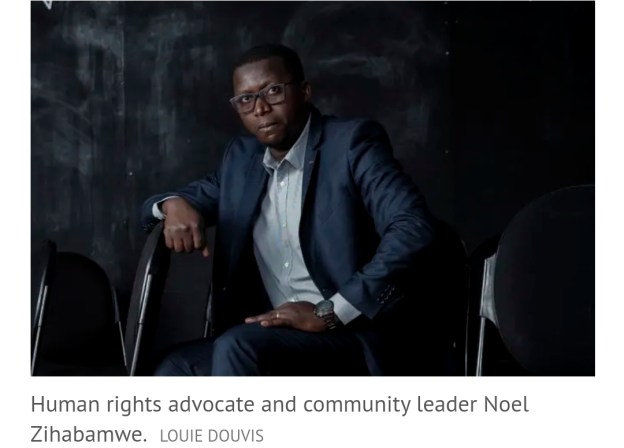
The complaint is being filed by Noel Zihabamwe and has gained the support of human rights barrister Jennifer Robinson, an Australian who is based in London. It also has the backing of the Australian Human Rights Institute at the University of NSW.

Human rights advocate and community leader Noel Zihabamwe.
Human rights advocate and community leader Noel Zihabamwe.CREDIT:LOUIE DOUVIS

The complaint to the United Nations Working Group on Enforced and Involuntary Disappearances over the disappearances of the two men in Rwanda in 2019 alleges their plight represented a violation of basic human rights under the International Covenant on Civil and Political Rights.

Ms Robinson said the UN was being asked to intervene with Rwanda to help locate Mr Zihabamwe’s brothers. Mr Zihabamwe moved to Australia on a humanitarian visa in 2006. He is now an Australian citizen, a human rights advocate, and a member of Sydney’s Rwandan community.

“For too long, Noel and his family have been suffering with the mental anguish of not knowing the fate of his brothers, Jean and Antoine – they simply don’t know if they are still alive or whether they are being unlawfully detained,” she said. “The circumstance of their disappearance suggests there was involvement by the Rwandan state but Noel’s inquiries with Rwanda have so far been met with a wall of silence.

“We are now asking the United Nations to intervene with Rwanda to assist us to locate Jean and Antoine so that Noel and his family can know the truth and, if possible, so that we can take the appropriate action to ensure their safety and liberty.”

Australian independent law firm Corrs Chambers Westgarth is also acting on Mr Zihabamwe’s behalf.

As reported in the Herald last year, Mr Zihabamwe alleges he was approached by representatives of the Rwandan government in 2016 in an effort to recruit him to become an agent of influence for them in Australia. His brothers went missing a month after he shared his story anonymously with the ABC in August 2019.

Mr Zihabamwe has alleged his brothers were abducted by Rwandan police while on a bus in an Eastern Province of Rwanda. He said the men have not been seen since their disappearance.

“I approached the Rwandan police and Rwandan Investigative Bureau in relation to the disappearance of my brothers, however, the Rwandan government continues to deny their abduction,” he said.

The High Commission of the Republic of Rwanda in Singapore has strongly denied Mr Zihabamwe’s claims about his missing brothers as “baseless” and accused him of trying to discredit the government of Rwanda.

In a statement, the High Commission said: “Rwanda remains committed to the safety and wellbeing of its citizens”. “We continue to work tirelessly for the betterment of Rwandan citizens at home and abroad, with the support of the overwhelming majority of all Rwandans,” the statement said.

Justine Nolan, the director of the Australian Human Rights Institute said many enforced disappearances had been reported in the African nation since the Rwandan Patriotic Front came to power around 1994.

A NSW Police spokesman has said the alleged threat against Mr Zihabamwe was initially investigated by North Sydney police who sought advice from the protection operations unit, counter terrorism and special tactics command. It said a prosecution could not be pursued for diplomatic reasons. A DFAT spokesman has said the Australian government took the alleged threats made towards an Australian citizen seriously.

Anna Patty

 « Emmanuel Macron et Paul Kagamé réinventent la Pravda et le révisionnisme soviétique » – Jacques Myard.

Tribune. Le voyage du Président de la République, Emmanuel Macron, au Rwanda, laisse pantois. Les accusations de responsabilités de la France dans les génocides rwandais relèvent du plus pure révisionnisme historique .

La mission d’information parlementaire présidée par Paul Quilès qui a rendu son rapport le 15 décembre 1998 le démontre parfaitement, j’y ai participé activement.

E. Macron a commandé le rapport Duclert afin de souligner l’aveuglement de la France sur la tragédie  du Rwanda. En réalité ce rapport est une « commande politique » sur la période post 6 avril 1994. Il ne porte que sur les événements tragiques du massacre des Tutsis par les Hutus en passant sous silence les événements d’avant et d’après.

Il y a bien évidemment eu génocide dans les moments qui ont suivi la destruction de l’avion d’Habyarimana à Kigali le 6 avril 1994. Le rapport Duclert, à ce propos, glisse sur cet acte de guerre et se refuse de répondre à la question « qui a décidé de détruire l’avion du Président rwandais ». Il ne fait que préciser qu’il y a des doutes sur les commanditaires …et pour cause.

Nous savons que les missiles qui ont abattu l’avion piloté par deux français étaient des missiles livrés par l’URSS à l’Ouganda.

Paul Kagamé a été le chef des services secrets de l’Ouganda avant de devenir le chef des forces du Front Patriotiques Rwanda ( FPR ) qui ont attaqué le Rwanda dès 1990 avec le soutien de milieux économiques anglo-saxons, notamment lors de l’attaque du 1er Octobre 1990 .

Lorsque le Président François Mitterrand a appris cet attentat, il a déclaré : « cela va être terrible ».

Au 6 avril 1994 la France n’avait plus de coopération militaire avec le régime d’Habyarimana. Elle avait retiré tous ses coopérants .

Il y avait sur place des casques bleus belges qui n’ont pas bougé, un bataillon du FPR, le Président Habyarimana revenait d’Arusha où avait été négocié un accord pour organiser des élections démocratiques au Rwanda. La France a tout mis en œuvre pour la conclusion de cet  accord.

Paul Kagamé savait parfaitement que s’il y avait des élections démocratiques, il ne les gagnerait pas, pour des raisons claniques, le seul moyen était la lutte armée pour prendre le pouvoir, ce qu’il a fait.

La faiblesse structurelle du rapport Duclert réside dans le fait majeur qu’il ne se concentre que sur la période post avril 1994, oubliant toutes les attaques armées du FPR de Kagamé, attaques répétées à partir de l’Ouganda, à partir de 1990 contre le gouvernement légal, avec le soutien actif de milieux économiques anglo-saxons, qui l’ont doté en armement.

C’est à cette période que la France a mis en place une coopération militaire pour répondre à ces agressions.

Juste avant le 6 avril 1994, il est exact que la radio des mille collines, contrôlée par les Hutus extrémistes, a appelé aux meurtres des Tutsis.

La première personne qui a parlé de génocide a été le Pape et dans la foulée Alain Juppé, Ministre des Affaires Étrangères qui a bataillé pour obtenir la résolution 929 du Conseil de Sécurité du 22 juin 1994 pour monter l’opération Turquoise contre l’avis des Américains qui ont tout fait pour que la Résolution ne mentionne pas le terme «  génocide ».

Cette résolution dispose: « Profondément préoccupé par la poursuite des massacres systématiques et de grande ampleur de la population civile au Rwanda ».

Cette formulation est loin d’être neutre, elle prend en compte le fait qu’après le massacre génocidaire, des Tutsis par les Hutus, il y a eu dans la foulée le massacre des Hutus pas les Tutsis, notamment dans leur fuite au Congo.

Les massacres réciproques constituent malheureusement une très longue histoire du Rwanda. La France en intervenant avec l’opération Turquoise a permis l’arrêt de ces massacres. C’est tout à son Honneur.

Il convient de rappeler que le chiffre de 800 000 Tutsis assassinés malheureusement, est sans doute inexact. Le recensement de 1991 dénombrant 596 000 Tutsis représentait 8,4 % de la population.

En conséquence, avoir une lecture biaisée, partielle de la tragédie du Rwanda, en ciblant la prétendue responsabilité française est non seulement du négationnisme, mais une faute lourde que les autorités françaises et rwandaises reprennent en niant les réalités historiques à des fins de volonté politique justifiant le voyage du Président de la République à Kigali.

The Economist du 27 mars 2021 consacre un long article sur Paul Kagamé. Il a eu dans le passé le soutien actif des médias anglo-saxons, lesquels doutent  désormais fortement de sa vraie nature. The Economist  titre « Paragon or Prison » « modèle de vertu ou prison ». Les actions de Kagamé, les assassinats multiples qu’il a perpétrés, dont l’assassinat de son ancien chef des services secret qui connaissait les activités de Paul Kagamé,- il a été assassiné dans son hôtel en Afrique du sud-  illustre sa véritable nature .

Les tueurs avaient simplement posé sur la porte « Don’t disturb », sans commentaire.

Un article du 30 Avril 2021du Washington Post va dans le même sens.

Les réalités historiques sur les événements au Rwanda et surtout sur la prétendue responsabilité de la France sont très loin des commentaires entendus sur nombre de médias français et autres qui véhiculent  une vision accusatrice de la France à des fins politiques pour justifier un voyage de la honte .

Pour ma part, j’estime que le voyage du Président de la République est une faute sans appel. Faire confiance à Paul Kagamé qui n’est rien d’autre qu’un criminel de guerre, un génocidaire, relève d’un total aveuglement.

La France n’a pas failli au Rwanda, rendons justice à nos militaires qui sont intervenus dans l’opération Turquoise !

Jacques Myard
Membre Honoraire du Parlement
Maire de Maisons-Laffitte
Président du Cercle Nation et République

Entreprendre.fr

RDC: La société civile du Sud-Kivu se mobilise suite à des propos polémiques de Paul Kagame.

Des propos du président rwandais Pal Kagame sur les crimes commis en RDC ont choqué la société civile du Sud-Kivu (image d'illustration)
Des propos du président rwandais Pal Kagame sur les crimes commis en RDC ont choqué la société civile du Sud-Kivu (image d’illustration) AFP/File

La société civile du Sud-Kivu exige les excuses du président rwandais Paul Kagame, après les propos tenus sur RFI et France 24 lors de son passage à Paris il y a deux semaines. Paul Kagame avait estimé que le rapport Mapping des Nations Unies était controversé, et que d’autres rapports avaient conclus à l’absence de crimes en RDC. Des propos qui ont choqué la société civile du Sud-Kivu, qui a organisé un sit-in devant l’Institut français de Bukavu ce mardi matin.

Vêtus de noir, avec des foulards ou des sacs de la même couleur sur la tête en signe de lamentation, ils sont des centaines à camper pour faire entendre leur message. Banderole à la main, Nabintu Fortune est une rescapée d’un massacre commis à Kaziba il y a plus de 20 ans.

« J’ai perdu mon frère avec sa femme, j’ai perdu ma petite sœur avec son mari et leur bébé, j’ai perdu mon oncle avec deux cousins, et tous ont été enterrés dans une fosse commune à Namushwaga précisement, à Kaziba. Que la communauté internationale puisse s’investir dans ce dossier pour punir les auteurs des crimes. »

Sur les calicots, des messages comme : « Les crimes commis en RDC ne doivent pas rester impunis », ou encore « Debout Mapping ».

Après deux heures de sit-in à chanter la colère, le président de la société civile du Sud-Kivu Adrien Zawadi lit ce message:

« La société civile du Sud-Kivu demande aux Nations Unies la création d’un tribunal spécial pour la RDC ; au président rwandais, commandant supreme des forces armées rwandaises dont certains éléments sont présumés auteurs des crimes graves au Congo, de présenter des excuses au peuple congolais et de s’apprêter de rendre compte à la justice. A la France de savoir que les crimes commis en RDC ne sont pas un deal diplomatique redresseur des torts qu’elle a causé au Rwanda. »

Aussi, les manifestants fustigent le dénigrement du prix Nobel de la paix 2018, le docteur Denis Mukwege, par Paul Kagame, et appellent les Pays voisins de la RDC à soutenir leur démarche.

RFI

ONLY IN KAGAME’S RWANDA DO THEY KILL YOUR PARENTS AND JAIL YOU FOR TALKING ABOUT IT

Stating the truth about repression and atrocities committed by Paul Kagame’s regime in Rwanda is treated as a criminal offence. Speaking the truth is criminalized. Kagame’s government which uses physical violence, torture, assassinations, and enforced disappearances as tools to silence independent voices has mastered the practice of making up charges using ill defined laws to carry out its repression. In high profile cases such as presidential challengers in elections such as Victoire Ingabire, Diane Rwigara and Fred Barafinda; lengthy prison sentences and detentions are given to candidates challenging Kagame. To set up individuals for arrest, torture, dissappearance or assassinations, the Rwandan government uses its propaganda newspapers as well as individual members of the government or the ruling party, who run smear campaigns to demonize the targetted individuals. After that, charges are made up, critics arrested, sham trials held and lengthy detentions or prison terms are served. In more alarming cases, after the smear campaign by members of the ruling party and members of the government, those who are targetted or dissappeared, never to be seen or heard from again.

Stating the truth about repression committed by the ruling Rwandese Patriotic Front (RPF) government had a high price even for journalists. Uwimana Agnes Nkusi and Saidath Mukakibibi served seven and four year sentences respectively for criticizing Kagame. Another journalist, Cyuma Hassan, was held in pre-trial detention for nearly a year for reporting on the RPF government’s destruction of poor people’s houses at the beginning of the coronavirus pandemic. Even gospel singers are not spared. Kizito Mihigo, a popular gospel singer was assassinated in a police cell in February 2020. Kizito had previously served four years in prison for singing a song calling out killings by the RPF. Kagame took it so personally that he verbally attacked Kizito Mihigo in a speech shortly after the song was released. Now the government has tuned on another singer, Aimable Karasira for his expressions on YouTube and his music. With all speech being stiffled in the country, Rwandans have turned to youtube as a tool to freely express themselves. In turn, the government has aimed its wrath on YouTubers. A few months prior to Karasira’s arrest, another outspoken YouTuber who criticized the regime, Idamange Iryamugwiza Yvonne, was also arrested and has spent the last three months in pretrial detention.

Aimable Karasira is a popular singer and a phenomenal spokesperson for the common Rwandan person. Karasira’s YouTube channel is one of the most popular channels among Rwandans at home and abroad. He was arrested on May 31,2021 by the Rwanda Investigation Bureau and charged with genocide denial, justifying the genocide and divisionism.

Karasira has been under constant surveillance, pressure and harassment that are similar to the lead-up to the arrests of Kizito Mihigo, Victoire Ingabire and Diane Rwigara. Like Kizito Mihigo, Aimable Karasira is a survivor of the Rwandan genocide in 1994. Karasira has openly spoken about surviving the genocide and also about the fact that after surviving the genocide, his parents and sister were killed by the RPF after the genocide. The RPF, in power since 1994, is responsible for killing millions of people inside Rwanda and the Congo. The RPF party members and Rwandan security agents also carry out assassinations, abductions, kidnappings, and other illegal activities abroad. In fact, official members of the RPF take an oath that states: “If I betray you or stray from the RPF’s plans and intentions, I would be betraying all Rwandans and must be punished by hanging”; they also swear to fight “enemies of Rwanda, wherever they may be,”. A recent BBC report includes such a swearing-in ceremony taking place in the UK.

RPF members, mostly military but also civilian, take part in attacks against those who speak out against the RPF and the regime inside Rwanda and abroad. The RPF also has unofficial members: those who did not take the oath but serve in various capacities including surveillance inside and outside the country, infiltration, smear campaigns, demonization of critics, whitewashing of RPF crimes, and harrassment of Rwandans worldwide. One of the most notorious groups that serves the RPF in this capacity is IBUKA, an organization setup to represent interests of Tutsi genocide survivors. However in reality, the group is a hate group that acts as a branch of the government. In fact, Tutsis such as Karasira, Kizito, Idamange and countless others who reject the RPF’s repression, crimes and hate-mongering openly reject IBUKA. In turn, IBUKA serves as one of institutions that constantly harasses such survivors instead of serving its purpose of supporting survivors; members of IBUKA also harrass any other Rwandans who refuse to partake in silent complicity with RPF crimes.

Since 2019, Karasira had been under constant harassment by high-ranking authorities in Rwanda as well as high-ranking members of the RPF, with character assassination as the main tool of harassment. This is usually a sign of things to come in terms of disappearance, being illegally detained, or having trumped-up charges brought up against the targeted individual, Karasira in this case. I warned about this plan on multiple occasions in 2020 on various platforms including an article on the BlackStarNews. In fact, the ramping up of this character assassination campaign had already yielded results prior to his arrest: he was fired as a university lecturer in fall 2020 for statements he made on his social media accounts. The leading figures in the smear campaign against Karasira are government official Edouard Bamporiki and member of the RPF Tom Ndahiro, two individuals notorious for spreading hate within and outside of Rwanda.

The accusation against Karasira that he denies the 1994 genocide, a crime in Rwanda, does not hold water as he openly speaks about surviving the same genocide. Only in Rwandan officials’ logic does a person deny the same thing he testifies to have survived. It is total nonsense. Idamange, another genocide survivor is facing similar charges. The unstated “crime” he committed is that he openly talks about his family members who were killed by the RPF as well as other atrocities committed by the RPF inside Rwanda and in the Congo. Similarly, Idamange is accused of denying genocide because she refuses to be silent while the regime uses the genocide she survived as a tool of repression on Rwandans and blackmail against the international community.

In a previous article, I wrote that “Aimable Karasira is in danger of losing his liberty due to the Rwandan government’s witch hunt of those who disagree with its practices.” The cases of real life hero of the film “Hotel Rwanda” Paul Rusesabagina who was abducted in DUBAi in August 2020, taken to Rwanda, tortured and made to face trumped up charges as well as Aimable Karasira, Kizito Mihigo, Idamange, Diane Rwigara, and Victoire Ingabire are just a small representation of thousands of victims of this regime’s pattern of egregious violations of human rights, civil rights, and freedom of law-abiding, peaceful dissenters.

The above mentioned cases among thousands of others must be taken seriously by Rwanda’s donors. Donor nations must demand immediate release of those among them who are still imprisoned or are in detention such as Aimable Karasira and Idamange. In particular, donors such as the Dutch government that focus on Rwanda’s judiciary must act immediately or cease funding of this system that perpetuates injustices.

Rwanda receives foreign aid from western nations such as the US, the UK and the European Union. Donor nations should cease providing aid to Rwanda until these horrible practices of killing, abducting, torturing, and assassinating people inside and outside of Rwanda stop. The world must raise its voice against Paul Kagame and his death squads around the world as well as against his repression inside of Rwanda. Sharing this article and demanding the release of Aimable Karasira and Idamange are steps individuals may take to help today by shining light on these atrocities.

Blackstarnews.com

Rwanda : un youtubeur critique du pouvoir arrêté et risque 10 à 25 ans de prison pour négation du génocide

Les autorités rwandaises ont annoncé lundi soir l’arrestation d’un youtubeur critique du pouvoir, accusé de négation du génocide de 1994, au cours duquel 800.000 personnes, majoritairement des Tutsi, ont été tuées.

Aimable Karasira, 40 ans, ancien professeur d’université, anime une chaîne YouTube suivie par 62.000 abonnés, sur laquelle il attaque régulièrement le gouvernement.

Ses prises de position sont radicales dans un pays où débattre publiquement de certains aspects du génocide est tabou. 

Kigali a souvent été critiqué par les groupes de défense des droits humains pour sa répression de la liberté d’expression et son utilisation des lois contre la négation du génocide pour envoyer ceux qui le critiquent en prison.

Aimable Karasira a commenté pendant des jours sur les réseaux sociaux le génocide de 1994 contre les Tutsi, affirmant qu’il n’était pas planifié et a semé la division parmi les Rwandais“, a déclaré dans un communiqué diffusé lundi soir le Bureau rwandais des enquêtes (RIB). 

S’il est reconnu coupable, Aimable Karasira encourt entre 10 et 25 ans de prison. Il a récemment été renvoyé pour “indiscipline” de l’Université du Rwanda, où il enseignait les technologies de l’information.

D’autres antécédents

Dans une vidéo du 20 mai, il critiquait le Front patriotique rwandais (FPR) au pouvoir, l’accusant d'”alimenter la haine“, et remettait en cause certains aspects du génocide.

En septembre 2020, la police rwandaise avait menacé de l’arrêter et de le poursuivre après l’interview d’un ancien candidat à la présidence, Fred Barafinda Sekikubo, également critique du gouvernement.

YouTube est très populaire au Rwanda, où le contrôle des médias est strict, et plusieurs personnes s’exprimant sur cette plateforme ont été arrêtées ces dernières années. 

En mars, Yvonne Ndamange a ainsi été détenue pour avoir appelé sur YouTube à des manifestations contre la “dictature” du président Paul Kagame. 

Innocent Bahati, qui a publié sur la plateforme des poèmes critiquant le gouvernement, est porté disparu depuis le 7 février. Selon l’ONG Human Rights Watch, sa disparition devrait être considérée comme “suspecte“, M. Bahati ayant été plusieurs fois détenu pour ses prises de position.

Belga

My story proves Rwanda’s lack of respect for good governance and human rights


Victoire Ingabire Umuhoza

Responsibility for defending what the Commonwealth stands for must not pass to the country without reforms.

Victoire Ingabire Umuhoza launched the Dalfa Umurinzi party to ‘strive for the rule of law’.

Global development is supported by

Bill and Melinda Gates Foundation

If Rwanda had hosted the Commonwealth heads of government meeting, which has been cancelled for the second time due to Covid-19, the UK was due to hand the country the Commonwealth chair.

Rwanda would have held the responsibility for defending what the Commonwealth stands for – despite violating those same values for decades. When Rwanda was admitted as a member in 2009, I had hoped our government would apply Commonwealth values in its governance. But this did not happen.

In January 2010, I made the decision to leave my family and career in the Netherlands and return to my beloved Rwanda. I intended to register my party, the United Democratic Forces of Rwanda (UDF-Inkingi), and to contest the 2010 presidential elections.

But the Rwandan government does not tolerate dissenting voices. I was arrested and dragged into politically motivated judicial proceedings. After I was sentenced to eight years in jail by the high court, I appealed to the supreme court and the sentence was increased to 15 years. The African Court on Human and People’s Rights cleared me and held that Rwanda had violated my rights to freedom of expression as well as to adequate defence. After eight years’ imprisonment, I was released under presidential grace in 2018.

I spent five years in solitary detention, during which time I wrote a book, Between 4 walls of the 1930 prison: memoirs of a Rwandan prisoner of conscience. In it, I recount the three years between announcing my presidential candidacy to my incarceration in the infamous “1930” maximum security prison. I dedicated my book primarily to all who are engaged in the struggle for democracy in Rwanda, with a special thought for the vice-president of the Democratic Green Party, André Kagwa Rwisereka, who was murdered in 2010 and the former head of intelligence, Patrick Karegeya, who was murdered in 2013.

The more injustice that I and my fellow citizens have endured – including the killing of my close political aides – the more motivated I am to fight for democracy in Rwanda. On my release, I launched the political party Dalfa Umurinzi with a mission to strive for the rule of law and for sustainable development benefiting every Rwandan. Although the constitution provides me with the right to organise a general assembly, I’m not permitted to register my political party or be approved to operate.

The more injustice I and my fellow citizens have endured, the more motivated I am to fight for democracy in Rwanda

In 2019, I received an international award from the Association for Human Rights of Spain (APDHE). I couldn’t travel to Spain to collect the prize because I had no right to leave Rwanda without permission from the justice minister. Two requests to do so have received no response from the authorities. I have not seen my family in the Netherlands for more than 10 years.

There is a pattern of limiting political participation to those affiliated to the ruling party and excluding serious contenders in Rwanda’s presidential elections. This is done by fabricating charges and abusing the judicial system. These acts represent a violation of Commonwealth core principles.Advertisement

They also challenge the claim often advanced by the ruling circle in Rwanda that the established political system is based on power-sharing consensus democracy with the intent of overcoming ethnic divisions and accelerating development.

Rwanda’s oft-repeated development success story is flawed. In 2006, 72% of Rwanda’s debt was written off under the IMF and World Bank’s heavily indebted poor countries initiative, while Rwanda received more overseas development assistance than countries with similar incomes – a total of $17bn (£11bn) from 2000 to 2019.

Despite this, Rwanda remains one of the world’s poorest countries, ranked 160th out of 189 countries in the UN Human Development Index of 2019. The government’s 2000 development agenda, which aimed to transform Rwanda into a middle-income economy by 2020, has not succeeded and delivery has been postponed to 2035.

Although economic growth has been high in Rwanda, it is characterised by low per capita income, low private investment, low exports and high reliance on aid. Since 2012, Rwanda’s borrowing has intensified, increasing indebtedness to 66% of GDP in 2020.

The main economic challenges include an undeveloped private sector, increasing unproductive indebtedness, high youth unemployment and a consistently high poverty rate, as well as a population happiness deficit.

Rwanda’s alleged role in regional political tensions has also prevented economic development. Reconciliation policies, implemented after the civil war and the 1994 genocide, are not inclusive. They weaken the social capital that is needed for our population to trust each other and work together efficiently. The repression of dissenting voices has encouraged Rwanda’s citizens to abstain from participating in social, economic and political decisions.Advertisement

Prior to Covid-19, Rwanda had a cash gap of 15.7% of GDP a year to meet its sustainable development goals by 2030. This has increased to 21.3% of GDP per year. Given that its government was provided with significant financial assistance to support its development plan to transform Rwanda into a middle-income state over the past two decades, and has not succeeded, I would argue that any further financing must be accompanied by radical governance reforms. Current governance in Rwanda – that limits political space, lacks separation of power, impedes freedom of expression and represses critics of the government – cannot lead to sustainable development.

I believe I made the right decision to return to Rwanda. My story, and those of others who have been harassed, jailed, forced into exile or worse for challenging the government, are tangible evidence of a lack of respect for human rights and of good governance, and are violations of the Commonwealth’s fundamental values. Governance reforms should be a prerequisite before Rwanda hosts the next Commonwealth heads of government meeting and takes over the chair.

Victoire Ingabire Umuhoza is president of the Dalfa Umurinzi political party, Rwanda.

The Guardian

Jeu, set et match : KAGAME

Le discours d’Emmanuel Macron à Kigali (Rwanda) fera date : il en restera l’image de la France, un genou à terre et le carnet de chèques à la main.

Retour en arrière

Dès les années 1980, à la tête d’un « Front patriotique rwandais » fabriqué de toute pièce, Paul Kagame à partir de l’Ouganda voisin où il s’est installé, organise la déstabilisation du pouvoir en place au Rwanda, suscitant de fait une première guerre civile et sa prise de contrôle d’une partie du pays.

Trois ans plus tard survient l’immonde boucherie qui a vu s’entretuer Hutus et Tutsi deux ethnies ancestralement installées au Rwanda, pays assez éloigné de la zone d’influence française, mais lié au nôtre par un accord de coopération et d’assistance militaire depuis 1975. Paul Kagame prend le pouvoir, et ne lâchera plus jamais.

Revisiter l’Histoire

On doit reconnaitre à l’inamovible Président du Rwanda, Paul Kagamé, une ténacité à nulle autre pareille et une persistance absolue à vouloir revisiter l’Histoire.

Révolutionnaire dans les années 80, il a endossé depuis le déguisement d’un redresseur de tort, qui dissimule sous sa cape de Zorro, l’uniforme du militaire/chef des services secrets qu’il a toujours été.

On connait bien maintenant la psychologie du Président Macron, banquier d’affaires de son état et comédien à ses heures perdues, qui a fait du « en même temps » sa marque de fabrique : dire un jour blanc et un autre jour noir et changer de pied quand le terrain devient hostile. Or l’Afrique de l’Ouest est aujourd’hui un terrain miné pour la France, en grande partie à cause d’une politique erratique (ou pire une non-politique) menée sous les quinquennats de Nicolas Sarkozy, puis de François Hollande et dont notre actuel Président a emboité les pas.

Tenter de s’ouvrir des portes en Afrique de l’Est où la mentalité colle mieux à la culture « davossienne » d’Emmanuel Macron est une belle esquive, à l’heure où l’Afrique francophone lui tourne le dos et où la France y est mal menée.

Un effet d’aubaine donc pour deux personnalités qui se sont trouvées : Paul Kagame termine avec brio son entreprise de révision de l’histoire depuis 20 ans qui tend à le dédouaner définitivement du génocide rwandais ;

Emmanuel Macron veut se désengluer d’un bourbier africain qui lui colle aux semelles en cherchant de nouvelles alliances sous domination anglo-saxonne.

Dont acte.

Mais de là à s’associer à la plus grande opération de désinformation de la fin du 20ème siècle, et à s’essuyer les pieds sur l’honneur de l’institution militaire, à lui imputer une responsabilité de massacres suscités par d’autres, il y avait un fossé jamais franchi. Le Président de la République, chef des armées, l’a fait en toute connaissance de cause. Allant même jusqu’à apporter une offrande de 500 millions d’euros, probablement au titre de dommages de guerre …

Cette affaire restera un cas d’école magistral d’une entreprise de désinformation totalement réussie.

Quelques filets de voix tentent de tempérer la doxa officielle martelée par des ONG, des rapports sortis opportunément pour balayer les jugements des tribunaux internationaux, des influenceurs, toutes et tous dédiés à la cause.

Jeu, set et match Kagame. Du travail de pro.

Charles Millon
Ancien ministre de la Défense
Le 28 mai 2021