Responsibility for defending what the Commonwealth stands for must not pass to the country without reforms.
Global development is supported by
If Rwanda had hosted the Commonwealth heads of government meeting, which has been cancelled for the second time due to Covid-19, the UK was due to hand the country the Commonwealth chair.
Rwanda would have held the responsibility for defending what the Commonwealth stands for – despite violating those same values for decades. When Rwanda was admitted as a member in 2009, I had hoped our government would apply Commonwealth values in its governance. But this did not happen.
In January 2010, I made the decision to leave my family and career in the Netherlands and return to my beloved Rwanda. I intended to register my party, the United Democratic Forces of Rwanda (UDF-Inkingi), and to contest the 2010 presidential elections.
But the Rwandan government does not tolerate dissenting voices. I was arrested and dragged into politically motivated judicial proceedings. After I was sentenced to eight years in jail by the high court, I appealed to the supreme court and the sentence was increased to 15 years. The African Court on Human and People’s Rights cleared me and held that Rwanda had violated my rights to freedom of expression as well as to adequate defence. After eight years’ imprisonment, I was released under presidential grace in 2018.
I spent five years in solitary detention, during which time I wrote a book,Between 4 walls of the 1930 prison: memoirs of a Rwandan prisoner of conscience. In it, I recount the three years between announcing my presidential candidacy to my incarceration in the infamous “1930” maximum security prison. I dedicated my book primarily to all who are engaged in the struggle for democracy in Rwanda, with a special thought for the vice-president of the Democratic Green Party, André Kagwa Rwisereka, who was murdered in 2010 and the former head of intelligence, Patrick Karegeya, who was murdered in 2013.
The more injustice that I and my fellow citizens have endured – including the killing of my close political aides – the more motivated I am to fight for democracy in Rwanda. On my release, I launched the political party Dalfa Umurinzi with a mission to strive for the rule of law and for sustainable development benefiting every Rwandan. Although the constitution provides me with the right to organise a general assembly, I’m not permitted to register my political party or be approved to operate.
The more injustice I and my fellow citizens have endured, the more motivated I am to fight for democracy in Rwanda
In 2019, I received an international award from the Association for Human Rights of Spain (APDHE). I couldn’t travel to Spain to collect the prize because I had no right to leave Rwanda without permission from the justice minister. Two requests to do so have received no response from the authorities. I have not seen my family in the Netherlands for more than 10 years.
There is a pattern of limiting political participation to those affiliated to the ruling party and excluding serious contenders in Rwanda’s presidential elections. This is done by fabricating charges and abusing the judicial system. These acts represent a violation of Commonwealth core principles.Advertisement
They also challenge the claim often advanced by the ruling circle in Rwanda that the established political system is based on power-sharing consensus democracy with the intent of overcoming ethnic divisions and accelerating development.
Rwanda’s oft-repeated development success story is flawed. In 2006, 72% of Rwanda’s debt was written off under the IMF and World Bank’s heavily indebted poor countries initiative, while Rwanda received more overseas development assistance than countries with similar incomes – a total of $17bn (£11bn) from 2000 to 2019.
Despite this, Rwanda remains one of the world’s poorest countries, ranked 160th out of 189 countries in the UN Human Development Index of 2019. The government’s 2000 development agenda, which aimed to transform Rwanda into a middle-income economy by 2020, has not succeeded and delivery has been postponed to 2035.
Although economic growth has been high in Rwanda, it is characterised by low per capita income, low private investment, low exports and high reliance on aid. Since 2012, Rwanda’s borrowing has intensified, increasing indebtedness to 66% of GDP in 2020.
The main economic challenges include an undeveloped private sector, increasing unproductive indebtedness, high youth unemployment and a consistently high poverty rate, as well as a population happiness deficit.
Rwanda’s alleged role in regional political tensions has also prevented economic development. Reconciliation policies, implemented after the civil war and the 1994 genocide, are not inclusive. They weaken the social capital that is needed for our population to trust each other and work together efficiently. The repression of dissenting voices has encouraged Rwanda’s citizens to abstain from participating in social, economic and political decisions.Advertisement
Prior to Covid-19, Rwanda had a cash gap of 15.7% of GDP a year to meet its sustainable development goals by 2030. This has increased to 21.3% of GDP per year. Given that its government was provided with significant financial assistance to support its development plan to transform Rwanda into a middle-income state over the past two decades, and has not succeeded, I would argue that any further financing must be accompanied by radical governance reforms. Current governance in Rwanda – that limits political space, lacks separation of power, impedes freedom of expression and represses critics of the government – cannot lead to sustainable development.
I believe I made the right decision to return to Rwanda. My story, and those of others who have been harassed, jailed, forced into exile or worse for challenging the government, are tangible evidence of a lack of respect for human rights and of good governance, and are violations of the Commonwealth’s fundamental values. Governance reforms should be a prerequisite before Rwanda hosts the next Commonwealth heads of government meeting and takes over the chair.
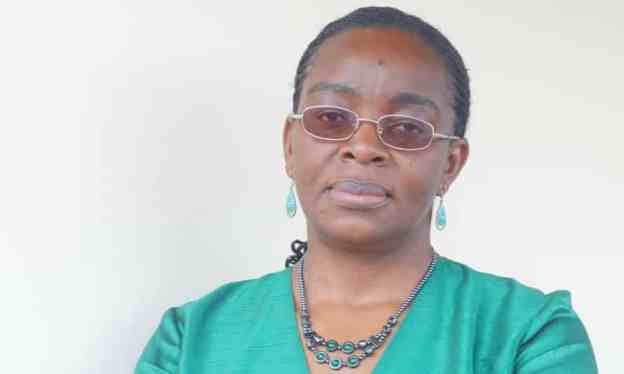
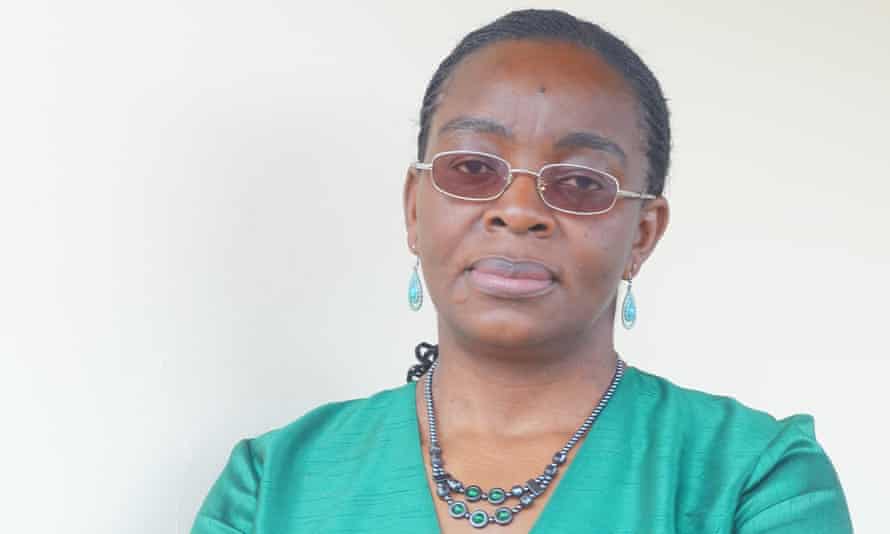
Victoire Ingabire Umuhoza is president of the Dalfa Umurinzi political party, Rwanda.
Lettre ouverte à tous les chefs de gouvernement du Commonwealth
Des organisations de la société civile à travers le monde demandent aux autorités rwandaises d’autoriser une enquête indépendante, impartiale et efficace sur sa mort en détention du chanteur populaire de gospel et activiste pour la paix Kizito Mihigo. Alors que vos gouvernements marquent la journée du Commonwealth aujourd’hui et s’apprêtent à participer au sommet des chefs de gouvernement du Commonwealth à Kigali en juin, nous vous écrivons pour vous demander de vous engager auprès de vos homologues du gouvernement rwandais afin de soutenir cet appel.
Le 14 février 2020, le Bureau d’enquête rwandais (RIB) a confirmé que Mihigo avait été arrêté près de la frontière. Il était accusé de tentative de passage illégal au Burundi, d’avoir rejoint des groupes « terroristes » et de corruption, ainsi que d’avoir violé les conditions de sa libération de prison en 2018. Quelques jours plus tard, le 17 février 2020, la police nationale rwandaise annonçait que Mihigo avait été retrouvé mort à 5 heures du matin, dans sa cellule au poste de police où il était détenu à Kigali, à la suite d’un suicide présumé.
Il y a pourtant des raisons de douter de cette version des faits. Au Rwanda, les dissidents et les voix critiques font souvent l’objet de menaces, de harcèlement judiciaire et d’arrestations arbitraires. Ces dernières années, plusieurs membres de l’opposition et journalistes ont disparu ou ont été retrouvés morts dans des circonstances suspectes. Après avoir publié en 2014 une chanson dans laquelle il faisait part de sa compassion pour les victimes du génocide et d’autres violences, chanson interprétée comme une référence aux crimes commis par le Front patriotique rwandais lors de sa prise de contrôle du pays en 1994, Mihigo a été menacé, détenu au secret pendant 9 jours et ensuite poursuivi pour complot contre le gouvernement, entre autres chefs d’inculpation. Le 27 février 2015, il a été reconnu coupable et condamné à 10 ans. Après sa grâce présidentielle et sa libération en 2018, et jusqu’aux jours qui ont précédé sa mort, Mihigo a informé ses contacts qu’on le menaçait pour qu’il fasse des faux témoignages contre les opposants politiques au gouvernement et qu’il voulait fuir le pays car il craignait pour sa sécurité.
L’annonce de la mort de Mihigo a provoqué une onde de choc au Rwanda et au-delà de ses frontières. Avant de perdre les faveurs du gouvernement en 2014, Mihigo avait joué un rôle important dans la vie publique rwandaise, notamment en participant à la composition du nouvel hymne national en 2001 et en chantantrégulièrement lors de cérémonies officielles. Le travail de Mihigo – lui-même un rescapé du génocide – pour promouvoir la réconciliation a reçu une reconnaissance tout aussi importante ; en 2011, par exemple, la première dame Jeannette Kagame lui a remis un prix « Célébrons les jeunes Rwandais » en hommage à son travail.
Selon l’Observation générale n°3 sur l’article 4 de la Charte africaine des droits de l’homme et des peuples, « Lorsqu’une personne meurt dans un centre de détention de l’État, ce dernier est présumé responsable et il lui incombe de prouver que sa responsabilité n’est pas engagée moyennant une enquête rapide, impartiale, approfondie et transparente menée par un organisme indépendant ». De même, la version révisée du Manuel des Nations Unies sur la prévention des exécutions extrajudiciaires, arbitraires et sommaires et les moyens d’enquête sur ces exécutions (le Protocole du Minnesota), prévoit qu’il existe une présomption générale de responsabilité de l’État pour un décès en détention, sauf preuve du contraire, et souligne que cela est particulièrement vrai dans les cas où la personne décédée « était, avant sa mort, un opposant politique au gouvernement ou un défenseur des droits de l’homme ; elle souffrait de problèmes de santé mentale reconnus ; ou elle s’est suicidée dans des circonstances inexpliquées ».
Le jour où la mort de Mihigo a été annoncée, et avant qu’une enquête indépendante n’ait pu être menée, la porte-parole du RIB, Marie-Michelle Umuhoza, a déclaré aux médias rwandais que Mihigo s’était « étranglé » avec les draps de son lit, qu’il avait fait preuve d’un « comportement inhabituel » pendant sa détention et qu’il avait refusé de parler aux enquêteurs, à son avocat et à sa famille. Le 26 février, citant un rapport d’autopsie, l’Organe national de poursuite judiciaire a conclu que la mort de Mihigo « résultait d’un suicide par pendaison » et a déclaré qu’il n’engagerait pas de poursuites pénales.
Mihigo est l’un de plusieursdétenus à être mort dans des circonstances suspectes lors de sa détention au Rwanda ces dernières années. Des enquêtes indépendantes, impartiales et efficaces, susceptibles de déboucher sur des poursuites crédibles, sont essentielles pour dissuader de futures violations des droits et promouvoir la responsabilité, la justice et l’État de droit. Le fait de ne pas mener de telles enquêtes constitue une violation des obligations de l’État au titre du droit à la vie.
Dans la Charte du Commonwealth de 2013 les États membres ont réaffirmé leurs valeurs et principes fondamentaux, notamment la défense des droits humains, la liberté d’expression, l’État de droit et le rôle de la société civile. La tenue du sommet des chefs de gouvernement du Commonwealth au Rwanda sans aborder l’absence de progrès des autorités rwandaises en matière de justice pour les violations des droits humains en général, et la mort de Mihigo en particulier, jette de sérieux doutes sur les engagements du Commonwealth en matière de droits humains.
Dans l’intérêt des droits humains au Rwanda et de l’intégrité du Commonwealth, nous vous demandons instamment de soutenir l’appel lancé aux autorités rwandaises pour qu’elles autorisent une enquête indépendante, impartiale et efficace sur la mort de Mihigo en détention.
Très sincèrement,
Action des chrétiens pour l’abolition de la torture (ACAT-France)
African Child Care Network ACCN
AfricanDefenders
AfricTivistes
Amnesty International
Article 19 Eastern Africa
Asian Forum for Human Rights and Development (FORUM-ASIA)
Australian Centre for International Justice
Banglar Manabadhikar Suraksha Mancha (MASUM)
Brainforest
Bytes for All
CIVICUS
Commonwealth Human Rights Initiative (CHRI)
Defend Defenders
Defenders Coalition Kenya
Ethiopian Human Rights Defenders Center (EHRDC)
FIDH within the framework of the Observatory for the protection of Human Rights Defenders
Human Rights Defenders Network-Sierra Leone
Human Rights Watch
Humanitarian Development Organization HDO
Maldivian Democracy Network (MDN)
Network of Civil Society Organizations for the Observation and Monitoring of Elections in Guinea (ROSE)
Nile Initiative for Development NID
Odhikar
Ole Reitov, Artistic Freedom Expert
PEN America
PEN International
Quill Foundation
Robert F. Kennedy Human Rights
Réseau de Défenseurs des Droits Humains de l’Afrique Centrale
South Sudan Human Rights Defenders Network
Southern Africa Human Rights Defenders Network (SAHRDN)
The Center for Peace and Advocacy
The Daphne Caruana Galizia Foundation (Malta)
The Voice Project
Vanguard Africa
World Organisation Against Torture (OMCT), within the framework of the Observatory for the Protection of Human Rights Defenders
Contexte de l’arrestation de Kizito Mihigo
Le 27 février 2015, Kizito Mihigo a été condamné à 10 ans de prison pour complot contre le gouvernement en place ou contre le Président de la République, formation d’un groupe criminel et conspiration en vue de commettre un assassinat à l’issue d’un procès qui s’est appuyé sur des aveux qui auraient été obtenus sous la torture.
Il avait été arrêté le 6 avril 2014 et détenu au secret pendant neuf jours au cours desquels il avait déclaré que des hauts responsables du gouvernement l’avaient interrogé à plusieurs reprises sur une chanson religieuse, Igisobanuro cy’Urupfu (L’explication de la mort) écrite en mars et dans laquelle il priait pour toutes les personnes tuées, notamment les victimes du génocide et d’autres violences. Il a déclaré que ces hauts responsables l’avaient également interrogé sur ses liens présumés avec le Congrès national du Rwanda, un groupe d’opposition en exil, et que les policiers l’avaient battu et forcé à avouer les infractions dont il a été accusé par la suite devant le tribunal. Dans un enregistrement que Mihigo a réalisé le 6 octobre 2016 alors qu’il était en prison, et qui a été rendu public après sa mort, il en vient à la conclusion que ces poursuites ont été motivées par des raisons politiques, dans le but de supprimer la chanson.
Dans cet enregistrement, Mihigo décrit des rencontres avec plusieurs hauts responsables du gouvernement, qui, il a dit, lui auraient expliqué que le président n’aimait pas sa chanson et qu’il devait « demander pardon », ou risquer la mort. Dans l’enregistrement, Mihigo a décrit également sa détention au secret du 6 au 15 avril 2014, au cours de laquelle il a dit avoir été battu et interrogé par Dan Munyuza, l’inspecteur général adjoint de la police de l’époque et actuel inspecteur général de la police, qui lui a dit de plaider coupable et de « demander pardon » ou risquer une condamnation à la prison à vie. Ces allégations suggèrent que Mihigo a été victime de torture et d’autres mauvais traitements, ainsi que d’autres violations graves de ses droits à un procès équitable, à la liberté, à l’intégrité physique et à la sécurité.
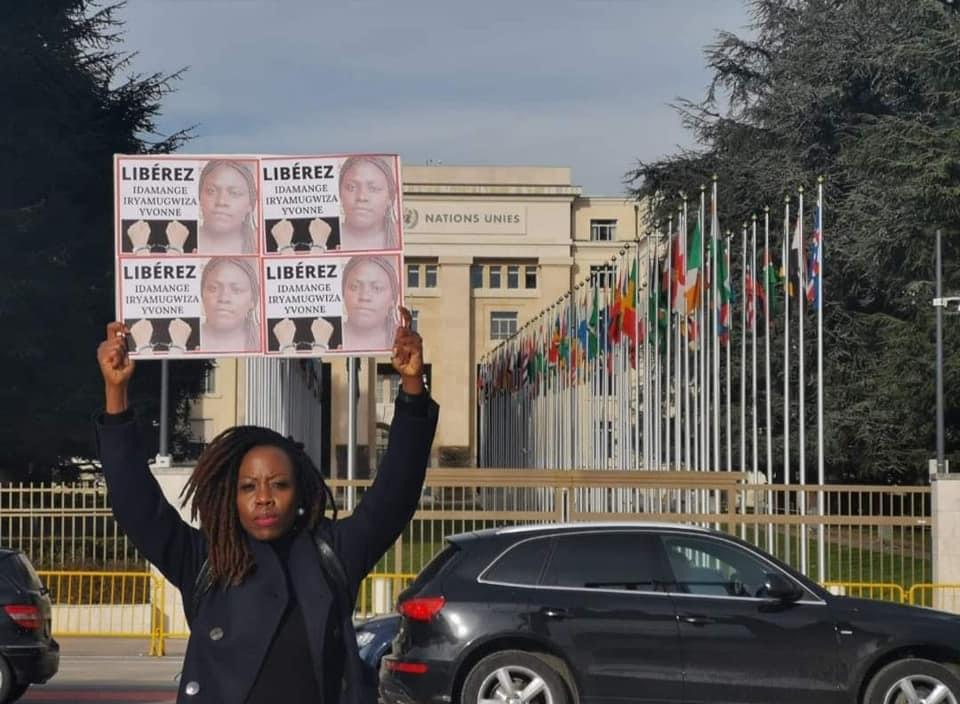
Aimée Bamukunde brandissant une pancarte à l’effigie d’Idamange devant le palais des Nations à Genève
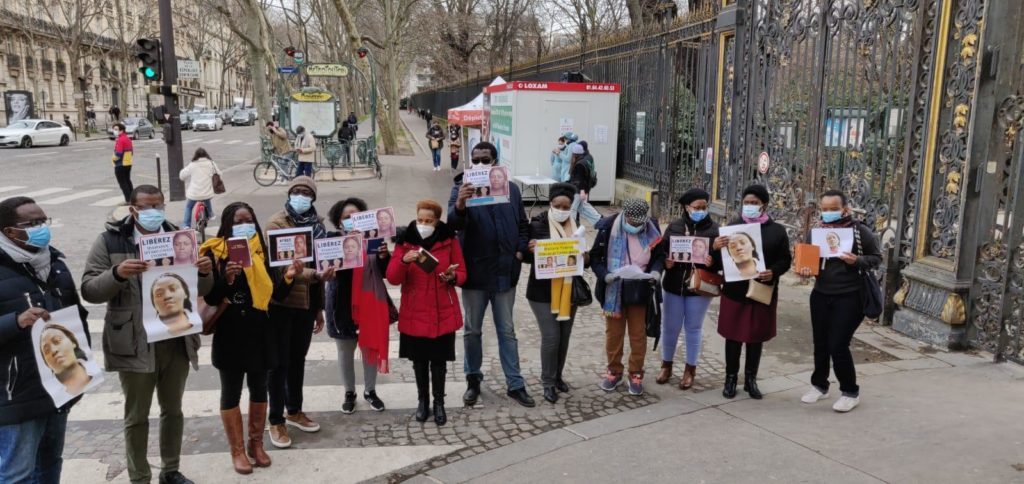
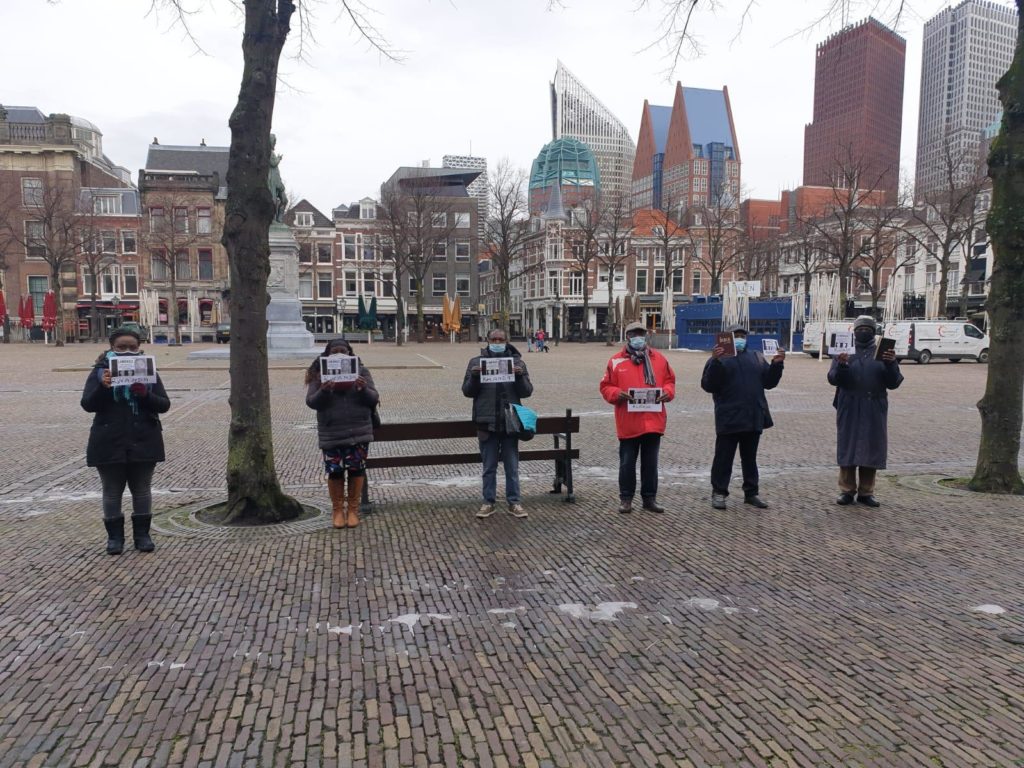
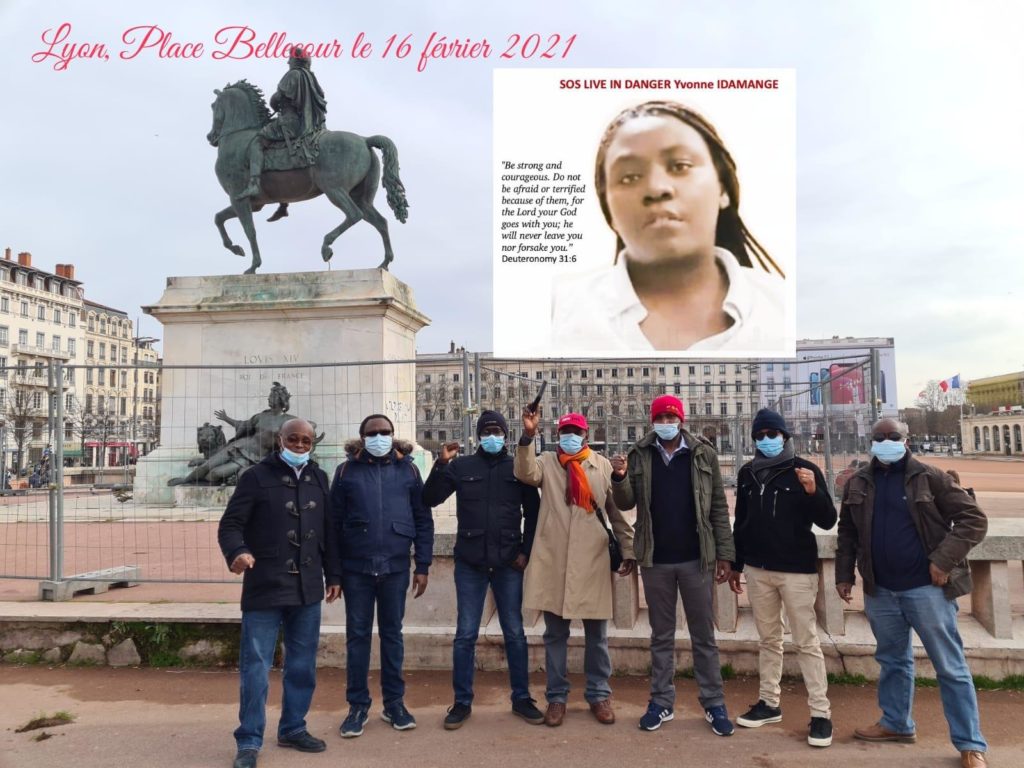
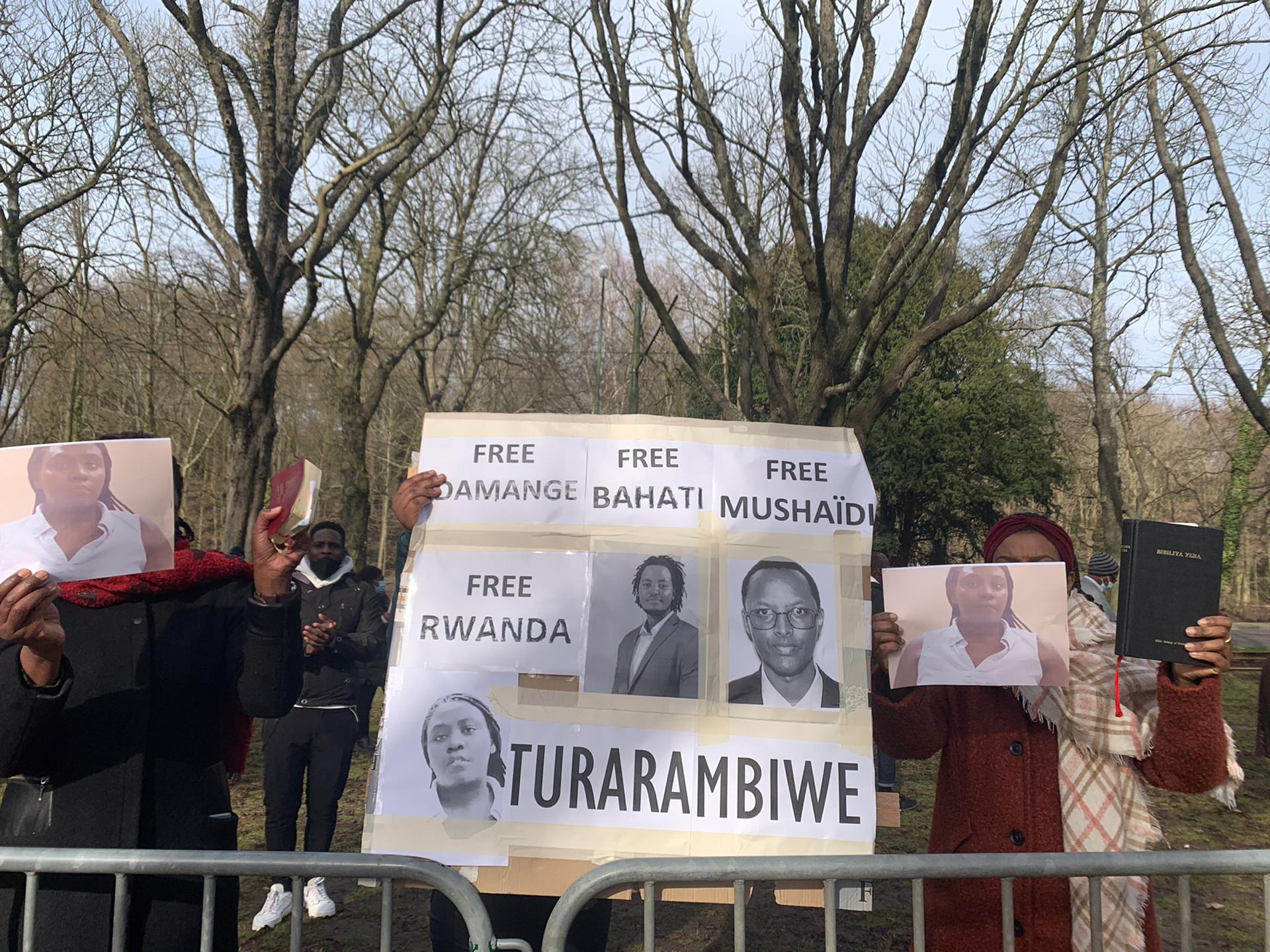
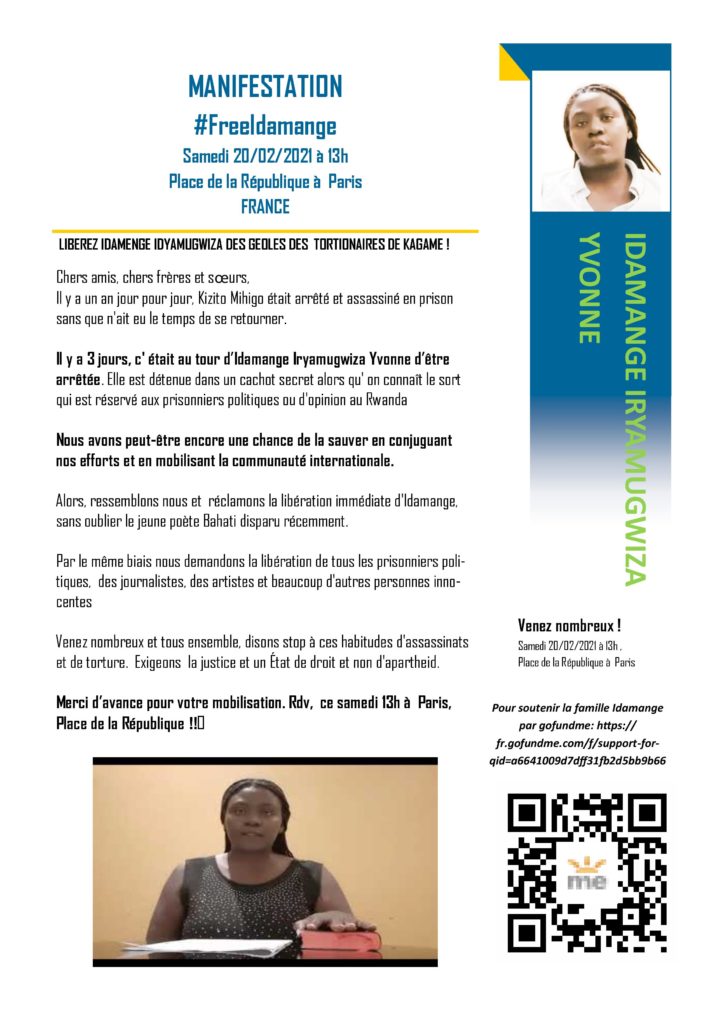
Ce mardi 16 février 2021, à 13 heures, plusieurs centaines de rwandais ont spontanément manifesté dans plusieurs villes européennes afin de demander la libération d’Yvonne Idamange et demander que les droits fondamentaux des citoyens rwandais au pays ou en exil cessent d’être bafoués.
Des mobilisations ont simultanément eu lieu à Bruxelles, Paris, La Haye, Genève, Lyon et d’autres actions sont envisagées dans les prochains jours à Montréal, Stockholm, Paris ou encore à Genève une nouvelle fois.
Cette mobilisation de la communauté rwandaise en exil fait suite à l’arrestation d’Yvonne Iryamugwiza Idamange pour une vidéo qu’elle a publiée ce lundi 15 février 2021 sur sa chaine YouTube et qui a déjà été vue plus de 130’000 fois en l’espace de quatre jours seulement.
Dans cette vidéo, Yvonne Idamange exprime son ras le bol de voir des jeunes talents rwandais emprisonnés, victimes de disparitions forcées ou tués « sur une base quotidienne », et cite entre autres noms, celui de Kizito Mihigo, assassiné le 17 février 2020, celui du journaliste Cyuma Hassan Dieudonné, emprisonné pour « non respect des mesures de confinement » depuis avril 2020 ainsi que celui du jeune poète Mussa Innocent Bahati porté disparu depuis le 7 février 2021.https://www.youtube.com/embed/wUf1OrNKcTA?start=1&feature=oembed
Dans son message, cette maman de quatre enfants a appelé les rwandais à se rendre à la présidence munis d’une bible pour « réclamer la démocratie au Rwanda» et la fin des abus graves des droits de l’Homme qui continuent à être régulièrement commis dans le pays.
Dans un langage très virulent à l’encontre du pouvoir en place, ou elle est allée jusqu’à qualifier le général Kagame de « cadavre » en écho à une rumeur persistante depuis plusieurs mois dans certains milieux rwandais selon laquelle Paul kagame serait décédé, l’activiste a évoqué un impérieux « besoin de changement » dans la gouvernance du pays et a appelé à plusieurs reprises dans sa vidéo, à une « révolution pacifique », à laquelle elle a appelé les « rwandais de l’extérieur » à se joindre « si vous restez les bras croisés, Dieu vous demandera des comptes ».
« Tu vaste taire, si tu ne te tais pas, ils vont te tuer, les gens parleront de ta mort une semaine et après ce sera fini »
Dans la même vidéo, Yvonne Idamange explique avoir reçu quelques jours plus tôt la visite du secrétaire d’État Edouard Bamporiki, qui lui aurait proposée, au nom de l’Etat rwandais d’acheter son silence. Madame Idamange dit avoir en sapossession l’enregistrement de cette conversation dans laquelle le Ministre luidemande ce que l’Etat rwandais pourrait lui offrir en échange de son silence. Une proposition à laquelle elle a opposé une fin de non recevoir « Je lui ai répondu que si c’était nécessaire, je suis prête à mourir pour les enfants du Rwanda car je ne peux pas accepter de me vendre et me taire sur le sang des rwandais (…) il m’a dit, tu vas te taire, et si tu ne te tais pas, ils vont te tuer, les gens parleront de ta mort une semaine et ce sera fini ».
Sur twitter le principal intéressé a par la suite confirmé cet entretien en ces termes « c’était ma responsabilité en tant qu’avocat et ami de la famille de lui rappeler les crimes et leurs sanctions dans la loi. Je suis fier de l’avoir fait. Sinon le temps que j’ai passé à l’école de droit aurait été vain. Nous nous connaissons depuis 2003. »https://platform.twitter.com/embed/Tweet.html?creatorScreenName=Jambonewsnet&dnt=true&embedId=twitter-widget-0&frame=false&hideCard=false&hideThread=false&id=1361434237501665283&lang=fr&origin=https%3A%2F%2Fwww.jambonews.net%2Factualites%2F20210219-bruxelles-paris-geneve-la-haye-lyon-les-rwandais-expriment-leur-ras-le-bol%2F&siteScreenName=Jambonewsnet&theme=light&widgetsVersion=889aa01%3A1612811843556&width=500px
Quelques heures à peine après la publication de cette vidéo, la police rwandaise annonçait son arrestation « pour de sérieux crimes comprenant « l’incitation à l’ordre public, la rébellion contre une arrestation légale et une attaque grave contre un membre des forces de sécurité », la police l’accusant d’avoir blessé l’un des policiers venu l’arrêter à la tête avec une bouteille.
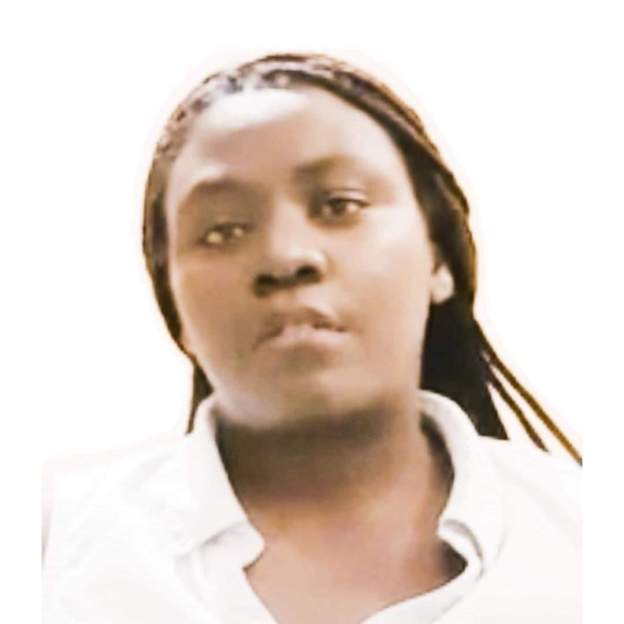
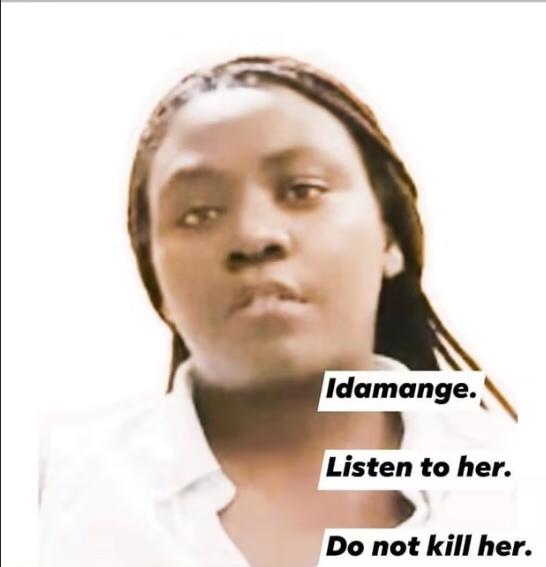
Beaucoup de rwandais ont mis sur leurs profils de réseaux sociaux la photo d’Yvonne Idamange avec comme message « ne la tuez pas, écoutez la »
Dès l’annonce de son arrestation, les réseaux sociaux rwandais se sont enflammés, plusieurs milliers de rwandais diffusant sa photo ou la mettant comme photo de profil avec souvent un même message « ne tuez pas Idamange, écoutez là ». Le lendemain, plusieurs centaines de personnes se sont rassemblées à Bruxelles, Paris, Genève, la Haye ou Lyon pour demander la libération immédiate de la jeune femme ainsi que le respect des droits de l’Homme au Rwanda.
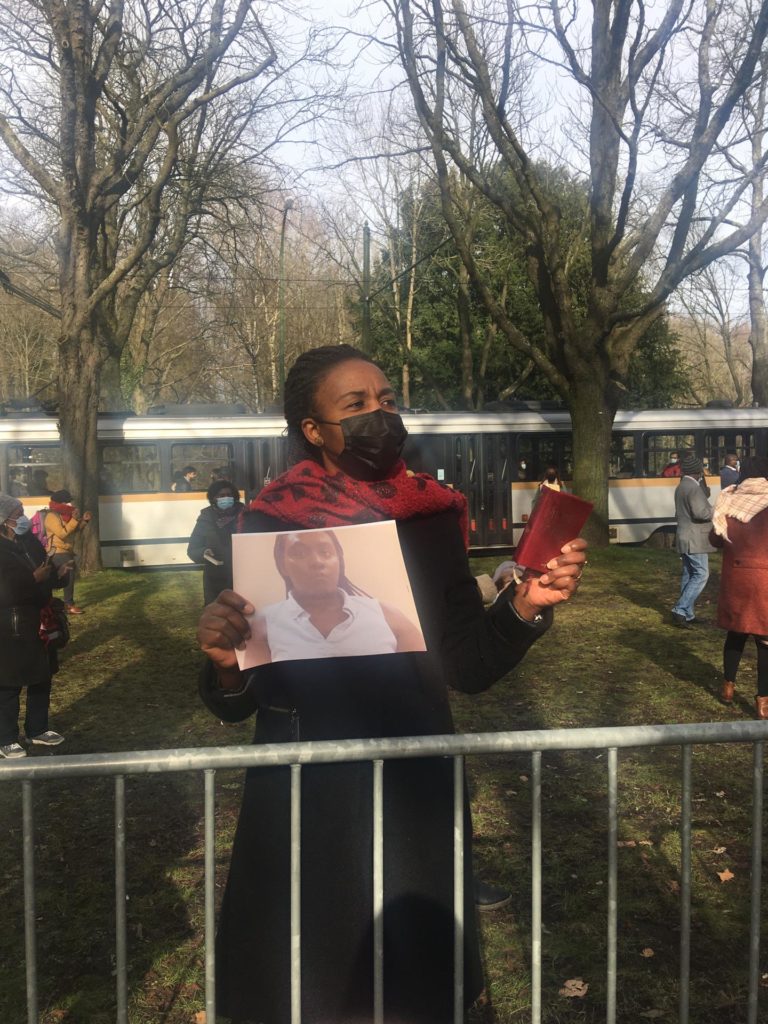
À Bruxelles beaucoup de manifestants avaient une bible dans une main, une photo d’Yvonne Idamange dans l’autre
A Bruxelles, environ 200 manifestants selon les organisateurs, 150 selon la police se sont rassemblés devant l’ambassade du Rwanda, pour la plupart munis d’une bible dans une main (à la demande d’Idamange) et d’une photo d’Yvonne Idamange dans l’autre.
Dans leurs slogans, les manifestants ont à plusieurs reprises exprimé leur ras le bol de voir les droits des rwandais être continuellement bafoués sans aucune réaction nationale ou internationale. « Turarambiwe, Turarambiwe, Turarambiwe » (nous en avons assez) ont ainsi scandé les manifestants qui répétaient en boucle les noms de jeunes rwandais assassinés par le régime ou portés disparus à l’instar de Mussa Innocent Bahati, le dernier nom en date à s’être ajouté sur cette trop longue liste de personnes portées disparues au Rwanda.https://www.youtube.com/embed/w9_pYNXmFYw?start=588&feature=oembed
A d’autres reprises les manifestants ont scandé le mot « révolution » en écho à l’appel d’Idamange d’avoir une « révolution pacifique » au Rwanda. Ils exigeaient la libération de Yvonne Idamange ainsi que des autres prisonniers politiques au Rwanda. A la veille de la commémoration de l’anniversaire de l’assassinat de Kizito Mihigo, les manifestants ont terminé leur événement dans le recueillement, en entonnant un couplet de la chanson Igisobanuro cy’urupfu, celle-là même qui qui fut à l’origine du long chemin de croix de l’artiste chrétien.
« Je me suis levée pour ceux au Rwanda qui ne peuvent pas le faire »
Ganishya Runyinya, une des participantes à la manifestation à Bruxelles explique avoir voulu manifester car elle a été frappée par le fait de voir “une mère célibataire de quatre enfants qui a l’air d’avoir tout, qui semble faire partie de la classe privilégiée du Rwanda se lever et laisser de côté son privilège pour parler au nom de tous les rwandais en étant consciente des risques qu’elle encourt. »
Le fait que Yvonne Idamange, s’est montrée prête à tout sacrifier y compris sa vie pour s’exprimer, ajoute Ganishya Runyinya, « montre que les rwandais en sont arrivés à un point de non retour. Son action de refuser de vivre dans son confort en gardant les yeux fermés sur la détresse de la population rwandaise me fait penser à la phrase prononcé par Kizito Mihigo dans l’une des dernières vidéos qu’il a enregistrées avant son assassinat dans laquelle il explique qu’il préfère mal vivre, vivre difficilement, mais en étant libre intérieurement que de faire ce qu’ils veulent, mais en étant vraiment enchainé, sans être lui-même. » https://player.vimeo.com/video/512280075?dnt=1&app_id=122963
C’est ce « sacrifice de soi » qu’Idamange a fait pour les rwandais, continue Ganishya, « qui m’a poussé à ne pas rester les bras croisés. Je sais très bien qu’au Rwanda personne n’allait aller à la présidence comme elle l’avait demandé et ce en raison du climat de peur qui y règne, mais moi je n’ai aucune raison d’avoir peur. La ou je vis, j’ai la possibilité de faire le geste que ceux au Rwanda ne peuvent pas faire en raison des craintes pour leur vies. Je me suis levée pour ceux qui ne peuvent pas le faire. »
À Paris , les manifestants se sont rassemblés au Parc de Monceau
A Paris, les manifestants se sont rassemblés aux alentours de 12h au Parc de Monceau à proximité de l’ambassade du Rwanda. Vers 13h, une délégation, de quatre personnes ont approché pour déposer leur message dans les boutes de l’ambassade. Les autres devant rester en retrait en raison des mesures de confinement imposées en France.
Marie Jeanne Rutayisire, une des manifestantes explique s’être mobilisée « afin de contester les injustices qui se passent eu Rwanda, et soutenir Idamange qui réclame les droits pour tous les rwandais. »
« Le courage d’Idamange m’a émue et inspirée »
A Genève, des personnes venant de différents cantons, se sont rencontrés à la place de la Nation devant le palais des Nations Unies à 13 h avec des photos d’Idamange, des photos d’autres prisonniers, ainsi que celles de personnes victimes de disparitions forcées. Une délégation s’est ensuite rendue devant l’ambassade du Rwanda avant de revenir à nouveau place des Nations.
Aimée Bamukunde, dont la photo d’elle brandissant une pancarte à l’effigie d’Idamange en face du palais des Nations est vite devenue virale, explique s’être mobilisée car « en tant que rwandaise », elle se sent concernée par ce qui se passe à l’intérieur du pays et par tous les problèmes qu’Idamange a cités. « On peut ne pas être d’accord avec tout ce qu’elle a dit mais son courage m’a émue et inspirée encore plus. Idamange aurait pu être ma grande sœur, ma cousine, ma voisine, c’est cette force d’une maman de quatre enfants qui met de coté sa propre vie et qui parle pour tout son peuple qui m’a poussée à me mobiliser pour elle. C’est cela que je recherche et qui m’inspire, ces femmes qui osent dire tout haut ce que le gens pensent mais n’osent pas dire. »
Au delà du courage d’Idamange, c’est la forme et le contenu du discours de la jeune femme qui semble avoir marqué Aimée Bamukunde « elle était méthodique, organisée, et parlait dans un langage clair. Elle parlait des problèmes que les rwandais vivent. Bien qu’elle ne soit pas elle –même dans le besoin, elle parlait pour les plus démunis. Elle a parlé pour tous les rwandais non seulement ceux à l’intérieur mais aussi ceux à l’extérieur du pays et c’est cela qui m’a frappé.
La jeune femme explique avoir été séduite par le caractère « inclusif » du discours d’Yvonne Idamange « personnellement ma cause, ce sont les enfants rwandais dans les camps de réfugiés à l’extérieur du pays qu’on a tendance à oublier. Quand elle s’adresse à « chaque rwandais ou qu’il soit », aucun enfant du Rwanda n’est exclu, c’est son discours inclusif qui m’a séduite. Des gens ayant vu ma photo circuler me disent merci de faire ceci, moi j’ai plutôt envie de dire merci à elle, merci à toutes ces mamans qui font en sorte que les choses changent, c’est une héroïne. »
« Je me suis reconnue en elle »
À La Haye, les manifestants se sont rassemblés à « Plein » devant le parlement néerlandais brandissant des photos d’Idamange.
A La Haye, les manifestants se sont rassemblés à « Plein » devant le parlement néerlandais brandissant des photos d’Idamange.
Gloria Uwishema, une des manifestantes explique s’être mobilisée car d’une part elle s’indignait de voir une rwandaise persécutée pour sa liberté d’expression «il n’y avait pas de raisons de la persécuter. Son cas montre justement qu’il y’a un grand manque d’espace d’expression au Rwanda ». D’autre part, Gloria Uwishema explique s’être mobilisée en tant que femme, afin de soutenir une femme de sa génération, ayant des enfants comme elle et « qui est parvenue à dire les problèmes des rwandais. Idamange n’arrive pas à s’imaginer le Rwanda de demain, pour elle mais surtout pour ses enfants, elle s’inquiète de l’avenir et du chemin que notre pays est entrain d’emprunter. Je me suis beaucoup reconnue en elle. »
Dans la foulée de la manifestation, Prosper Shima, jeune rwandais habitant également aux Pays-Bas et qui organisait le rassemblement, ne s’est pas arrêté à ce rassemblement et envoie depuis lors des courriers signés par près d’une centaine des personnes aux différents pays partenaires du Rwanda « nous avons déjà écrit à différentes ambassades qui se trouvent au Rwanda, à la Mission européenne à Kigali, à l’ambassade des Etats-Unis, à l’ambassade des Pays-Bas en leur demandant d’exhorter les autorités rwandaises à respecter les droits fondamentaux des rwandais ainsi que le droit à la liberté d’expression de Madame Idamange. »
« On en a marre, on veut soutenir les rwandais qui souffrent de ce système qui les écrase dans tous les sens »
À Lyon, les manifestants se sont rassemblés place Bellecour
A Lyon, les manifestants se sont rassemblés sur la place Bellecour à 13h tapante pour «pour dénoncer la violation des droits humains et soutenir la démocratie au Rwanda ». Vu le court délai, certains ayant été prévenus le matin même, les manifestants se sont retrouvés sans affiches d’Idamange mais avec une bible comme elle l’avait demandé.
Léon Ruhungira qui fut parmi les personnes qui se sont mobilisées, explique l’avoir fait pour « soutenir la liberté de parole au Rwanda et manifester contre l’injustice qui frappe les rwandais. On en a marre, on veut soutenir les rwandais qui, au pays, en ont marre et osent parler. On veut soutenir les rwandais qui souffrent de ce système qui les écrase dans tous les sens. Il est temps que ça change. »
« On ne va pas s’arrêter tant que la situation ne change pas »
Quatre jours après l’arrestation de la Youtubeuse, l’émotion reste vive au sein de la communauté rwandaise et la mobilisation autour de son cas ne montre aucun signe d’essoufflement.
Dans les foras rwandais, malgré l’actualité particulièrement chargée des derniers jours, Yvonne Idamange continue à être le principal sujet de discussions et plusieurs émissions YouTube continuent à lui être consacrées quotidiennement.
La mobilisation ne faiblit pas et des nouvelles manifestations sont annoncées ce week-end, à Paris, Genève, Stockolm et même au Canada. Une grande « manifestation virtuelle » est également annoncée pour le 28 février.
Diane Gasana, jeune rwandaise vivant en Suisse et qui est parmi les organisateurs de la manifestation de samedi à Genève explique vouloir à nouveau se mobiliser car « ça va trop loin. On a été touchés par l’arrestation d’une mère célibataire. Tout ce qu’elle a fait c’est dénoncer les défaillances du système. Pour nous, s’exprimer n’est pas un crime. »
Mardidernier, elle faisait partie des manifestants qui se sont rendus devant le Palais des Nations à Genève ainsi qu’à l’ambassade du Rwanda « Ce qui m’a choquée est que quand nous sommes arrivés à l’ambassade, ils nous ont regardé par la fenêtre et aucun d’eux n’a daigné venir écouter nos revendications. Pourtant nous n’étions ni nombreux, ni menaçants, on a ressenti cela comme un mépris. On ne va pas s’arrêter jusqu’à ce que l’Etat nous entende ou que la situation au Rwanda change ».
A côté de ces gestes de soutien, une récolte de Fonds a été lancée afin d’aider Yvonne Idamange pour ses frais judiciaires et soutenir ses quatre enfants. En seulement quatre jours, la cagnotte atteint déjà près de 20 000 dollars et les dons continuent à affluer.
A. Kunenga cg kugaragaza ibitagenda neza muri Leta. B. Kuvuga ubundi bwicanyi butari Genocide bwakozwe ningabo za APR. C. Kwamagana amahano akorwa na Leta D. Kwanga kwifatanya nabandi gushinja ibinyoma muri gacaca E. Kwitandukanya na Leta yica abaturage ishinjwe F. Kugaragaza ko Genocide yabaye igikoresho cya politike mu nyungu za bamwe.
Group 2: A. Guhamya ko wahagaritse Genocide kdi bamwe mu bayikoze bari ingabo zawe (abatekinisiye, technicians) B. Kwica bamwe mubayirokotse ubita ibipingamizi kuko batifatanije nawe mu migambi mibisha( urugero: Assiel Kabera, Mucyo, Kizito…) C. Kurya imfashanyo zinfubyi nabapfakazi barokotse ukabaha ibyo usigaje D. Kurihira abana barokotse ukabima akazi nkuko Mucyo yababajije mukamwica? E. Kwanga gushyingura abayizize imibiri ikabikwa muri étagères nkaho ari exposition cg exhibition. F. Gufata abo wishe ukabitirira Genocide ugamije guhunga ubutabera.
Bwana Dr Bizimana uri mukuru bihagije, warize ba umugabo va mu kinyoma ubwire abagutumye ko murambiranye mu ipfundikanya n’ibinyoma, ariko unabambarize iyo hatabaho ayo mahano yaduhekuye baba bitwaza iki?
Bwana Muyobozi, niba koko murwanya ipfobya muzahindure inyito” Kwibuka” nayo irapfobya, ubundi hibukwa uwibagiranye, twe abacu tubahoza Ku mutima. Ariko kdi mwe na ba Peter Mahirwe(Tom) ndetse na Hon Bamporiki n’abandi mwirirwa mukinira Ku bacu mujye mwibuka birumvikana kandi bifite injyana. Mwese tuzi ibyanyu. Peter Mahirwe we uwaba nkawe yamwambika ubusa ku gasozi ariko ntibikabe!
Twibukiranye Muyobozi, ejobundi sibwo Min Businjye yariye iminwa muri Universal Periodic Review, ahakana amabi mukora, bukeye kabiri ,dore nawe wihaye uriya mubyeyi Idamange, ni ikihe kinyoma yavuze? Ese utareba ninde ko ibyo yavuze ari ukuri? Karasira wavuze ikibi yavuze ni iki? Ahubwo ko we yabaye imfura akavuga abacecetse se bo ko muri kumwe nabo!
Ingabire nawe natinze kumenya ibye, umva ibyo avuga nuburyo abona ibintu ntacyo yakabaye ashinjwa, ahubwo se ko bazi bike!
Erega twarahumutse, nta marira mwahojeje abanyarda nkuko mwaririmbaga, ahubwo mwateje imiborogo. Imisoro nimisanzu mwanengaga ko yubatse irebero mwayikubye inshuro zirenga ijana, mutwara imitungo ababyeyi bacu baruhiye murayidukodesha. Tuzababaza byinshi, twarakuze nimutwica dore ko ariwo muco. Murabeshya abadukomotseho ni hahandi muzabasobanurira! Numvise uvuga iby’ ubushobozi ngo leta yafashije abacitse ku icumu, Leta kuba yararihiye abana bagizwe imfubyi na Genocide ntimukabigire igikangisho, leta mwahiritse niyo yabishe( mubigizemo uruhare ruhishe) mwagombaga no gutanga indishyi ahubwo, nonese ko mwishyuye intwaro Leta ya Habyarimana yaguze ibarwanya! Ntawe ushimirwa inshingano. Aho ugayirwa kutazuzuza neza. Nkumenere ibanga, benshi bamenye uburyo foundation mwayubakiye Ku kinyoma inyubako yose ni ikinyoma, muba mwereka abazungu gusa!!! Ikindi mureke ba Karasira, n’abandi mutazi bamwe munari kumwe nabo aho, mwarishe, ntaho mwari nutaniye n’ interahamwe z’inkoramaraso , mwageze ubwo mwica n’abo mwari mwemereye UN ko mushoboye kubarokora. Muri iyi nkubiri siho Karasira yaburiye ababyeyi bombi.
Nzaguha, Muyobozi ubishatse, list y’ahantu hamwe na hamwe mwiciye abaturage, nyuma yo kubahamagaza mu nama. Abanyarwanda bacecekanye byinshi mubimenye.
Bwana Muyobozi , nizere ko ntawe ntutse, singambiriye gupfobya cg kwangisha abaturage ubutegetsi gusa murananzwe byo so ibanga! Nimuhindure imigenzereze cg se muzahangane na rubanda yariye karungu nkuko Bamporiki ahora abivuga. Ninde wababeshye ko ibyo mwita ukuri ariko kuri kw’ihame(verité absolue cg absolute truth) kuki mutemera kuvugana n’abandi kubyo mutumvikana ibyo ni ikimenyetso cy’ umunyakinyoma.
Ngaho ba umugabo nibura rimwe tuzakwite intwari, usabe ba shobuja mugire ibyo muhindura. Gusa ntimunyite umuvugizi ntawe mvugira, uretse ko turi benshi niba muzica niba muzafunga cg mukadukurikirana iyo turi simbizi.
Members of the United Nations Human Rights Council
Geneva, Switzerland
RE:Noncompliance of the Republic of Rwanda with the human rights recommendations.
Dear all,
On January 25th, 2021; the third universal periodic review (UPR) on human rights situation was held, Rwanda being the State under Review (SuR). As Rwandans concerned with the worsening human rights violations, we followed with interest all exchanges that followed the SuR report. We were happy to see some Members of the Council raising important questions on Rwanda’s lack of improvement since last UPR. Indeed, while the country was supposed to comply with last recommendations new cases of violations have been recorded. It seems that at every UPR, Rwanda will have created new incidents of violation of the rule of law, freedoms, democracy, and good governance as well.
These violations are a clear indicator of the lack of political will to adhere to the international human rights standards, and of inertia to implement the international treaties and agreements of which Rwanda is a member until today.
Our contribution, as ISHEMA Party, focuses on freedom of expression, justice, civil and political rights.
Freedom of expression and association
The Constitution of 2003 as amended in 2015 clearly stipulates the right of the citizens to express themselves freely, to have access to information and to adhere to association[1]. Despite this, the citizens are still persecuted for having exercised their rights. During the period of review some cases are still unresolved.
Aimable KARASIRA
In august 2020, Mr Aimable KARASIRA was dismissed[2] by the University of Rwanda where he had been a lecturer of Information technology (IT) for more than a decade. The dismissal took place after Mr KARASIRA created a Youtube channel “Ukuri Mbona”[3] on which he challenged some public policies and vehiculated the injustices he faced twenty-seven years ago. He lamented what he viewed as police state behaviour of the government and became the voice of the voiceless. He commented the 2020 World Happiness Report[4] which ranked Rwandans among the least happy people in world. Before an action was taken against him, a State minister threatened him via twitter[5]. Although Mr KARASIRA exercised his constitutional right, the vice chancellor of the University of Rwanda dismissed him citing non-compliance with the presidential order on public servants’ ethics. This was suspected to be a deliberate ill interpretation of the presidential order aimed at silencing Mr KARASIRA, since no order is supposed to go against the Constitution.
Dieudonné NIYONSENGA aka Cyuma Hassan
This journalist and his driver, Fidèle KOMEZUSENGE, were arrested on April 8th, 2020 on charges of non- compliance with Covi-19 lockdown measures. After ten months, the duo remains in custody without due trial. The true reason of their arrest is their reporting on measures of lockdown that were enforced without taking into consideration the local socio-economic implications and impacts on the welfare. Mr NIYONSENGA reported on sensitive cases where the military personnel committed rape in Bannyahe area[6], and he is the only one to have reported that the body of Kizito MIHIGO presented three wounds on the head[7], an information that contradicted the official version of suicide.
The government should:
Revise the dismissal of Mr KARASIRA, compensate, and reintegrate him in his profession.
Unconditionally release, rehabilitate, and compensate NIYONSENGA Dieudonné and his driver Fidèle KOMEZUSENGE.
Justice and extrajudicial killings
Kizito MIHIGO
Arrested and put in prison in 2014, Kizito MIHIGO was tortured and forced to plead guilty to charges of planning to oust the government of Paul Kagame. His true crime was the song he released, a song that challenged the official version on genocide in Rwanda. In his song “Igisobanuro cy’Urupfu”, Kizito sought to plead for commemoration of Hutu killed during the war and genocide. He emphasized that, although the genocide made him orphan, it could not make him ignore other Rwandans who were killed in other massacres that are not recognized as genocide. He was sentenced to ten years of prison but was released on presidential mercy along with Mrs Victoire INGABIRE. By doing this, Rwanda was seeking to lead the Organisation International de la Francophonie (OIF), a strategy that worked perfectly. On February 17th, 2020; the gospel singer was found dead in his police cell. The police immediately announced that he committed suicide without prior investigation. All calls to carry out an independent inquiry into this mysterious death went unanswered.
Victoire Ingabire
Arrested in 2010 when she wanted to run for presidential elections, Mrs Victoire Umuhoza INGABIRE was tried on charges related to a speech she had delivered requesting the commemoration of the Hutu who were killed by the RPF. She was sentenced to 8 years which was turned into 15 years in the appeal. In 2018, Ingabirewas released along with Kizito Mihigo in a move that sought to promote the Rwanda’s candidate to the post of General Secretary of OIF[8]. The African Court on Human and People’s Rights held that Rwanda has violated Ingabire’s rights and asked that she be paid US$65,000 in compensation[9]. To date, the Government of Rwanda did not implement the court’s order.
Diane SHIMA RWIGARA
She declared her intention to run for the 2017 presidential elections. She was arrested along with her mother and sister. Ms RWIGARA remained in prison until trial which acquitted her after one year in custody[10]. To date, she was never compensated.
The Government should:
Compensate Ms RWIGARA for damages inflicted on her during her imprisonment.
Compensate and rehabilitate Mrs Victoire INGABIRE so that she enjoys civic and political rights taken away by human rights violation.
Implement the African Court on Human and People’s Rights order to compensate Mrs Victoire INGABIRE
Allow an international independent investigation into the killing of Kizito MIHIGO and bring to justice those responsible.
Political space, multiparty system, and elections
The Constitution allows the civic and political rights to be exercised and political parties are legal. However, the registration of new political parties remains tremendously hindered by the Rwanda Governance Board, the state’s agency in charge of monitoring the political organizations activities. As such for the past 12 years, no new political party could register. During the period of review, Ishema Party[11] created in exile attempted to send a team to Rwanda for registration, and to run for 2017 presidential elections but the team was denied entry twice: in November 2016 and January 2017. DALFA – Umurinzi[12], a political organization led by Victoire Ingabire did not get the permission to register November 2019. There were numerous applications which were turned down. As a result, Rwanda has the biggest number of political organisations[13] in exile, a threatening situation.
For the 2017 presidential elections, Ms Diane RWIGARA, Mr Fred SEKIKUBO BARAFINDA saw themselves denied the right to be on the candidates list and were accused of irregularities in their applications. Ms RWIGARA was put in prison[14] and Mr SEKIKUBO was forced into psychic institution[15]; manoeuvres forged to exclude the candidates from the presidential race.
The national electoral commission (NEC) lacks independence that should be its principal pillar. All the officials of the commission are cadres of the Rwandese Patriotic Front (RPF), other political parties and civil society are not represented, which impairs the neutrality and independence of the electoral body.
Fr. Thomas NAHIMANA, Mrs Nadine Claire KASINGE, Mr Skyler KEJO and Mr Venant NKURUNZIZA
The four comprised the team of ISHEMA Party that was going to register the party in Rwanda and ready for the 2017 presidential elections. The Government of Rwanda denied them entry into the country on November 23rd, 2016 in Nairobi, Kenya; and on January 22nd, 2017[16]. The letter that was signed by the immigration Director indicated that the team would not be accepted on the national territory. However, on the first occasion in November 2016, Kagame had threatened the ISHEMA Party’s presidential candidate, hinting on legal pursuit[17]. It should be noted that such a decision to refuse the Rwandan citizens to return home was the same advanced by the RPF to justify their attack of October 1990. This means that anyone who would like to launch a military attack on Rwanda would have a sound justification to do so. The political space remains tightened with most recent political organization having been allowed to register in 2009 despite numerous pending applications requests.
Bernard NTAGANDA
A lawyer of profession, Bernard NTAGANDA founded PS Imberakuri, a political party registered in Rwanda. He was arrested in 2010[18] for trying to run for president office. He was sentenced to four years in prison but at his release, he was denied his rights to exercise his profession or any job in other fields.
The Government should:
Allow the registration of the political parties without any hindrance with a relatively short timeframe for instructing any new application.
Unconditionally release all political prisoners and allow them to enjoy civic and political rights. These should include Déo MUSHAYIDI, Théoneste NIYITEGEKA, Joseph NKUSI, Paul RUSESABAGINA, Callixte NSABIMANA SANKARA, Ignace NKAKA alias La Forge Fils BAZEYE, Lt Col Jean Pierre NSEKANABO and the members of DALFA-UMURINZI, amongst others.
Allow Bernard NTAGANDA to exercise his profession and any other activity of his choice without hindrance.
Dear Members of the Council,
The Government of Rwanda under the RPF has demonstrated its capacity to manipulate the international community to attract compassion. Most importantly, this Government is ready to say what you want to hear, knowingly that the implementation of pledges will not happen. In its submission the Government of Rwanda will show how mechanisms are put in place and most probably, tell lies about accomplishments, just to embellish the presentation. In practice, things are different. The new cases of rights violation show the lack of political will to respect the engagements and to improve the situation.
The respect of human rights, democracy and good governance is our common affair. We are all concerned by what happens in one and all nations. Any failure to prevent human right violations renders us accomplices which is not better than those responsible of atrocities. After three reviews with worsening situation, a tougher action is needed, even imperative for Rwanda’s case.
We are not alone to propose serious measures against the Government of Rwanda to coerce it to cooperate[19]. Economic sanctions could be applied in a manner that does not harm more the victims of the human rights violations. In 2013, the sanctions worked well to end Rwanda’s support to the M23 rebels in the Democratic Republic of the Congo[20].
The Government of should:
Unconditionally, release all journalists and political figures since they are victims of last violations.
Compensate all political figures who suffered losses due to unjust treatment.
Declare a total amnesty to all political figures so that they enjoy their civil and political rights lost.
Organize an Inter- Rwandan inclusive dialogue between the Government of Rwanda and all the active forces, political and civil society actors to determine ways to save the nation against potential armed conflict.
Set up a transition government that integrate all the opposition forces to organize future elections in a credible and inclusive manner.
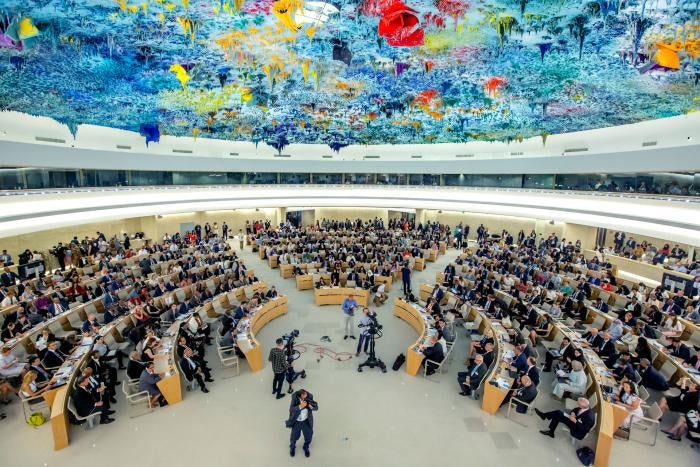
(Genève) – Les pays membres des Nations Unies ont émis de vives critiques et de nombreuses recommandations concernant le bilan des droits humains au Rwanda lors de l’Examen périodique universel (EPU) du pays, qui s’est tenu au Conseil des droits de l’homme à Genève le 25 janvier 2021.
Pendant l’examen, des pays de toutes régions confondues ont appelé le Rwanda à mettre fin à la torture et aux mauvais traitements et à enquêter sur les cas d’exécutions extrajudiciaires, de disparitions forcées, de détentions arbitraires et de morts en détention. De nombreux pays ont déclaré que le Rwanda devrait autoriser les journalistes et activistes à travailler de manière indépendante, permettre aux organisations non gouvernementales de s’enregistrer, et protéger la liberté d’expression, notamment en réformant sa loi sur les médias et son code pénal. Plusieurs pays ont également déclaré que le Rwanda devrait protéger les groupes marginalisés, comme les enfants des rues, et veiller à ce qu’ils ne soient pas soumis à des arrestations et détentions arbitraires, notamment dans des centres de « transit ».
« Les vives critiques adressées au Rwanda par les pays du monde entier témoignent de l’inquiétude de la communauté internationale face à la crise des droits humains au Rwanda », a déclaré Lewis Mudge, directeur pour l’Afrique centrale à Human Rights Watch. « Il est crucial que ces pays fassent un suivi direct avec le gouvernement rwandais et qu’ils fassent pression pour qu’il adopte des mesures concrètes pour mettre en œuvre leurs recommandations ».
Créé en 2006, l’Examen périodique universel consiste en un examen complet du bilan de tous les États membres des Nations unies en matière de droits humains, effectué par d’autres membres tous les cinq ans, à tour de rôle. Les organisations locales et internationales, ainsi que le pays examiné, peuvent fournir des rapports qui alimentent le processus d’examen.
Après chaque examen, un groupe de trois pays collabore avec le pays examiné et le Haut-Commissariat des Nations unies aux droits de l’homme pour produire un « rapport final » qui comprend les recommandations et les réponses du pays. Le Conseil des droits de l’homme adoptera le rapport final lors de sa session du mois de juin.
Pendant son examen, le Rwanda a reçu 284 recommandations de la part de 99 pays. Il en a accepté 160, a pris note de 75 autres, et a dit ne pas soutenir les 49 recommandations restantes. Le Rwanda devrait agir immédiatement en vue d’améliorer son bilan en matière de droits humains, et les experts, les agences et les États membres des Nations unies devraient continuer à faire pression sur le Rwanda pour qu’il mette fin aux violations, a déclaré Human Rights Watch.
Dans le cadre de l’examen actuel, Human Rights Watch a fait une contribution sur la situation des droits humains au Rwanda depuis 2015 et sur la mise en œuvre par le gouvernement des recommandations qu’il a reçues lors de son dernier examen.
En 2015, le gouvernement a fait valoir que certaines des recommandations reçues – dont certaines demandaient des réformes majeures ou des enquêtes sur les violations graves des droits humains et appelaient à déterminer les responsabilités en la matière – étaient déjà partiellement ou totalement mises en œuvre. Le gouvernement a également affirmé, dans une déclaration générale, que plusieurs autres de ces recommandations étaient « actuellement incompatibles avec sa législation interne et ses obligations constitutionnelles », dont une recommandation appelant le Rwanda à adopter des lois et des politiques spécifiques pour protéger le travail des défenseurs des droits humains. Toutefois, le Rwanda est tenu de respecter ses obligations en vertu du droit international et il lui est interdit de prétendre qu’il n’est pas en mesure de le faire parce que son droit interne est incompatible avec ces obligations. Le gouvernement a répondu aux recommandations demandant la ratification de la Convention internationale pour la protection de toutes les personnes contre les disparitions forcées en déclarant que la ratification des instruments internationaux ne peut se faire qu’après consultation et approbation du Parlement rwandais. À la connaissance de Human Rights Watch, ce processus n’a pas encore eu lieu.
Entre 2010 et 2017, Human Rights Watch a documenté que les militaires rwandais ont fréquemment détenu arbitrairement et torturé des personnes, en les battant et en les asphyxiant, en utilisant des chocs électriques et en organisant des simulacres d’exécution dans les camps militaires autour de Kigali et dans le nord-ouest du pays. La plupart des détenus avaient été victimes de disparition forcée et détenus au secret pendant des mois dans des conditions déplorables. Le 25 janvier, la délégation rwandaise a rejeté les allégations de torture et de détention illégale dans des centres de détention non officiels.
Lors de l’examen du Rwanda en 2021, de nombreux pays ont réitéré leur recommandation au Rwanda de ratifier la Convention contre les disparitions forcées et le Statut de Rome pour que le pays devienne partie à la Cour pénale internationale. Plusieurs pays ont aussi exhorté le Rwanda à autoriser le sous-comité des Nations unies pour la prévention de la torture et autres peines ou traitements cruels, inhumains ou dégradants à reprendre ses visites. En 2017, le sous-comité a suspendu sa visite d’État au Rwanda, avant de l’annuler neuf mois plus tard, invoquant des obstructions de la part du gouvernement et la crainte de représailles contre les personnes interrogées. L’annulation de 2018 reste la seule fois où le sous-comité a dû interrompre une visite d’État avant qu’elle ne soit terminée.
Même dans les cas où le Rwanda a accepté les recommandations en 2015, cela n’a pas nécessairement conduit à des améliorations concrètes en matière de droits humains, a déclaré Human Rights Watch. Le Rwanda s’est par exemple engagé à poursuivre ses efforts pour protéger les enfants en situation difficile, comme les enfants des rues, et à adopter une nouvelle législation pour réglementer les centres de transit et de « réhabilitation ». Dans son dernier rapport au Conseil des droits de l’homme, le Rwanda a affirmé que cette question avait été résolue par la création d’un Service national de réhabilitation en 2017 et que 4 416 enfants avaient suivi ce processus de réhabilitation.
En janvier 2020, Human Rights Watch a cependant constaté qu’en vertu de la nouvelle législation, les enfants accusés d’être des « mendiants », « vagabonds » ou « délinquants » sont effectivement traités comme des criminels et sont susceptibles d’être exposés à des mauvais traitements. Ils sont arrêtés arbitrairement et détenus dans des conditions déplorables dans des centres de transit ou de réhabilitation, sans procédure équitable ni contrôle judiciaire, en violation des normes régionales et internationales.
Le Rwanda doit accueillir la prochaine réunion des chefs de gouvernement du Commonwealth en juin. Lors de l’examen du 25 janvier, le Royaume-Uni a exhorté le Rwanda, en tant que membre et futur président du Commonwealth, « à incarner les valeurs du Commonwealth que sont la démocratie, l’État de droit et le respect des droits humains », consacrées dans sa déclaration de Harare de 1991.
Les gouvernements du Commonwealth, notamment ceux qui ont fait des recommandations dans le cadre de l’EPU, comme l’Australie, la Barbade, le Canada, Chypre, Fidji, la Sierra Leone et le Royaume-Uni, devraient profiter de la réunion du Commonwealth pour fixer des critères mesurables et exhorter le Rwanda à mettre en œuvre leurs recommandations, notamment en lançant des enquêtes et des poursuites judiciaires transparentes sur les décès en détention, les exécutions extrajudiciaires, les disparitions forcées, la torture et la détention arbitraire ou illégale ; en agissant pour la protection des journalistes et des défenseurs des droits humains afin de leur permettre de faire leur travail ; et en mettant fin aux abus contre les enfants des rues dans les centres de transit. Tout manquement à ces obligations porte atteinte aux valeurs et aux objectifs du Commonwealth.
Les responsables des gouvernements qui se rendent à Kigali devraient également évoquer des dossiers spécifiques. Par exemple, ils devraient demander une enquête internationale et indépendante sur la mort en garde à vue du célèbre chanteur et activiste Kizito Mihigo compte tenu du fait que les autorités rwandaises n’ont pas mené d’enquête crédible qui réponde aux normes régionales et internationales à son sujet, a déclaré Human Rights Watch.
« Les autorités rwandaises doivent aller au-delà des promesses vides et des faux-fuyants pour régler leurs problèmes de droits humains », a déclaré Lewis Mudge. « Pour prouver sa volonté de mettre fin à l’impunité, le gouvernement devrait garantir des enquêtes crédibles et transparentes qui débouchent sur des poursuites contre les responsables d’exécutions extrajudiciaires, de disparitions forcées, de tortures et de détentions arbitraires et illégales. En attendant, les autres gouvernements devraient accroître la pression sur le gouvernement.
U.S. Statement at the Universal Periodic Review of Rwanda
37th SessionGeneva, January 25, 2021
As Delivered by Charles Bentley, U.S. Mission to International Organizations in GenevaThe United States warmly welcomes the Rwandan delegation.We recommend that Rwanda:
Promote the right to freedom of expression by ending detentions and harassment of members of the media and civil society for their reporting.
Independently and transparently investigate credible allegations of unlawful or arbitrary arrests and detentions, killings, and enforced disappearances of human rights defenders, political opponents, and journalists, prosecuting alleged perpetrators under the law.
Enforce the protection of all persons’ rights to life and liberty by strengthening the independence of the justice system and ensuring no one is convicted on the basis of information extracted under torture or duress.
We commend Rwanda’s progress increasing gender equality and access to education. However, we are concerned about limited civic and political space, specifically unduly burdensome permitting requirements which inhibit the right of peaceful assembly.
The UK delivered a statement on Rwanda at the 37th Session of Universal Periodic Review (UPR), sharing recommendations to improve their human rights record.
Published 25 January 2021
Ambassador Julian Braithwaite, UK Permanent Representative to the UN, Geneva.
The United Kingdom welcomes Rwanda’s strong record on economic and social rights, and promotion of gender equality. We remain concerned, however, by continued restrictions to civil and political rights and media freedom. As a member of the Commonwealth, and future Chair-in-Office, we urge Rwanda to model Commonwealth values of democracy, rule of law, and respect for human rights.
We recommend that Rwanda:
Conduct transparent, credible and independent investigations into allegations of extrajudicial killings, deaths in custody, enforced disappearances and torture, and bring perpetrators to justice.
Protect and enable journalists to work freely, without fear of retribution, and ensure that state authorities comply with the Access to Information law.
Screen, identify and provide support to trafficking victims, including those held in Government transit centres.
By Andrew Harding Africa correspondent, BBC NewsPublished6 hours ago
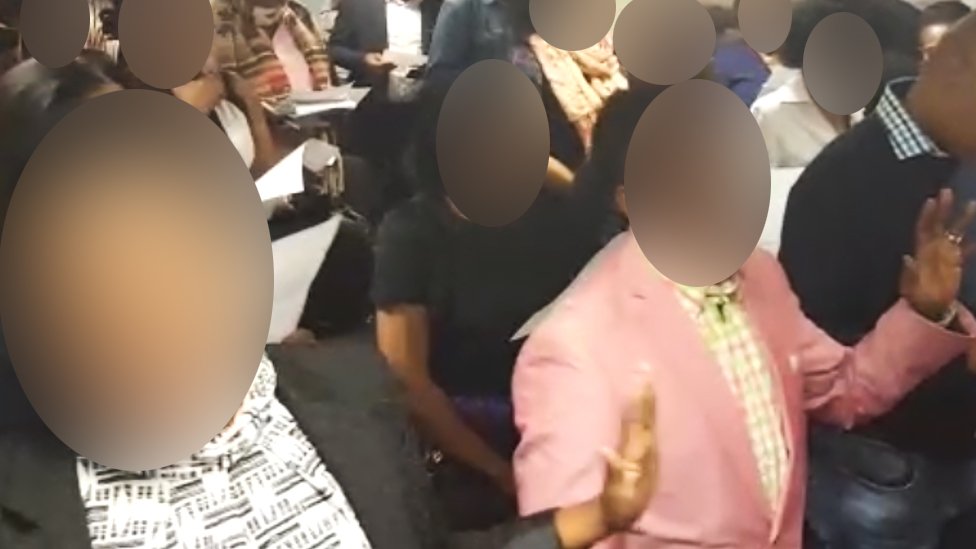
image captionThe footage, which the BBC has chosen to blur, shows members of the group promising to fight “enemies” of Rwanda
Leaked footage of a controversial “oath” ceremony at the Rwandan High Commission in London has fuelled allegations of an aggressive global crackdown on dissent by the authoritarian government of the small East African nation, dubbed the new “North Korea” by its critics.
Members of the Rwandan diaspora have told the BBC that such ceremonies are commonplace and designed to instil fear and obedience.
One man said his relatives back in Rwanda had been abducted and possibly killed to punish him for refusing to co-operate. The Rwandan authorities have dismissed the allegations as false and unsubstantiated.
In the video footage, recently circulated on WhatsApp, more than 30 individuals can be seen standing in a crowded conference room at the Rwandan embassy in the UK, raising their hands and pledging loyalty to the governing party, the Rwandan Patriotic Front (RPF).
“If I betray you or stray from the RPF’s plans and intentions, I would be betraying all Rwandans and must be punished by hanging,” the group says, in Kinyarwanda, while also promising to fight “enemies of Rwanda, wherever they may be”.
The RPF’s use of an embassy – which in London is close to Marylebone Station – for an overtly political pledge is, in itself, noteworthy.
‘They’re terrified’
But, while some of those attending the ceremony – understood to have taken place in 2017 – may well have been genuine supporters of the governing party, now living abroad, others have told the BBC that many attendees were there under duress.BBC”This is what happens everywhere. It’s routine. Either you take [the oath] or you are [the] enemy. It is black and white”David Himbara Ex-adviser to President Kagame
“I am certain the majority of people taking that oath did not believe it. We were lying to protect ourselves and our families back in Rwanda,” said one person who was – according to our investigation – present at the ceremony, but who asked us not to reveal their name for fear of reprisals.
“This is what happens everywhere. It’s routine. Either you take [the oath] or you are [the] enemy. It is black and white,” said David Himbara, who was once a senior adviser to Rwanda’s President Paul Kagame.
He is a Canadian citizen, academic and activist who says his life has repeatedly been threatened by Rwanda’s security services.
“The vast majority go because they’re terrified. They think that if they don’t go, something will happen to their family [in Rwanda],” said Rene Mugenzi, a British-Rwandan human rights activist, who was recently convicted of theft in the UK and jailed.
“You need to be active [in the RPF]. Even if you are neutral… they suspect you to be supporting opposition groups,” he said.
Asked about the “oath” ceremony, the Rwandan High Commission replied, by email, that members of the diaspora used its conference room for a variety of cultural engagements and that participation in an RPF loyalty pledge was legal and “entirely of their own choice and no-one is forced to do so”.
‘My brothers were abducted’
But the BBC has heard new evidence that Rwanda’s government has not only sought to threaten members of the diaspora seen as disloyal, but also that it seeks to punish such people by targeting their relatives still living in Rwanda.
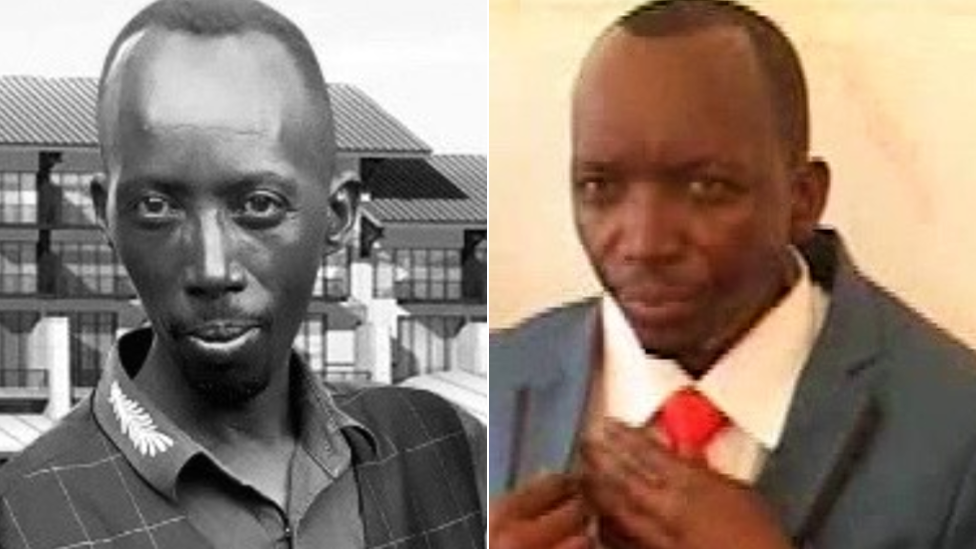
image captionFamily photos of Jean Nsengimana (L) and Antonine Zihabamwe (R), who have been missing for more than a year
“In order to intimidate me, they abducted my two brothers. They were never involved in politics. They were on Rwanda soil. Why should they be paying such a heavy price for doing nothing?” asked an emotional Noel Zihabamwe, from his home in Australia.
Mr Zihabamwe is a prominent member of the Rwandan diaspora in Sydney, who came to the country as a refugee in 2006, seeking to escape what he saw as an increasingly stifling and repressive political climate.
He says his refusal to actively support the RPF government prompted a public death threat from a visiting Rwandan diplomat in late 2017, which he reported to the Australian authorities.Noel ZihabamweThey often use this kind of kidnapping or murdering family members. This has to stop. We have had enough”Noel Zihabamwe A Rwandan living in Australia
That was followed by the alleged abduction of his two brothers, Jean Nsengimana and Antonine Zihabamwe, who were reportedly taken off a bus by police officers near the Rwandan town of Karangazi in September 2019 and have not been seen again.
“They often use this kind of kidnapping or murdering family members. This has to stop. We have had enough,” Mr Zihabamwe said.
“We would like to see the Rwandan government restore democratic rights to all citizens, cease targeted killings, kidnappings, illegal arrests and campaigns of intimidation of former citizens, like me, who are living overseas,” added Mr Zihabamwe, who now believes his brothers are probably dead and has decided to speak out in public, despite what he believes are considerable risks for himself and his extended family.
“Why can’t they let the family know where their bodies are, so we can organise a formal funeral? There are many Rwandans outside who have lost or missed their beloved ones.
“I want to speak against injustice. We need leadership that can stand for everyone, not for some,” he told the BBC.
‘No basis to allegations’
The Rwandan High Commission in London dismissed Mr Zihabamwe’s allegations as “tired and recycled” falsehoods and a “cheap ploy by political detractors to get free media attention”.
But allegations such as these are considered credible by many researchers, human rights groups and foreign diplomats, who say the Rwandan authorities appear to have calculated that – despite provoking some criticism from Western governments – such actions, which have included several targeted assassinations abroad, never appear to result in any long-term damage to Rwanda’s international relations.
The Rwandan government has received widespread global praise and financial support, over decades, for its hugely successful development agenda, which has helped to combat poverty and transformed Rwanda into one of the continent’s most impressive economies.
“Their view is – we can do what we like, kill who we like,” said one source, speaking on condition of anonymity.
The death earlier this year, in police custody, of the popular gospel singer Kizito Mihigo also stirred huge anger.
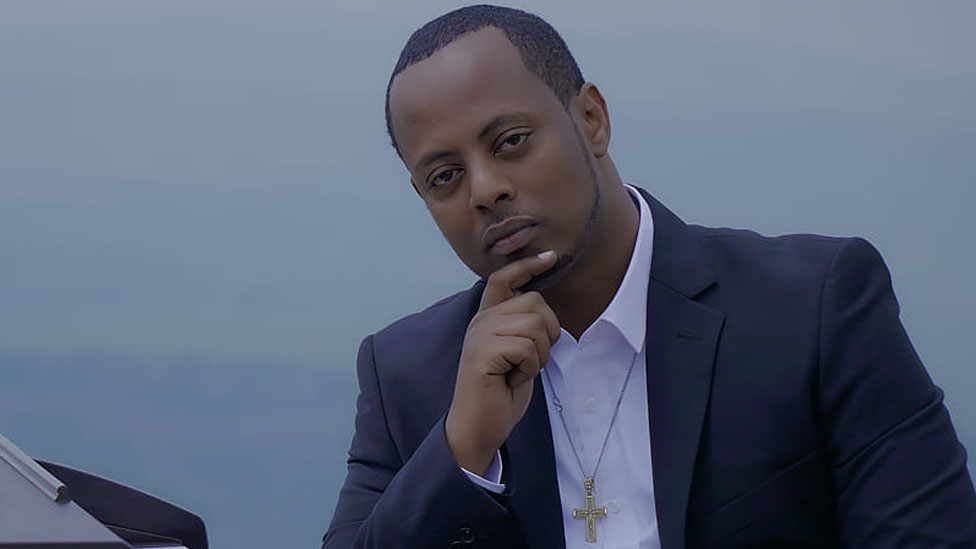
image captionGospel singer Kizito Mihigo was found dead earlier this year, at the age of 38, in a police cell
Kizito, as he was popularly known, had tried to cross Rwanda’s border illegally, the authorities said. They say he killed himself – a version which is widely disputed in the diaspora and by many analysts.
“If you’re Rwandan, it’s simply safer to stay silent,” said Sarah Jackson, Amnesty International’s deputy director for East Africa.
“The Rwandan authorities have a whole toolbox of tactics that they use to supress dissent at home and abroad, ranging from harassment to threats to illegal detention, disappearances, torture, and even extending to returning Rwandan dissidents from other countries back to Rwanda without going through extradition proceedings… and to threatening family members too.”
The Rwandan High Commission in London said such allegations had no basis, and were being spread by a “handful of opponents… in order to damage the image and continued development journey of Rwanda”.
‘Totalitarianism’
President Kagame officially secured almost 99% of the vote in Rwanda’s last presidential election in 2017.
In London, Abdulkarim Ali, an official in the opposition Rwandan National Congress, said: “Either you pay allegiance to the RPF or… you become an enemy of the state. We normally compare it to North Korea.”
In Canada, Mr Himbara described the Rwandan government’s ideology as one of “totalitarianism – a government that wants to control all aspects of the Rwandan people, even in the diaspora”.
The Rwandan High Commission in London said the government’s main focus was to lift Rwandans out of poverty and create a good quality of life and opportunities for all of them.
“The focus of the High Commission is not on a handful of opponents who consistently spread false information in order to damage the image and continued development journey of Rwanda.”








 GAHUNDE