Tag Archives: Rwanda

L’espion rwandais, Capitaine BWITARE n’est plus

Un bonne nouvelle pour ceux qu’il chassait. Pour ceux qui l’ont envoyé aussi. Car, ils n’auront pas à s’expliquer,  comme il part avec tant de secrets qui devraient les incriminer dans l’avenir.

Le célèbre agent de renseignement extérieur, le capitaine Bwayitare, n’est plus. Son nom est Bwitare, prénom Eulade, connu dans le cercle du renseignement rwandais sous le nom de Bwayitare. Gradé Capitaine dans les Forces Rwandaises de Défense (FRD), il opérait sous la direction d’un service de suivi externe rattaché à la Direction du renseignement militaire (Directorate of Military Intelligence – DMI en sigle ), rebaptisé désormais renseignement de défense.

Le capitaine Bwitare faisait partie des impitoyables agents et l’une des rares personnes nées en République Démocratique du Congo (RDC) à être déployées dans le DMI du criminel Paul Kagame. Il était l’agent de confiance de Jack Nziza qui le surnommait «umucongo» (C’est-à-dire, Congolais). Pendant des années, le capitaine Bwitare a opéré directement sous les ordres du général de division Jack Nziza et du général James Kabarebe. Dans le domaine du renseignement extérieur, le capitaine Eulade Bwitare a participé à la planification, au suivi et exécution des plans d’élimination des opposants réels ou supposés. Plusieurs Rwandais innocents sont morts sous ses opérations.

Des sources dignes de confiance indiquent que lorsque sa santé a commencé à se détériorer, les services rwandais des renseignements extérieurs l’ont relocalisé en Belgique où ils l’auraient aidé à obtenir l’asile sous de fausses histoires et, de ce fait il était permis d’accéder à un système de santé gratuit de première classe.

En Belgique, le capitaine Eulade Bwitare a continué de coordonner les opérations de renseignement du DMI – collecte d’informations, surveillance et guidage des assassins de Kigali qui fréquentent l’Europe pour des opérations de ce genre.

L’on s’attendait à ce que le capitaine Bwayitare (Bwitare) abandonne ses crimes et essaie de se repentir de ses atrocités en matière de droits de l’homme, mais il a plutôt continué à coordonner les activités de renseignement DMI en Europe.

Parmi les cibles clés du capitaine Eulade Bwitare, il y avait, entre autres, le major Jean Marie Micombero, Seruga Titus, Rugema Kayumba, Alex Rudasingwa, Placide Kayumba,etc. Heureusement,  le capitaine part avant ses cibles clés.

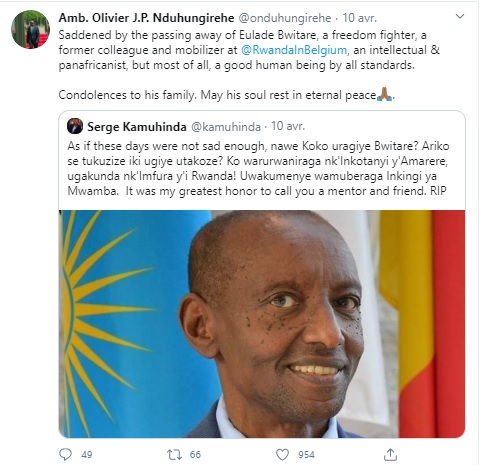
En tant qu’ambassadeur du Rwanda en Belgique, Olivier Nduhungirehe a établi une relation de travail étroite avec le capitaine Bwitare et ils sont devenus de bons amis. Pour Olivier Nduhungirehe, c’était un mauvais week-end de Pâques, car cette mort est annoncée au moment où il venait d’être démis de ses fonctions.

ndu

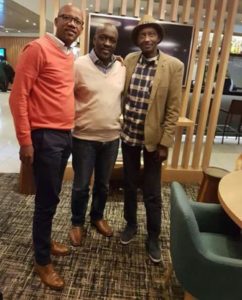
Dans la photo ci-dessous, en pull rouge, c’est Aimable Bayingana, un agent du régime notoire qui a été incorporé pour espionner ses compatriotes hutus. Au milieu, avec un pull blanc – Fidel Sugira, un agent basé en Norvège et le capitaine Eulade Bwitare dans une veste et un chapeau marron.

IMG-20200411-WA0030-242x300

Source: BWITARE est mort


Avis aux lecteurs: Nos articles peuvent être reproduits à condition de citer le nom d’auteur et le site web source.

Notice to readers: Our articles may be reproduced provided the author’s name and the source website are cited.

Rwanda: Covid-19, opportunité d’un changement politique?

C’est ce que les Rwandais anticipent. Et l’opposition politique s’engage dans ce processus afin que le pays ne plonge dans une autre tragédie due au vide de leadership. Avec la pandémie du COVID-19, les dégâts attendus sont aussi autres que sanitaires, les situations socio-économique et politique étant déjà très fragiles. Cette fragilité conjuguée aux mesures de confinement sans l’accompagnement qu’il faut, risque de provoquer les soulèvements populaires susceptibles de renverser le régime en place.

L’échec du gouvernement

En date du 21 mars 2020, le Premier Ministre, Dr Edouard NGIRENTE, a déclaré les mesures qu’il faut respecter afin de stopper la propagation du COVID-19. Bien qu’illégale et illogique, la déclaration du Premier Ministre a été effective 5 heures plus tard. Les mesures affichent un vide fatidique. Elles imposent aux citoyens de rester à la maison sans se soucier de la survie de ceux qui, habituellement, nourrissent leurs familles après avoir travaillé, et quotidiennement.  Même si les Rwandais sont naturellement solidaires, la responsabilité de l’Etat dans des moments comme ceux-ci ne peut pas être exclue, d’ailleurs , elle est obligatoire. Le gouvernement a raté l’occasion de démontrer ses capacités managériales, dans les limites établies par la loi. Malgré les dettes qui sont garanties au pouvoir au nom du COVID-19, il est important de remarquer que la solution ne viendra pas de là , et les conséquences socio-économiques seront énormes.

Si le confinement dure plusieurs semaines, un mouvement de “résistance” va se créer à partir de petits groupes de personnes qui défieront l’autorité au nom de chercher les nourritures. Les grands stocks de vivres seront visés et dévalisés suivis des résidences des hommes et femmes de la classe politique au pouvoir. Les leaders charismatiques émergeront de la masse qui, depuis longtemps aspire au changement, et exerceront la coordination des petits groupes, peaufinant le mouvement en une vrai lutte politique que le régime ne pourra contrer.

Les forces de l’ordre comprendront très vite l’échec du gouvernement et s’aligneront au mouvement. Les plus courageux assureront la protection du peuple contre quelques éléments restant fidèles au régime. Un haut gradé militaire pourrait déclarer un coup d’état pour restaurer l’ordre, lançant un appel aux forces vives de la nation pour former un gouvernement de transition, qui débouchera aux élections libres et un nouveau chapitre dans la politique rwandaise.

L’effet pangolin

Le potentiel changement politique du au COVID-19 est observable aussi par les grands centres d’études stratégiques. En date du 24 mars 2020, le Centre d’analyse et prospective stratégique (CAPS) a émis une note interne et confidentielle au cercle diplomatique français intitulée “L’effet pangolin” : la tempête qui vient en Afrique?” dans laquelle quelques scénarios sont considérés. Selon ce document qui parle du continent africain en général, les économies vont s’effondrer provoquant les émeutes qui feront tomber les régimes. Le document évoque une thèse, “le mort politique zéro ”  selon laquelle « Le risque d’infection d’un dirigeant âgé et souffrant d’autres pathologies pourrait avoir de lourdes conséquences et obligerait à se positionner clairement et rapidement sur la fin d’un système et sur une transition ».

« Anticiper le discrédit des autorités politiques signifie accompagner en urgence l’émergence d’autres formes d’autorités africaines crédibles pour s’adresser aux peuples afin d’affronter les responsabilités de la crise politique qui va naître du choc provoqué par le Covid-19 en Afrique… et sans doute ailleurs ».

Au vu de la situation au Rwanda, tout est possible. L’absence du président aux côtés du peuple, constitue un augure à ne pas négliger. Les manipulations des images faites par les services de renseignements dans le but de faire croire que Kagame est présent ne font qu’accentuer l’inquiétude et le sentiment que les citoyens du menu peuple sont abandonnés à leur propre sort.

Dans un pays où le président est considéré plus dangereux que COVID-19, l’opposition politique est appelée à jouer son rôle. La société civile doit sa contribution.

Chaste Gahunde


Avis aux lecteurs: Nos articles peuvent être reproduits à condition de citer le nom d’auteur et le site web source.

Notice to readers: Our articles may be reproduced provided the author’s name and the source website are cited.
Rwanda: Opposition , Civil Society advise Kagame on COVID-19.

Open letter to the President of the Republic of Rwanda on proposals for measures to better manage the Covid-19 crisis in Rwanda

Mr. President,
We, the undersigned Rwandans living abroad, feel deeply sorry and stand in solidarity with our compatriots at home for the suffering and difficulties of all kinds that they are enduring during this harsh health crisis caused by coronavirus (COVID_19) pandemic. Many Rwandans, especially those living in rural areas, are living in economic precariousness as a result of the far-reaching change in the agricultural policy which has ruined their food security. The resulting rural exodus has created a high rise in urban population living from hand to mouth because of an unsustainable economic boom that
has failed to create viable jobs.

We are confident that the age-old spirit of solidarity and resilience that characterizes the Rwandan people will enable them to valiantly weather this harsh ordeal. But for this to happen, the government will need to take on complaints and pragmatic advice from its concerned citizens, more than in the past. We ourselves are committed to continuing to reflect on a range of actions of solidarity that would enable us to alleviate the suffering of our compatriots at home, and we will communicate on this in due course. In the meantime, we are sending you, by this letter, a contribution in the form of a few ideas, which we consider useful and practical, easy to implement quickly in order to stem the harmful consequences of the measures your government continues to take to combat the COVID_19 crisis.

Some resources that can be mobilized rapidly

While waiting for the people, taken by surprise by this scourge, to recover and for both national and international solidarity to produce positive impact, we would like to draw your kind attention to the existence of a certain number of internal resources that can be immediately mobilized, in case they have escaped your attention and that of your collaborators.

It is worth remembering the Rwandan saying, “Ukena ufite itungo rikakugoboka”, which translates as, “When poverty knocks at the door, you rely on your savings”. It is important, indeed, that the population we are trying to save from the threat of COVID_19 is not swept away by hunger in their confinement. The damage would be far greater than the damage we want to avoid. It is also important that Rwandans be able to draw on their reserves first while waiting for help from elsewhere.

1. Appeal for support from the “AGACIRO” fund
This fund, which bears an evocative name of “Agaciro = Dignity” was launched in 2012, with the stated objective of promoting self-sufficiency among Rwandans and this within the framework of the master plan which aims to raise Rwanda’s human development from low to medium in 2020. It is time to take advantage of the results of this fund which at the end of 2017 reached 52.3 billion Rwandan francs, of which 41.8 billion Rwandan francs came from contributions, while 10.5 billion Rwandan francs came from the investment income of the same Agaciro Fund. This is the time to use all this money made from the sweat of the Rwandan citizens.

2. Appeal for support from the significant wealth held by the RPF party-state
As you know, Mr. President, the RPF, a political organization that came to power in Rwanda a quarter of a century ago, is among the richest, if not the richest political party in the world. As of 30/07/2017, the RPF was already considered as the country’s largest private employer, whose assets were estimated at some 500 million dollars. In your capacity as the chairman of the Party and President, in these difficult times, your party, the RPF could make a gesture of empathy towards the Rwandan people, by taking some of its immense wealth and help the most needy.

3. Release of prisoners in Rwandan prisons
Currently and officially, there are around 75,000 prisoners in the official Rwandan prisons. As you know, Mr. President, on March 25, 2020, even the UN High Commissioner for Human Rights, Ms. BACHELET Michelle recommended to governments to release “every person detained without sufficient legal basis, including political prisoners, and those detained for critical, dissenting views”, as part of the fight against COVID_19. This recommendation makes a lot of sense, particularly in the case of Rwanda where many prisoners have been locked up for several years without files. This would not only prevent the spread of the coronavirus epidemic in these prison environments but would also free up financial resources that could be immediately mobilized to help the most
vulnerable members of the population. It is true that, as of 1 April 2020, the General Prosecutor has sent a directive to the prosecutors to do so; but the directive is accompanied by vague and limiting conditionalities and only a small segment of the prison population could benefit from it.

4. The ISHEMA RYACU Fund set up at the time of General Karake’s arrest in London on June 20, 2015

You will recall, Mr. President, that General Emmanuel Karenzi Karake, then head of the fearsome National Intelligence and Security Service, was arrested in 2015 in London on the basis of a European arrest warrant issued by Spain. He could only be released on bail of 1 million pounds ($1.5 million) obtained by mobilising the contributions of the Rwandan people. This sum can and should be used immediately to support the most vulnerable sections of the population.

5. Repatriation of the funds stored in tax havens revealed in the “Panama Papers”
Finally, Mr President, a recent World Bank study, based on data from 22 countries, including Rwanda, showed that World Bank aid regularly falls into the hands of predators who are quick to make deposits in external banks where banking secrecy is guaranteed, such as Switzerland, Luxembourg, the Cayman Islands or Singapore. For example, the survey showed that the World Bank has made largesse to Rwanda, which in 2018 received double the aid it used to receive in previous years, rising to $545 million. Researchers discovered during the investigation that $190 million left Rwanda and was deposited in tax havens. These funds, and others like them, must, for reasons of morality and practical efficiency, be quickly returned to the country to be used to alleviate the people’s hardship in the face of this terrible coronavirus crisis.

Good use should be made of the funds from aid or credit facilities that the country may receive in these times
Mr. President, we learn that under the Rapid Credit Facility, the International Monetary Fund has just granted Rwanda a rapid concessional financial assistance of $109.4 million to help address the difficulties associated with managing the coronavirus pandemic. We dare hope that these funds, which the Rwandan taxpayer will have to pay back, will really serve to alleviate the difficulties faced by the most vulnerable and will not end up in the pockets and accounts of the regime’s powerful.
The vulnerable group includes people whose homes have been demolished. Indeed, many of us were surprised to see that while the storm ‘Covid_19’ was forecast, Kigali city officials sent demolition workers to destroy houses in Nyarutarama village. The whole world witnessed these inhuman operations, marked by cruelty and lack of sensitivity and empathy towards these poor families, brutally thrown into the street without any other help. Worse still, in your public intervention, you not only approved these operations to destroy these homes of the poor, but also reaffirmed what you said in 2014 that the demolition workers were kind because they could have swept the houses
with their occupants inside them without mercy.

Investment experiences not to be repeated in the future:
It has come to our attention that certain projects that have consumed huge amounts of public funds and that were commissioned under your full and complete responsibility, Mr. President, have turned out to be budgetary black holes.

  1. For example, it is reported that the OneWeb program to which you committed funds estimated at some $1.2 billion from Rwanda and other partners is bankrupt. It is known that decisions to commit those funds were made at your sole discretion. It is one of the projects whose contours remain unclear to many Rwandans. The people would benefit from a future ban on such practices in the management of public assets.
  2. The Rwandan carrier “RWANDAIR”, which has swallowed up large sums of money in recent years, is currently finding its planes grounded with a high probability of not being able to fly again. It should be recalled that despite the huge sums of public funds that have been injected into it, this white elephant project has always been in the red financially. This is further proof of the discrepancy between your investment choices in recent years and the good father’s predictions that should have been made.
  3. The ”Visit Rwanda” deals saw one of the poorest countries in the world afford to grant some 33 million euros to the Arsenal club and some 8 to 10 million euros per yearaccording to estimates to the Parisian club PSG. In the future, Mr. President, this kind of casino investment should be abandoned in favour of more realistic and more “good head of family ” practices.
  4. Mr. President, another budget-consuming item of recent years that will have to be regulated as soon as possible is your travels abroad. The following figures are frightening;

If there is one positive effect to be remembered from the current coronavirus crisis, it is that you have slowed down your taste for travel. The state coffers are certainly relieved. We note that most of the major meetings are currently conducted via teleconferences. We are delighted about this and we can only encourage you to continue to proceed in the same way even after the crisis.

Mr. President, it is clear that if the resources associated with all these projects mentioned above, and the list is not limited, had been invested in health projects, medical training, adequate payment of teachers, and other projects close to the concerns of the citizen, they would have been of great use to the Rwandan people in these difficult times.

All these projects and so many others of pure prestige will serve as lessons for those who are or will be in charge of our country in future to be pragmatic and far-sighted.

Most importantly, Mr. President, we propose that, as soon as we come out of this crisis, you should dare take firm decisions and agree to open up the Rwandan political space, the only way to free all the energies of the people of Rwanda currently being constrained by the frequent violations of human rights by the regime you lead.
In this regard, opposition groups have repeatedly reached out to you, offering to engage with all the active forces of the country. So far you have preferred to respond with contempt and witch hunt for the opponents.

We urge you, Mr. President, to re-examine your stance and listen, for once, to the voice of the people who are crying out for a change in mentalities and methods of governance and yearning for truth and freedom for all.
The signatories of the present letter are ready to make a positive contribution to a process of change towards lasting social peace can be initiated and achieved.

Done on April 9, 2020

The signatories:
1. Laurent Munyandilikirwa, Président de l’Observatoire des Droits de l’Homme au Rwanda (ODHR);
2. Emery Nshimiyimana, Secrétaire Général de la Fondation IBUKABOSE-RENGERABOSE, Mémoire et Justice pour tous ;
3. Jean Marie Ndagijimana, Coordinateur du Comité pour l’Unité, la Paix et la Réconciliation au Rwanda (CUPR) ;
4. René Mugenzi, Coordinateur de Global Campaign for Rwandans’s Human Rights (GCRHR);
5. Joseph Matata, Coordinateur du Centre de Lutte contre l’Impunité et l’Injustice au Rwanda (CLIIR);
6. Theobald Rutihunza, Président du Réseau International pour la Promotion et la Défense des Droits de l’Homme au Rwanda (RIPRODHOR) ;
7. Robert Mugabowindekwe, President de JAMBO asbl ;
8. Calixte Kanani, Coordinateur du Comité de Suivi de la Problématique des Réfugiés Rwandais (CSPR) ;
9. Aloys Simpunga, Initiative HUMURA ;
10. JMV Nyirimbirima, Chairperson the Global Voice of Rwandan Refugees (GVRR)
11. Stany Rwandarugari, Rwandan Platform for Dialogue, Truth, and Justice (RDTJ)
12. Marcelline Nyiranduwamungu, Présidente du Réseau international des Femmes pour la Démocratie et la Paix (RifDP);
13. Pascal Kalinganire, General Coordinator of the Organization for Peace, Justice and Development in Rwanda and Great Lakes Region (OPJDR);
14. Pierre Claver Nkinamubanzi, Président du Congrès rwandais du Canada (CRC);
15. Nelson Gatsimbazi, Rwandiska föreningen för mänskliga rättigheter (RFMR);
16. Rugema Kayumba, Norway Sub Sahara Africa development organisation(NSADO);
17. Celestin Muhindura, President of Rwanda National Forum (RNF);
18. Gilbert Mwenedata, Président de l’initiative du Peuple pour l’Alliance Démocratique (IPAD) ;
19. Emmanuel Mugenzi, Coordinator in charge of political matters, Rwandan Alliance for the National Pact (RANP-Abaryankuna) ;
20. Jean Damascène Munyampeta, Secrétaire Général du Pacte Démocratique du Peuple (PDP-IMANZI) ;
21. Général Emmanuel Habyarimana, Président de la Convention Nationale Républicaine (CNRIntwari) ;
22. JABO AKISHULI, Secrétaire Exécutif, UNITED FREEDOM FIGHTERS (UFF- INDANGAMIRWA);
23. Jerôme Nayigiziki, Coordinateur, RNC-Ihuriro ;
24. Jean Baptiste Ryumugabe, Coordinateur PSI-Imberakuri ;
25. Etienne Masozera, Président AMAHORO-PC ;
26. Justin Bahunga, Président FDU-INKINGI;
27. Nadine Claire Kasinge, Présidente ISHEMA PARTY;
28. Anastase Gasana, President Democratic Rwanda Party, DRP-ABASANGIZI;
29. Paul Rusesabagina, Vice President, Mouvement Rwandais pour le Changement Démocratique (MRCD)


Avis aux lecteurs: Nos articles peuvent être reproduits à condition de citer le nom d’auteur et le site web source.

Notice to readers: Our articles may be reproduced provided the author’s name and the source website are cited.
 

Kagame Sacked Nduhungirehe For Mourning Hutu Opposition Leaders Murdered During Genocide Against Tutsi

The sacked minister Olivier Nduhungirehe served a boss and a government that he did not understand. Had Nduhungirehe understood General Paul Kagame, the minister would have understood that genocide is an industry and brand you do not touch. This industry and brand belongs to only one man – Kagame.

If anyone dares to question any of the elements of the events that led to genocide, how it evolved, the numbers involved, the heroes that ended it, that Doubting Thomas is finished. That is what Nduhungirehe did – he dared touch Kagame’s industry and brand. The former minister dared to go outside the Kagame’s parameters.

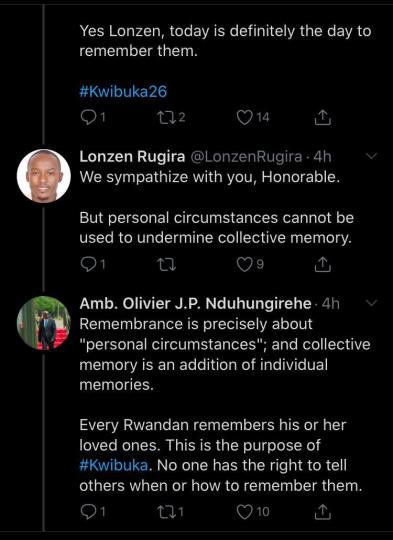
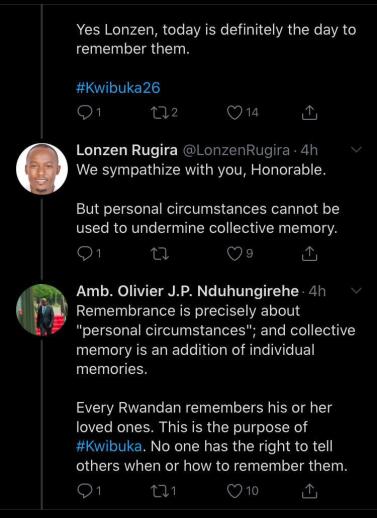
Nduhungirehe publicly on Twitter mourned Hutu opposition leaders such as Prime Minister Agathe Uwilingiyimana who were murdered on April 7, 1994. Nduhungirehe added that he knew the murdered families and that he knew some of them “personally and grew up with their children.”

WhatsApp Image 2020-04-10 at 15.40.06 (1)

Nduhungirehe was immediately ambushed by Kagame’s social media army that reminded Nduhungirehe that “Today is not the day to remember politicians.” That was the end of Nduhungirehe career as minister in Kagame’s Rwanda.

Nduhungirehe seems to have forgotten that he worked for a totalitarian dictatorship that operates on the principle of blind and total submission to the powers that be. There is no room in Rwanda to deviate however slightly from the official line even in thoughts let alone spoken words. You are not even allowed to mourn murdered friends.

David Himbara, PhD

https://medium.com


Avis aux lecteurs: Nos articles peuvent être reproduits à condition de citer le nom d’auteur et le site web source.
Notice to readers: Our articles may be reproduced provided the author’s name and the source website are cited.
Amb. Nduhungirehe Olivier viré de ses fonctions!

Amb. Nduhungirehe Olivier viré de ses fonctions!

Oui, vous l’avez bien entendu. Monsieur Olivier NDUHUNGIREHE, fils NDUHUNGIREHE Jean Chrysostome et petit-fils NGURUBE, ne répond plus au titre de Ministre. Un non- événement. En effet, tous ceux qui connaissent le modus operandi du FPR s’attendaient à ce qu’un jour ça arrive, mais pas dans ces circonstances. Il est accusé d’avoir promu ses propres ambitions au dessus de la ligne politique du gouvernement. L’on se souviendra que NDUHUNGIREHE ne cessait de dire à ses proches que sa ligne d’arrivée est Village Urugwiro. Tout à fait légitime et légale ailleurs, mais pas au Rwanda.

ondu Lux

Les honneurs royaux au Luxembourg, un avant-goût de la présidence

cortege

Un cortège bien musclé en son honneur

sommet

Les moments mémorables, s’ils pouvaient durer !

Monsieur NDUHUNGIREHE aura savouré les privilèges qui , selon le système du FPR ne reviennent qu’à Paul Kagame. Et ça, ça tue!

Disons qu’il avait déjà cumulé assez de fautes pour mériter son sort, certes, ce n’est pas lui qui devait partir, surtout maintenant. Depuis la disparition de Paul Kagame, pas mal de choses se passent mal.  Les citoyens mis en confinement sans suivre la procédure légale, et le Premier Ministre qui signe au nom du Président sans avoir indiqué officiellement pourquoi, le manque de stratégie explicite contre le COVID-19, les communiqués sans signature comme si les ministres avaient honte d’afficher leur identité et d’assumer leurs actes,…On ne sait pas exactement qui est aux commandes, ce dont est certain, ce n’est pas le dictateur de Kigali.

Que signifie son éloignement?

Même s’il commettait bien de conneries, Monsieur NDUHUNGIREHE servait “d’idiot utile“, un “Hutu de service” au vrai sens du mot. Celui qui défend l’indéfendable, qui accepte d’encaisser les coups à la place de son maître sachant qu’un jour, on lui dira qu’il est viré car ce qu’il a dit n’était pas conforme aux lignes du gouvernement.

Le FPR, n’ayant pas pu convaincre les Hutu, il lui faut des éléments égarés ramassés ici et là, genre UWIZEYIMANA Evode, NDUHUNGIREHE Olivier, BAMPORIKI Edouard, qui ont un talent et qui vont nettoyer l’image, pour éviter le régime d’être traité de ségrégationniste.  Car au Rwanda, il n’y a que ça: les morts discriminés, les tueurs aussi, les orphelins, … dans tous les milieux on sent la discrimination. Le seul moyen de masquer ça, du moins aux yeux des non- Rwandais, est de recruter les “NDUHUNGIREHE” pour “essuyer tout”! Cette stratégie est préférée au dialogue franc qui pourrait intégrer les Hutus après avoir abordé de vrais sujets socio-politiques qui gangrènent la réconciliation nationale car devenus tabous au profit du FPR.

Les Hutus intelligents mais naïfs se sont retrouvés dans cette trappe, sauf qu’ils finissent mal après avoir terni leur propre image.  A l’exception de  ceux qui ont pris les fonctions dans l’immédiat après la conquête du pouvoir,  ces Hutus de service n’avaient pas forcément l’ambition politique, mais avaient d’autres soucis personnels ou professionnels.

Citons-en quelques

  1. Bernard MAKUZA, Premier Ministre de 2000 en 2011. Hutu et issu du Parti politique, Mouvement Démocratique Républicain (MDR). En connivence avec KAGAME, son cousin,  il initia le bannissement officieux de son Parti, et comme récompense il reste jusqu’aujourd’hui en tant que sénateur.
  2. Pierre Damien HABUMUREMYI,  Hutu, Premier Ministre indépendant de 2011 en 2014. Plus tard, il dévoilera qu’il appartenait au FPR.
  3. Anastase MUREKEZI, Hutu, Premier Ministre issu du Parti de NDUHUNGIREHE, PSD, de 2014 en 2017.
  4. De 2017, Edouard NGIRENTE, Hutu, Premier Ministre, indépendant.

Olivier NDUHUNGIREHE a rejoint le système en tant que Conseiller d’ambassade en Ethiopie (2007-2010), puis au siège des Nations Unies (2010 – 2015). En 2016, il devient Ambassadeur en Belgique son ancien pays de refuge et deuxième patrie, mais il est obligé de demander l’annulation de sa nationalité belge. En 2017, il est rappelé à Kigali pour servir en tant que Secrétaire d’Etat au sein du Ministère des affaires étrangères et coopération internationale. C’est lui qui gère les Affaires de L’East African Community, notamment, il est visible dans le dossier de la frontière Ougando-rwandaise. Récemment, il était le seul à justifier les erreurs détectées dans la déclaration des mesures contre COVID-19 en violation de la Constitution rwandaise. L’une des raisons de sa misère? D’autres observateurs avisés suspectent un échange qu’il aurait eu sur Twitter au sujet de la commémoration des victimes du génocide de 1994.

WhatsApp Image 2020-04-10 at 15.40.06 (1)

Il est viré, seulement deux mois après la démission de trois autres ministres dont deux Hutus. De ces trois, le fameux Evode UWIZEYIMANA a disparu des radars depuis. Sans doute que le Premier Ministre aurait dû partir avant NDUHUNGIREHE.

fired

Chaste Gahunde


Avis aux lecteurs: Nos articles peuvent être reproduits à condition de citer le nom d’auteur et le site web source.
Notice to readers: Our articles may be reproduced provided the author’s name and the source website are cited.

Rwanda: Political parties and activists advise the Commonwealth not hold CHOGM in Rwanda.

Allowing Rwanda and particularly General Paul Kagame to host the CHOGM 2020 will only serve as a declaration of the Commonwealth’s indifference to human rights concerns.

Baroness Patricia Scotland

Secretary General

Commonwealth Secretariat

Headquarters Marlborough House

Pall Mall London SW1Y 5HX                                                                                                Email: secretary-general@commonwealth.int

April 2, 2020

Dear Secretary General,

Subject: Rwanda as the host of CHOGM 2020

This letter follows earlier complaints made by different organisations and individuals about the unsuitability of Rwanda as a host of CHOGM 2020 due to its violation of the core values of the commonwealth particularly the respect for political and civil rights. In the absence of any public statement by Commonwealth secretariat about a change of mind on the matter, we would like to reiterate that your decision to nominate Rwanda to host CHOGM 2020 is a gross contradiction to the Commonwealth’s core values and principles.

The Rwandan regime continues to face allegations of human rights violations that are of an extremely serious nature. There are no better reliable sources than the United  States Government, the biggest democracy and key ally of the Rwandan government, Human Rights Watch, Amnesty International, UN Human Rights Council and Freedom House.

The latest US government report on human rights for the year 2019, highlights among other abuses “unlawful or arbitrary killings by state security forces; forced disappearance by state security forces; torture by state security forces; arbitrary detention by state security forces; political prisoners; arbitrary or unlawful interference with privacy; the worst forms of restrictions on free expression, press, and the internet, including threats of violence against journalists, censorship, website blocking, and criminal libel and slander laws; substantial interference with the rights of peaceful assembly and freedom of association, such as overly restrictive nongovernmental organization (NGO) laws; and restrictions on political participation; criminal violence against women and girls, which the government took insufficient action to prevent or prosecute.” As the US report of 2017 point out the restrictions on freedom to participate in the political process denies the Rwandan citizens “the ability to change government through free and fair elections”.

Freedom House report 2020 considers Rwanda as no free country with a score of 22% in terms of political and civil rights.

For ease of reference we shall highlight the most salient cases of persistent gross human rights violations in Rwanda for the past 26 years. They are widely documented by Human Rights bodies, despite Rwanda’s repeated denials. The UN High Commissioner for Human Rights has always named Rwanda among top 10 countries in the world that have gone unpunished for intimidation and repression against critics.

President Paul Kagame and the ruling Rwandan Patriotic Front (RPF) continue to exert control over political landscape in Rwanda, as political opposition leaders have been intimidated, silenced, arrested, killed or forced into exile. The ruling political party – RPF controls legislative assemblies i.e. Parliament and Senate, through sham elections and partisan appointments. Therefore, President Paul Kagame was able to win an election with a score of 98.8 percent of the vote in the 2017 presidential elections, only possible in totalitarian states. In this respect, the ruling party was able to force constitutional change that allows President Paul Kagame to continue to rule till 2034. For all intents and purposes this was a constitutional coup which should have called for sanctions from the commonwealth.

The Rwandan government continues to limit the ability of civil society groups, the media, international human rights organizations, and political opponents to function freely and independently or to criticize the government’s policies and practices. They are constrained particularly by articles 194 and 204 of the penal code under which criticising government is construed as harmful propaganda to tarnish the image of the country abroad or causing uprising or unrest among the population.

The government appears to use a broad strategy to spread fear to enforce its repressive orders and deter any resistance to government dictates. For example, between April 2016 to March  2017, State security forces in the Western Province summarily killed at least 37 suspected petty offenders, including stealing a goat or a bunch of bananas. The regime continues to arrest and detain people in unofficial military detention centres, where scores of detainees have been tortured.

In July 2018, the United Nations Subcommittee on Prevention of Torture (SPT) cancelled its visit to Rwanda, due to a lack of cooperation from Rwandan authorities, making it the first time in 11 years the SPT would cancel a visit. This followed a suspension of a visit in October 2017 due “series of obstructions imposed by authorities”.

The political transition that Rwanda begun after the genocide has, instead of leading to democracy, resulted in the legitimization and consolidation of authoritarian rule. Rwanda is now a very authoritarian regime with a façade of a democracy. As the report of the Commonwealth Human Rights Initiative (2009) rightly points out, “the regime uses the constitution opportunistically as a façade, which hides the exclusionary and repressive nature of the regime; relies on power structures that sometimes run parallel to, and sometimes cross-cuts the formal government and in which the army plays a central role”. Some political analysts have described Rwanda as an “army with a state” rather than a state with an army.

Rwanda holds regular elections, but their outcome is pre-determined because of the legal, administrative and physical obstacles that the RPF has put in place to deny opposition its constitutional right to get to power. There is no meaningful competition for political power between the RPF and genuine political opposition parties and thus no real opportunity to change the government through free and fair elections.

Elections are systematically manipulated and heavily rigged by the RPF in order to ensure a landslide victory. To create a semblance of a broad-based government and Parliament the RPF is usually compelled to “doctor” the results in order to give the satellite or proxy parties enough votes to meet the threshold required for representation in Parliament.

After years of threats, intimidation, mysterious deaths, and high profile, politically  motivated trials, few opposition parties remain active or make public comments on government policies. For example, the openly active party in Rwanda, Forces Démocratiques Unifiées (FDU)-Inkingi) has paid a heavy price in terms of the highest toll of arrests, forced disappearances and assassinations. Its former President Mrs Victoire Ingabire Umuhoza, was sentenced to 15 years jail after a political trial. Even though she was released under a presidential pardon she is still being harassed by the Rwanda investigation Bureau through constant summons for interrogation about her political life. During the 2019 year alone two members were murdered, and one disappeared in circumstances that led many to believe it was the work of secret services. Mr Anselme Mutuyimana was murdered in March 2019 and Syldio Dusabumuremyi stabbed to death in September 2019. Eugène Ndereyimana, also a member of FDU-Inkingi, was reported missing on 15 July 2019, after he failed to arrive for a meeting in Nyagatare, in Rwanda’s Eastern Province. Boniface Twagirimana, the party’s 1st Vice President mysteriously “disappeared” from his prison cell in Mpanga, southern Rwanda, in October 2018 and is missing up to this day. Several party leaders are still languishing in prison.

Any person suspected of being in touch with members of RNC party outside the country is accused of collaborating with a terrorist organisation.

Opinion leaders from the Tutsi survivors of genocide who have tried to express views different from the government have been put in jail, have been killed or forced into exile. In an open letter to President Kagame in July 2019, presidential hopeful Diane Rwigara, a survivor of genocide too, gave a list of more than 40 survivors of genocide suspected of having been killed by the regime.

– Ms Diane Rwigara, presidential hopeful in 2017 elections, her sister Anne, and their mother were arrested in September 2017. They were charged with “inciting insurrection or trouble among the population” because they had criticised the government.

– Mr Gilbert Mwenedata, another presidential hopeful in 2017 elections, a survivor of Tutsi genocide, was forced to flee the country for fear of reprisals after the elections.

– In February 2020: Barafinda Sekibubo Fred a presidential hopeful in 2017 elections was taken to a mental hospital by Rwanda Investigation Bureau (former CID) after showing what the police consider to be symptoms of mental health problem. In an interview one local TV channel he raised questions as to why people including those who were part of the government are fleeing the country when there is no war in Rwanda and why people are surprised and run to tell the President that there are people fighting the government. The family (wife and 10 children) fear that he could be injected with harmful substances in the psychiatric hospital and end up having mental problems.

– Deo Mushayidi President of PDP-Imanzi and Dr Theoneste Niyitegeka former leader of MDR are still locked up.

– Kizito Mihigo, Rwanda’s most popular and beloved gospel singers, 38-year-old, survivor of  Tutsi genocide, was found dead at a police station in the capital, Kigali, on Monday, 17th February 2020. It is an open secret that it was a murder case carried out by Rwandan security services.

– After the assassination of Kizito Mihigo, opposition politician Victoire Ingabire noted, « I was in prison and spent eight years and when I was released and I thought the government of Rwanda was ready to open up the political space, but one month later, our vice president disappeared, four months later my assistant was killed, in July 2019 our representative in eastern province disappeared, and this year our national coordinator was murdered. Today is Kizito, I think tomorrow will be me, or Bernard Ntaganda or someone else in the opposition.”

Repression Abroad

In May 2011, Scotland Yard warned two prominent Rwandans living in Britain, Mr Rene Mugenzi and Jonathan Musonera and warned them that it had reliable intelligence that Rwanda’s government poses an imminent threat to their lives.

– In September 2019, South Africa’s National Prosecution Authority issued arrest warrants for two Rwandans accused of murdering Rwandan critic Col. Patrick Karegeya, who was found dead in his hotel room in Johannesburg on January 1, 2014.

– South Africa’s special investigative unit said in written testimony that Col Patrick Karegeya’s murder and attacks on Rwanda’s former army chief of staff Gen. Kayumba Nyamwasa “were directly linked to the involvement of the Rwandan government.”

– In October 2019, a Financial Times investigation revealed that Israeli software developed by the NSO Group was used to spy on political dissidents and critics living abroad. The spyware targeted individuals through WhatsApp calls and allowed hackers to access personal data on the phone, such as messages and location.

– Australia’s ABC uncovering allegations of a complex web of Rwandan spies living within the suburbs, creating a culture of fear among the refugees who had escaped that nation in pursuit of a safer life. ABC titled the documentary “Spies in our suburbs, unearthing an alleged shadowy network of spies and their efforts to silence dissent.” Expats and Rwandan refugees in Australia say silencing critics and suppressing support for opposition parties in exile are among the top priorities of the Rwandan Government.

– In 2019, hacking attempts, surveillance and intimidation, the Rwandan government has been accused of putting pressure on opponents and journalists established in Belgium, Le Soir and De Morgen reported on 22nd November 2019. Belgian National security “confirms Rwandan intelligence services are actively engaged in Belgium attempting to weaken what is perceived as a political threat from the opposition” to Paul Kagame’s regime. The justice minister confirmed these allegations in October 2019. Peter Verlinden, a former VRT journalist, and his Rwandan wife Marie Bamutese have been used as an example of the victims of such practices, Belga reports. The couple says they have been threatened since 2015, following the publication of their book concerning violence in eastern DR Congo.

Freedom of Expression

Years of regime interference, repression, incarceration and state sponsored assassinations have left civil society in Rwanda very weak, leaving Rwandan human rights organizations largely unable to publicly document violations by state agents.

While the law guarantees freedom of the press, the media remains tightly controlled by the government. Media outlets are either state-controlled, co-opted or constantly under siege. Most journalists are unable or unwilling to engage in investigative reporting on politically sensitive issues and rarely criticize government policies, because of intimidation, threats, and prosecutions. They risk arrest under a variety of restrictive laws and can face long jail terms if convicted. Many have fled the country to avoid persecution and reprisals, but even in exile Rwandan journalists  have experienced intimidation and even death like Charles Ingabire who was shot in Kampala – Uganda. This has created a culture of fear among journalists and has led to widespread self- censorship.

The Government also intimidates international journalists, for example BBC Kinyarwanda service remains suspended since 2014. The regime censorship of internet content has increased in recent years. Several independent or opposition-aligned news outlets abroad have remained inaccessible in the country, especially those website and blogs which question human rights excesses and regime policies.

We urge the Commonwealth to re-consider Rwanda’s suitability as a host for CHOGM 2020. The Commonwealth secretariat must revisit the conclusions of the Commonwealth Human Rights Initiative delegation to Rwanda in 2009 on the human rights situation in Rwanda and examine the deterioration of the human situation since that visit. It will realise that during the last 26 years the Rwandan regime has demonstrated that it is unwilling to manage societal demands without resorting to violence and coercion. By providing space for Rwanda and particularly General Paul Kagame to host of CHOGM 2020 will only serve as a declaration of the Commonwealth’s indifference to human rights concerns. It will be construed as endorsing the regime over its role in egregious human rights violations and tyranny.

It is very clear that persuasion alone cannot bring the Rwandan regime to behave in a civilised manner. The commonwealth should be able to set SMART objectives for the Rwandan regime to implement the core values of the commonwealth as pre-condition for holding the commonwealth summit in Kigali- Rwanda. The Rwandan regime must show practical steps it will make to restore democracy, observe human rights observance and good governance.

The Commonwealth Secretariat should set benchmarks for Rwanda including:

  1. Fully restore the rule of law;
  2. Lift restrictions on the enjoyment of all fundamental freedoms;
  3. Respect the separation of powers i.e. the independence of the three branches of government;
  4. Institute effective mechanisms to protect journalists, civil society groups and human rights defenders;
  5. Allow full and credible international investigations into all allegations concerning violations of international humanitarian law in the country;
  6. As a matter of urgency allow an immediate and independent enquiry into the death of Mr Kizito Mihigo.


Signatories:

  1. Laurent Munyandilikirwa, Président de l’Observatoire des Droits de l’homme au Rwanda (ODHR) ;
  2. Emery Nshimiyimana, Secrétaire Général de la Fondation IBUKABOSE-RENGERABOSE, Mémoire et Justice pour tous ;
  3. Jean Marie Ndagijimana, Coordinateur du Comité pour l’Unité, la Paix et la Réconciliation au Rwanda (CUPR) ;
  4. René Mugenzi, Coordinateur de Global Campaign for Rwandans’s human rights (GCRHR);
  5. Joseph Matata, Coordinateur du Centre de Lutte contre l’Impunité et l’Injustice au Rwanda (CLIIR);
  6. Theobald Rutihunza, Président du Réseau International pour la Promotion et la Défense des Droits de l’Homme au Rwanda (RIPRODHOR) ;
  7. Robert Mugabowindekwe, President de JAMBO asbl ;
  8. Callixte Kanani, Coordinateur du Comité de Suivi de la Problématique des Réfugiés Rwandais (CSPR) ;
  9. Aloys Simpunga , Initiative HUMURA ;
  10. JMV Nyirimbirima, Chairperson the Global Voice of Rwandan Refugees (GVRR)
  11. Stany Rwandarugari, Rwandan Platform for Dialogue, Truth, and Justice (RDTJ)
  12. Marcelline Nyiranduwamungu, Présidente du Réseau international pour la Démocratie et la Paix (RifDP);
  13. Pascal Kalinganire, General Coordinator of the Organization for Peace, Justice and Development in Rwanda and Great Lakes Region (OPJDR);
  14. Pierre Claver Nkinamubanzi, Président du Congrès rwandais du Canada (CRC);
  15. Nelson Gatsimbazi, Rwandiska föreningen för mänskliga rättigheter (RFMR);
  16. Rugema Kayumba, Norway Sub Sahara Africa development organisation(NSADO);
  17. Celestin Muhindura, President of Rwanda National Forum (RNF);
  18. Gilbert Mwenedata, Président de l’initiative du Peuple pour l’Alliance Démocratique (IPAD) ;
  19. Emmanuel Mugenzi, Coordinator in charge of political matters, Rwandan Alliance for the National Pact (RANP-Abaryankuna) ;
  20. Jean Damascène Munyampeta, Secrétaire Général du Pacte Démocratique du Peuple (PDP- IMANZI) ;
  21. General Emmanuel Habyarimana, Président de la Convention Nationale Républicaine (CNR- Intwari) ;
  22. JABO AKISHULI, Secrétaire Exécutif, UNITED FREEDOM FIGHTERS (UFF- INDANGAMIRWA);
  23. Jerôme Nayigiziki, Coordinateur, RNC-Ihuriro ;
  24. Jean Baptiste Ryumugabe, Secrétaire Exécutif PSI-Imberakuri ;
  25. Etienne Masozera, Président AMAHORO-PC ;
  26. Justin Bahunga, Président FDU-INKINGI;
  27. Nadine Claire Kasinge, Présidente ISHEMA PARTY;
  28. Anastase Gasana, President Democratic Rwanda Party, DRP-ABASANGIZI.

References/Key reading notes

https://apnews.com/a97d40a146284383a717aa2ec42eb39b

https://donordirectaction.org/2012/09/dr-denis-mukwege-addresses-un-on-sexual-violence-in- drc/

https://eastafricamonitor.com/why-are-the-political-killings-and-disappearances-under-paul- kagame-being-ignored/

https://edition.cnn.com/2019/12/24/africa/rwanda-pastor-daughter-treason-charges/index.html

https://newint.org/features/2004/05/01/congo

http://news.bbc.co.uk/1/hi/world/africa/6131516.stm

https://reliefweb.int/report/burundi/plundering-dr-congo-natural-resources-final-report-panel- experts-s20021146

https://rwandansrights.org/un-special-rapporteur-findings-on-rights-to-freedom-in-rwanda-are- unfortunately-characteristics-of-an-oppressive-regime/

Click to access drc_un_report_final_june2010.pdf

https://abc.net.au/news/2019-08-25/spies-in-our-suburbs-alleged-spy-web-silencing- rwandan-refugees/11317704

https://aljazeera.com/indepth/features/2016/01/blood-minerals-profits-conflict-drc- 160118124123342.html

https://amnesty.org/en/countries/africa/rwanda/report-rwanda/

https://amnesty.org/en/documents/afr47/1600/2019/en/

https://atlanticcouncil.org/events/past-events/nobel-peace-prize-laureate-on-sexual- violence-in-the-drc

https://brusselstimes.com/all-news/belgium-all-news/79862/belgium-a-playground-for- rwandan-spies/

https://cfr.org/blog/alongside-real-progress-kagames-human-rights-abuses-persist

https://dw.com/en/rwanda-gospel-singer-kizito-mihigos-death-likely-a-political- assassination/a-52463272

https://dw.com/en/rwandas-opposition-rattled-by-killings-and-disappearances-of- members/a-50596049

https://hrw.org/news/2012/09/11/dr-congo-m23-rebels-committing-war-crimes

https://hrw.org/news/2013/02/05/dr-congo-war-crimes-m23-congolese-army

https://hrw.org/news/2015/08/27/icc-trial-bosco-ntaganda-alleged-crimes-democratic- republic-congo#2

https://hrw.org/sites/default/files/reports/burundi0904.pdf

https://hrw.org/world-report/2020/country-chapters/rwanda

https://independent.co.uk/news/uk/crime/rwandan-assassin-sent-to-kill-dissidents-in-uk- 2286712.html

https://iol.co.za/news/opinion/death-in-custody-of-rwandas-kizito-mihigo-reminiscent-of- neil-aggett-43672971

https://nybooks.com/daily/2017/08/04/rwanda-kagame-efficient-repression/

https://monitor.co.ug/News/National/Rwanda-makes-3-more-demands-ahead-of- meet/688334-5462902-9ne2ju/index.html

https://ohchr.org/EN/Countries/AfricaRegion/Pages/DRCUNMappingReport.aspx#

https://telegraph.co.uk/news/2019/09/24/rwandan-opposition-leader-third-killed-single- year/

umurage.org/featured-legacy-makers/the-man-who-repairs-women


Avis aux lecteurs: Nos articles peuvent être reproduits à condition de citer le nom d’auteur et le site web source.
Notice to readers: Our articles may be reproduced provided the author’s name and the source website are cited.
Rwanda: le FMI donne un crédit de 109 millions de dollars pour lutter contre COVID-19.

Le gouvernement de Kagame reçoit un crédit du FMI de 109,4 millions de dollars pour lutter contre le COVID-19

Le 2 avril 2020, le Fonds Monétaire International (FMI) a approuvé un crédit de 109,4 millions de dollars américains au Rwanda dans le cadre de ce qu’on appelle la Facilité de Crédit Rapide (FCR). Selon le FMI, l’impact économique de la pandémie de COVID-19 au Rwanda “avance très vite, les perspectives à court terme se détériorant rapidement”.

Le FMI ajoute que le gouvernement rwandais a «agi rapidement en mettant en place des mesures pour aider à contenir et à atténuer la propagation de la maladie». Les fonds du FCR appuieront les efforts du gouvernement rwandais pour étayer les réserves internationales en déclin et fourniront de l’argent pour augmenter les dépenses afin de contenir Covid-19. Le FMI ajoute qu ‘«il continuera de suivre de près la situation du Rwanda et est prêt à fournir des conseils politiques et un soutien supplémentaire si nécessaire».

Selon le FMI “La facilité de crédit rapide (FCR) permet d’apporter rapidement une aide financière concessionnelle assortie d’une conditionnalité limitée aux pays à faible revenu qui se heurtent à un problème immédiat de balance des paiements. La FCR a été créée comme guichet du fonds fiduciaire pour la réduction de la pauvreté et pour la croissance (Fonds fiduciaire RPC), dans le cadre d’une réforme plus large visant à assouplir le soutien financier du FMI et à mieux l’adapter aux besoins divers des pays à faible revenu, notamment en période de crise. La FRC unifie l’aide d’urgence concessionnelle du FMI et peut être utilisée de façon souple dans un plus grand nombre de circonstances et met davantage l’accent sur les objectifs du pays en matière de croissance et de réduction de la pauvreté”.

La pandémie COVID-19 met à nu Kagame, qui, malgré sa vantardise à propos d’une économie forte, n’arrive même pas à résister pendant deux semaines sans s’agenouiller.

Pour information, à la fin de 2019, le Rwanda avait une dette extérieur de 3.26 milliards de dollars, soit 271.66 dollars par habitant. Ce montant est le triple de ce que la dette était en 2000.

Chaste GAHUNDE


Avis aux lecteurs: Nos articles peuvent être reproduits à condition de citer le nom d’auteur et le site web source.
Notice to readers: Our articles may be reproduced provided the author’s name and the source website are cited.
L’armée rwandaise profite du COVID-19 pour violer les femmes.

Le Rwanda descend aux enfers. Avec la pandémie Covid-19, le pays a basculé dans le désordre total.

  1. Tout commence par les ministres de la santé et du commerce qui émanent des déclarations sur les comportements à adopter.
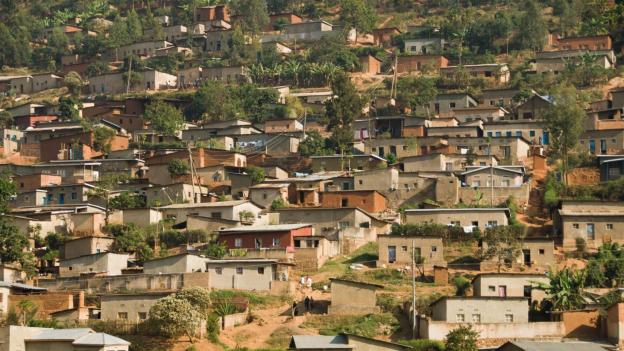
  2. Sauf que dans la banlieue, la démolition des maisons des pauvres continue. Comme s’il s’agissait de faciliter la tâche au virus. Les sans-abri sont plus vulnérables, car ils ne peuvent pas se confiner.
  3. Et puis, le président de la République prend la fuite à bord de son jet privé vers Londres, l’information qui a été ni confirmée ni infirmée par la présidence. Un peu avant sa disparition des radars, il se lave les mains, un geste sensé conscientiser son peuple à la lutte contre la propagation du Covid-19 en se lavant les mains au savon à plusieurs reprises par jour. Curieusement, le geste ressemble à celui de Ponce Pilate avant de livrer Jésus aux Juifs pour la crucifixion, s’insurge Jeanne Mukamurenzi, une activiste politique.
  4. Ensuite, le Premier Ministre signe un document sans base légale selon lequel tous les citoyens devraient respecter les mesures applicables durant l’état d’urgence, suivant l’exemple d’autres pays. Pas de déclaration explicite d’état d’urgence, et pas de loi, tout bascule dans le chaos. Constitutionnellement, il revient au Président de faire une telle déclaration. Seul en cas de son absence due à une maladie ou indisponibilité temporaire liée aux autres raisons, le Premier Ministre devient habilité. Mais tout requiert la bénédiction du Conseil des ministres.
  5. Le lendemain, deux hommes sont tués par balles de la police, sous prétexte qu’ils violaient la loi de confinement. Quelle loi? Sortie quand, et dans quelle gazette? Un autre est avalé par un crocodile en essayant d’échapper à la police. Chaque agent de police impose une amende avec un montant qu’il veut. Pas de loi, pas d’ordre.
  6. Les plus vulnérables souffrent déjà du manque de vivres. Il n’y a pas de mesures pour pallier la perte de revenus provoquée par la décision du Premier Ministre.
  7. Le président lit un discours. Tout ce qu’on voit est l’état de santé en dégringolade. Il va très mal. Il n’arrive pas à passer son message. Il confie les Rwandais, chose qu’il n’a jamais fait avant. En fait, il est trop fier de lui même qu’il ne croit pas en miracles de Dieu. Cette fois-ci, c’est différent.
  8. Et comme si ce n’était pas assez, les Rwandais sont surpris d’apprendre qu’ils allaient servir de cobayes pour  tester la vaccination contre COVID-19! Qui s’est permis de vendre les Rwandais? Tout y est pour comprendre. C’est le partenaire de Kagame, Dr Clet Niyikiza, qui annonce la nouvelle. C’est flippant!
  9. La famine fait déjà rage. Le gouvernement n’a rien fait pour voter un budget de secours. Le menu peuple a tout a perdu, mais le Président (de sa cachette) et le gouvernement , l’assemblée nationale, eux ils touchent leurs salaires en entier.
  10. La police tue les gens, ils frappent, sans pitié. Personne ne dit mot. Personne n’est là pour les victimes. L’église est muette, les associations muselées, …
  11.  Et l’armée viole les femmes, les sans-abri.

Tous les ingrédients sont complets pour le malheur de ce beau pays délaissé dans de mauvaises mains. Il est grand temps que le peuple reprenne ce qui leur appartient: le pouvoir du Peuple par le Peuple et pour le Peuple.

Chaste GAHUNDE


Avis aux lecteurs: Nos articles peuvent être reproduits à condition de citer le nom d’auteur et le site web source.
Notice to readers: Our articles may be reproduced provided the author’s name and the source website are cited.