Her Majesty Queen Elizabeth, Head of the Commonwealth.
Heads of States and Governments members of the Commonwealth. (all)
Secretary General of the Commonwealth
RE: LET 2022 CHOGM SET A GROUND FOR AN INCLUSIVE INTER RWANDAN DIALOGUE
–––––––––––––––––––––––––––––––––––––––
Your Majesty,
Your Excellencies,
It is decided. Irreversible. Or almost. The Commonwealth of Nations, an organization whose values and principles are democracy, good governance, human rights, rule of law amongst others, is going to hold its highest meeting in a liberticide country, Rwanda[1]. For a common citizen, this is heart-breaking. Why? Because in a country under dictatorship, where top leaders have no respect of their own people they are supposed to protect, the hope is turned to external forces, and the Commonwealth is a such force. You can imagine what a disappointment it can be to wake up to the news that your hope, your expected advocate is supporting your persecutor! The leadership of ISHEMA Party, a political organization in opposition to the ruling party RPF, takes the liberty to alert you on what you might not be aware of and could harm the good image the Commonwealth citizenry has of the noble organization. At the same occasion, we request your mediation between the government of Rwanda and the opposition through an inter Rwandan dialogue to shape the future of our nation where “never again” shall have sense.
I. Kagame, the Commonwealth Chair-in-Office (CIO)
One of biggest achievements in the process of self-realization of any dictator would be to be legally recognized as the Head of more than 50 countries from all corners of the globe. For Mr Kagame, this would not have happened, had the leader of Rwanda respected the Constitution of 2003 which provided that “under no circumstances may anyone serve more than two presidential terms”. The President whose role is to guarantee the protection of the Constitution failed his mission, not by omission, rather by a deliberate action aimed at self-aggrandizement, self-enrichment, and exclusion as well as deprivation of others’ rights on political participation and competition.
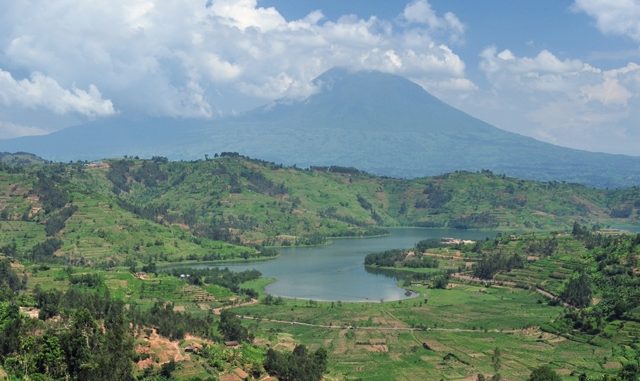
Lake and volcano in the Virunga Mountains of Rwanda / credit: Wikipedia/Neil Palmer
Rwanda is one of the world’s fastest growing economies and is ranked second in Africa as the easiest place to do business. In addition, this landlocked country boasts the world’s record for female representation in parliament. And it’s the only African country that manufactures “Made in Africa” smartphones.
These milestones make for impressive reading in the Western world, so accustomed to morbid news from the most corrupt region of the world.
This has also led major global brands including the world’s biggest car manufacturer, the world’s biggest nuclear company by foreign orders, a major U.S. multinational telecommunications company plus a retinue of other global corporations to set up shop in a country the size of the U.S. state of Maryland.
In the paternalistic eyes and hearts of foreign development partners in Africa, Rwanda is obsequiously referred to as the “Singapore of Africa,” a moniker that gives the impression that all is hunky-dory in this “land of a thousand hills.”
Rwanda’s economic and social accomplishments—while impressive—mask the underbelly of one of the world’s cruelest states, led by Paul Kagame.
Here, freedom of expression is muzzled. Extrajudicial killings are institutionalized. Show trials are routinely encouraged. Forced disappearances are embraced, while private businesses are forcibly seized by a regime that operates like the Nazi Gestapo.
Despite evidence of Kagame ordering his political opponents to be murdered, arrested, jailed, kidnapped, assassinated and tortured, the international community has continued to turn the other way. Why is that the case in Rwanda, but not in countries like Ethiopia, where U.S. Secretary of State Antony Blinken has called for a ceasefire to allow for humanitarian aid to flow into the Tigray region?
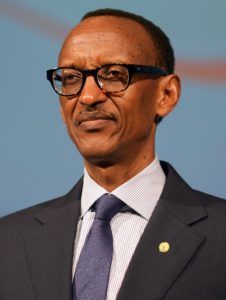
Rwandan President Paul Kagame / credit: cmonionline
The President and the ruling Rwanda Patriotic Front (RPF) have built and fine-tuned over the decades a totalitarian police state in which criticism of the government, or any semblance of dissent, is criminalized and often results in death for those who dare to speak out, said Jeffrey Smith, founding director of Vanguard Africa. He told TF in an email exchange, “There is no independent media, nor independent human rights groups or a political opposition that are allowed the minimum space to operate. The ruling RPF, in essence, has been wholly conflated with the state,” says Smith.
The 1994 genocide killed about 800,000 people drawn mainly from the minority Tutsi community, including moderate Hutus, while the rest of the world silently looked on. But Rwanda has since experienced an economic recovery that has been inextricably linked to Kagame, who officially took power in 2000.
In a controversial 2015 constitutional referendum, Rwandans voted overwhelmingly to allow Kagame, 63, to stand again for office beyond the end of his second term, which ended in 2017. He won elections held the same year with nearly 99 percent of the vote. In theory, he could run twice again, keeping him in power until 2034. His current term ends in 2024.
So why does the Western world play blind and deaf to the excess exhibited by Kagame? In other words, why the complicity in crimes and misdeeds in Rwanda ever since the end of the genocide?
“Rwanda has performed exceedingly well on the economic front. It’s seen as a success story in a continent that is dotted with malfunctioning states,” Lewis Mudge, the Central Africa Director at Human Rights Watch (HRW) told TF in a telephone interview. “The international donor community loves a good story and Rwanda serves as an example.”
The United States and the United Kingdom, like other Western governments, did not intervene in the 1994 Rwandan genocide. Nonetheless, both U.S. President Bill Clinton and U.K. Prime Minister Tony Blair later emerged as moralists and humanitarian interventionists, claiming human rights as one of the guiding principles for U.S. and British leadership in the world. This argument has since been used to bomb Yugoslavia, and invade Afghanistan, Iraq, Libya and Syria.
However, a U.S. diplomat quoted in the New York Times in an article aptly titled, “The Global Elite’s Favorite Strongman,” explained the reason the West disregarded the atrocities happening in Rwanda. “You put your money in, and you get results out. We needed a success story, and he was it.”
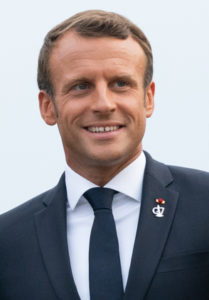
French President Emmanuel Macron / credit: The White House
In late May, French President Emmanuel Macron travelled to Rwanda, formerly a French colony, in a gesture largely aimed at fixing a glacial relationship that had broken down as a result of the latter having backed the former extremist government in Rwanda, including supporting and training its military, which committed genocide.
In addition, France is determined to win back its influence in former French colonies in Africa, including in Rwanda. Some have begun cooperating with other powers, among them China and Turkey, said Arrey E. Ntui, a researcher with the International Crises Group (ICG).
“The French Government is currently not that popular in Africa as a result of its past exploitative history with African states,” said Ntui. “The current leadership in Africa is assertive and takes no prisoners. This calls for France to tread carefully because there are emerging nations that are willing to partner with Africa without a condescending attitude. So it would have been foolhardy, for example, for Macron to censure his Rwandan counterpart on account of real or imagined human rights abuses happening in Rwanda.”
Since his inauguration in May 2017, Macron has visited 18 African countries out of 62 states he has so far visited, a sign that he is determined to claw back the influence France once had when it counted 20 countries as its colonies within the African continent.
But should the world expect an insurgency anytime soon in Rwanda?
Victoire Ingabire Umuhoza, a former presidential contestant who has been jailed for 15 years for daring to challenge Kagame told TF the Kagame government took power after a war and genocide.
“I would say that all these crimes committed in our country have traumatized Rwandans,” Umuhoza said. “Moreover, there is no room for dissenting voices in Rwanda. If one criticizes the government they are immediately labeled as the enemy of the state. Under such circumstances, people live in constant fear of expressing themselves. But this silence worries me a lot because it can lead to implosion in Rwanda one day.”
U.S. National Intelligence Council’s Global Trends Report published every five years says the world is “at a critical juncture in human history” and warns that a number of countries are at high risk of becoming failed states by 2030—Rwanda being one of them.
Charles Wachira is a foreign correspondent based in Nairobi, Kenya, and is formerly an East Africa correspondent with Bloomberg. He covers issues including human rights, business, politics and international relations
Authoritarian states deliberately use a number of tools to manage their image internationally, writes Alexander Dukalskis. Creating positive news, distracting and silencing critique, and shaping elite opinion help make the world safer for dictatorships
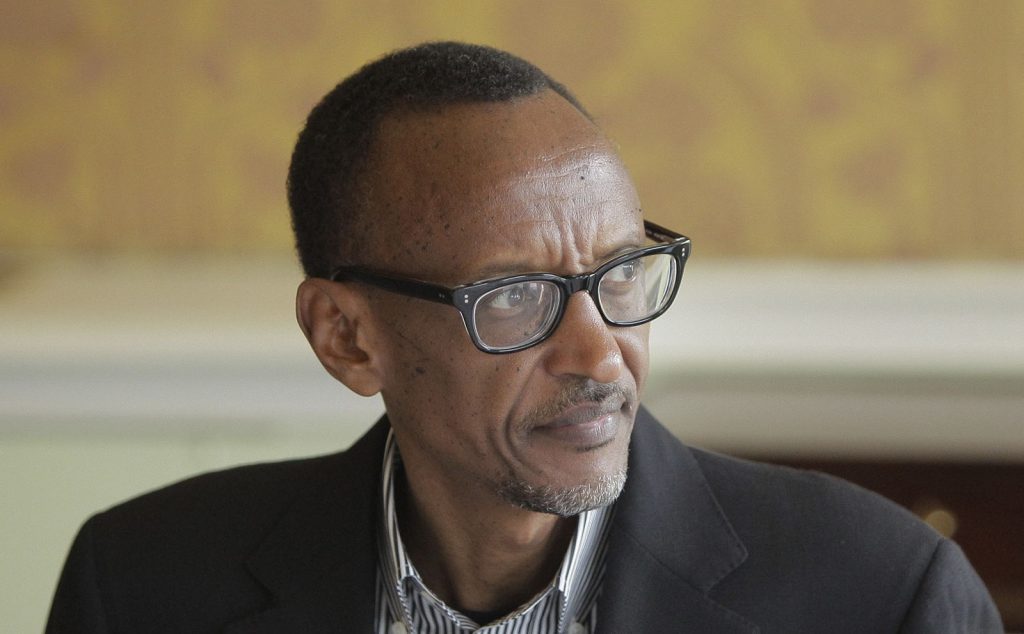
Rwanda’s authoritarian leader Paul Kagame Photo: Wikimedia Commons
In 2012 news broke about a public relations contract between a firm called Racepoint Global and the Rwandan government. The contract involved a plan written by the firm to improve Rwanda’s image internationally, including managing the image of its authoritarian leader, Paul Kagame.
The plan is telling. Of course, it includes the standard public relations stuff like making the country look attractive and Kagame a wise leader. But more interestingly, it details its aims to undermine Rwanda’s critics abroad – including human rights activists.
The plan also aims to cultivate journalists in leading outlets to promote a positive image of Kagame, and Rwanda. Thanks to the US Foreign Agents Registration Act (FARA), you can look up the plan for yourself.
Soft power or image management?
We often think about states promoting a positive image of themselves abroad through ‘soft power’ initiatives. And rightfully so: they do this a lot. But the Rwanda Racepoint memo is a revealing reminder that states – and especially authoritarian ones with an image problem – do a lot of other things to manage their image. These activities are often ethically dubious or sometimes outright illegal – violent, even.
In his excellent book, journalist Ron Nixon details the methods South Africa’s Apartheid regime used to improve its dire image internationally. These included paying lobbyists, and sponsoring ‘look and see’ tours to South Africa for opinion-shapers. The regime even attempted to purchase a newspaper covertly, discrediting critics as closet communists. Many authoritarian states do all these things and more.
Authoritarian image management
In my new book Making the World Safe for Dictatorship, I try to understand what motivates these efforts and how they operate. Focusing on authoritarian states, I create a framework of what I call ‘authoritarian image management.’
Authoritarian states use a range of tactics abroad to burnish their image and stamp out criticism; in short, they try to make their world safe for their dictatorship.
Authoritarian states use a range of tactics abroad to burnish their image and stamp out criticism; in short, they try to make their world safe for their dictatorship. The idea of the book is to put all these different methods into the same conversation. It aims to understand their strengths and weaknesses, and how different states adopt different tactics.
Authoritarian image management has two audiences: mass publics or specific elites. Further, it can have two main forms: promoting positive messages or obstructing criticisms of the state. Put together, you get four types of authoritarian image management, depending on audience and form.
To study these tactics, I use a range of data, including FARA documents, interviews, case study evidence, and video analysis. I also created a publicly available database of all instances in which authoritarian states threatened and/or repressed one of their own citizens abroad between 1991 and 2019.
Creating positive images
Here let me highlight some examples that have transpired since the book came out.
First, perhaps the most salient example of an authoritarian state putting out positive messages designed for a mass audience is covid-related messaging by the People’s Republic of China (PRC).
The Chinese authorities have attempted to present the PRC as successful at home in eliminating the disease and generous abroad in helping other countries meet the pandemic’s challenges.
In a recent paper with my co-author Sam Brazys, we analyse the messaging of Xinhua, China’s main state news agency, and find that it portrays China in positive and generous terms. The idea is to portray China’s authoritarian system as capable domestically and non-threatening internationally.
China’s Xinhua state news agency portrays the country’s authoritarian system as capable domestically and non-threatening internationally
Responding to criticism
Second, authoritarian states don’t just try to present positive images to the general foreign public. They also try to mitigate or distract from bad news or criticism.
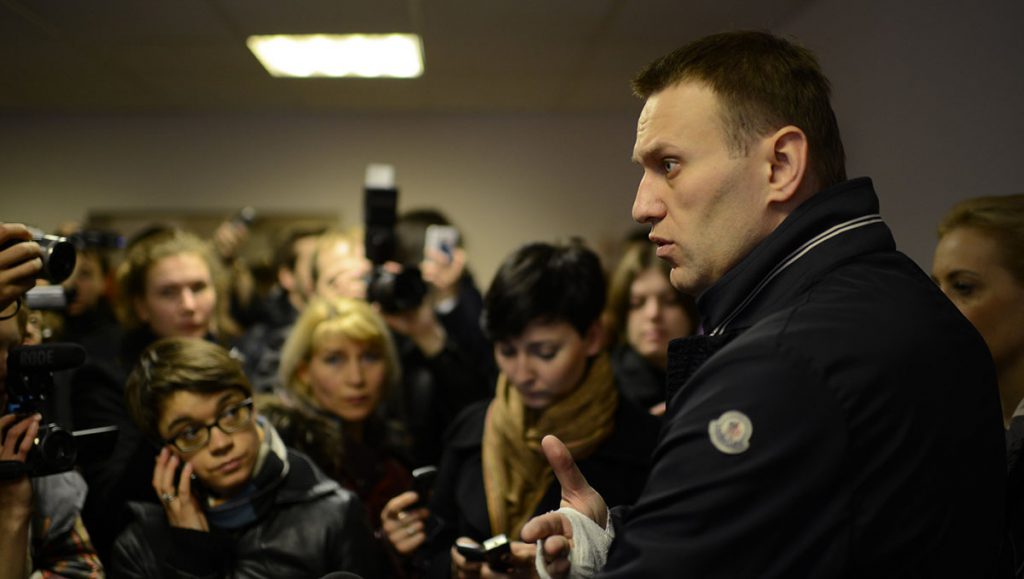
Russian opposition leader Alexei Navalny speaks to journalists after a trial in Kirov, Russia Photo: Mitya Aleshkovsky, Flikr
Someone like Navalny is a public relations problem for Russian authorities, and his global name recognition means that the government can’t just pretend he doesn’t exist. The authorities perceive that they have to respond to the negative press.
Silencing critique
Third, authoritarian states can try to silence specific critics or groups of critics abroad. This tactic involves what scholars call ‘extraterritorial repression’ or ‘transnational repression.’ Freedom House has recently released a major report and underlying data on the subject.
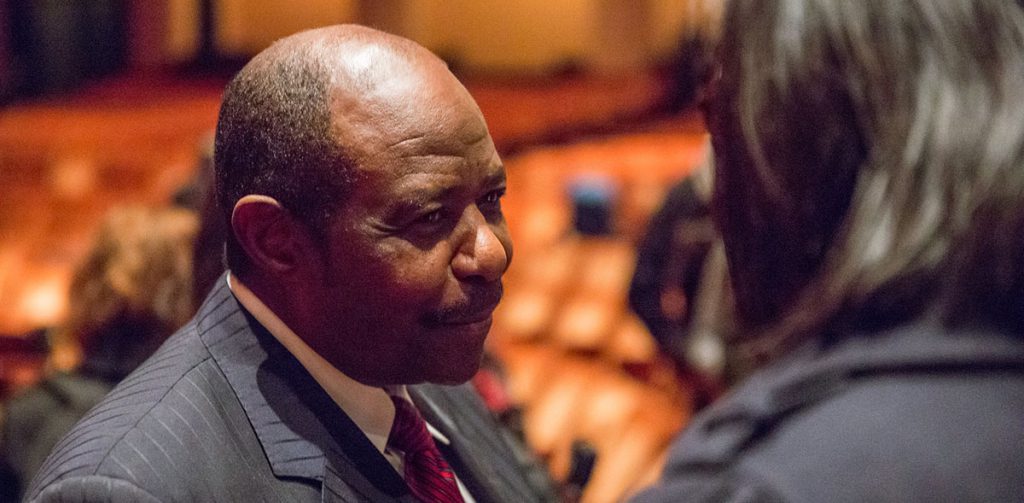
Activist and humanitarian Paul Rusesabagina was a prominent critic of Rwanda’s Kagame government Photo: Gerald R. Ford School of Public Policy, Flikr
From abroad he frequently criticised Kagame’s government. In August 2020 he was apparently deceived into boarding a charter flight and ultimately ended up in Rwanda where he now faces a terrorism trial.
A prominent critic of the Rwandan government is now no longer able to voice his criticisms to international audiences.
Shaping elite opinion
Authoritarian states try to cultivate elite opinion shapers to disseminate positive messages to international audiences. Sometimes this is through direct funding, sometimes through access. It may even stem from ideological affinity.
Authoritarian states try to cultivate elite opinion shapers to disseminate positive messages to international audiences
There are lots of potential examples here and many grey areas. One topic is funding for think tanks. In her recent report on the subject, Nadège Rolland details how authoritarian states try to fund think tanks to shape elite conversation on issues important to them. A similar logic can extend to universities.
These examples are just the tip of the iceberg. Authoritarian image management is about more than just ‘soft power’.
Once you start thinking about the multiple methods available to authoritarian actors abroad it becomes important to see them as tools in a toolkit rather than as unrelated to one another.
By Andrew Harding Africa correspondent, BBC NewsPublished6 hours ago
image captionThe footage, which the BBC has chosen to blur, shows members of the group promising to fight “enemies” of Rwanda
Leaked footage of a controversial “oath” ceremony at the Rwandan High Commission in London has fuelled allegations of an aggressive global crackdown on dissent by the authoritarian government of the small East African nation, dubbed the new “North Korea” by its critics.
Members of the Rwandan diaspora have told the BBC that such ceremonies are commonplace and designed to instil fear and obedience.
One man said his relatives back in Rwanda had been abducted and possibly killed to punish him for refusing to co-operate. The Rwandan authorities have dismissed the allegations as false and unsubstantiated.
In the video footage, recently circulated on WhatsApp, more than 30 individuals can be seen standing in a crowded conference room at the Rwandan embassy in the UK, raising their hands and pledging loyalty to the governing party, the Rwandan Patriotic Front (RPF).
“If I betray you or stray from the RPF’s plans and intentions, I would be betraying all Rwandans and must be punished by hanging,” the group says, in Kinyarwanda, while also promising to fight “enemies of Rwanda, wherever they may be”.
The RPF’s use of an embassy – which in London is close to Marylebone Station – for an overtly political pledge is, in itself, noteworthy.
‘They’re terrified’
But, while some of those attending the ceremony – understood to have taken place in 2017 – may well have been genuine supporters of the governing party, now living abroad, others have told the BBC that many attendees were there under duress.BBC”This is what happens everywhere. It’s routine. Either you take [the oath] or you are [the] enemy. It is black and white”David Himbara Ex-adviser to President Kagame
“I am certain the majority of people taking that oath did not believe it. We were lying to protect ourselves and our families back in Rwanda,” said one person who was – according to our investigation – present at the ceremony, but who asked us not to reveal their name for fear of reprisals.
“This is what happens everywhere. It’s routine. Either you take [the oath] or you are [the] enemy. It is black and white,” said David Himbara, who was once a senior adviser to Rwanda’s President Paul Kagame.
He is a Canadian citizen, academic and activist who says his life has repeatedly been threatened by Rwanda’s security services.
“The vast majority go because they’re terrified. They think that if they don’t go, something will happen to their family [in Rwanda],” said Rene Mugenzi, a British-Rwandan human rights activist, who was recently convicted of theft in the UK and jailed.
“You need to be active [in the RPF]. Even if you are neutral… they suspect you to be supporting opposition groups,” he said.
Asked about the “oath” ceremony, the Rwandan High Commission replied, by email, that members of the diaspora used its conference room for a variety of cultural engagements and that participation in an RPF loyalty pledge was legal and “entirely of their own choice and no-one is forced to do so”.
‘My brothers were abducted’
But the BBC has heard new evidence that Rwanda’s government has not only sought to threaten members of the diaspora seen as disloyal, but also that it seeks to punish such people by targeting their relatives still living in Rwanda.
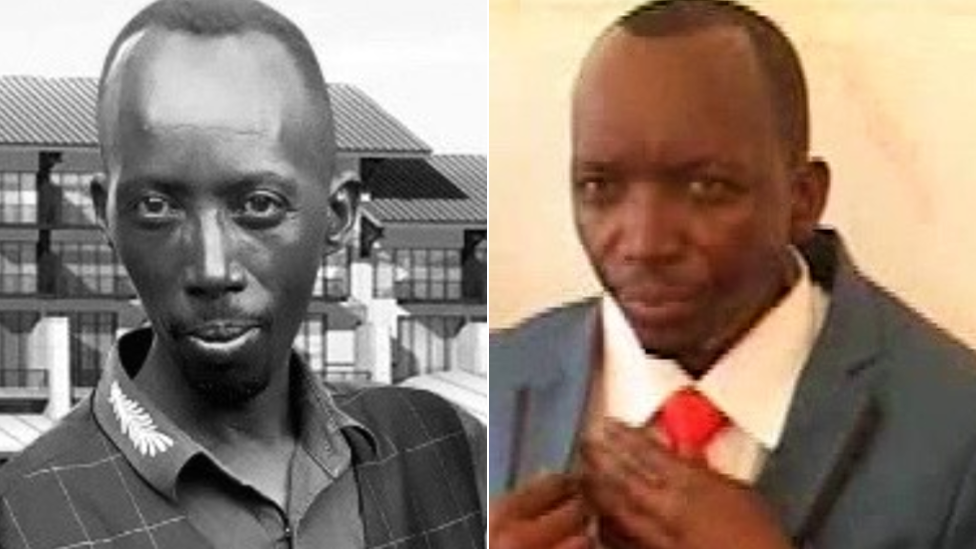
image captionFamily photos of Jean Nsengimana (L) and Antonine Zihabamwe (R), who have been missing for more than a year
“In order to intimidate me, they abducted my two brothers. They were never involved in politics. They were on Rwanda soil. Why should they be paying such a heavy price for doing nothing?” asked an emotional Noel Zihabamwe, from his home in Australia.
Mr Zihabamwe is a prominent member of the Rwandan diaspora in Sydney, who came to the country as a refugee in 2006, seeking to escape what he saw as an increasingly stifling and repressive political climate.
He says his refusal to actively support the RPF government prompted a public death threat from a visiting Rwandan diplomat in late 2017, which he reported to the Australian authorities.Noel ZihabamweThey often use this kind of kidnapping or murdering family members. This has to stop. We have had enough”Noel Zihabamwe A Rwandan living in Australia
That was followed by the alleged abduction of his two brothers, Jean Nsengimana and Antonine Zihabamwe, who were reportedly taken off a bus by police officers near the Rwandan town of Karangazi in September 2019 and have not been seen again.
“They often use this kind of kidnapping or murdering family members. This has to stop. We have had enough,” Mr Zihabamwe said.
“We would like to see the Rwandan government restore democratic rights to all citizens, cease targeted killings, kidnappings, illegal arrests and campaigns of intimidation of former citizens, like me, who are living overseas,” added Mr Zihabamwe, who now believes his brothers are probably dead and has decided to speak out in public, despite what he believes are considerable risks for himself and his extended family.
“Why can’t they let the family know where their bodies are, so we can organise a formal funeral? There are many Rwandans outside who have lost or missed their beloved ones.
“I want to speak against injustice. We need leadership that can stand for everyone, not for some,” he told the BBC.
‘No basis to allegations’
The Rwandan High Commission in London dismissed Mr Zihabamwe’s allegations as “tired and recycled” falsehoods and a “cheap ploy by political detractors to get free media attention”.
But allegations such as these are considered credible by many researchers, human rights groups and foreign diplomats, who say the Rwandan authorities appear to have calculated that – despite provoking some criticism from Western governments – such actions, which have included several targeted assassinations abroad, never appear to result in any long-term damage to Rwanda’s international relations.
The Rwandan government has received widespread global praise and financial support, over decades, for its hugely successful development agenda, which has helped to combat poverty and transformed Rwanda into one of the continent’s most impressive economies.
“Their view is – we can do what we like, kill who we like,” said one source, speaking on condition of anonymity.
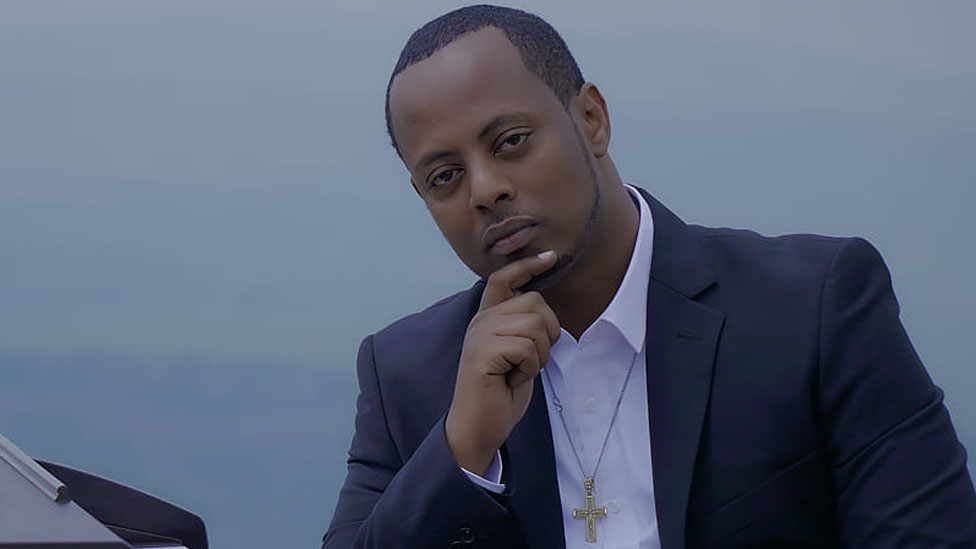
The death earlier this year, in police custody, of the popular gospel singer Kizito Mihigo also stirred huge anger.
image captionGospel singer Kizito Mihigo was found dead earlier this year, at the age of 38, in a police cell
Kizito, as he was popularly known, had tried to cross Rwanda’s border illegally, the authorities said. They say he killed himself – a version which is widely disputed in the diaspora and by many analysts.
“If you’re Rwandan, it’s simply safer to stay silent,” said Sarah Jackson, Amnesty International’s deputy director for East Africa.
“The Rwandan authorities have a whole toolbox of tactics that they use to supress dissent at home and abroad, ranging from harassment to threats to illegal detention, disappearances, torture, and even extending to returning Rwandan dissidents from other countries back to Rwanda without going through extradition proceedings… and to threatening family members too.”
The Rwandan High Commission in London said such allegations had no basis, and were being spread by a “handful of opponents… in order to damage the image and continued development journey of Rwanda”.
‘Totalitarianism’
President Kagame officially secured almost 99% of the vote in Rwanda’s last presidential election in 2017.
In London, Abdulkarim Ali, an official in the opposition Rwandan National Congress, said: “Either you pay allegiance to the RPF or… you become an enemy of the state. We normally compare it to North Korea.”
In Canada, Mr Himbara described the Rwandan government’s ideology as one of “totalitarianism – a government that wants to control all aspects of the Rwandan people, even in the diaspora”.
The Rwandan High Commission in London said the government’s main focus was to lift Rwandans out of poverty and create a good quality of life and opportunities for all of them.
“The focus of the High Commission is not on a handful of opponents who consistently spread false information in order to damage the image and continued development journey of Rwanda.”
1. À partir du 28 janvier 1961, le Rwanda a aboli la monarchie et est devenu une République, et à partir du 1er juillet 1962, il est devenu un État indépendant qui place en avant les intérêts de ses citoyens.
2. La gouvernance dans la République est très différente de celle de la monarchie. Dans la République, les décisions sont prises avec la concertation du peuple et évaluées par le peuple. Dans la monarchie, la gouvernance est basée sur « l’Ubwiru » le top secret dont la priorité était de servir l’intérêt du monarque et de sa clique au-dessus de l’intérêt commun.
3. Le régime dirigé par le FPR a souvent été caractérisé par des violations des droits de l’homme, notamment le droit à l’information sur la gestion de la chose publique ainsi que sur les accords que le Rwanda conclue avec d’autres pays. Un tel manque de transparence favorise des malversations de fonds publics et de compromissions néfastes à la souveraineté nationale.
4. Les autorités du FPR Inkotanyi étant soupçonnées de crimes graves et d’autres manquements dans leur administration, elles ne sont pas capables de protéger les intérêts du pays, plutôt en cas de pression, elles sont prêtes à signer quoi que ce soit dans le but d’échapper à la justice. En fait, leurs crimes les retiennent en otage, ce qui nuit aux intérêts du Rwanda sur la scène internationale.
5. L’accord entre le Rwanda et les clubs Arsenal et Paris Saint Germain, l’accord entre le gouvernement du Rwanda et les hommes d’affaires à l’instar des sieurs Howard Buffet et Bill Gates, les accords entre le Rwanda et les États-Unis, ou les pays tels que la Russie, la Chine, le Qatar et l’Israël n’ont jamais été rendus publics. Aucun membre de l’assemblée nationale n’en a été informé.
Les accords militaires inquiétants
6. Le 28 mai 2020, le Rwanda a signé un accord avec les États-Unis d’Amérique sur la coopération militaire. Ce genre de traités sont souvent sujets de controverses parce que les États-Unis cherchent à imposer la présence de leurs troupes dans d’autres pays et à porter des armes, mais ne peuvent pas répondre à la justice en cas de violations de la loi. Un pays qui refuse de signer de tels accords se voit dans le collimateur des « grands » dans un complot international, comme cela est arrivé au Burundi ces dernières années.
7. La Constitution du Rwanda de 2003, telle qu’amendée à ce jour, dans son article 169 au premier paragraphe dispose :
“Les accords d’installation de bases militaires étrangères sur le territoire national sont interdits.”
8. La signature de ces accords a eu lieu quelques jours après la menace des États-Unis sur l’éventuelle révision de la qualification du « génocide contre les Tutsi ». Dans la déclaration adressée au président de l’assemblée générale des Nations Unies, le représentant des Etas Unis d’Amérique insiste que de nombreux Hutus ont été tués lors du génocide, y compris ceux qui s’opposaient aux tueries. Cette superpuissance a signalé que, pour cela, les termes qui excluent les victimes hutues pourraient être revisités. Que le Rwanda ait immédiatement signé l’accord devrait inquiéter plus d’un.
Pour toutes ces raisons :
9. Le régime du FPR doit permettre l’accès aux accords signés avec des pays étrangers, des organisations internationales ainsi que des individus afin que le public puisse vérifier si ces accords ne sont pas effectivement en violation de la Constitution.
10. En effet, la loi organique n ° 03/2012 / OL du 13/06/2012 déterminant la structure, le fonctionnement et la compétence de la Cour suprême, notamment les articles 53 et 54, prévoit qu’en cas de violation de la Constitution par les accords internationaux, une plainte peut être déposée à la Cour suprême pour correction avec en annexe une copie de l’accord en question. Pour que cela se produise, les autorités doivent rendre accessible le contenu de ces accords qui restent cachés.
Ni inama yahawe izina rya Rwanda Bridge Builders. Yabaye kuwa 23 kugeza kuwa 24 Gicurasi 2020. Yahuje abari hafi 60 harimo amashyaka ya politiki atavuga rumwe na FPR ndetse n’imiryango itegamiye kuri Leta yita ku bibazo by’u Rwanda.
Muri iyi minsi, Madamu Victoire Ingabire Umuhoza akomeje gusiragizwa no kubuzwa uburenganzira bwe ku mpamvu zitavugwa, ahubwo hakavugwa ibidafite aho bihuriye.
Yigeze gutumizwa ngo avuge ku bitero byagabwe mu Kinigi. Ikibazo: Ese uyu Munyapolitike afite irihe peti rya gisirikare ku buryo abazwa ibyabereye ku rugamba, nk’aho ari we wari uruyoboye?
Arahamagazwa ngo avuge ku iyicwa ry’umuntu ryabaye adahari. Ikibazo: Ese uyu Munyapolitike ni we ushinzwe umutekano mu karere kabereyemo ubwo bwicanyi ku buryo agomba gusobanura uko byagenze?
Ikigaragara ni uko FPR yubatse imitwe y’iterabwoba yica abantu igafitira ibitero ku gihugu maze igashaka kubitwerera abatavuga rumwe nayo. Na none ariko biragaragara ko FPR itakimenya gutekinika. Ubu ikoranabuhanga rirahari biroroshye kumenya ko Ingabire atigeze ajya kurwana mu Kinigi cyangwa ngo ajye kwica aho ariho hose. Biranoroshye kubona ko nta tegeko yatanze ngo ibyo bikorwe.
Ingabire Victoire arazira iki?
Arazira kuba ari umunyapolitike udatinya guhangana n’amabi ya FPR Inkotanyi ntatinye kuvuga icyo atekereza kandi agakoresha inzira itamena amaraso. Iyi nzira FPR irayitinya cyane. Ikindi ni uko ari umunyapolitike utari mu murongo wa FPR ariwo wa Lunari, ni ukuvuga “ubutegetsi bw’abantu bakeya babwifatira bakabugena uko bashatse, bagakeberaho ubakomeye amashyi, bakita ku nyungu zabo gusa, abasigaye on s’en fout”.
Arazira umwenda Leta imurimo wa miliyoni 65 yatsindiye mu Rukiko nyafurika rw’uburenganzira bw’ikiremwamuntu. Iyo bigeze ku ifaranga, FPR nta shyano isiga inyuma. Kugira ngo Ingabire atabona umwanya wo kwishyuza aya mafaranga, FPR imuhoza muri muzunga, ishaka kubeshya rubanda ko ari we mugiranabi. Nyamara si ko bimeze. Imana tugira iwacu, ni uko abacyemera ibinyoma bya FPR ari bake cyane.
Mu gusoza, reka twibuke uko Ingabire yasobanuye ikimugenza. Hari tariki ya 16 Mutarama 2010 ku kibuga mpuzamahanga Gregoire Kayibanda, i Kanombe. Na none twakwibuka ko nyuma ya Ingabire , abandi bashatse gutaha ngo bakorere politiki mu gihugu cyabo bangiwe kwinjira .Ubusanzwe, kubuzwa kwinjira mu gihugu cyawe, biguha uburenganzira bwo gufata umuheto ukaburwanira.
Nzanywe n’amahoro, kandi niyo azaranga imikorere yanjye muri politiki yo guca ingoyi mu gihugu cyanjye.
Mu buhungiro, twashinze umuryango, FDU-INKINGI, tuhakorera politiki, none igihe cyageze cyo kwimukira mu rwatubyaye, tukegera Abanyarwanda bahasigaye, tukivugurura kugira ngo imbaraga zacu twese hamwe zitubere umusemburo wo guca ingoyi no kwimakaza demukarasi ishingiye ku kwishyira ukizana.
Mbazaniye intashyo y’abavandimwe banyu bakiri ishyanga.Bifatanije na mwe muri aya mahindura dutangiye yo gusubiza Umunyarwanda agaciro mu mahoro, nta maraso yongeye kumeneka.Nje kwandikisha ishyaka ryanyu kugira ngo tuzapigane n’abandi mu matora azaba uyu mwaka. Iyi nzira ni ndende, ni révolution kandi itora si ryo herezo.
Ndi umukobwa utashye iwacu, ntabaye mu mahoro, nje gufatanya namwe kwigobotora iyi ngoyi. Simperekejwe n’ingabo kuko nje mbasanga, nsanga ababyeyi, basaza banjye, barumuna na bakuru banjye.Umwana utaha iwabo ntiyimirwa.
Abambaza bati ese nta byiza iyi ngoma yagejeje ku Banyarwanda? Si akazi kanjye kuyivuga ibigwi. Icyo mbasubiza ni uko uyobora igihugu aba yiyemeje kugikorera neza no guteza imbere abagituye. Agawa ibibi agikorera. Ibigwi bye afite abavugizi bazi kubirata mu itangazamakuru rya Leta n’irindi rimubogamiyeho.
Avis aux lecteurs:Nos articles peuvent être reproduits à condition de citer le nom d’auteur et le site web source. Notice to readers: Our articles may be reproduced provided the author’s name and the source website are cited.
Contrairement aux affirmations du président Paul Kagame, des troupes rwandaises fidèles au régime de Kigali, font souvent des incursions dans l’est de la RDC.
Les faits attestent la présence rwandaise à l’est de la République démocratique du Congo (RDC) même si le président Paul Kagame affirme le contraire. Evoquant la province du Sud-Kivu, à l’est de la RDC, Paul Kagame a fait savoir, lundi (27.04.20) qu’ »il n’y a aucun soldat des RDF (Forces de défense rwandaises) dans cette partie du monde ».
Le président rwandais ne nie pas cependant l’échange d’information entre les deux pays pour lutter contre les rebelles hutus rwandais des forces démocratiques de libération du Rwanda (FDLR).
Enième dénégation de Kigali
Selon Boniface Musavuli, analyste des questions sécuritaires, les incursions de militaires rwandais en RDC relèvent d’un secret de polichinelle :
« Les troupes rwandaises sont dans l’est du Congo depuis la guerre de l’AFDL (Alliance des Forces Démocratiques pour la Libération du Congo), c’est-à-dire en 1996. Ces troupes ont trouvé une autre façon de se dissimuler en revêtant les uniformes de l’armée congolaise. Paul Kagame ne peut pas le reconnaître parce que s’il le faisait, ça deviendrait une affaire de droit international. C’est un homme qui est assez prudent par rapport à la justice internationale. »
En 2009, des soldats rwandais se retirent de la ville de Goma, dans l’est de la RDC après une offensive controversée contre les FDLR.
Sujet politiquement délicat
Le Groupe d’étude sur le Congo (GEC) a affirmé, en se basant sur « plusieurs sources militaires, diplomatiques et de la société civile », que des soldats des forces spéciales rwandaises ont participé, fin novembre, à une offensive en RDC. Ce n’est pas la première fois que le Rwanda nie la présence de son armée chez son voisin, relève Jean-Claude Mputu, spécialiste de ce pays.
Il n’y a eu aucune réaction des autorités congolaises après les dénégations de Paul Kagame. Jean-Claude Mputu pense que reconnaître la présence rwandaise en territoire congolais est un casse-tête pour Kinshasa.
« Les dirigeants politiques qui assumeront cet état de fait savent qu’ils vont faire l’objet d’un courroux populaire inédit, ça c’est une réalité aujourd’hui. Donc ils font semblant de nier alors qu’entre eux, en off, ils reconnaissent clairement cette présence. »
Diplomatie transparente : une condition pour la paix
De son côté, Paul Kagame affirme que ce sont des militaires burundais qui sont présents dans le Sud-Kivu congolais, voisin du Burundi. « Ce sont des éléments de l’armée burundaise qui travaillent officiellement pour leur pays », croit savoir le chef de l’Etat rwandais.
Pour le président Tshisekedi comme pour ses prédécesseurs, admettre la présence rwandaise sur le territoire congolais relève du casse-tête
Onesphore Sematumba, analyste à l’International Crisis Group (ICG), estime qu’une diplomatie transparente est nécessaire dans la région, en vue de l’instauration de la paix : « Tant que l’est congolais va rester le ventre mou de la sécurité régionale, tant que les rebelles armés y trouveront leur sanctuaire, les armées étrangères seront tentées de traverser. »
Selon le site actualite.cd, des rebelles hutus rwandais du CNRD (Conseil national pour la renaissance et la démocratie) ont encore fait une incursion dans le Sud-Kivu mardi (28.04.20) nuit. Un enfant de sept ans aurait été tué, des biens des habitants emportés.
Dans un communiqué publié lundi (27.04.20), les rebelles hutus rwandais des FDLR ont démenti leur implication vendredi (24.04.20) dans une attaque qui a fait une dizaine de morts, dont des écogardes du parc de Virunga. Les FDLR indiquent que le territoire où a eu lieu l’attaque est sous contrôle de militaires rwandais « en connivence avec certains officiels congolais ».
Faustin Twagiramungu dans une conférence de presse à Bruxelles en 2015
« Celui qui accepte le mal sans lutter contre lui coopère avec lui » (Martin Luther King)
Chers compatriotes,
En ma qualité d’homme politique rwandais et de témoin de l’histoire de notre pays, je me vois dans l’obligation d’attirer votre attention sur l’immense détresse et les terribles humiliations que subit le peuple rwandais depuis plus de 25 ans. Plus le temps passe, plus la situation de nos compatriotes ne cesse de se détériorer. Jamais le pays n’avait connu autant de malheurs orchestrées par le pouvoir en place, dont des atteintes massives à la vie, à la liberté et à d’autres droits fondamentaux, des spoliations et des destructions de biens privés, des famines endémiques délibérément provoquées pour décimer une partie de la population, et bien d’autres maux devenus le lot quotidien des Rwandais. Au rythme où vont les choses, le pire est à craindre, aussi longtemps que le Rwanda sera sous le joug d’un tyran sanguinaire qui ne s’en cache plus.
En effet, lorsqu’un Chef d’Etat en exercice, en l’occurrence le Général Paul KAGAME, affirme haut et fort qu’il a tué et qu’il va continuer de tuer ses citoyens, et qu’en dépit d’être condamné il soit plutôt applaudi, ne peut que nous amener à nous inquiéter et à nous interroger!
Cet exemple récent et d’autres cas que vous connaissez certainement, me poussent à pointer du doigt votre passivité, collective ou individuelle, devant le drame qui se joue devant vos yeux. N’entendez-vous pas cette petite voix de la conscience vous demander instamment: « Qu’as-tu fait de ton intelligence, de ton savoir et de ton savoir-faire ? Qu’as-tu fait pour ton peuple ? »
Chers compatriotes, RÉVEILLEZ-VOUS !
Le seul pouvoir légitime est celui qui repose sur le consentement du peuple. Par conséquent, l’exercice du pouvoir ne saurait avoir d’autre finalité, que le bien de la communauté publique. Et pourtant, le régime du FPR exerce son pouvoir par le fer et le sang dans le but de l’enrichissement illicite de ses dignitaires. Que faudra-t-il faire pour que vous soyez pleinement sensibilisés à cette situation pour le moins injuste et inacceptable ? La tyrannie est présente. Elle fait des ravages tous les jours.
Certains d’entre vous se disent : «Je ne vais pas risquer ma peau pour affronter ce régime impitoyable ! Je m’en remets au destin!». C’est ce fatalisme qui nourrit et entretient le mal. C’est l’alibi de l’indignité ! Qui pense ainsi est un lâche qui s’ignore. Souvent, nous oublions que mourir ne dépend pas de nous. Mais n’oubliez jamais, qu’il dépend de vous de sauver votre peuple en détresse.
Ce que nous avons vécu et que vivent nos compatriotes est indicible ! Qui parmi vous n’a pas perdu un ami, un frère, une sœur, un parent ? Toutes les familles ont été touchées par la volonté des assassins, qui se croient toujours et pour toujours au-dessus des lois.
Combien parmi vous sont tellement terrorisés, qui se déguisent en cadavres ambulants, pour ne pas « être tués une deuxième fois » ! Ils sont devenus comme des zombis, qui obéissent, au doigt et à l’œil, à ce régime qui les tue. Ce n’est pas en abandonnant votre corps et votre esprit à ces forces du mal, que vous vivrez mieux ! Soyez dignes, pensez au moins au bien et à l’avenir de vos enfants et leurs descendants ; l’histoire vous en saura gré !
Chers compatriotes, ENGAGEZ-VOUS !
Les hommes, les femmes, les garçons et les filles de votre âge ont décidé de mener une lutte sans merci contre ce régime du FPR-KAGAME qui tue et malmène les Rwandais. Rejoignez-les ou soutenez-les d’une façon ou d’une autre ! Ils comptent sur vous. Ils sont engagés dans des associations ou partis d’opposition au Rwanda et à l’extérieur. Ils sont en prison ou en exil. Ils se battent jour et nuit, chacun à sa manière, pour la dignité, la paix, la justice, la liberté et la démocratie dans notre pays.
Certains en payent le prix fort, et malgré cela les autres continuent. Avec eux, je crois en la victoire finale. Ceux qui ont été tués dans ce combat, sont des filles et fils dignes de la nation. Ils sont tombés sur le champ d’honneur, nous ne les oublierons jamais. Ils forcent notre admiration, ils nous inspirent jour et nuit ; faisons tout ce qui est en notre pouvoir pour que leur sacrifice ne soit pas vain.
Certains pensent, à tort, ne pas être concernés par cette lutte, au motif qu’ils ont une situation sociale ou financière enviable. Ils oublient que le régime dictatorial du FPR-KAGAME peut à tout moment tout leur prendre, à ceux qui sont à l’intérieur du pays, ou, pour ceux qui sont en exil, les malmener d’une façon ou d’une autre, par le biais de sbires mandatés à cet effet. Faut-il encore souligner qu’il s’agit d’abord et avant tout d’un combat pour la dignité et la liberté ? En l’espèce, ces paroles d’un sage africain méritent toute notre attention : « Etre pauvre et libre plutôt que riche dans l’esclavage ! »
Chers compatriotes, BATTEZ-VOUS !
Pour que votre peuple et vous-même soyez en sûreté, il faut être délivré de la force tyrannique ! Cette machine d’oppression est contraire au droit, elle s’oppose à votre liberté, elle nuit à votre vie tout simplement !
Comme tout être humain, la raison vous oblige, tous et chacun, de considérer comme ennemi de votre conservation, celui qui veut vous ravir votre vie, si vous ne vous soumettez pas comme son esclave corvéable à merci. Dans ces conditions, il vous impose une situation d’état de guerre et devient ipso facto votre agresseur, contre qui vous avez le droit et surtout le devoir de combattre. Vous l’aurez compris, c’est une question de survie et de légitime défense.
Chers compatriotes, INDIGNEZ-VOUS !
Vingt-cinq ans que les ossements des nôtres sont exposés comme des trophées de guerre ; ça suffit ! Le régime FPR dirigé par Paul KAGAME a décidé d’ôter l’humanité à nos défunts. Ils sont privés du repos éternel auquel ont droit tous les morts. Tous ces corps exposés à GISOZI et ailleurs sont ceux des nôtres, vous et moi. Aucun de ces morts n’appartient à la famille de KAGAME, car si c’était le cas, pareille humiliation lui aurait été épargnée.
Les nôtres sont devenus des objets de curiosité. Ils sont déshumanisés tous les jours, sous le regard complice des visiteurs étrangers, qui sont soumis malgré eux, à un exercice émotionnel des plus étranges, qu’ils n’osent pas dénoncer. Cette mise en scène macabre est choquante et inacceptable : elle est savamment entretenue par le régime dictatorial du FPR-KAGAME en vue de maintenir dans la culpabilisation une partie des Rwandais et de s’attirer la sympathie d’une Communauté internationale dont la naïveté est habilement exploitée par le pouvoir de Kigali.
Nous ne le dirons jamais assez : l’exposition de ces ossements doit cesser. Non seulement elle procède d’une instrumentalisation politique des plus condamnables, mais aussi elle constitue le comble du cynisme, quand on sait que, dans la plupart des « sites mémoriaux », il s’agit des restes des corps des personnes tuées massivement par l’Armée du Général KAGAME lors de sa conquête du pays en 1994.
Il faut agir et vite, pour que ces corps soient enterrés en toute dignité. Ne laissons plus faire cette affreuse exposition, contraire à nos croyances et notre culture. Notre passivité chosifie nos morts et les réduit au néant. Ils sont morts injustement, et comble du drame, ils sont devenus le décor d’un spectacle politique pitoyable !
Le FPR nous terrorise tellement qu’il est difficile de protester contre cette infamie. Mais jusqu’à quand nos morts devront supporter notre silence complice ? ll est temps d’agir, pas seulement pour ce cas, mais aussi pour d’autres injustices du quotidien. Ensemble, levons-nous comme un seul homme pour briser ce cycle de violence et d’impunité qui a trop duré, et pour mettre un terme au régime dictatorial et criminel de Paul KAGAME.
Chers compatriotes,
Je n’en doute pas, mon message aura contribué, je l’espère, à vous rappeler votre devoir d’intellectuel. Vous, comme moi, avons l’obligation de nous engager résolument en faveur de l’avènement au Rwanda d’un nouvel ordre politique respectueux de la vie, de la dignité, de la liberté et d’autres droits fondamentaux dont nos compatriotes sont privés depuis plus de 25 ans.
Nous devons d’abord et avant tout compter sur nous-mêmes car, comme le dit bien à propos un adage rwandais, « les semences venant d’ailleurs arrivent généralement en fin de saison » (Ak’imuhana kaza imvura ihise). Au lieu d’attendre notre salut d’une Communauté internationale indifférente à notre sort ou en complicité avec notre oppresseur, misons plutôt sur notre énergie et celle de la jeunesse de notre pays, acquise dans sa grande majorité à l’urgence et la nécessité d’un changement politique au Rwanda, qui doit se faire dans l’unité de toutes les composantes de la société rwandaise.
Demain ou après-demain, sonnera le départ pour une marche commune vers la libération du peuple par le renversement du régime honni qui l’asphyxie depuis que le Général KAGAME règne en tyran sanguinaire sur le pays. Soyez au Rendez-vous de l’histoire, de votre histoire, que vous écrirez avec un cœur de patriotisme, de fraternité et de concorde nationale. « A la fin, nous nous souviendrons, non pas des mots de nos ennemis, mais des silences de nos amis. » (Martin Luther King)
Avec toutes mes amitiés et mes sincères salutations.
The United Nations Security Council has been urged by the U.N. Secretary General to authorize the deployment of a U.N. intervention force in Rwanda for the purpose of stopping massacres of innocent civilians.
The massacres have been going on for several years but particularly become intense after the death of President Habyarimana on April 6, 1994.
The Rwandese Patriotic Front wishes to make the following observations regarding the massacres:
1. The massacres ware carefully planned in advance and systematically executed to ensure the complete extermination of those perceived as opponents of the regime. The plans for these massacres were hatched during President Habyarimana’s own life time with his knowledge and active participation.
2. RPF has very firm evidence indicating that the massacres were but for the death of the President originally intended to take place during the transition period after the Rwandese Patriotic Army forces had handed over their weapons to the United Nations and gone to the assembly points where they would be easy prey.
3. The occurrence of these massacres did not come as a surprise to RPF. Indeed, the RPF consistently brought the alarming preparations for these massacres to the attention of the international community for many months prior to their outbreak. The Secretary General of U.N. and the governments of all the countries which were represented at Arusha during the peace talks were duly informed about the preparations for these massacres through their accredited representatives in Kigali and various high ranking officials who have visited RPF both at Kigali and Mulindi ever since the signing of the peace agreement to discuss the possibilities of facilitating implementation of the peace agreement.
The international community was fore warned but did not find it possible or necessary to take any measures to prevent these massacres.
4. There is a misleading impression that the atrocities which have been committed were committed in course of armed conflict between two fighting groups. There are two groups alright but only one is armed and is committing the atrocities. The group of the victims is unarmed and defenseless. This is simply a case of state inspired violence against innocent citizens on account of their perceived political beliefs or ethnic origins.
The massacres are above all not a result of fighting between two different ethnic groups as the statement of the U.N. Secretary General would appear to indicate.
5. Although the Tutsi community has been singled out as a candidate for extermination, Rwandese of other ethnicities have equally been victims of the atrocities. Tens of thousands of Hutus have died because they belonged to opposition parties. Indeed, the majority of prominent public personalities who were executed were Hutus. The false perception that this is an ethnic conflict needs to be corrected.
6. These massacres are not new in Rwanda’s history. They are a repeat of similar massacres which were committed by the very same security apparatus headed by President Habyarimana between 1959 and 1966, between 1972 and 1973 and between 1990 and 1994.
7. The atrocities in Rwanda have been committed exclusively by the regime. The Rwandese Patriotic Front has not, contrary to what some have implied from the contents of the letter of the U.N. Secretary General addressed to the U.N. Security Council on April 29, 1994, been involved in committing and is not planning to carry out any atrocities. It has instead fallen upon us to rescue many Rwandese from such atrocities. The Rwandese Patriotic Front reiterates that all areas under its control are completely secure and open to inspection by the International community.
8. President Habyarimana and his collaborators planned and prepared for these massacres by taking advantage of the cease-fire arrangements which RPF had agreed to for the purpose of providing a suitable environment for promoting national reconciliation, restoring peace and democratizing our country.
RPF is firmly convinced that the international community has exhibited double standards by insisting that RPF must abide by the peace process agreed upon while doing nothing whatsoever about Habyarimana’s evident preparations to wreck the very peace process which they were promoting.
The United Nations mission (UNAMIR) which was in Rwanda, with a force of more than 2,500 personnel, at the outbreak of the current crisis was unable to offer protection to Rwandese Citizens who were threatened with violence. It did not intervene to stop the massacres, citing the constraints imposed by their mandate, although the mandate could have been changed by the U.N. Security Council at short notice. The force was instead withdrawn leaving the Rwando8s population at the mercy of the murderers.
The International Community stood by and helplessly watched while hundreds of thousands of innocent Rwandese Citizens perished. Few have dared to come out in public to condemn the authors of the atrocities which are being committed, let alone taken any steps to actively assist the actual and potential victims.
As a result of the massacres, it is reported (OXFAM) that more than a half million people (500,000) may have already died.
The manner and scale of the massacres clearly leave no doubt whatsoever that the atrocities which have been committed amount to genocide as defined by the relevant U.N. Conventions. We feel that the debate in some circles, including the U.N. Security Council, about whether genocide has really been committed is academic if not cynical. We the Rwandese and other people who have witnessed the atrocities first hand know for sure that genocide has indeed taken place.
The massacres have been orchestred by the so-called provisional government using the following:
1. The Presidential Guard.
2. Members of the regular National Army.
3. The Para-military Police (Gendarmerie Nationale),
4. Armed civilians and militia under the control of the late President’s party, the MRND and its allies, particularly the extremist CDR party.
The International Community owes the Rwandese people an obligation to condemn and ostracize the perpetrators of these massacres and to help in bringing them to justice. Some countries have, instead, lent legitimacy to these murderers and are already plotting to create a future role for them in the politics of our country. We would mention in particular the governments of France and Egypt which have hosted high level talks with members of the so-called provisional government and appear to be master-minding the current proposal for the deployment of a U.N. intervention force as a result of those talks.
The United Nations should take a leading role in ensuring that the members of the regime responsible for the massacres are not accorded legitimacy by any government or International organization. Should the U.N. itself receive and accord legitimacy to members of the said regime, the Rwandese Patriotic Front will have no option but to request that even the 270 member remnant of UNAMIR be recalled.
The Special Representative of the U.N. Secretary General to Rwanda, Dr. Jacques Roger Boon-Booh has throughout his stay in our country behaved in a very partisan manner and is not up to task entrusted to him. The Rwandese Patriotic Front will not participate in any future U.N. effort to resolve the Rwanda conflict unless and until the said Special Representative and his Assistant are recalled.
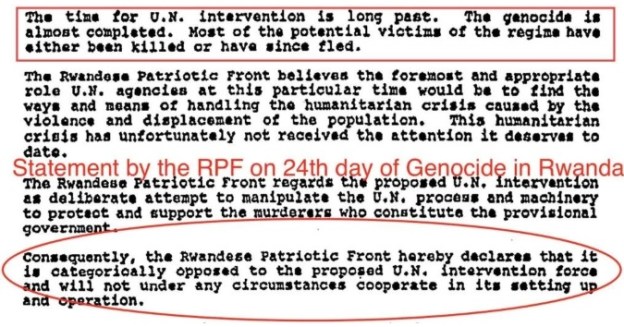
The time for U.N. intervention is long past. The genocide is almost completed. Most of the potential victims of the regime have either been killed or have since fled.
The Rwandese Patriotic Front believes the foremost and appropriate role U.N. agencies at this particular time would be to find the ways and means of handling the humanitarian crisis caused by the violence and displacement of the population. This humanitarian crisis has unfortunately not received the attention it deserves to date.
The Rwandese Patriotic Front regards the proposed U.N. intervention as deliberate attempt to manipulate the U.N. process and machinery to protect and support the murderers who constitute the provisional government.
Consequently, the Rwandese Patriotic Front hereby declares that it is categorically opposed to the proposed U.N. intervention force and will not under any circumstances cooperate in its setting up and operation.
In view of the forgoing the Rwandese Patriotic Front:
a. Calls upon the U.N. Security Council not to authorize the deployment of the proposed force as U.N. intervention at this stage can no longer serve any useful purpose as far as stopping the massacres is concerned.
b. Requests International Community to exert pressure on the murderers who constitute the so-called provisional government and are responsible for the massacres by:
1. Withholding recognition for the so-called provisional government which has taken power by unconstitutional means.
2. Condemning in person the prominent personalities of the regime who have been involved in committing atrocities.
3. Imposing punitive sanctions against the so called provisional government.
4. Setting in motion the process of establishing without delay war crimes tribunals and other mechanisms for bringing the persons responsible for the atrocities to justice.
c. Requests the U.N. Secretary General to replace his Special Representative in Rwanda without delay by someone more competent.
d. Calls upon the international community to urgently respond to the humanitarian crisis in Rwanda by providing assistance to the needy and gives its assurances that it shall cooperate fully in all efforts to alleviate the currant humanitarian crisis.
e. Calls upon the United Nations to immediately send a mission to areas of Rwanda controlled by RPF to confirm that no massacres or human rights of any nature have been committed by RPP forces as implied in the above-mentioned letter by the U.N. Secretary General to the Security council.
For: The Political Bureau of The Rwandese Patriotic Front









 GAHUNDE