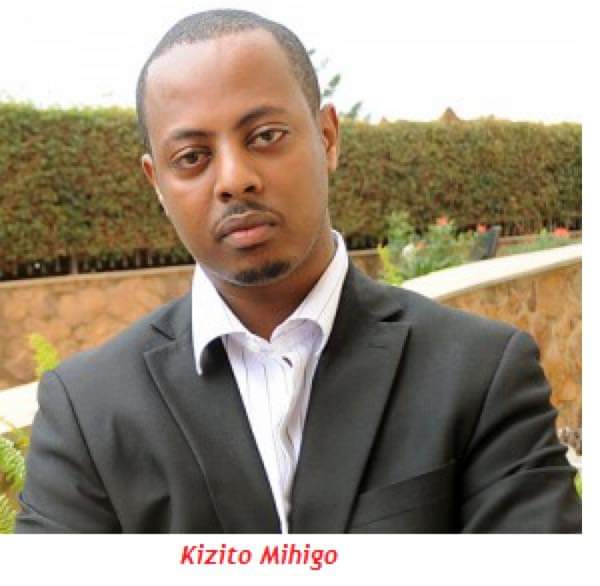
Kizito Mihigo Calvary: what he said before he was assassinated

One of motives to kill Kizito MIHIGO was to prevent him from talking about what he saw througout his ordeal. He had just discovered that all the Human Rights Watch’s reports on rights abuses, torture cases,.. which Kigali refuted all the time were true. He was ready to testify. Kagame’s men killed him. But it was to late he had managed to speak out.

The following text is an initial transcript of parts of the recordings he sent out to his contact whilst in prison.

This note was recorded on October, 6th, 2016. I am Kizito Mihigo. I am detained in the central prison of Kigali, officially called Nyarugenge prison, and alternatively called 1930, in reference to the year when it was built. In April 2014, after having composed and produced a christian song, I was kidnapped, detained and accused of plotting and conspiring against the regime and its president.

In fact, on March 5th, 2014 I had made public a new song titled “igisobanuro cy’urupfu”, (translation: explanation of death). And I published it on my youtube channel, on my personal website, and the official pages of my foundation. During the following days, I received insults, menaces and warning messages telling me that something bad was going to happen to me. I was also contacted several times by government officials, including the minister of culture, the chief of the criminal investigation department (CID), the responsible of culture in the ministry of defense, the executive director of the National Commission Against the Genocide (CNLG) and the office of the president. 

During his speech at the occasion of delivering new ranks to police officers on March 17th, 2014, the president had declared this: “I am not a singer to please the country’s enemies.” In the evening of April 1st, 2014 I was invited by the Chief of staff in the president office. The meeting took place in the office of the president of the senate. The current senate president at the time was vice president of the same institution. Both told me that the president had not liked my song. Therefore I had to apologise in writing to him. I had also to apologise to the population, which allegedly had been shocked by my song. At that meeting I tried to explain unsuccessfully that my song hadn’t been composed with the intention of harming anyone. It was rather a christian message which preached compassion, forgiveness and reconciliation to its audience.

The president’s chief of staff and the senate’s vice president told me that if I didn’t comply with what they were asking me to do, I was a dead man. Therefore I did what they had asked me, meaning apologizing to the president through a letter and the population through the media. The president’s chief of staff had reassured me that if I did what was asked from me, I wouldn’t have any more problems or face any other (translator emphasis – punitive) measures. 

But on April 06, 2014, between 10:00am and 11:00am, when, with my driver I arrived in front of the traffic lights located on the road between the Parliament building and the Rwanda Development Board (RDB) headquarters, a  person entered spontaneously into my car through an unlocked door. It was a policeman I knew. He ordered me to get out of my car and enter his. I went into his car. It was driven by another policeman that I also knew. They confiscated my phone, they told me that we were going to meet one of their superiors who wanted to talk to me. We didn’t go where they had mentioned, but instead we drove around the city of Kigali for tens of minutes. At the end I was taken to the police centre of Gikondo, generally known as Chez Gacinya.

I stayed there for nearly 30 minutes, in a conference room without anyone asking me anything. And when I tried to ask questions, nobody replied to me. I was thereafter put back into the car, then we drove towards Kicukiro. Before arriving at the destination, two individuals in civil uniforms joined us. They sat one on my left and the other on my right. The vehicle continued towards the Nyanza forest. The area is located in the city suburb in the direction leading to Bugesera.

I remained in the car parked in that forest, and surrounded by people I didn’t know and who were not talking to me. From midday until late evening around 8:00pm. Around 6:00pm, a thought came to my mind telling me that these people were going to kill me in that forest. My body was going to be discovered the following day, on April 07, the day of comemorating the 94 genocide. Then I said (to my kidnappers) that if the problem was my song, I had discussed the issue with the president’s chief of staff and the senate’s vice president. Within a few minutes, the car left the forest and I was again driven to the office of the senate’s vice president. I met with the same officials as before, but there was a third one this time, the deputy police commissioner.

They told me that, on top of the song, for which I was accused, they had found in my phone a whatsapp discussion where I exchanged views with someone from the opposition. And it was true. I had a conversation with someone from the opposition, and in our exchange we were very critical of the government. I knew that the Rwandan government didn’t like to be criticised. And for me it’s not a crime to criticise a government.

During that second meeting in the office of the senate’s vice president, I was seriously insulted by the three present personalities, and threatened of being killed. I said sorry. I was then told that I needed to continue asking for forgiveness, but that this time they were not sure if I was going to be forgiven. I was then taken to the car. Once inside, I had my head and face covered with a black balaclava. The vehicle was running but I couldn’t know where we were going. Within minutes, I found myself in a room with a bed, in a residential house, and I stayed there for nine days. 

I was handcuffed 24/7. I ate once every two days. On this very day while I am saying this, I can’t tell where that house/ prison is located. Because each time I was taken out or coming in, my head and face were always covered. I got seriously questioned in that house, and on several occasions. On April 10th for example, meaning four days after the kidnapping, I was taken to the office of the deputy police commissioner, Dan Munyuza, I was beaten up by policemen who were there, I was lying on the ground and getting hit on my back. Thereafter I was taken to a room at the offices of the prime minister. I found there many VIPs from the government. They asked me as well many questions about my song and my whatsapp conversation with a member of the opposition.

Up until April 15th, I stayed locked up in the same secret safe house. It was the same day that I was brought in front of the media. The deputy police commissioner came to me and said that if I continued asking for forgiveness publicly and pleading guilty for all the accusations against me, for the period of investigation and hearing in front of the court, things would be easier for me. On the other hand, if I pleaded not guilty and started denouncing all the injustices I had been victim of, I was going to be sentenced for life imprisonment. And I was certainly going to die in prison. He continued insisting on me pleading guilty on that day, before I appeared in front of the journalists. He explained that pleading guilty and asking for forgiveness, that’s how things will get easier for you, but if you start challenging the authority, pleading not guilty or denouncing your kidnapping or torture and other illegal practices inflicted unto you, you will get a life imprisonment.

I agreed on the terms of the arrangement. To the media and the judge I said that I was sorry for my deeds, but I couldn’t help saying that I only discussed with someone my song. During my hearing, nothing related to the song was mentioned, but I know well deep down that it is central to the whole saga. It was farther to its launch that I had been arrested, even if they hadn’t traced that conversation (with someone in the opposition), they would’ve caused me problems. That had already occurred uniquely because of that song.

On April 15th, after addressing the press, I was taken to the public attorney without a lawyer. The public attorney gave me one day to find myself a lawyer. During my hearing, I always pleaded guilty as I had promised. And on February, 27th 2015 I was sentenced to 10 years of imprisonment. I was told that I was guilty of all the accusations against me, except being complicit in acts of terrorism. Within 30 days after the sentencing, I introduced an appeal to the High Court and I am still waiting (on October 6th, 2016) to hear from them.

This note is recorded on February 8th, 2017 at the Central prison of Kigali, called 1930. I am Kizito Mihigo, detained since April 2014. Recently, exactly on January 21st 2017, I received the visit of the General Police Commissioner, Emmanuel Gasana, who came alone and I chatted with him in the office of the prison’s director. He explained to me that the motive of his visit was to ask me if I didn’t have any message to transmit to the highest authority of the country. I told him that the only message for him was to ask for forgiveness and be allowed to get back into society and become active again, pursue my musical activities. He asked me a few questions about my case. He asked me among other things why I had dared discussing with a member of the opposition, which is the main official offence for my imprisonment. I replied that I was frustrated. I disagreed with some government policies and actions. And that on a personal level I had also had opposing views with some political personalities. He asked me if there wasn’t any other way of solving issues which didn’t involve discussing with the opposition. I replied that I hadn’t anymore trust in the government, and that I needed someone who could understand me. He asked me if I wanted the president to forgive me or a presidential pardon. I said yes. I wanted to be forgiven, but that I wanted to be allowed to pursue my artistic and christian work, which promotes peace and reconciliation. I explained to him that by advocating for peace and reconciliation as an artist, I would be contributing to the work of the government for national reconciliation. After around ten minutes of conversation, the police commissioner left without saying goodbye. The same way as he had come in and didn’t greet me. I didn’t know exactly the motive of his visit, neither who had sent him. 

In conclusion, in my view, my case is political, with fabricated evidence. For example, I didn’t know the individuals who were brought to testify against me. I only knew Cassien Ntamuhanga who was a journalist. I find that there wasn’t any connection between our cases. But the prosecution needed those false witnesses to prove that I was guilty. And the evidence of such manipulation is that the witness called Jean Paul indicated to the judge in the courtroom that the police had tortured him telling him that he had to plead guilty to make Kizito become guilty. It was a political case, without any respect for proper legal procedures. It was characterised by many illegal practices, including torture, kidnapping, unauthorised detention. The arrest procedure was also illegal. Normally, when someone is arrested, they are told the motive of the arrest and shown a legal document authorising it. This wasn’t the case in my situation.”

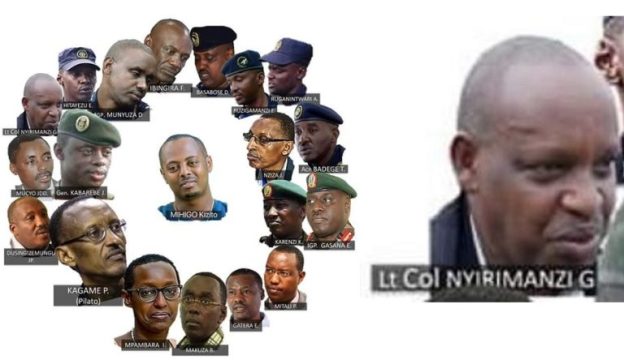
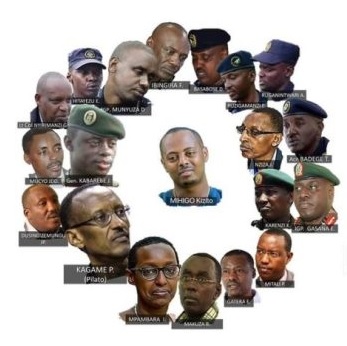
The list of the people in high positions of authority in Rwanda, from government officials, to security forces and civilians, who tortured Kizito Mihigo directly and or indirectly by giving orders, includes the following names. The list is not comprehensive.
abishi

Paul Kagame, Protais Mitali, Gerard Nyilimanzi, Ines Mpambara, Bernard Makuza, Athanase Ruganintwali, Aphrodis, Dan Munyuza, Jean de Dieu Mucyo, James Kabarebe, Karenzi Karake, Jack Nziza, Fred Ibingira, Rurayi Gasana, Jean Pierre Dusingizemungu, and Egide Gatera.

Source: The Rising Continent


Avis aux lecteurs: Nos articles peuvent être reproduits à condition de citer le nom d'auteur et le site web source.
Notice to readers: Our articles may be reproduced provided the author's name and the source website are cited.

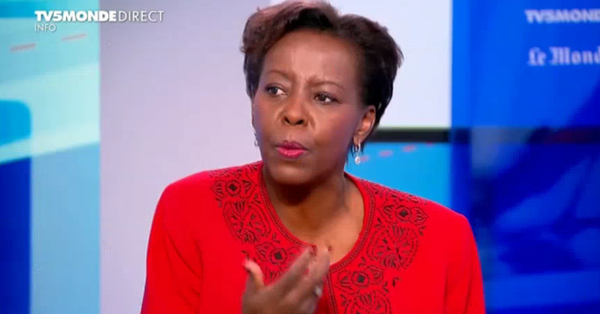
A son tour, Mushikiwabo crucifie Kizito Mihigo!

Le contraire aurait été étonnant. Après quelques semaines de silence imposé, Mushikiwabo ne va pas échapper à la question sur la mort de Kizito Mihigo. Comme on l’aurait deviné, Madame ne se donne pas la peine de feindre l’empathie envers celui qu’elle déshumanise pour le seul fait d’avoir réclamé la reconnaissance des victimes de crimes commis par le Front Patriotique Rwandais (FPR).

L’on reconnait la maîtresse de la diplomatie rwandaise au lendemain de la strangulation dans une chambre d’hôtel Sud-africain de l’ex chef espion rwandais, Patrick Karegeya. Comme tout âme bienveillante attribuait l’assassinat de Karegeya aux escadrons de la mort de Kagame, Mushikiwabo a fustigé ces accusations, sans pour autant manquer d’exprimer l’excitation (ou plus) que la mort de “l’ennemi” de son pays l’avait procurée.

Et qui pourrait oublier son arrogance inégalée lors du sommet France – Afrique tenu à Dakar en 2014? Lors de ce sommet le président français , François Hollande dans le temps, avait critiqué les dirigeants qui manœuvrent les Constitutions  de leurs pays en vue de s’éterniser au pouvoir. Mushikiwabo a vu le doigt pointé à Kagame, et a évacué les propos qui ne pouvaient que l’abaisser, sauf qu’elle s’en tapait, aussi longtemps qu’elle faisait plaisir à son chef. Une année plus tard Kagame a changé la Constitution pour se faire réélire président en 2017. Une autre histoire!

Cette fois-ci, Mushikiwabo tente de justifier l’assassinat de Kizito : “Ce jeune homme avait basculé dans une sorte de recherche de célébrité auprès de toute sorte d’individus qui n’étaient pas des gens qui voulaient du bien au pays”1.  En d’autres termes, la peine de mort “par pendaison” est décrétée à quiconque tente de (1) être une célébrité et/ ou (2) parle aux gens qui ne veulent pas du bien au pays. C’est bien noté Madame. Vous me rappelez un truc: j’ai entendu dire que le prétexte avancé lors du génocide contre les Tutsi était qu’ils s’associaient aux “individus qui n’étaient pas des gens qui voulaient du bien au pays”   et que, de ce fait, leur mort était justifiée. Je n’ai pas été d’accord avec ce prétexte, tout comme je n’achète pas vos conneries sur Kizito.

Chaste Gahunde


(1) Lemonde.fr


Avis aux lecteurs: Nos articles peuvent être reproduits à condition de citer le nom d’auteur et le site web source.                                                                                                          Notice to readers: Our articles may be reproduced provided the author’s name and the source website are cited.

Rwanda : we have another Virus to fight, more virulent than Covid-19.

As the world stands together in fighting the corona virus (COVID-19) let us not forget, as Rwandans , that we have another virus which we have to fight: Kagamevirus (AKAGA-94).

Let us not forget to fight the virus that has attacked our entire governing system and left it almost crippled.
Let us stand together to fight the virus that recently killed Kizito Mihigo.
Let us stand together in fighting the virus that recently made Barafinda Sekikubo Fred to be admitted in the mental hospital, while he is not mentally ill.

Let us stand together in fighting the virus that keeps on attacking opposition leaders, like Madame Victoire Ingabire and Maître Bernard Ntaganda.
Let us stand together in fighting the virus that has closed the political space in Rwanda.

Let us stand together in fighting the virus that has been attacking our neighboring countries and caused the borders to be closed to many Rwandans who depended on cross border trade.

Dear Country men and women, we must fight vigorously and defeat this virus.
I am optimistic that victory is certain.

God bless us all and protect us from our Rwandan common virus and COVID-19.
May God bring to an end the COVID -19 and hill those who are suffering from it.
RIP Kizito Mihigo who was killed by Our common Rwandan virus, Kagamevirus, (AKAGA-94)


Jeanne Mukamurenzi


Avis aux lecteurs: Nos articles peuvent être reproduits à condition de citer le nom d'auteur et le site web source.
Notice to readers: Our articles may be reproduced provided the author's name and the source website are cited.
 

KAGAME a dissimulé les informations sur Corona Virus au Rwanda.

On ne pourra jamais faire confiance au régime de Paul Kagame. Une fois de plus le gouvernement est attrapé la main dans le sac. Il ne s’agit pas d’un sujet à prendre à la légère car ça concerne la santé publique.
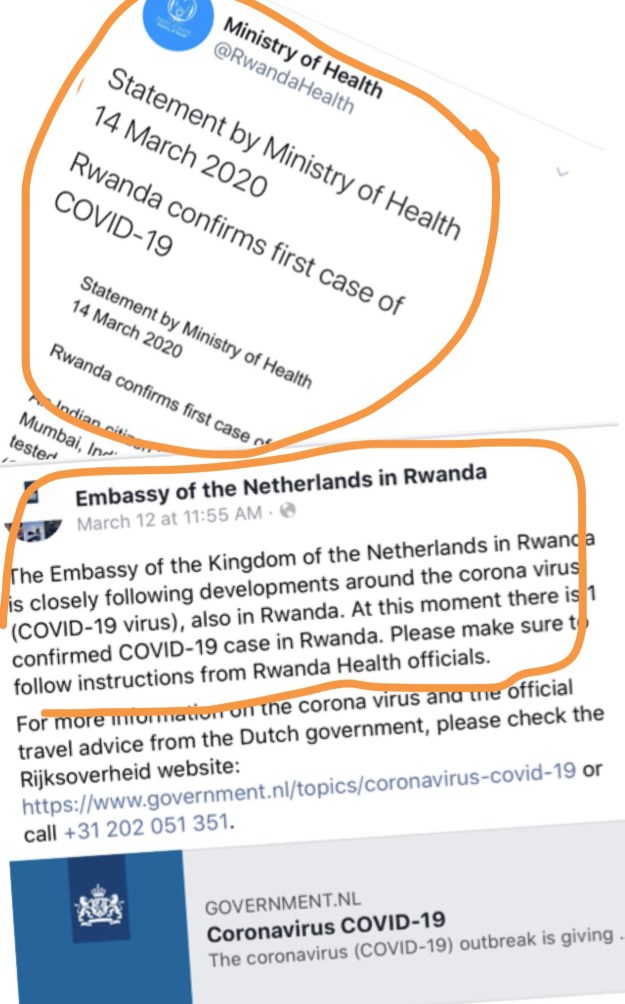
En effet, le gouvernement de Paul Kagame a tenté de dissimuler les informations concernant la présence du virus sur le territoire rwandais. Le régime a annoncé le premier cas de Covid-19 au Rwanda le 14 mars 2020. Mais l’ambassade des Pays-Bas l’avait déjà annoncé le 12 mars 2020 – deux jours avant le gouvernement du Rwanda.
Certaines maisons de presse ont immédiatement publié les révélations de l’ambassade des Pays-Bas. En d’autres termes, le régime n’a pas pu cacher l’affaire une fois que les Néerlandais l’ont révélée et que les médias ont publié l’histoire. L’on ne sait pas encore comment l’ambassade des Pays Bas a été au courant de la présence du virus.
Tout ce qu’on sait est que  le régime subit beaucoup de pression ces derniers jours après l’assassinat de Kizito MIHIGO dans les locaux de la police où il était détenu provisoirement avant de répondre aux allégations de “tentative de s’exiler”. Une pétition a été mise en ligne pour demander les pays membres du Commonwealth de ne pas tenir le sommet de CHOGM (Commonwealth Heads of Governments Meeting) à Kigali suite aux abus multiples du pouvoir contre les droits de l’homme.
Ayant peur de rater l’opportunité d’accueillir ce sommet si important, le régime voudrait dissimuler toutes les mauvaises nouvelles, inclus le Coronavirus au Rwanda. Ainsi, Kagame  mettait en danger plus de douze millions de vies humaines pour soigner son image. C’est horrible!
COVID RWANL

Chaste GAHUNDE


Avis aux lecteurs: Nos articles peuvent être reproduits à condition de citer le nom d'auteur et le site web source.
Notice to readers: Our articles may be reproduced provided the author's name and the source website are cited.
RWANDA Govt social media accounts used to “intimidate people” – US Government.

“Government-run social media accounts were used to debate and at times intimidate individuals who posted online comments considered critical of the government,” reads the 38-page report in part.

The report, compiled annually by the US State Department, also says the Rwandan government continued to monitor email and internet chat rooms.

It reads: “Individuals and groups could engage in the peaceful expression of views online, including by email and social media, but were subject to monitoring. There were reports that some individuals were arrested based in part on information obtained from email and internet monitoring.”

As for how much access Rwandans have to content online, the Americans, who are the single biggest bilateral donor to Rwanda, say there is notable restrictions of what we in Rwanda can see.

The report reads: “The government restricts the types of online content that users can access, particularly content that strays from the government’s official line, and continued to block websites.”

In May 2019, the minister of information and communications technology and innovation, Paula Ingabire, announced in Parliament the government planned to impose regulations on social media content so as to combat misinformation and protect citizens.

Minister of information and communications technology and innovation, Paula Ingabire  Musoni was instrumental in establishing censorship against critics.

The government blocked access within the country to several websites critical of its policies, including websites of the Rwandan diaspora.

According to a 2010 law relating to electronic messages, signatures, and transactions, intermediaries and service providers are not held liable for content transmitted through their networks.

Nonetheless, says the US report, service providers are required to remove content when handed a takedown notice, and there are no avenues for appeal.


Chris Kamo 


Avis aux lecteurs: Nos articles peuvent être reproduits à condition de citer le nom d'auteur et le site web source.
Notice to readers: Our articles may be reproduced provided the author's name and the source website are cited.
 

US – trained rank among Kizito Mihigo’s assassins.

Testimonies about Kizito Mihigo’ death keep flowing in from all sides indicating who did what and in which circumstances it took place. The most important testimony comes from Kizito’s own audio recorded in 2016 and 2017 whilst in his detention facility also known as 1930 prison.

What we know so far:

Kizito’s assassination is a state’s crime. Green and Ward (2005) give us the most important definition of a state’s crime:

“illegal or deviant activities perpetrated by the state, or with the complicity of state agencies’. State crimes are committed by, or on behalf of nation states in order to achieve their policies”. 

The first mindest of the crime happens to be Mrs Ines MPAMBARA, a canadian of rwandan origin who as presidential cabinet director acted on orders from Paul Kagame, the president of Rwanda.

kizito-mihigo-tueurs-Copie-2-768x444

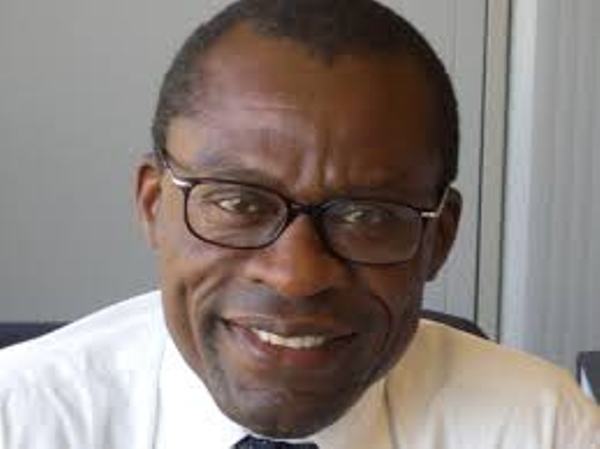
Another prominent figure into this scandal is Lt Colonel Gérard NYILIMANZI, a US -trained military rank well known in ideological conferences aimed at trying to re-write the History based on fabricated stories and nonsensical myth-like  and virtual war expeditions that , he says, might have been carried out by Kagame and his rebel group.

He attended Karubanda Petit Séminaire in 1980’s, then Université Nationale du Rwanda where he studied English in Facult of Arts ( Faculté des lettres). He joined the Rwandese Patriotic Front (RPF) gorilla war and from 1994 he was promoted from Lieutenant to the rank of Major in 2005, to Lieutenant Colonel today. He also attended military training in the United States of America from where he is said to be brilliant.

Rwandans are longing for justice but are always confronted with a bunch of state agents armoured by political power such as Lt Colonel who are determined to take the wrong side of history. Time will come when they will have to answer for any single crime they committed.


Chaste Gahunde


Avis aux lecteurs: Nos articles peuvent être reproduits à condition de citer le nom d'auteur et le site web source.
Notice to readers: Our articles may be reproduced provided the author's name and the source website are cited.

Et si le coronavirus mettait un frein au processus de globalisation tant décrié ?


Le monde semble plus que jamais divisé dans sa lutte contre une pandémie jusque-là méconnue : le coronavirus. En attendant un hypothétique vaccin ou un sérum, tout porte à croire que les grandes nations, détentrices du savoir-faire médical ou du savoir-faire tout court, se laissent emporter par leur égoïsme et leurs intérêts nationaux.

Ainsi, nous assistons malgré nous au repli sur soi des donneurs de leçons pour un monde globalisé et uniforme. Les Etats-Unis, par la voix de son président, ont décrété une urgence médicale. Donald Trump qui ironisait jusque-là sur le coronavirus vient de prendre une décision qui met à mal les sacro-saints pactes entre les occidentaux : les États-Unis sont désormais fermés à tous les européens. Sauf aux anglais. La décision de Donald Trump trahit un système autarcique qu’il faut dénoncer avec vigueur.

Certains esprits bienveillants y trouveront de quoi alimenter une brouille qui réactive les décisions unilatérales de Washington qui mettent à mal les relations avec ses partenaires historiques. Mais il serait sans doute excessif de jeter l’anathème sur Donald Trump. L’Europe aussi a pris des mesures similaires à l’égard des pays les plus affectés. L’Italie a fermé ses frontières. L’Allemagne, la Pologne, la Belgique et autres États européens vivent à huis clos.

Les procédures de coordination de l’Union Européenne ont volé en éclats. Exit le traité de Schengen. Chacun pour soi et les frontières deviennent hermétiques. Chaque pays européen établit, souverainement, un système parfaitement autarcique.

Toutes ces décisions nationalistes et souveraines mettent à mal l’Union européenne. Elles mettent à jour les fragilités des engagements au sein même de l’Europe qui a su tisser des liens forts pour ses politiques communes économiques et financières.

Le coronavirus vient mettre un coup de frein aux politiques de globalisation. Ce virus que nous ne maîtrisons toujours pas paralyse les économies qui avaient déjà du mal à confirmer les prévisions de croissances des pays riches.

Le commerce mondial mis à mal

La mondialisation qui est la suite logique de la globalisation se définit comme un processus multidimensionnel des différents aspects de la vie des sociétés et des individus. Elle est prise en otage par le coronavirus. Les voyages des marchandises et des personnes sont paralysés. Les avions rongent leurs freins sur les tarmacs alors que les passagers sont indésirables sous d’autres cieux. La perception que nous avons des transactions industrielles, commerciales et financières est remise en cause. Au nom de la souveraineté des états, le processus d’internationalisation de ces transactions est battu en brèche.

La crise du coronavirus nous démontre la fragilité des mécanismes globaux. Le monde perd la face et montre ses divisions. Tout cela à cause d’un virus. Les guerres n’ont pas freiné la circulation des marchandises ni celle des personnes. Le coronavirus fait mieux que les guerres. Il tue sans tenir compte des frontières, des pays et des confessions religieuses. Pire, il nous oblige à rester chez nous…

Le coronavirus démonte les mécanismes de la globalisation et étale au grand jour nos égoïsmes, nos faiblesses et surtout nos divisions. Il fait mieux que les barrières visibles qui séparent les riches et les pauvres. La panique est généralisée. Les problèmes climatiques se trouvent relégués au second rang en attendant une nouvelle crise financière qui va bousculer les marchés déjà fragilisés.

La nature sera toujours la plus forte. Nous ne savons pas grand-chose d’elle. Elle va encore frapper et bousculer « nos équilibres ». Les prévisions alarmistes sur une prochaine crise financière mettront à mal la globalisation. Le pire reste à venir avec l’affolement des marchés financiers et des bourses.

Par Michel Lobé Étamé
Journaliste

Source: www.jmtvplus.com 


Avis aux lecteurs: Nos articles peuvent être reproduits à condition de citer le nom d'auteur et le site web source.
Notice to readers: Our articles may be reproduced provided the author's name and the source website are cited.
Rwandans would prefer Corona virus to Kagame!

akaga-94

Millions have perished in hands of Paul Kagame (AKAGA-94)

Worse than coronavirus (COVID-19), there is kagamevirus (AKAGA-94). His first victim dates back to 1994, Bill Clinton. The latter contaminated Habyarimana and Ntaryamira, they had less immunity and could not survive it. And then, millions of Rwandans and Congolese had it, an unnamed disaster!

Since then, kagamevirus kills non-stop, young and old, every day, every minute. He kills at night, he kills in broad daylight, and boasts of it. He kills from Uganda, he only knows how to kill and terrorize anyone who dares to resist him. Degrading detention centers are dedicated to him, these are in fact his palaces used to isolate the surviving victims, connected to a hope of medicine / miracle for healing.

Dear friends Microscopes, let’s quickly find the miracle molecule against akaga94! This is urgent!

François Munyabagisha

Source: https://www.facebook.com/plugins/post.php?href=https%3A%2F%2Fwww.facebook.com%2Ffrancois.munyabagisha%2Fposts%2F10219588427753853&width=500“>FACEBOOK

A free translation from french by this blog’s admin


Avis aux lecteurs: Nos articles peuvent être reproduits à condition de citer le nom d'auteur et le site web source.
Notice to readers: Our articles may be reproduced provided the author's name and the source website are cited.
Rwanda: la langue de Molière toujours tenue à l’écart !

Malgré son statut de membre de l’organisation internationale de la francophonie (OIF), le Rwanda ne fait aucun effort pour donner la place à la langue française qui pourtant est désignée par la Constitution comme langue parlée ( avec l’anglais et le Kinyarwanda). Le Rwanda a le privilège de diriger l’OIF, un choix qui a laissé pas mal d’observateurs en état de choc.

En effet, à la veille  de la nomination de la rwandaise Louise Mushikiwabo en tant que secrétaire générale de l’OIF, l’indignation  était totale. Le Rwanda est accusé entre autres de graves crimes contre l’humanité et les abus de pouvoir contre les droits de l’homme. La liberté d’expression,  le droit à la vie et à la propriété privée, l’état de droit, sont bafoués aux yeux de la communauté internationale qui semble hypnotisée par ce comportement inédit d’un régime irrespectueux de tout.

Pourtant,  tous ces abus étaient ignorés sous le même prétexte que celui avancé lors de l’adhésion du Rwanda à l’organisation des pays anciennement colonisés par le Royaume Uni: donner la chance au Rwanda est un appel à l’action, lui donner des responsabilités , c’est le forcer à se conformer aux principes de l’organisation.  Ceci n’est forcément pas une mauvaise idée  sauf que ça ne marche jamais avec Kagame et son système. Kagame vous fera croire qu’il est de même logique que vous, mais il attendra un moment propice pour tricher et vous decevoir.

Ainsi, même après avoir réussi à “infiltrer” Louise Mushikiwabo dans Paris pour cottoyer les influents francophones et plaider en faveur de son ancien maître, la langue française est toujours absente que ce soit dans l’éducation, sur les sites web du gouvernement ou dans les communiqués et décrets dans l’administration publique.

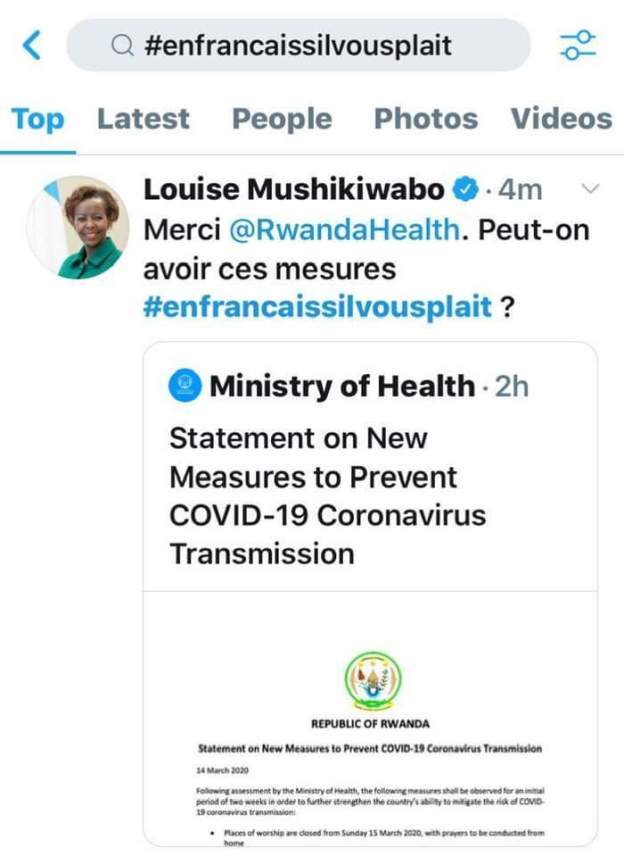
A ce sujet,  Louise Mushikiwabo semble en avoir marre et se révolte.


FB_IMG_1584227743194

C’est en réagissant au communiqué du ministère de la santé au sujet des mesures prises contre la pandémie COVID-19. Elle s’en félicite en ajoutant un hashtag “en français s’il vous plait”.

Quoiqu’on fasse la langue de Molière reste négligée non pas par ce qu’elle est moche ( moi je la trouve douce, délicieuse et surtout romantique) mais parce que la clique dirigeante du pays n’en pige que dalle.

Chaste Gahunde.


Avis aux lecteurs: Nos articles peuvent être reproduits à condition de citer le nom d'auteur et le site web source.
Notice to readers: Our articles may be reproduced provided the author's name and the source website are cited.

L’assassinat de Kizito Mihigo: Ines MPAMBARA risque la prison à vie.

IMG-20200217-WA0069

Depuis le 17 février 2020, le monde entier en général et les Rwandais en particulier n’ont cessé de pleurer le chantre de la réconciliation rwandaise, feu Kizito MIHIGO tué dans les locaux de la police rwandaise. Bien avant sa mort, pressentant le malheur qui le guettait, Kizito est parvenu à enregistrer le conte de son calvaire. Il a aussi pu sortir quelques manuscrits qui feraient objet d’un “bon” film d’horreur.

De son témoignage, nous connaissons désormais ses tortionnaires ainsi que tous leurs complices qui tôt ou tard ne pourront plus échapper à la justice. Parmi eux, une femme toute-puissante, seconde à la première dame du Rwanda: Inès MPAMBARA.

Directrice de cabinet du président KAGAME pendant près de 12 ans, Madame MPAMBARA se serait installée au Québec avec ses parents dans les années 1990 en provenance du Burundi, le pays d’exil de ses parents. Aujourd’hui elle a une double nationalité ( rwando – canadienne) à l’instar de son maître Kagame, rwando – ougandais.

Le Canada est intransigeant envers ses citoyens qui se rendent auteurs ou complices des crimes de guerre, génocides et crimes contre l’humanité, même si ces crimes sont commis en dehors des frontières. Ainsi l’article 6, de la loi sur les crimes contre l’humanité et les crimes de guerre (1)  stipule :

Quiconque commet à l’étranger une des infractions ci-après, avant ou après l’entrée en vigueur du présent article, est coupable d’un acte criminel et peut être poursuivi pour cette infraction aux termes de l’article 8:

a)génocide;

b) crime contre l’humanité;

C)crime de guerre.

Et l’article 8 :

 Quiconque est accusé d’avoir commis une infraction visée aux articles 6 ou 7 peut être poursuivi pour cette infraction si l’une des conditions suivantes est remplie :

a) à l’époque :

(i)soit lui-même est citoyen canadien ou employé au service du Canada à titre civil ou militaire,

(ii) soit lui-même est citoyen d’un État participant à un conflit armé contre le Canada ou employé au service d’un tel État à titre civil ou militaire,

(iii) soit la victime est citoyen canadien,

(iv) soit la victime est un ressortissant d’un État allié du Canada dans un conflit armé;

b)après la commission présumée de l’infraction, l’auteur se trouve au Canada.

Le paragraphe 3 de l’article 6 définit le crime contre l’humanité comme: meurtre, extermination, réduction en esclavage, déportation, emprisonnement, torture, violence sexuelle, persécution ou autre fait — acte ou omission — inhumain, d’une part, commis contre une population civile ou un groupe identifiable de personnes et, d’autre part, qui constitue, au moment et au lieu de la perpétration, un crime contre l’humanité selon le droit international coutumier ou le droit international conventionnel ou en raison de son caractère criminel d’après les principes généraux de droit reconnus par l’ensemble des nations, qu’il constitue ou non une transgression du droit en vigueur à ce moment et dans ce lieu“.

Quant aux peines, quiconque commet ce genre d’infractions, (dans le cas de Kizito MIHIGO, madame Inès MPAMBARA) est passible de l’emprisonnement à perpétuité.

Chaste GAHUNDE


(1) https://laws-lois.justice.gc.ca/fra/lois/  

Avis aux lecteurs: Nos articles peuvent être reproduits à condition de citer le nom d’auteur et le site web source.